
Old Testament Readings From Vespers of the Synaxis of the Archangels and Angels
OLD TESTAMENT READINGS FROM GREAT VESPERS ON THE EVEN OF THE FEAST OF THE SYNAXIS OF THE ARCHANGELS AND ANGELS
First Reading Taken From the Book of Joshua (5:13-15)
"Then it came to pass, when Joshua was at Jericho, he looked up and saw a man standing before him with a sword drawn in his hand. So Joshua came near and said to him, 'Are you for us or the side of our adversaries?' He said to him, 'I am now come, the chief captain of the host of the Lord.' Then Joshua fell on his face upon the earth and said to him, 'O Master, what do you command your servant?' 'The chief captain of the Lord said to Joshua, 'Loose the shoe from your feet; for the place on which you stand is holy.'

My beloved spiritual children in Christ Our Only True God and Our Only True Savior,
CHRIST IS IN OUR MIDST! HE WAS, IS, AND EVER SHALL BE.
+
OLD TESTAMENT READINGS FROM GREAT VESPERS ON THE EVEN OF THE FEAST OF THE SYNAXIS OF THE ARCHANGELS AND ANGELS
First Reading Taken From the Book of Joshua (5:13-15)
"Then it came to pass, when Joshua was at Jericho, he looked up and saw a man standing before him with a sword drawn in his hand. So Joshua came near and said to him, 'Are you for us or the side of our adversaries?' He said to him, 'I am now come, the chief captain of the host of the Lord.' Then Joshua fell on his face upon the earth and said to him, 'O Master, what do you command your servant?' 'The chief captain of the Lord said to Joshua, 'Loose the shoe from your feet; for the place on which you stand is holy.'
+
Second Reading Taken From the Book of Judges (6:11-22)
"Now the Angel of the Lord came and sat under the terebinth tree in Ephrathah which belonged to Joash the father of Esdri, while his son Gideon threshed wheat in the winepress in order to hid from the presence of the Midianites. And the Angel of the Lord appeared to him and said to him and said to him, 'The Lord is with you, mighty one of the armies!' Gideon said to Him, 'It is I, my Lord?' If the Lord is with us, why then have these evils come upon us? And where are all His miracles which our fathers told us about, saying, 'Did not the Lord brings us up from Egypt?' But now the Lord has driven us out and delivered us into the hands of the Midianites.' Then the Angel of the Lord turned to him and said, 'Go with this strength of yours, and you shall save Israel from the hand of the Midianites. Indeed, I have sent you."
And Gideon said to Him, 'Be gracious with me, my Lord, for how can I save Israel?' My thousand is weakened in Manasseh, and I am the smallest in my father's house.' And the Angel of the Lord said to him, 'The Lord will be with you, and you shall strike the Midianites as one man.' Then Gideon said to Him, 'If now I have found mercy in Your sight, then You shall do everything for me today that You have told me. Do not leave here, I pray, until I come to You and I will bring out my offering and set it before You.' And He said, 'I am, I will wait until you come back.' So Gideon went in and prepared a goat kid, and unleavened bread from an ephah of flour. He put the meat in a basket, and he put the broth in pot; and he brought them out to Him under the terebinth tree and approached. The Angel of God said to him, 'Take the meat and the unleavened bread and lay them on this rock, and pour out the broth.' And he did so. Then the Angel of the Lord stretched out the end of the staff that was in his hand and touched the meat and the unleavened bread; and fire rose out of the rock and consumed the meat and the unleavened bread. And the Angel of the Lord departed out of his sight.
Now Gideon perceived this was the Angel of the Lord. So Gideon said, 'O Lord, my Lord! For I have seen the Angel of the Lord face to face.' Then the Lord said to him, 'Peace be with you; do not fear, you shall not die.' So Gideon built an altar there to the Lord. To this day it is still in Ephratha of the father of Esdri.
+
The Third Reading Taken From the Book of Daniel (10:1-21)
"At that time Michael the great prince, who stands watch over the sons of your people, shall stand up, and there shall be a time of tribulation, such as never happened until that time, since there was a nation upon the earth. But at that time your people shall be saved, all found written in the book. Then many of those who sleep in the dust of the earth shall awake, some in everlasting life, and some to disgrace and everlasting shame. Those who understand shall shine like the brightness of the firmament, and some who are righteous, like the stars of heaven forever and ever. As for you, Daniel, close up these words and seal the book until the knowledge is increased.'
Then I, Daniel, looked and behold, there stood two others, one on this riverbank and the other on the other riverbank. One said to the man clothed in fine lines who was above the water of the river, 'How long will it be to the end of these wonders of which You have spoken?' 'Then I heard from the man clothed in fine lines who was above the water of the river, as he held up the right hand and his left hand to heaven and swore by Him Who lives forever and swore by Him who lives forever that it would be for a time, times, and half a time. Thus when the dispersion is ended, they shall know all these things.
Although I heard, I did not understand. So I said, 'My lord, what shall be the end of these things?' He replied, 'Go your way, Daniel, for the words are closed up and sealed till the time of the end. Many shall choose to be made white and refined through fire; but the lawless shall act lawlessly. None of the lawless shall understand, but the wise shall understand. From the time the daily sacrifice is taken away and the abomination of desolation is set up, there shall be one thousand two hundred and ninety days..."
Commentary on 12:1-3
At Christ's Second Coming, the Antichrist will be crushed, the tribulation will end, and all the dead will awake (v. 2). Resurrection to everlasting shame is the destiny of those who, in the end, are found outside of Christ.
12:7 "But he who reads this passage, even half asleep, cannot fail to see that the kingdom of Antichrist shall fiercely, though for a short time, assail the Church before the Last Judgment (Second Coming) of God shall introduce the eternal reign of the Saints. For it is patent from the context that the time, times, and half a time, means a year, and two years, and half a year, that is to say, three years and a half.'
12:11 Hippolytus writes that the prophecy concerns the three and a half years--"the one thousand two hundred and three score days (the half of the week) during which the tyrant is to reign and persecute the church."
War in Heaven Revelation (12:7-12)
"And war broke out in heaven, Michael and his Angels fought with the dragon; and the dragon and his angels (demons) fought, but they did not prevail nor was a place found for them in heaven any longer. So the great dragon was cast out, that serpent of old, called the Devil and Satan, who deceives the whole world, he was cast to the earth, and his angels were cast out with him. Then I heard a loud voice saying in heaven, "now salvation, and strength, and the kingdom of our God, and the power of His Christ have come, for the accuser of our brethren who accused them before our God day and night, has been cast down. And they overcame him by the blood of the Lamb and by the word of their testimony, and they did not love their lives to the death. Therefore, rejoice, O heavens, and you who dwell in them! Woe to the inhabitants of the earth and the sea! For the devil has come down to you, having great wrath, because he knows that he has a short time." (Source: Orthodox Study Bible)
_____________________
"Glory Be To GOD For All Things!" - Saint John Chrysostom
+++
With sincere agape in His Holy Diakonia (Ministry)
The sinner and unworthy servant of God
+Father George
November 8 - Synaxis of the Archangel Michael and the other Bodiless Powers (Part II)
The three Orders in the lowest hierarchy are the Principalities, Archangels, and Angels. The Principalities are so called because they rule over the Angels below them and direct them to fulfill God's commands. It is they who watch over the world, protecting and guarding every kingdom and principality, every province and people, tribe and nation, for each of these has its own angel of this rank as guardian and governor. According to Saint Gregory, it is the duty of this Order to teach men to render to all in authority the honor due their station.
My beloved spiritual children in Christ Our Only True God and Our Only True Savior,
CHRIST IS IN OUR MIDST! HE WAS, IS, AND EVER SHALL BE.
+
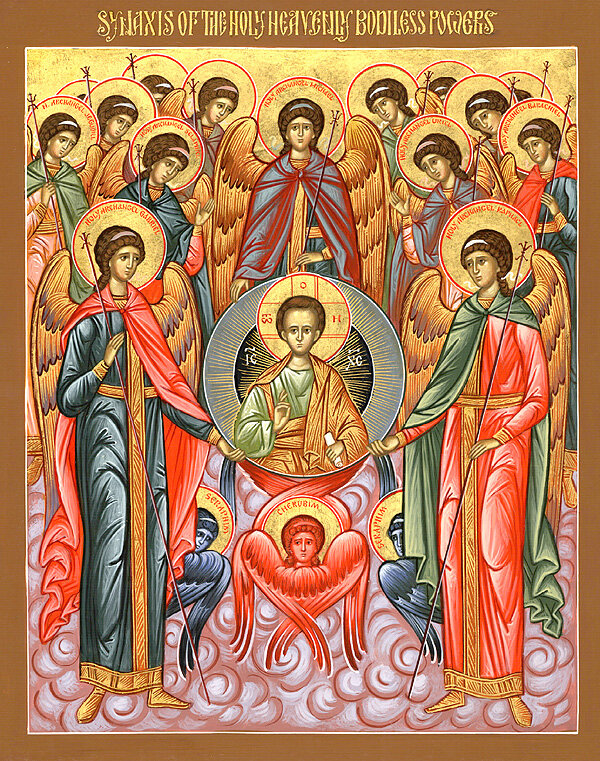
ON NOVEMBER 8th OUR HOLY ORTHODOX CHRISTIAN CHURCH COMMEMORATES THE SYNAXIS OF THE HOLY CHIEF COMMANDER MICHAEL AND THE OTHER BODILESS POWERS (Part II)
The three Orders in the lowest hierarchy are the Principalities, Archangels, and Angels. The Principalities are so called because they rule over the Angels below them and direct them to fulfill God's commands. It is they who watch over the world, protecting and guarding every kingdom and principality, every province and people, tribe and nation, for each of these has its own angel of this rank as guardian and governor. According to Saint Gregory, it is the duty of this Order to teach men to render to all in authority the honor due their station. These Angels usher worthy men into such positions as they merit and instruct them not to use their offices for their own gain or profit, nor to become vainglorious or full of conceit, but to honor God, to increase His glory and to spread word of it, for the benefit of all those under their authority.
The Archangels are the great messengers of God, eminent, and wondrous tidings. According to the renowned Saint Dionysios, it is they who deliver prophecies to men, enlightening them so that they may know and understand the will of God. They learn of God's will from the higher ranks and entrust the secrets thereof to the angels below them, who in turn declare them to men. Saint Gregory the Dialogist says that they spread abroad the faith among men, illuminating their minds with the light of the knowledge of the Holy Gospel and revealing to them the mysteries of the Orthodox faith.
The Angels occupy the lowest position in the hierarchy of heaven and are the closest of its ranks to men. They reveal the lesser mysteries of God and His intentions to men, whom they guide to live virtuously and righteously. Each of the faithful is entrusted to one of them. They support those of us who stand firm, and they raise up the fallen. Even if we sin, they do not forsake us but are always ready to help us, if only we desire it.
Nevertheless, the name Angel is proper to the higher ranks of heaven, for even if each has its own place and position and its own name which accords with the manner of grace bestowed upon it, that is to say, Seraphim, Cherubim, Throne, and so forth, they are still all called Angels; for in the sense the name refers not to what they are in essence but to the manner of service they perform. All of them alike are Angels, since they fulfill God's commands, as it is written: "are they not all ministering spirits, sent forth to minister?" (Hebrews, Chapter 1). Each order has its own ministry (diakonia), and their ministrations differ, because the Wise Creator does not reveal the mysteries of His Divine Will to each Rank equally. He manifests His Sacred Will to the lower Orders through the Higher and through the latter commands the former to fulfill the dictates of His Will, as many plainly be seen in the Book of the Prophet Zachariah. This Book tells how, after a certain Angel, who commanded him to return to the Prophet and to reveal to him the future of Jerusalem. Thus it is written, "Behold, the Angel that talked with me went forth, and another Angel went out to meet him, and said to unto him, Run, speak to this young man" (that is, to the Prophet Zecharias), "saying, Jerusalem shall be inhabited as a town without walls for the multitude of men and cattle therein, for I, saith the Lord, will be unto her a wall of the round about" (Zechariah, Chapter 2). "When one Angel says to the other, Run, speak to this young man, there can be no doubt that certain Angels dispatch others here and there and that the Lower Orders that send them. Similarly, we find in the prophecy of Daniel that one Angel tells another to explain to the Prophet the vision which he saw. Therefore, it is clear that the Lower Ranks of Angels learn of the Will and intentions of the Divine Creator form the Higher Orders and are sent by the latter to do His desire.
It is fitting that the Orthodox Church here below should celebrate the Synaxis (Assembly) and seek the aid of all Nine Orders of the Holy Angels on the 8th day of this month of November, sending up fervent entreaties unto them; for on the Fearful Day of Judgment, which the divine teachers of the Church call the Eighth Day, when He Who is the Son of Man and God, the Righteous Judge, "shall come in His glory, and all the Holy Angels with Him" (Matthew, Chapter 25), as the Lord Himself prophesied in the Holy Gospel, all the ranks of Angels shall be gathered together (synaxis). "He shall send His Angels with a great sound of a trumpet, and they shall gather together His elect from the four winds" (Matthew, Chapter 24), that is, from the east, the west, the north, and the south. May the Lord then summon us, who reverently celebrate the Synaxis of the Angels, into the choir of the chosen!
The Holy Chief Commander Michael, the faithful servant of the Lord, was appointed by God as general commander over the entire assembly of the nine Angelic Orders. When Satan exalted himself in pride, feel away from God Into perdition, and was cast into the abyss, Michael called together all the ranks and hosts of Angels (Synaxis) and cried out with a mighty voice, "Let us attend! Stand a right before Him who created us, and do not consider doing what is not pleasing to God (The Prologue). Behold what has befallen those created with us, who until now ere communicants of the divine light! (Pantoleon the Chartophylax of the Great Church). Behold how they were straightway exiled from light into darkness because of pride, cast from light into darkness because of pride, cast from the heights into the abyss! (Isaiah, Chapter 14) Behold how the morning star, which lit up the down, has fallen to earth and been crushed!" (The morning star, Venus, shines shortly before dawn).
When Michael, who stood foremost among the Seraphim, the Cherubim, and all the ranks of heaven, said this to the entire assembly (synaxis) of the Angels, they glorified the Most Holy and Undivided Trinity, one in essence, the one God; and together they chanted the triumphal hymn: "Agios, Agios, Agios, Kyrios Sabaoth..." ("Holy, Holy, Holy, Lord God of Sabaoth, heaven and earth are full of thy glory!" (What we chant in every Divine Liturgy)
It is this assembly (synaxis) of the Holy Angels that we venerate on the present Feast of the Synaxis of the Angels; for they ever glorify the Father, Son, and Holy Spirit, attentively and harmoniously, with one mind, heart, and voice (The Prologue and The Menaion). May we mortals also glorify Him unto the Ages of Ages. Amen. (Source: The Great Collection of the Lives of the Saints)
________________
"Glory Be To GOD For All Things!" - Saint John Chrysostom
+++
With sincere agape in His Holy Diakonia (Ministry)
The sinner and unworthy servant of God
+Father George
November 8 - Synaxis of the Archangel Michael and the other Bodiless Powers (Part I)
The Holy Church, which rejects the impious worship of Angels devised by idolaters and heretics of old, received from the divinely inspired Holy Fathers the tradition of celebrating with reverence the Synaxis of the Holy Angels. In the days of the Old Testament, the people of God, having fallen away from the Creator, began to worship that which the Lord created. They made idols after the likeness of things visible, of that which is in heaven above and earth beneath, the work of their own hands (Exodus, Ch. 20). At that time, when the people offered oblations (sacrifice) unto the sun, the moon, and the stars as gods, imagining that these possessed living souls, they also began to worship Angels. The Book of Kings makes mention of this, saying that they "burned incense unto Baal, to the sun, and to the moon, and to the twelve signs of the Zodiac, and to all the host of heaven" (Kings, Ch. 23), that is, to the Angels; for the host of heaven is comprised of the Angels, as is said in the Gospel. And "suddenly there was with the Angel a multitude of the heavenly host" (Luke, Ch.2).

My beloved spiritual children in Christ Our Only True God and Our Only True Savior,
CHRIST IS IN OUR MIDST! HE WAS, IS, AND EVER SHALL BE.
+
ON NOVEMBER 8th OUR HOLY ORTHODOX CHRISTIAN CHURCH COMMEMORATES THE SYNAXIS OF THE HOLY CHIEF COMMANDER MICHAEL AND THE OTHER BODILESS POWERS
+
The Holy Church, which rejects the impious worship of Angels devised by idolaters and heretics of old, received from the divinely inspired Holy Fathers the tradition of celebrating with reverence the Synaxis of the Holy Angels. In the days of the Old Testament, the people of God, having fallen away from the Creator, began to worship that which the Lord created. They made idols after the likeness of things visible, of that which is in heaven above and earth beneath, the work of their own hands (Exodus, Ch. 20). At that time, when the people offered oblations (sacrifice) unto the sun, the moon, and the stars as gods, imagining that these possessed living souls, they also began to worship Angels. The Book of Kings makes mention of this, saying that they "burned incense unto Baal, to the sun, and to the moon, and to the twelve signs of the Zodiac, and to all the host of heaven" (Kings, Ch. 23), that is, to the Angels; for the host of heaven is comprised of the Angels, as is said in the Gospel. And "suddenly there was with the Angel a multitude of the heavenly host" (Luke, Ch.2).
The local Synod (Council) of the Holy Fathers that met at Laodicea denounced this heresy (The thirty-fifth canon of the Council of Laodicea), but while it anathematized and rejected the heretical worship of Angels, it decreed lawful the pious and proper veneration of the holy Angels as God's servants and the guardians of the race of man, establishing the celebration of the festival held in their honor on this day.
The Synod decreed that the feast of the Angels be celebrated in November, the ninth month counting form March, when the world was created, since there are nine orders of Angels, according to Saint Dionysius the Areopagite, the Disciple of the holy Apostle Paul. Saint Paul was taken up to the third heaven, where he saw how the holy Angels are divided into ranks, and he told his Disciple of this (II Corinthians, Ch. 12). These nine ranks are grouped in three hierarchies of three orders; the highest, the middle, and the lowest.
The highest hierarchy of Angels, which is the nearest to the Most Holy Trinity, consists of the Seraphim, the Cherubim, and the Thrones. Closest of all to the Creator and Fashioner stand the Seraphim, beloved of God, of whom Prophet Isaiah said, "Seraphim stood round about Him: each had six wings" (Daniel, Chapter 7). They are like fire, because they stand nearest to Him of Whom it is written: "Our God is a consuming fire, and His throne is like a fiery flame," and "The sight of the glory of the Lord was like a devouring fire". Since they stand before such glory, the Seraphim are themselves fiery, as it is written: "He maketh His Angels spirits, and His ministers a flame of fire" (Psalm 103).They burn with love for God and kindle the love of God in others, as their name itself reveals, for in the Hebrew tongue "seraphim" means "burning" or "consuming."
The divinely wise Cherubim stand next after the Seraphim in the presence of God the All-knowing, Who dwells in transcendent light. These Angels, who abide in God's ineffable light, themselves ever shine more brilliantly than the orders below them with the light of righteousness and the knowledge of God and His Wisdom. They are themselves radiant and illumine others; therefore, they are called Cherubim, which in Hebrew means "much wisdom," or "an effusion of wisdom." Through the Cherubim wisdom is poured out, and through them the noetic eyes of others are illumined, enabling them to see the glory of God and to know Him.
The Thrones stand after the Cherubim before the exalted Throne on high. They are called God-bearing by Saint Dionysius, since, according to the explanation offered by Saint Maximus the Confessor, God noetically rests upon them as upon noetic Thrones. Saint Basil the Great writes that they are called God-bearing not according to their essence but because of the grace vouchsafed them and the service entrusted to them. The flesh of Christ the Lord, however, is God-bearing by essence, hypostatically joined with God the Logos/Word Himself. Christ's flesh bears God the Logos/Word in an undivided union and is called, and ever remains, His True and Living flesh, but the Thrones are called God-bearing and inexpressible manner, not by nature but because of the grace and service entrusted to them. Seated upon them in a way that cannot be described. God ordains His judgments, as David said: "Thou hast sat upon a throne, O Thou that judgest righteousness". Therefore, it is through the Thrones of God brings to pass His righteous judgments, for they are the ministers of His justice, imparting to the tribunals of magistrates here below, and to kings and lords, the ability to pass righteous judgment.
There are three ranks in the middle hierarchy of the holy Angels as well: Dominions, Powers, and Virtues. The Dominions are so called because they rule over the Angels subject to them, while they are themselves free, since, as Saint Dionysius says, they have set aside servile fear and ever serve the Lord willingly and gladly. They pour down upon the authorities ordained by God here below power to rule wisely and to exercise dominion judiciously, governing well the lands entrusted to them. They also teach us to rule over our senses, to subdue our disorderly lusts and passions, to subject the flesh to the spirit, to exercise authority over our will, and to prevail over every temptation.
The Powers, full of Divine might, serve the mighty powerful will of the All-powerful and Omnipotent Lord without hesitation or delay. They work exceedingly great marvels and impart the grace to perform similar miracles upon those of God's favorites who have been deemed worthy to work wonders, to heal every illness, and to foretell the future. Likewise, the holy Powers strengthen men as they labor and are heavy laden in bearing the yoke of their various burdens, strengthening them to fulfill the obligations of their station in life and helping the feeble in their weakness. They assist every man to be patient and not to weaken in trials, but to endure everything that comes to pass with nobility of soul and resolute courage, humbly giving thanks to God, who orders all things for our benefit.
The Virtues bear their name because they have authority over the devil. They subdue the power of the demons and ward off the temptations which the spirits of evil bring upon men, and they forbid the demons to harm men as they desire. The Virtues confirm those who labor for virtue's sake in their spiritual undertakings and struggles, protecting them, lest they be deprived of the spiritual kingdom. Those who war with their passions and desires the Virtues help in the day of battle, assisting them in dispelling every wicked thought and the enemy's calumny and in overcoming the devil. (Source: The Great Collection of the Lives of the Saints)
(To be continued)
_________________________
"Glory Be To GOD For All Things!" - Saint John Chrysostom
+++
With sincere agape in His Holy Diakonia (Ministry)
The sinner and unworthy servant of God
+Father George
A Guide to Spiritual Life (Part II)
How to Remain in Communion With God
There are many necessary elements for remaining in communion with God. Among the chief are:
Regular attendance at Sunday Divine Liturgy, as well as consistent participation in the Feasts and fasts of the Church year.
Maintaining a daily prayer rule (for a basic outline; see Morning Prayers and Evening Prayers on pages 755 to 761 in the Orthodox Study Bible).
Daily reading and study of the Holy Scripture.
Regularly partaking of the Holy Eucharist (Holy Communion).
Regular repentance and confession of sins.

My beloved spiritual life in Christ Our Only True God and Our Only True Savior,
CHRIST IS IN OUR MIDST! HE WAS, IS, AND EVER SHALL BE.
+
A GUIDE TO SPIRITUAL LIFE (II)
How to Remain in Communion With God
There are many necessary elements for remaining in communion with God. Among the chief are:
Regular attendance at Sunday Divine Liturgy, as well as consistent participation in the Feasts and fasts of the Church year.
Maintaining a daily prayer rule (for a basic outline; see Morning Prayers and Evening Prayers on pages 755 to 761 in the Orthodox Study Bible).
Daily reading and study of the Holy Scripture.
Regularly partaking of the Holy Eucharist (Holy Communion).
Regular repentance and confession of sins.
Spiritual Helps in the Examination of Your Conscience
Pride: the lack of humility befitting a creature of God
Creed: too great a desire for money or worldly goods.
Lust: impure and unworthy desire for something evil.
Anger: unworthy irritation and lack of self-control.
Gluttony: the habit of eating or drinking too much.
Envy: jealousy of some other person's happiness.
Sloth: laziness that keeps us from doing our duty to God and man.
The Seven Capital Virtues
The seven capital virtues are the opposite of the seven grievous sins.
Humility
Liberality
Chastity
Mildness
Temperance
Contentment
Diligence
The Works of the Flesh
Adultery
Fornication
Uncleaness
Licentiousness
Idolatry
Sorcery
Hatred
Contentions
Jealousies
Outbursts of wrath
Selfish ambitions
Disssensions
Heresies
Envy
Murders
Drunkenness
Revelries
(See Galatians 5:19-21)
Nine Ways of Participating in Another's Sin
By counsel.
By command.
By consent.
By provocation.
By praise or flattery.
By concealment.
By partaking
By silence.
By defense of the sin committed.
The Fruit of the Holy Spirit
Love.
Joy.
Peace
Longsuffering.
Kindness.
Goodness.
Faithfulness.
Gentleness.
Self-control.
Modesty.
Continence.
Chastity.
(See Galatians 5:22, 23)
The Three Theological Virtues
Faith.
Hope.
Love
(See 1 Corinthians 13:13)
The Chief Aids to Penitence
Prayer.
Fasting.
Performance of the spiritual and corporal works of mercy.
(See Matthew 6:1-18)
The Chief Corporal Works of Mercy
To feed the hungry.
To give drink to the thirsty.
To shelter the homeless.
To clothe the naked
To visit those in prison.
To visit the sick.
To bury the dead.
(See Matthew 25:34-45)
(Source: Orthodox Study Bible)
___________________________
"Glory Be To GOD For All Things!" -- Saint John Chrysostom
+++
With sincere agape in His Holy Diakonia (Ministry)
The sinner and unworthy servant of God
+Father George
A Guide to Spiritual Life (Part I)
"One of the best known of the Desert Fathers of fourth-century Egypt. Saint Serapion the Sindonite, traveled once on pilgrimage to Rome. Here he was told of a celebrated recluse, a woman who lived always in one small room, never going out.Skeptical about her way of life--for he was himself a great wonderer--Serapion called on her and asked: 'Why are you sitting here?' To this she replied: 'I am not sitting, I am on a journey.'

My beloved spiritual children in Christ Our Only True God and Our Only True Savior,
CHRIST IS IN OUR MIDST! HE WAS, IS, AND EVER SHALL BE.
+
A GUIDE TO THE SPIRITUAL LIFE
"One of the best known of the Desert Fathers of fourth-century Egypt. Saint Serapion the Sindonite, traveled once on pilgrimage to Rome. Here he was told of a celebrated recluse, a woman who lived always in one small room, never going out.Skeptical about her way of life--for he was himself a great wonderer--Serapion called on her and asked: 'Why are you sitting here?' To this she replied: 'I am not sitting, I am on a journey.'
I am not sitting, I am on a journey. Every Christian may apply these words to himself. To be a Christian is to be a traveler. Our situation, say the Greek Holy Fathers, is like that of the Israelite people in the desert of Sinai: We live in tents, not houses, for spiritually we are always on the move. We are on a journey through the inward space of the heart, a journey not measured by the hours of our watch or the days of the calendar, for it is a journey out of time into eternity." (Metropolitan Kallistos Ware, The Orthodox Way, SVS Press).
Introduction
Having examined the role of the Bible in the Orthodox Church, let us now turn to a second, crucially important issue. What does it mean to be A true Christian--to walk as a committed disciple of Jesus Christ at the dawn of a new millennium of human existence? Once again, the Orthodox Church provides profound answers, based on two thousand years of Spirit-led experience.
In the teaching of the Orthodox Faith, salvation is never limited to a point in time. Salvation is not a one-dimensional event, a past-tense occurrence with merely philosophical or "positional" implications for the present. Rather, as illustrated above, salvation is perceived to be a lifetime experience--a journey "not measured by the hours of our watch or the days of the calendar, for it is a journey out of time into eternity." Like every journey, this journey must have a beginning. And like every journey, this journey continues until it reaches its final destination. By faith we come to Christ. Through His sacraments we walk with Him daily--hour by hour, moment by moment. And with hope and love we move ahead to that time when we will be eternally in His presence, worshipping with the Angels. As Saint Paul says: "Now we see in a mirror, dimly, but then face to face. Now I know in part, but then I shall know just as I also am known" (1 Corinthians 13:12).
We now turn to a brief examination of the Christian life--how we become Christians, and how we remain in communion with God throughout our entire lives.
Beginning the Journey to the Kingdom
Most people, at one time or another, wonder if there is real meaning to life--an underlying pattern or purpose to it all. For me, that quest for meaning and purpose took place in college.
By the end of my junior year, I was ready to do a turn-around. I knew that Jesus Christ had a rightful claim on my life. And I had come to see that life apart from Him--even the enjoyable and constructive parts of life--held little meaning and satisfaction. I was into myself, out for myself, but at a point of wanting to start over...
An Incomparable Life
Often when we think about the life of Christ, we start two thousand years ago at a manger in the Middle East, with the Baby, the Wise Men, the Star. While these things concern His earthly birth. His story really begins in eternity past. Because before time began, before the world was made, before beginning, Christ was there. For there was never a time when he did not exist!
The first words in the Holy Bible are, "In the beginning God..." (Genesis 1:1). For God was there from the start, always existing in Three Persons: Father, Son, and Holy Spirit. From God the Father there was begotten or born from before all time God the Son. And eternally proceeding from the Father is God the Holy Spirit.
At the creation of the human race, we find God saying: "Let Us make man in Our image, according to Our likeness" (Genesis 1:26). Note the plurality of persons in the Godhead. Thus, from before all ages, God the Son--also called in Holy Scripture the Logos/Word of God--reigned with God the Father and God the Holy Spirit. This explains why the Gospels teach that God the Son, Jesus Christ, came to reveal the Father to us, and to send to us the comforter, the Holy Spirit.
Throughout the history of ancient Israel, the Prophets foretold the coming of the One Who would be the Messiah of Israel, the Anointed One. They predicted He would be born in Bethlehem...
"...Jesus Christ preached one central message. It is called the Gospel, the Good News, and it is this: "Repent, for the Kingdom of Heaven is at hand!" (Matthew 3:2). To repent means to turn around, to commit one's life fully to Christ, to say "yes" to the Lord and absolutely mean it. And why are we called to this life of repentance? Because to enter God's Kingdom there is one requirement, we must be righteous. We repent because we are unrighteous--we come far short of living lives that bring glory to God.
When we first repent, we turn to the Lord Jesus Christ and tell him we are sorry at heart for how we have lived. As undeserving sinners, we ask for His mercy and His forgiveness, and commit ourselves into His care for the rest of our lives.
Let's face it. If the Kingdom of God is worth anything, it's worth everything. We are called upon by Christ Himself to lay down everything that would keep us from entering it. That is why Jesus compared the Kingdom of God to a treasure hidden in a field. Once we realize the incredible value of that precious piece, we will sell everything we have to obtain it. This divesting of our private holdings is exactly what repentance means. We give up what we must not keep for the incomparable riches of Jesus Christ. This cost to us is the greatest bargain we can ever know.
Besides their love for Christ, there is at least one other vital characteristic the Saints, Confessors, Holy Fathers and Mothers, Martyrs, and host of others who lived their lives under the Lordship of Christ as fellow heirs of His Kingdom. They all grew to know God and serve Him in the Church. This stands in stark contrast to much of what is taught under the guise of Christianity. Tragically, some who still use His name have so willfully departed from the path which Christ set forth and those heroes and heroines of the Faith followed, that they have made knowing God nearly impossible. This, coupled with the churchless Christ of televangelism, has promoted people who sincerely desire to serve the Lord to try to make it on their own. But this option works no better.
Such and worse is the plight of those who try to follow Christ--even zealously--but Apart from the Church. They may be sincere, but they will never really get to know Him out there. For One must live within the Body of Christ, be fed by her Mysteria (Sacraments), be instructed in her true Faith, and worship at her altar to attain the godliness and righteousness that lead to the Kingdom's open doors. (Source: Orthodox Study Bible)
(To be continued)
____________________
"Glory Be To GOD For All Things!" - Saint John Chrysostom
+++
With sincere agape in His Holy Diakonia (Ministry)
The sinner and unworthy servant of God
+Father George
Some Orthodox Christian Beliefs and Their Biblical Foundation (Part III)
Biblically and historically, true worship has consistently been liturgical. "Spontaneous" worship is an innovation of the last century or so.

My beloved spiritual children in Christ Our Only True God and the Only True Savior,
CHRIST IS IN OUR MIDST! HE WAS, IS, AND EVER SHALL BE.
+
SOME ORTHODOX CHRISTIAN BELIEFS AND THEIR BIBLICAL FOUNDATION (Part III)
What do Orthodox Christians believe about liturgy?
Biblically and historically, true worship has consistently been liturgical. "Spontaneous" worship is an innovation of the last century or so.
Liturgical worship, written prayers (the Psalms), and feast days were the norm throughout the history of Israel (see Exodus 23:14-19; 24:1, 2).
The worship of heaven is liturgical (Isaiah 6:1-9; Hebrews 8:1-3; Revelation (Apocalypse) 4).
The foundations of liturgical worship in the Church are apparent in the New Testament. The most oft-repeated prayer of the Church is there (Matthew 6:9-13). The words we say at baptism are there (Matthew 28:19). The words spoken at Holy Communion are there, with Saint Paul repeating Jesus' words (1 Corinthians 11:23-26). Further, the believers in Acts 13:2 about A.D. 49, were seen in a liturgical service to the Lord: "as they ministered [Greek: leitourgouaton, the root word for "liturgy"] to the Lord and fasted, the Holy Spirit said..." Note, too, in this passage that the Holy Spirit speaks to us during liturgical worship. Thus praise to God must never become dead form, but rather living worship, "in spirit and truth" (John 4:23, 24).
Some Protestant groups have reacted against Rome by dismissing liturgical worship (though everyone has patterned worship, "spontaneous" or not!). But the Holy Bible and Church history are clear: liturgical worship is the norm for the people of God. Documents like the Didache (A.D. 70) and the writings of Saint Justin Martyr (A.D. 150) and Hippolytos (early 200s) all show that the worship of the early Church was, without exception, liturgical.
Our image, according to our likeness" (Genesis 1:26). Note the plurality of Persons in the Godhead. Thus from before all ages, God the Son--also called in Holy Scripture the Logos/Word of God--reigned with God the Father and God the Holy Spirit. This explains why the Gospels teach that God the Son, Jesus Christ, came to reveal the Father to us, and to send to us the Comforter, the Holy Spirit.
Throughout the history of ancient Israel, the Prophets foretold the coming of One Who would be the Messiah of Israel, the Anointed One. They predicted He would be born in Bethlehem (Mic. 5:2), that a sign of His coming would be that a virgin would conceive Him (Isaiah 7:14), and that He would suffer and die for the sins of the people (Isaiah 53:5, 6). There are some three hundred references to His coming in the Old Testament Scripture, all penned hundreds of years before He came.
Then, just as promised, in the fullness of time the Angel appeared to a godly young Jewish virgin named Mary, and announced to her that she would bear a Son. "You shall call His name Jesus," the Angel said, "for He will save His people from their sins" (Matthew 1:21). Thus, in the womb of the Virgin Mary, the humanity of Jesus Christ was formed. The Son of God became everything we are--except for sin--in order that we might become the recipients of everything He is. As Saint John writes, "The Logos/Word became flesh and dwelt among us" (John 1:14). God became man to reveal Himself to us.
Most of us ask ourselves at one time or another, "Does anyone else in all the world understand me?" The Incarnation--the "enfleshment"--of the Son of God answers that question once and for all--with a resounding yes! Because Jesus Christ is fully God, He knows all things--even the number of the hairs on our heads (Luke 12:7). He created us. And because He is fully man, He is acquainted firsthand with our weaknesses, our disappointments, our sufferings. He knows about rejection, loneliness, hunger, and death because He went through them. Isaiah the Prophet wrote of Him, "Surely He has borne our griefs and carried our sorrows" (Isaiah 53:4).
Taking His flesh from His Holy Mother Mary, Jesus experienced birth and growth like all of us. In His early years He knew both servitude and apprenticeship to His earthly father, Joseph, in his trade of carpentry. And He knew the higher the priority of obedience and submission to His Heavenly Father on one occasion staying behind in the Temple to be about His Father's business instead of accompanying Mary and Joseph back home from a trip to Jerusalem.
He went through the adolescent years--he experienced what it was like to be thirteen, fifteen--and faced head-on the opportunities for loss of temper, moral compromise, dishonesty, and rebellion present in His day. He knows about human frailty because He was tempted in every way we are, yet He never succumbed to sin.
At the age of thirty, He was baptized by Saint John the Baptist in the Jordan River. In so doing so, He not only began His own public ministry, but also forever set apart water as the means of beginning our new life in Christ through the Holy Spirit. This is why the Church, His followers here on earth, has baptized her converts in "water and the spirit" (John 3:5). Baptism is that God-given rite of passage into the Kingdom of God whose mystic power to change us surpassed all human reason.
Throughout His three-year public ministry, Jesus Christ worked countless miracles. He healed the sick, He brought sight to the blind, hearing to the deaf, and help to the helpless. He stilled a storm, cast out demons, and raised the dead. All these miracles established the presence of God's Kingdom and further affirmed that He was God. Those who knew Him but a short time said, "He has done all things well" (Mark 7:37). And when pressed on specifics, even His enemies could find no fault in Him (John 19:4, 6). The daily routines of entire towns and villages were cancelled or changed when He visited. Everything, it became apparent, was subject to Him.
After three years of His ministry the Jewish religious establishment could stand no more of Him. Because He was God and said so, calls for Jesus' death began to mount. Some of His followers saw the implications and fell away. Even the disciples whom He hand-picked faltered, one of them denying Him three times. Finally, the religious and civil authorities teamed up against Him, put Him through a sham of a trial, and crucified Him as a common criminal between two thieves. In a few hours, He was dead. No one yet understood that He had died for the entire world, carrying our sins and transgressions with Him into the grave.
Then came the culmination, the most powerful and supernatural event of all history. Three days after dying, Christ was alive again, for He cancelled out its power: and to those who are joined to Him, His promises is, 'because I live, you will live also" (John 13:19). He had forever trampled down our greatest enemy, death, by his own death. And in His Resurrection He bestows life on the living as well as upon those long dead.
For forty days after His Resurrection, Jesus opened the Holy Scripture to the eyes of His disciples, teaching them about His Everlasting Kingdom, and commissioning them to take the gospel to the whole world. He instructed them to build His Church, the expression of His Kingdom on the earth, and fulfilled for them His promise of the Holy Spirit to accomplish the task.
To be sure, the one thing Jesus Christ left behind in this world IS His Church. The Holy Scripture describes that Church as an assembly of His people, a new nation, a royal priesthood, a dwelling place of God in the Spirit. Because those who make up His Church share in His Resurrection, they are called the Body of Christ, and He Himself is head.
At the end of His forty days of teaching, while His disciples stood by as witnesses, Jesus Christ ascended in his glorified body into Heaven. He reigns at the right hand of His Father. As our Heavenly Bishop, He is Lord of His Church. In Him, Saint Paul writes, all things "consist" or are held together (Col. 1:17).
One day Jesus Christ will return to earth (His Second Coming) to confront the living and the dead. All humanity will appear before His awesome and dread judgment seat. The righteous will inherit eternal life; the wicked (evil), everlasting darkness (damnation). The Kingdom of God will be established in its fullness, and Christ will reign, together with the Father and the Holy Spirit, forever. (Source: Orthodox Study Bible)
(To be continued)
__________________________
"Glory Be To GOD For All Things!" -- Saint John Chrysostom
+++
With sincere agape in His Holy Diakonia (Ministry)
The sinner and unworthy servant of God
+Father George