
An Introduction to Orthodox Christian Spirituality
The sources of Orthodox Christian spirituality are the Holy Scripture, Holy Tradition, the Dogmatic Definitions of the Ecumenical Synods (Councils), and the spiritual teachings of the Greek Orthodox Holy Fathers. Orthodox spirituality is mainly through prayer, daily Christian living, and worship, which ultimately lead to union with the Divine Uncreated Light.
My beloved spiritual children in Christ Our Only True God and Our Only True Savior,
CHRIST IS IN OUR MIDST! HE WAS, IS, AND EVER SHALL BE.
+
AN INTRODUCTION TO ORTHODOX CHRISTIAN SPIRITUALITY
By George C. Papademetriou
Introduction
The sources of Orthodox Christian spirituality are the Holy Scripture, Holy Tradition, the Dogmatic Definitions of the Ecumenical Synods (Councils), and the spiritual teachings of the Greek Orthodox Holy Fathers. Orthodox spirituality is mainly through prayer, daily Christian living, and worship, which ultimately lead to union with the Divine Uncreated Light.
Man and His Purpose as a Creature of God
Before we enter into a discussion of the spirituality of the Orthodox Church, let us see what is man's purpose as a creature of God. Man is created in the image and likeness of God. The human destiny is not to achieve mystical union with the essence of God, but rather to attain moral and spiritual perfection by participation in the Divine Uncreated Energies. Man, according to the Orthodox Holy Fathers, was not created perfect from the beginning. Rather he was created with the potential to achieve perfection through grace. This, of course, was not realized because of the Fall. In the fullness of time, God sent our Lord and Savior Jesus Christ to become man, and through His Suffering and Resurrection from the dead, restored man to his original state of grace and enabled him to attain perfection. Christ says: "Be perfect as your Father in Heaven is perfect." The ultimate purpose of man, therefore, is to become perfect in God, through love (agape). That is, to attain perfect, selfless love of God and one's fellow human beings.
The Christian Commitment
The life of moral perfection, according to our Holy Bible and the Holy Fathers of the Church, is a call to a life in Christ, that is, a Christ-like life. Consequently, the spirituality of the Orthodox Christian is portrayed as a life in Christ, a life of commitment to the Lord, and a complete submission to His will. One lives only to do everything for Christ's sake, as Christ wants it and as Christ would do it.
The Christian commitment to Christ must be made by an inner, free act, and is not compelled by any external force.
Moral Perfection Is Life in Christ
Orthodox Christian spirituality is described throughout the centuries as life in Christ, striving for moral and spiritual perfection. The Mystical union in Orthodox spirituality is not the "devout life" is a sentimental and emotional relation to 'Divinity." The Orthodox Church rejects this concept in favor of one, which envisions the meeting of man with the Divine Person in a mystical way. Orthodox spirituality is union with Christ, with God. A spiritual person is one who purifies himself of all worldly and moral defects in order to be united with the love of Christ. The mystical experience takes place in this world, yet the cause, God, is from beyond the material world. Orthodox spirituality, as well as the whole thought of the Church, is based on the revelation found in the Old and New Testaments. Studying the Patristic (writings of the Holy Fathers of the Church) interpretation of the Christian Truths can see this. In the mystical vision of the Divine Energies of the advanced Christian, he experiences the Divine Presence within himself, a vision of the Uncreated Light, and of the Energies of God. It is especially through the Mysterion (Sacraments) of the Holy Eucharist (Holy Communion) that we experience mystical union with our Lord.
Three Ways Upwards
The Holy Fathers of the Church suggest three ways to make progress in the spiritual life and attain spiritual perfection:
The way of catharsis (cleansing) or purification
The way of illumination, and
The way of perfection by total Union with God.
These ways can bring the Christian who cooperates with the Divine Grace to perfection. Synergy of the individual effort with the help of the Grace of God brings us to our ultimate destiny of perfection. Our Lord's death and Resurrection achieve for us our end in attaining the presence of the Holy Spirit within us.
The Philokalia speaks of "the increasing knowledge of God decreases knowledge of all else. In other words, the more a man knows God; he knows less of other matters. Not only this, but he begins to realize more and more clearly that neither does he know God." This point is of fundamental importance to Orthodoxy that declares the total mystery and unknowability of the Divine Essence.
The purpose of man is to achieve moral perfection through the acquisition of the Holy Spirit. In the teachings of Saint Seraphim of Sarov, the Holy Spirit leads the individual through the steps outlined above in order to attain union with the Spirit of Truth.
Monasteries Are Spiritual Centers of Orthodox Spirituality
The spirituality of the Orthodox Church is best exemplified in its spiritual centers, the monasteries. The monk is a "martyr" or "witness" to Christ, the Son of the Living God. Dostoyevsky's The Brothers Karamazov is an excellent example of this Spiritual Model in the person of Father Zosssima. This monastic model eloquently portrays the spirituality of the Orthodox Church. Dostoyevsky distinguishes between worldly freedom and the spiritual person. He says that the worldly or secular people "maintain that the world is getting more and more united, more and more bound together in brotherly community, as it overcomes distance and sets thoughts flying through the air." But in reality, the opposite is true, as is evident in international conflicts and wars. This famous Orthodox novelist expressed eloquently the Orthodox view that in spiritual subjugation, that is, in absolute obedience to Christ, one finds limitless freedom. This is especially in Monasteries where spirituality is nurtured.
Illumination
God's act is pure Light, and when the Lord appears to us, He always appears as Light. In Holy Scripture, we read: "In Your Light, we shall see light." Only in the state of illumination, does Divine Grace makes possible the contemplation of the Divine Light. The hidden Truths of Holy Scripture are not revealed to everyone since illumination comes through the special Divine Gift of revelation. For this reason in the early Church, the Holy Bible was read-only in the Church and only by a charismatic person. In the Orthodox Church, we have never experienced "bibliolatry" or "worship of the book", as in some sects. The Church holds fast to the unadulterated spirit of the Holy Bible as it was delivered to the Saints, and through them, to us.
Spiritual Warfare
We are saved by Christ and in Christ. Yet we are still subject to temptation and to sin. Therefore, it is important to mention the fact to acquire spirituality or moral perfection, we must wage war against the "enemy" that is, sin, and the devil. Saint Makarios said: "I have not yet seen a perfect Christian man, one completely free (from the devil and sin)". And although one is at rest in grace and enters into mysteries and revelations and into the sweetness of grace, still sin is yet present within." Consequently, as long as we live, we must be ready to fight against the dark powers of the devil. And "Satan is never quiet from warring. As long as a man lives in this world and wears the flesh, he has to war." The Holy Bible is the most necessary means of spiritual warfare against the devil; it is also the chief means of acquiring knowledge of the Divine will.
The Role of the Mysteria (Sacraments)
We must further emphasize the role and purpose of the Holy Mysteria (Sacraments) in attaining spirituality. In the Mysteria (Sacraments), we receive Divine grace, and in the case of the Holy Eucharist (Holy Communion), Christ Himself, Who aids us in waging war successfully against the satanic powers. As Father Sergius Bulgakov says: "The heart of Orthodoxy lies in its rites." All the Orthodox Rites and Mysteries are meant to combat the powers of evil. The Mysteriaki Zoee (Sacramental life) of the Church is the chief means toward the attainment of spirituality and of ultimate salvation.
___________________
"Glory Be To GOD For All Things!" - Saint John Chrysostom
+++
With sincere agape in His Holy Diakonia (Ministry)
The sinner and unworthy servant of God
+Father George
Preparation Before Receiving Holy Communion
Our Holy Tradition offers the Orthodox Christian believer guidelines on how one is to spiritually prepare to receive Holy Communion. All Orthodox Christians should have a father confessor, whether be his/her parish priest or a monk-priest in one of our monasteries who will serve as his/her spiritual guide and counselor. The father confessor is the one who will guide the penitent Christian on what spiritual steps he/she needs to take in order to prepare for the reception of the Precious Body and Sacred Blood of our Lord and Savior Jesus Christ.

My beloved spiritual children in Christ Our Only True God and Our Only True Savior,
CHRIST IS IN OUR MIDST! HE WAS, IS, AND EVER SHALL BE.
+
PREPARATION BEFORE RECEIVING HOLY COMMUNION
Our Holy Tradition offers the Orthodox Christian believer guidelines on how one is to spiritually prepare to receive Holy Communion. All Orthodox Christians should have a father confessor, whether be his/her parish priest or a monk-priest in one of our monasteries who will serve as his/her spiritual guide and counselor. The father confessor is the one who will guide the penitent Christian on what spiritual steps he/she needs to take in order to prepare for the reception of the Precious Body and Sacred Blood of our Lord and Savior Jesus Christ.
To prepare to receive our Savior's Precious Body and Holy Blood the believer needs to first examine himself. This includes participating in the Mysterion (Sacrament) of Repentance/Confession the 'second baptism'. The believer confesses his or her sins believing that our Lord Jesus Christ is present and that He is the only One Who forgives sins. The Almighty God who awaits the return of the prodigal child to return to his true household.
Saint Paul reminds us, "But let a man examine himself and so let him eat of the bread and drink of the cup. For he who eats and drinks in an unworthy manner eats and drinks judgment to himself, not discerning the Lord's Body. For this reason, many are weak and sick among you and may sleep" (die) (1 Corinthians 11:26-29). To receive in an unworthy manner means coming to Him with hidden immorality (6:18-20). Failing to see the Gifts of God as the Holy things for the holy ones.
The purpose of the father confessor is to protect his spiritual child from approaching Holy Communion spiritually unprepared and therefore to bring "judgment to himself." The father confessor and/or spiritual father wants what is best for his spiritual child, in other words, to lead him or her to Lord of mercy and compassion. To reconcile his spiritual child to Christ our Savior. The father confessor does not ever judge the penitent for he is not a judge. There is only one judge, Jesus Christ. The spiritual father teaches his spiritual child, when approaching the Lord, to be totally honest and not to withhold anything from Him, knowing that He knows us from "our mother's womb". We have no secrets from our Creator and Redeemer.
The attitude of the father confessor toward his spiritual child is that of the loving Father in the Lord's Parable of the Prodigal Son. "In opening to us the door to the Kingdom of heaven, the Parables help us to love God and to know Him, to understand and believe His grace, mercy, and forgiveness, and to order our lives according to His Holy Word."
I am prayerfully optimistic that you are all familiar with the Prodigal Son. After the son squanders his living in the foreign land he finds himself alone and hungry. When he sees the reality of his situation he says, "I will arise and go to my father, and will say to him, 'Father, I have sinned against heaven and before you, and I am no longer worthy to be called your son. Make me like one of your servants.
And he arose and came to his father. But when he was still a great way off, his father saw him and had compassion, and ran and fell on his neck and kissed him. And the son said to him, 'Father, I have sinned against heaven and in your sight, and am no longer worthy to be called your son..." (Luke 15:17-21). This is how we sinners truly repent. This is how we approach the Mysterion (Sacrament) of Repentance/Confession). It is with a genuine spirit of repentance, a feeling of unworthiness, and a profound sense of contrition that we approach our Savior Jesus Christ, His Sacred Body, and Precious Blood. Holy Communion is Christ! When we receive Holy Communion, we receive Christ our Lord. We become one with Him and with one another through Holy Communion.
Another way of preparing to receive Holy Communion is by prayer and fasting. When we speak of fasting it is natural for some people to think of abstaining only from certain kinds of foods. Indeed, our Church tradition teaches that on Wednesdays, Fridays, Nativity fast, Great Lent, Dekapentavgousto (fifteen days of August), Apostles Fast; are days and seasons of abstaining from foods such as meats, dairy products, oil, fish, fowl, eggs, cheese, etc. However, Saint John Chrysostom writes, not only to abstain from things that go into your mouth but more so from words that come out of your mouth, i.e., slander, gossip, ugly rumors, lies, and other. Saint Paul writes to the Romans, "Let us walk properly, as in the day, not in revelry and drunkenness, not in lewdness and lust, not in strife and envy. But put on the Lord Jesus Christ, and make no provision for the flesh, to fulfill its lusts" (Romans 13:13-14).
"The experience of receiving the Lord within us should overwhelm us and lead us to the fear of God, to contrition and to tears. Saint Symeon the New Theologian says that we should not commune without shedding tears. Unfortunately, many Christians approach the Heavenly Banquet as they are, without the proper wedding garment. For the lack of preparation and total disregard of their host, they are tossed into the outer darkness." Let us not forget that 'we prepare with fasting before the Divine Liturgy so that we may feast with joy and thanksgiving at the marriage supper of the Lord..."
"...We must, therefore, have an awareness of what we receive, we must be conscious of our participation of the 'medicine of immortality' or else, it would mean, as Saint Symeon again points out, that 'the Living Water has passed through you as though a channel, because it did not find in you a cistern worthy to retain it. In reaching out for your part, while touching the untouchable Mysteries (Sacraments) and thus imagining that you eat, you continue to take nothing, to eat nothing, to have absolutely nothing.'"
The last words of Saint Cyril's lecture on the Holy Eucharist are, "Sever not yourselves from the Communion; deprive not yourselves, by the pollution of sins, of these Holy and Spiritual Mysteries. Only grave sins should keep us away from the Eucharistic Supper.
In order not to offer condemnation instead of life, the Orthodox Church excludes those who do not share her faith and have no other impediment. This was the practice of the Church since the beginning. That is how the Church Fathers interpreted the words of the Lord: "Do not give what is holy to the dogs". The Letter to the Hebrews states, 'We have an altar from which those who serve the tent have no right to eat". (The Heavenly Banquet by Fr. Emmanuel Hatzidakis)
"With the fear of God, with faith and with love draw near!"
_______________________
"Glory Be To GOD For All Things!" - Saint John Chrysostom
+++
With sincere agape in His Holy Diakonia (Ministry)
The sinner and unworthy servant of God,
+Father George
The Orthodox Christian Phronema
Saint Nikolai Velimirovich writes, "...[T]he enormous difference is clearly seen between a pagan philosopher and a Christian Saint. The one (the philosopher) loses himself in abstractions, in cleverly twisted words, in logical provocations, and in a thoughtful sport while the other (the Saint) directs his whole mind on the Living God and on the salvation of his soul. The one is abstract and dead, while the other is practical and alive."
My beloved spiritual children in Christ Our Only True God and Our Only True Savior,
CHRIST IS IN OUR MIDST! HE WAS, IS, AND EVER SHALL BE.
+
THE ORTHODOX CHRISTIAN PHRONEMA
Saint Nikolai Velimirovich writes, "...[T]he enormous difference is clearly seen between a pagan philosopher and a Christian Saint. The one (the philosopher) loses himself in abstractions, in cleverly twisted words, in logical provocations, and in a thoughtful sport while the other (the Saint) directs his whole mind on the Living God and on the salvation of his soul. The one is abstract and dead, while the other is practical and alive."
Phronema is a transliteration of the Greek word φρόνημα, which has the meaning of "mind", "spirit", "thought", "purpose", "will", and can have either a positive meaning ("high spirit", "resolution", "pride") or a bad sense ("presumption", "arrogance").
In the New Testament, the word is used four times in the Saint Paul's Letter to the Romans: twice with "τής σαρκός" (of the flesh) and twice "τού πνεύματοσ" (of the spirit): "for the mind of the flesh [is] death, and the mind of the Spirit - life and peace; because the mind of the flesh [is] enmity to God...and He Who is searching the hearts hath known what [is] the mind of the Spirit" (Romans 8:6-7, 27).
The term Phronema is used in Orthodox Theology to one particular mindset or outlook - the Orthodox Christian mind. The attaining of Phronema in this sense is a matter of practicing the correct faith (Orthodoxia) in the correct manner (Orthopraxia). Attaining Phronema is regarded as the first step toward theosis, the state of glorification. (Wikipedia)
The lack of this Phronema in many today underlies not only the general lack of fervor of the True spirit and practice of Orthodox Christianity but also the widespread success of the modernist and secular agendas in this century--agendas which threaten the very heart of Orthodox Christianity.
The development of an Orthodox Christian mindset--so essential in our day when there are so very few who propagate or even recognize, the Patristic (the Holy Fathers) ethos of Orthodoxy--cannot take place apart from orthopraxis.
His Eminence Metropolitan Hierotheos of Nafpaktos, Greece, speaks of it in his superb book The Mind of the Orthodox Church:
[Phronema means] in the biblical-Patristic Tradition the whole turn of mind which prevails in a man from the way in which he lives, and from the relationship which he has with God. And literally, if the nous [i.e., the spiritual intellect, not to be confused with "reason"] is darkened, then the whole mind is carnal. But if the nous is illuminated, which means that it has the Holy Spirit within it, then the whole mind is a mind of spirit and, of course, a mind of the Church...
When we speak of having an orthodox mind we mean chiefly that our nous is the nous of Christ, as the Apostle Paul says, or at least that we accept the experience of the saints and have communion with them. This is the way of the life of the Orthodox Christian Tradition and the way of life of Christ's life. The orthodox mind is expressed by the dogmas of the Church, because, on the one hand, the dogmas express the life which the Church has and the revelation which the Saints have received, and on the other hand, they lead the passionate people and the babes in Christ to unity and communion with God.
We must say at this point that the theology of the Church is ascetic, that is to say, it defines the methods of cure in order for man to attain deification (theosis)...So the dogmas express the revelation and the life which the Church has and they also cure man and lead him toward deification (theosis). They are spiritual road signs. In this sense, we can say that the dogmas save man and sanctify him. This happens because they cure him and give him the right orientation on his way toward God (pp. 120,122-123).
This passage from Metropolitan Hierotheos' book also describes the essential interplay between dogma and life in Christ. This page focuses on what it means to "follow the Holy Fathers" and "acquire their mind," which is the mind of the Church. Our challenge today is to establish and maintain genuine continuity with the Holy Fathers of the Church. This means more religious education, for ignorance of the Faith among many Orthodox Christians today, is appalling and is the single greatest factor in the crisis we are now facing.
It is no longer acceptable for Orthodox Christians to lack knowledge of the Faith which they claim as their own. Every effort must be made to learn as much as possible about our Holy Orthodox Church and our Holy Tradition. It is only when we possess a strong knowledge of it that we will be able to put it into practice. Inheriting the Faith from our parents is not enough. Much of what the average of Orthodox Christian knows is flawed and incorrect. It is referred to as "yia-yia-lo-gy. In other words, a kind of pious, but incorrect information passed on to us by our grandmothers.
We are expected, as Orthodox Christian believers, to possess the Orthodox Phronema, mind or spirit, so as to grow in Christ, to strive for spiritual maturity and to be able to educate our children and grandchildren. There are those who hardly know anything of the Faith, and, when they are asked what is the Orthodox Church? Or what is an Orthodox Christian? Reply "it is something like Roman Catholicism". I ask you, how can one practice the Faith if he or she does not know it?
There is no need to be ignorant of the Faith today knowing that we have all kinds of official sources that any interested Orthodox Christian can learn from home. The majority of our people are well educated and therefore there is no excuse or reason not to be well-versed in Orthodoxy. Many of you have a smart phone or computer use it to learn all that you can about your Orthodox Christian faith. Before the baptized Orthodox Christian begins to seek or search for spiritual knowledge and gratification elsewhere, he or she should turn to the Church in which they were baptized first.
It is most troubling that children who are baptized in our Church, by the time they reach young adulthood, do not know who is our Lord and Savior Jesus Christ, they know nothing of the Sacraments, know nothing about the Divine Liturgy, know nothing about Christian values, morality, commandments, prayer, salvation, traditions, saints, the way of the Christian life. How tragic is that? According to our Archdiocese and our Chicago Metropolis, we are losing over 60% of our young adults to other religions or no religion at all.
The attitude toward the Church is very casual. In other words, there is no personal commitment to Christ or to the Church! The choices taken by our people in regards to our church divine services are not based on our Faith or Tradition but on one's whim and convenience. Therefore, the ones who suffer the consequences of our decisions, are the children, the future generation of our Church.
I urge and appeal to everyone to take our Orthodox Christian Faith seriously and not to take it for granted. There is great danger out there in the world, in a secular society, where faith is not condoned or accepted, where young men and women are taught by atheists not to believe in God. Furthermore, not to listen to their parents, priests, and Church. That there is no such thing as right or wrong. That, in a secular society, everything is condoned i.e., wrong lifestyles, immorality, drugs, abortion upon demand, exploitation of others, lying, infidelity, no self-respect, no respect of others, of greed, materialism, selfishness, destructiveness, hate, deception, unbridled anger, and a slave to the dark powers.
Let us all follow Christ, our Lord, and Savior, and as His disciples, love Him, obey His Commandments, and be loyal only to Him!
__________________
"Glory Be To GOD For All Things!" - Saint John Chrysostom
+++
With sincere agape in His Holy Diakonia (Ministry)
The sinner and unworthy servant of God,
+Father George
The Divine Liturgy: The Epiclesis (Invocation)
When these words have been said, the whole sacred rite is accomplished, the offerings are consecrated, the Sacrifice complete, the Divine Oblation, slain for the salvation of the world, lies upon the altar. For it is no longer the bread, which until now has represented the Lord's Body, nor is it a simple offering, bearing the likeness of the true offering, carrying as if engraved on it the symbols of the Savior's Passion: it is the true victim, the most Holy Body of the Lord, which really suffered the outrages, insults and blows, which was crucified and slain, which under Pontius Pilate bore such splendid witness; that body which was mocked, scourged, spat upon, and which tasted gall, in like manner the wine has become the Blood, which flowed from that Body, it is that Body and Blood formed by the Holy Spirit, born of the Virgin Mary, which was buried, which rose again on the third day, which ascended into heaven and sits down at the right hand of the Father" (Saint Nicholas Cavasilas (+ 1371), On the Divine Liturgy).
My beloved spiritual children in Christ Our Only True God and Our Only True Savior,
CHRIST IS IN OUR MIDST! HE WAS, IS, AND EVER SHALL BE.
+
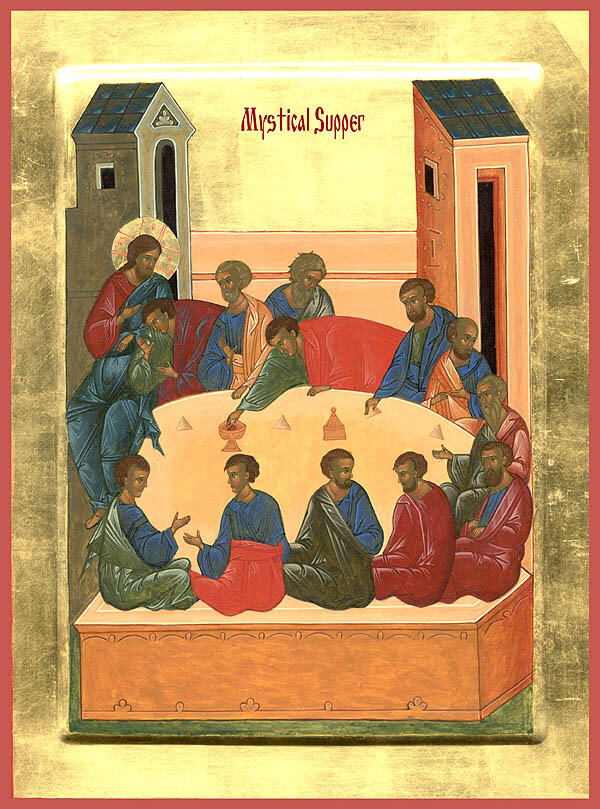
THE DIVINE LITURGY: THE EPICLESIS (INVOCATION)
"When these words have been said, the whole sacred rite is accomplished, the offerings are consecrated, the Sacrifice complete, the Divine Oblation, slain for the salvation of the world, lies upon the altar. For it is no longer the bread, which until now has represented the Lord's Body, nor is it a simple offering, bearing the likeness of the true offering, carrying as if engraved on it the symbols of the Savior's Passion: it is the true victim, the most Holy Body of the Lord, which really suffered the outrages, insults and blows, which was crucified and slain, which under Pontius Pilate bore such splendid witness; that body which was mocked, scourged, spat upon, and which tasted gall, in like manner the wine has become the Blood, which flowed from that Body, it is that Body and Blood formed by the Holy Spirit, born of the Virgin Mary, which was buried, which rose again on the third day, which ascended into heaven and sits down at the right hand of the Father" (Saint Nicholas Cavasilas (+ 1371), On the Divine Liturgy).
"...and we ask, pray, and entreat Thee: send down Thy Holy Spirit..."
To call upon Almighty God to send His Holy Spirit on us and on the Gifts offered! Who is so daring, so bold? That is why we "ask, we pray, and we entreat." We are totally unworthy of asking anything of God, particularly for the Great Gift of the Holy Spirit to be sent down for our sake! Prophet Elijah called upon God with fear and trembling to manifest Himself, doing it not of his own initiative but "at His word." Then God sent down fire, which consumed the offering (see 1 Kings19:36-38). What is that fire compared to the invisible fire of the Holy Spirit that descends and sanctifies the offerings, rendering them the very Body and Blood of the Lord?
Before the Ascension to heaven, the Lord said to His Disciples: "You shall receive power when the Holy Spirit has come upon you" (Acts 1:8). Here we see the power of the Holy Spirit at work. Elijah of old cried, "Answer me, O Lord" (1 Kings 18:37), and fire came down from heaven. Here the priest cries "Send down Thy Holy Spirit" and behold the Holy Spirit Descends and Sanctifies the Gifts. The priest "protracts the supplication for a long time, not in order to bring down a flame from heaven to burn the gifts presented, but so that the Grace, descends upon the sacrifice, through it may burn all the souls."
"...Upon us..."
In the Old Testament, during the journey of the Israelites through the desert, the glory of the Lord filled the Tabernacle in the form of a cloud (Exodus 40:34-35). Similarly, in every Divine Liturgy, the Holy Spirit Descends and fills the holy temple and the New Israel of God (the Holy Church) [Galatians 6:16]. There, when the cloud covered the tent, not even Moses could enter it; here, the Holy Spirit descends so that the faithful may unite themselves with Christ through the energy of the Holy Spirit.
Let us reiterate that the request it for the Holy Spirit to descend not only upon the Gifts offered, but also, ultimately, upon those who present the gifts, the holy people of God. This is quite remarkable! "The final and defining purpose of the epicletic summoning of the Holy Spirit, then, is not the consecration of the bread and wine, but the consecration of human beings. The Risen Christ does not assume the form of the consecrated bread and wine in order to hid in a tabernacle, but in order to be eaten and drunk, that He may abide in us and we in Him (John 6:56).
The ultimate purpose of the consecration of the Holy Gifts is to give life (i.e., the Lord, Who is Life) [John 14:6) to those who partake of them in faith and purity. "We call upon the Holy Spirit asking precisely the transfiguration of our life, the incorruptibility of our life: to change the gifts and those who partake of them into a new creation, freed from death--to the Body of Christ.
"...And upon these Gifts here presented..."
The change is taking place by the Grace of the Holy Spirit Who descends upon the gifts offered by the invocation (epiclesis) of the priest and with the participation of the entire congregation, which must be represented even if by one person alone.
"...And make this bread the Precious Body of Thy Christ..."
(He blesses the Holy Bread)
People: Amen.
Priest: ...And that which is in this Cup the Precious Blood of Thy Christ..."
People: Amen.
Priest: "...changing them..."
[Real Presence]
The faith of the Church, since the very beginning, has been that the bread and wine offered are changed into the Body and Blood of the Lord. The Orthodox Church has always understood the words of the Lord, "This is My Body...This is My Blood." quite literally, because her Divine Founder meant it that way. How do we know? He said clearly in public: "Truly, truly, I say to you, unless you eat the Flesh of the Son of Man and drink His Blood, you have no life in you" (John 6:53). And to drive this point across He repeated these words a few times over. Justifiably, as "many of His disciples" that did not trust fully in Him took offense at His words, and so "drew back and no longer went about with Him" (John 6:66).
"This is My Body...This is My Blood." This was not allegorical talk. It was not a parable in action, it was not a figure of speech. It was not symbolic language, it was realistic talk. "This is what I received from the Lord and in turn passed on to you," Saint Paul writes to the Corinthians (1 Corinthians 11:23-24).
"...by Thy Holy Spirit..."
"Christ, Who offered Himself without blemish to God through the Eternal Spirit (Hebrews 9:14) by the good will of the Father, offers Himself to us through the same Spirit. The Holy Spirit prepared the way for the Coming of Christ by "speaking through the Prophets". The Incarnation of Jesus Christ was accomplished through the Holy Spirit. The Holy Spirit descends upon the Disciples "as of tongues of fire" (Acts 2:3). The change of the Eucharistic elements into the Body and Blood of Christ is accomplished through the Holy Spirit. Instead of calling upon the Holy Spirit to sanctify the Gifts, God the Father is called upon to send His Holy Spirit. Who remains hidden, acting only through His Uncreated Grace.
The Holy Spirit continues the Mission of Jesus Christ in the world, being with us at every Holy Mysterion (Sacrament), but in a unique way in Holy Communion. Our sanctification is accomplished through Him. Without His activity in us, our souls would be dead. In fact, without the Holy Spirit we would be unable to perform any worthy deeds. It is the Grace of the Holy Spirit that "makes us partake of, and commune with God". The Holy Spirit is Divine, that is why It sanctifies us and deifies us (theosis).
Not the words alone, but also the actions affect the change. The sign of the Cross seals the Divine Gifts, together with our Amen, completing the change. The change and all the benefits that come from it "He confers on us by the power of the blessing, through which He changes the nature of the visible elements into that immortal body." (Source: The Heavenly Banquet. Understanding the Divine Liturgy by Father Emmanuel Hatzidakis)
_______________
Please note: After one understands what takes place at the Divine Liturgy it becomes clear that God the Holy Spirit is He Who bestows His Grace upon the Orthodox Christian believers. The Holy Spirit is "the Spirit of Truth." The Holy Spirit works only within the authentic church of Christ, the Orthodox Church. How can the Spirit of Truth act or guide those within the heretical groups which spread falsehood, heresy, division, confusion, and blasphemy against Him? The heretic is not only an enemy of the Truth. but also the enemy of God the Holy Spirit.
God the Holy Spirit is present! As God, He is present to inspire us, to bestow His grace upon us, to bring us healing, forgiveness, and to reconcile us with Him. He is present to guide us, to teach us how to pray, how to live a virtuous life, how to unite us with Him, how to work out our salvation, and to give life to us, how to attain the Kingdom of Heaven, how to become good samaritans to our fellow man, how to resist evil, sin, and death. The Holy Spirit is present to sanctify us and to make it possible for us to be reborn "through water and Him, the Holy Spirit".
How can anyone within the Church ever doubt His real presence? How can anyone fear, that either Holy Communion, or the instruments used to bestow upon us forgiveness of sins and eternal life, bring instead, illness and death? The Holy Spirit is the Life-giving and Life-creating Spirit. The Adversary and the true enemy of man is none other than Satan, it is he who brings death and destruction.
____________________
"Glory Be To GOD For All Things!" -- Saint John Chrysostom
+++
With sincere agape in His Holy Diakonia (Ministry)
The sinner and unworthy servant of God,
+Father George
Divine Grace
The word "Grace" is used in Sacred Scripture with various meanings.
Sometimes it signifies, in general, the mercy of God: "God is the God of all grace" (1 Peter 5:10). In this, its broadest meaning, Grace is God's goodwill to men of worthy life in all ages. Old Testament prophets like Abel, Enoch, Noah, Abraham, the Prophet Moses, and the later Prophets.

My beloved spiritual children in Christ Our Only True God and Our Only True Savior,
CHRIST IS IN OUR MIDST! HE WAS, IS, AND EVER SHALL BE.
+
DIVINE GRACE (Χάρις)
The word "Grace" is used in Sacred Scripture with various meanings.
Sometimes it signifies, in general, the mercy of God: "God is the God of all grace" (1 Peter 5:10). In this, its broadest meaning, Grace is God's goodwill to men of worthy life in all ages. Old Testament prophets like Abel, Enoch, Noah, Abraham, the Prophet Moses, and the later Prophets.
In the more precise meaning, the concept of Grace refers to the New Testament. Here in the New Testament, we distinguish two fundamental meanings of this concept. First, by the Grace of God, the Grace of Christ is to be understood the whole economy of our salvation, performed by the coming of the Son of God to earth, by His earthly life, His death on the Cross, His Resurrection, and His Ascension into heaven: "For by grace are ye saved through faith; and that not of yourselves: it is the gift of God, and not of works, lest any man should boast" (Ephesians 2:8-9). Secondly, Grace is the name applied to the Gifts of the Holy Spirit which have been sent down and are being sent down to the Church of Christ for the sanctification of its members, for their spiritual growth, and for the attainment by them of the Kingdom of Heaven.
In this second New Testament meaning of the word, Grace is a power sent down from on high, the power of God which is in the Church of Christ, which gives birth, gives life, perfects, and brings the believing and virtuous Christians to the appropriation of the salvation which has been brought by the Lord Jesus Christ.
The Holy Apostles, therefore, in their writings often used the Greek word charis, "grace" as identical meaning with the Greek word "dynamis", "power." The term "Grace" in the sense of "power" given from above for holy life is found in many places of the Apostolic Epistles (Letters) (2 Peter 1:3, Romans 5:2; Romans 16:20; 1 Peter 5:12; 2 Peter 3:18; 2 Timothy 2:1; 1 Corinthians 16:23; 2 Corinthians 13:14; Galatians 6:18; Ephesians 6:24, and other places). The Holy Apostle Paul writes: "The Lord said unto me, My grace is sufficient for thee; for My strength is made perfect in weakness" (2 Corinthians 12:9).
The distinction between these two meanings of the word "grace" and the predominant of it in the Holy Scripture of the New Testament as a Divine Power, is important to keep in mind because in Protestantism teaching has become established about Grace only in its general significance of the great work of our Redemption from sin through the Savior's exploit on the Cross, after which--as the Protestants think--a man who has come to believe and has received the remission of sins is already among the saved. However, the Holy Apostles teach us that a Christian, having justification as a gift in accordance with the general grace of redemption, is in this life as an individual only "being saved" (1 Corinthians 1:18), and needs the support of Grace given powers. "We have access by faith into this grace wherein we stand" (Romans 5:2; "we are saved by hope" (Romans 8:24).
How, then, does the saving Grace of God act?
Both the spiritual birth and the further spiritual growth of a man occur through mutual actions of two principles. One of these is the Grace of the Holy Spirit, the other, man's opening of his heart for the reception of it, a thirst for it, the desire to receive it, as the thirsty, dry earth receives the moisture of rain--in other words, personal effort for the reception, preservation, and activity in the soul of the Divine Gifts.
In accordance with this Sacred Teaching, the Council (Synod) of Carthage in the 3rd Century decreed: "Whosoever should say that the Grace of God, by which a man is justified through Jesus Christ our Lord, avails only for the remission of past sins, and not for assistance against committing sins in the future, let him be anathema. For the Grace of Christ gives not only the knowledge of our duty but also inspires us with a desire that we may be able to accomplish what we know" (Canons 125, also 126 and 127).
The experience of Orthodox ascetics inspires them to call Christians with all power to the humble acknowledgment of one's own infirmity so that the saving Grace of God might act. Very expressive to this case are the experiences of Saint Symeon the New Theologian (10th century).
He who bears the name Christian, we read in the same Holy Fathers, "If he does not bear in his heart the conviction that the Grace of God, given for faith, is the mercy of God...If he does not labor with the aim of receiving the Grace of God, first of all through Baptism, or if he had it and it departed by reason of his sin, to cause it to return through repentance, confession, and is self-belittling life; and if, in giving alms, fasting, performing vigils, prayers, and the rest, he thinks that he is performing glorious virtues and good deeds valuable in themselves--then he labors and exhausts himself in vain" (Homily 2).
What then, is the significance of ascetic struggle? It is a weapon against "the lust of the flesh, and the lust of the eyes, and the pride of life" (1 John 2:15-16). It is the cleansing of the field of the soul from stones, overgrown weeds, and swampy places, in preparation for a sacred sowing, which will be moistened from above by the Grace of God.
The Providence of God and Grace
From what has been set forth, it follows that there is a difference between the concepts of God's Providence and Grace. Providence is what we call God's power in the world that supports the existence of the world, its life, including the existence and life of mankind and of each man; while grace is the power of the Holy Spirit that penetrates the inward being of man, leading to his spiritual perfection and salvation. (Source: Orthodox Dogmatic Theology by Father Michael Pomazansky)
________________
Please note: Those who attack the Mysteria (Sacraments) the Church of Christ or deliberately plant seeds of doubt in the minds and hearts of the Orthodox Christians are committing blasphemy against the Holy Spirit. It is God the Holy Spirit that conveys Divine Grace to the believers through which they are forgiven, healed, restored, sanctified, and are saved.
The Church "is a spiritual hospital" through which every Orthodox Christian believer finds healing, both of soul and body. Christ, our Lord and Savior, is the only Physician of our souls and bodies. We, as Christians, as His followers, trust in Him and we always turn to Him for forgiveness and reconciliation.
The Sacraments of our Holy Orthodox Church are Divine and life-giving. Only the active members of the Body of Christ are able to receive them and not non-believers, or people of other religions.
Upon the consecration of an Orthodox bishop, the candidate vows to adhere and be obedient to the Holy Canons of the Church. The Holy Canons sustains the order and discipline in the Church. The Pidalion (Rudder) is comprised of decisions of Ecumenical, and Local Council decisions, as well as the divine teachings and commandments found in the New Testament. There are those, however, that believe that the Holy Canons should be discarded all-together and should not be implemented at all.
Every ship must have a rudder to direct its course and cannot function without it. It is the same with our Holy Church, the Ark of salvation, without the Holy Canons the Church will end up on rocks and be destroyed and would never reach her final destination. The Holy Canons also prevent any abuses, heresy, power struggles, unethical practices, distortions, anarchy, and a lack of guidance on spiritual matters, issues, and concerns.
The Holy Canons of the Orthodox Church hold everyone within her accountable with the ability to discipline and even excommunicate those who attempt to corrupt, to render it useless, to create division, and confusion among the believers. The Holy Canons of the Church are the laws of the Church, without them there is lawlessness.
________________________________
"Glory Be To GOD For All Things!" -- Saint John Chrysostom
+++
With sincere agape in His Holy Diakonia
The sinner and unworthy servant of God
+Father George
