
You are Essential in the Life of the Church
"We who are strong have an obligation to bear with the failings of the weak, and not to please ourselves. Let each of us please his neighbor for his good, to build up. For Christ did not please Himself..." (Romans 15:1-3).

My beloved spiritual children in Christ Our Only True God and Our Only True Savior,
CHRIST IS IN OUR MIDST! HE WAS, IS, AND EVER SHALL BE.
+
YOU ARE ESSENTIAL IN THE LIFE OF THE CHURCH
"We who are strong have an obligation to bear with the failings of the weak, and not to please ourselves. Let each of us please his neighbor for his good, to build up. For Christ did not please Himself..." (Romans 15:1-3).
We, as Orthodox Christian believers, do not live for ourselves. Our greatest example of this is our Lord, God, and Savior Jesus Christ. Our Lord's earthly life and ministry reveals His total devotion to all people and their needs. In His infinite love He embraced everyone who was lost, who was hurt, who was ill, who was sinful and was in need of forgiveness, who were possessed by demonic powers, who sought salvation.
The Orthodox Christian keeps the Lord Jesus in His sights and emulates His Divine example of unconditional love, mercy, kindness, compassion, self-sacrifice, forgiveness, humility, meekness, sacrifice, and selflessness. Let us turn to the holy Apostle Paul in his letter to the Philippians who reminds us of Christ's example of humility and says, "So if there is any encouragement in Christ, any comfort from love, any participation in the Spirit, any affection and sympathy, complete my joy by being of the same in, having the same love, being in full accord and of one mind. Do nothing from selfish ambition or conceit, but in humility count others more significant than yourselves. Let each of you look not only to your own interests, but also to the interests of others. Have this mind among yourselves, which is yours in Christ Jesus, who though he was in the form of God, did not count equality with God a thing to be grasped, but emptied himself, by taking the form of a servant, being born in the likeness of men..." (Philippians 2:1-7).
We are all precious in the eyes of God. We are all essential and part of His Divine plan. We have been given a special talent but not to hide it but to use it and invested so that it may be multiplied. There is a definite purpose to our living beyond just simply existing. It is God the Holy Spirit that through His grace can open the eyes of our understanding of His Divine Will for us.
The Orthodox Christian believers are essential in the Holy Church. The Holy Church of God is comprised of clergy and laity. There can be no Church without one or the other. The Orthodox Christian believers express openly and with confidence the True faith. The voice of the clergy and the lay Orthodox Christians voice the "conscience of the Church." No Orthodox Christian who is educated in the faith and practices it daily is ever willing to compromise it or adulterate it.
Historically the Church faced persecution from without from her enemies who sought to destroy it. Over the centuries, however, the Church, faced even a more insidious threats from within, by those who sought to corrupt it from within, known as heretics. The Holy Church had to come together in the form of Ecumenical Synods, not only to define the Truth under the guidance of the Holy Spirit, but to also defend it by establishing the dogmas of the Church. The dogmas of the Orthodox Church can never be challenged or changed by anyone. Those who attempted to do this found themselves excommunicated from her and branded forever as heretics.
The Church of Christ has faced all kinds of dangerous attacks over 2,000 years of her life and has always triumphed. In the Gospel of Saint Matthew Chapter 16:18 Jesus says, "...You are Peter and on this rock I will build my Church, and the gates of hell shall not prevail against it." The Church, my beloved spiritual children, is none other, than our Lord and Savior Jesus Christ. Nothing and no one can destroy the Church.
The Orthodox Christian is essential indeed. The voice of the people of God is always essential in matters of faith. It is therefore imperative that the Orthodox Christian not ever be deceived by the Adversary but remain alert to defend the Truth, Christ our God. The Lord is indeed the "Alpha and the Omega, the beginning and the end" (Revelation 21:6) of all. Our loyalty and commitment is to Him. "May all who seek You rejoice and be glad in You! Make those who love Your salvation say evermore, 'God is Great!' (Psalm 70:4).
__________________
"Glory Be To GOD For All Things!" - Saint John Chrysostom
+++
With sincere agape in His Holy Diakonia (Ministry)
The sinner and unworthy servant of God
+Father George
The Orthodox Way of Life - Living Through Christ Each Day
There is this incessant misconception involving the way in which Orthodox Christians should live with blurred lines of confusion of what is right and wrong in terms of practice. As an Orthodox Christian, there is an emphasis on acquiring humility and patience, through continual prayer, repentance, and love towards one another. Unfortunately, this current epoch of an existence is far from what is expected from us as not only Christians, but as an entire population of humans. Through the rapid explosion of technological advances, medical science discoveries, social behavior, humans are vey lost, drifting far away from God. With all the distractions there are today, it is very easy to be possessed by the physical aspects rather than the spiritual ones.
My beloved spiritual children in Christ Our Only True God and Our Only True Savior,
CHRIST IS IN OUR MIDST! HE WAS, IS, AND EVER SHALL BE.
+
THE ORTHODOX WAY OF LIFE - LIVING THROUGH CHRIST EACH DAY
There is this incessant misconception involving the way in which Orthodox Christians should live with blurred lines of confusion of what is right and wrong in terms of practice. As an Orthodox Christian, there is an emphasis on acquiring humility and patience, through continual prayer, repentance, and love towards one another. Unfortunately, this current epoch of an existence is far from what is expected from us as not only Christians, but as an entire population of humans. Through the rapid explosion of technological advances, medical science discoveries, social behavior, humans are vey lost, drifting far away from God. With all the distractions there are today, it is very easy to be possessed by the physical aspects rather than the spiritual ones.
People would prefer to stay home on a Sunday morning just to sleep-in long enough to watch a football game. Others, tentative about attending Sunday service, give their own children the choice of whether or not they want to attend Sunday School, as an attempt to "skip" church that day.
There are even people who just stop going to church altogether just because they do not feel the need to go. The sad part about all these scenarios is that they are considered a 'normative' behavior and these individuals see no problem with it whatsoever.
The enormous shift in values and traditions around most families is quite alarming. The devoid of our Lord being centered of our lives is an endangering practice. Being an Orthodox Christian is not only a once-a-year experience or private worship time at home. Life, as an Orthodox Christian is a consistent, unending path with our Lord and Savior Jesus Christ leading our way, according to His Will, and not our own.
Due to the many interruptions there are nowadays, we are forgetting why we are here. We are not alive for the sake of fulfilling the hedonistic tendency that has flooded the newer generations of human beings. We are the sinful salts of the earth that must attempt to grow in Christ and life one-step at a time. The main problem we have is not only hedonism but also indifference. People seem to care less about purpose or meaning of anything. Some only want to take from life all that they can take, with no intention of giving anything back.
Going to church once a week is the very least Orthodox Christians can do to practice their faith. It is amazing what one Liturgy service can do to someone. It could be one Gospel or Epistle reading, or even the priest's sermon that can make a difference. As simple phrase or message could be taken from that one-time visit each week to God's House. It all sounds so simple. Yet, why is it so difficult to do?
It is only through our Lord Jesus Christ, that we can be forgiven and allowed access into the Kingdom of God. However, we have only one lifetime to get this right! Heaven is an honor, a blessing, granted to us not an entitlement. Just because you are an Orthodox Christian, does not imply complete remission of sins if you do not actively practice the faith accordingly.
Beloved you must understand this life is only temporary. God can grant us life as quickly as He can take life away. Repent your sins and be sincere in your apologies. Ensure you treat others with dignity and respect, without expecting anything in return. Above all you must love the Lord Jesus Christ with all your heart, mind, and strength. Do not forget all that Jesus has done for us, and place Him in the hope of our salvation. (Source: Greek Orthodox Archdiocese. blogsgoarch.org)
______________________
"Glory Be To GOD For All Things!" - Saint John Chrysostom
+++
With sincere agape in His Holy Diakonia (Ministry)
The sinner and unworthy servant of God
+Father George
September 26 - Falling Asleep of St. John the Theologian
John was the son of Zebedee the fisherman and Salome the daughter of Joseph, the betrothed of the Holy Mother of God. Called by the Lord Jesus, John immediately left his father and the fishing nets and followed Christ with his brother James. From that time, he was not parted from his Lord until the end. With Peter and James, he was present at the raising of Jairus's daughter and at the Lord's Transfiguration (Metamorphosis), and he laid his head on Jesus' breast at the Mystical Supper.

My beloved spiritual children in Christ Our Only True God and Our Only True Savior,
CHRIST IS IN OUR MIDST! HE WAS, IS, AND EVER SHALL BE.
+
ON SEPTEMBER 26th OUR HOLY ORTHODOX CHRISTIAN CHURCH COMMEMORATES THE FALLIG ASLEEP OF SAINT JOHN THE THEOLOGIAN
John was the son of Zebedee the fisherman and Salome the daughter of Joseph, the betrothed of the Holy Mother of God. Called by the Lord Jesus, John immediately left his father and the fishing nets and followed Christ with his brother James. From that time, he was not parted from his Lord until the end. With Peter and James, he was present at the raising of Jairus's daughter and at the Lord's Transfiguration (Metamorphosis), and he laid his head on Jesus' breast at the Mystical Supper. When all the other had forsaken the Crucified Lord, John stayed beneath the Cross with the Holy Mother of God. In obedience to the Lord's wish, he was as a son to the Holy Ever-Virgin Mary, caring for her and serving her, looking after her right up to her Falling Asleep. After her Koimisis (Dormition), Saint John went off with his disciple Prochorus to preach the Gospel in Asia Minor, and mainly lived and worked in Ephesus. By his inspired preaching and miracles (wonders), he brought many to Christianity and undermined the foundation of paganism. The angry pagans bound him and sent him to Rome to the pagan Emperor Domitian. He was tortured and flogged before the Emperor, but, when he was unharmed either by the strong poison that he was given t drink or the boiling oil into which he was put, the Emperor was afraid and, thinking he was immortal, sent him into exile on the Greek Island of Patmos. On this island, Saint John the Theologian brought many to Christianity by his words and miracles and strengthened the Church of God. He wrote his Gospel and the Apocalypse (Book of Revelation there. In the time of the pagan Roman Emperor Nerva, who gave liberty to all the captives, Saint John returned to the city of Ephesus, where he lived for some time, confirming the work that he had earlier begun. He was over a hundred years old when he went to the Lord. When his disciples later opened his grave, they found that his body was not there. Every year, on May 8th, fine, fragrant dust endowed with healing power rose from his grave. After a long and fruitful life of labor upon earth, this beloved disciple of Christ and pillar of the Church entered unto the joy of his Lord, to peace and Eternal rejoicing. (Source: The Prologue from Ochrid)
___________________
DIVINE LITURGY AT 10:00 A.M. Parishioners at higher-risk are asked to attend this service and receive Holy Communion.
______________________
"Glory Be To GOD For All Things! - Saint John Chrysostom
+++
With sincere agape in His Holy Diakonia (Ministry)
The sinner and unworthy servant of God
+Father George
September 23 - Conception of Saint John the Baptist
On this day are celebrated God's mercy, His wondrous act and His wisdom: His mercy towards the devout and righteous parents of Saint John, the aged Zacharias and Elizabeth, who had all their lives begged a child of God; the miracle (wonder or in Greek, θαύμα (thavma)) of the conception of John in Elizabeth's more-than-aged womb; and the wisdom of the dispensation of man's salvation. For John, God had especially great plans: that he should be a Prophet and the Forerunner of Christ the Lord, the Savior of the world.

My beloved spiritual children in Christ Our Only True God and Our Only True Savior,
CHRIST IS IN OUR MIDST! HE WAS, IS, AND EVER SHALL BE.
+
ON SEPTEMBER 23rd OUR HOLY ORTHODOX CHRISTIAN CHURCH COMMEMORATES THE CONCEPTION OF SAINT JOHN THE BAPTIST AND FORERUNNER.
On this day are celebrated God's mercy, His wondrous act and His wisdom: His mercy towards the devout and righteous parents of Saint John, the aged Zacharias and Elizabeth, who had all their lives begged a child of God; the miracle (wonder or in Greek, θαύμα (thavma)) of the conception of John in Elizabeth's more-than-aged womb; and the wisdom of the dispensation of man's salvation. For John, God had especially great plans: that he should be a Prophet and the Forerunner of Christ the Lord, the Savior of the world. Through His Angels, God revealed the birth of Isaac to the childless Sarah, and of Samson to the childless Manoah and his wife, and of John the Baptist to the childless Zacharias and Elizabeth. Through His Angels, God revealed the birth of those for whom He had a special plan. How could children be born of aged parents? If someone is curious to find out, let him not ask men, for men do not know, nor does natural law (it being beyond natural law), but let him turn his gaze to the power of Almighty God, Who made the whole world from nothing and Who, for the creation of Adam, the first man, used no parents, either young or old. Instead of being curious, let us thank God that He often reveals to us His power and mercy and wisdom beyond the natural law, by which we would otherwise be fettered and, without these special miracles of God, would fall into despair and forgetfulness of Him. (Source: The Prologue from Ochrid)
__________________
"Glory Be To GOD For All Things!" - Saint John Chrysostom
+++
With sincere agape in His Holy Diakonia (Ministry)
The sinner and unworthy servant of God
+Father George

Orthodox Church Architecture (Part II)
While sharing many traditions, East and West in Christianity began to diverge from each other from an early date. Whereas the basilica, a long aisled hall with an apse at one end, was the most common form in the West, a more centralized style became predominant in the East. These churches were in origin 'martyria' focused on the tombs of the Saints--specifically, the Martyrs who had died during the persecutions, which only fully ended with the conversion of Emperor Constantine. They copied pagan tombs and were roofed over by a dome which symbolized heaven.
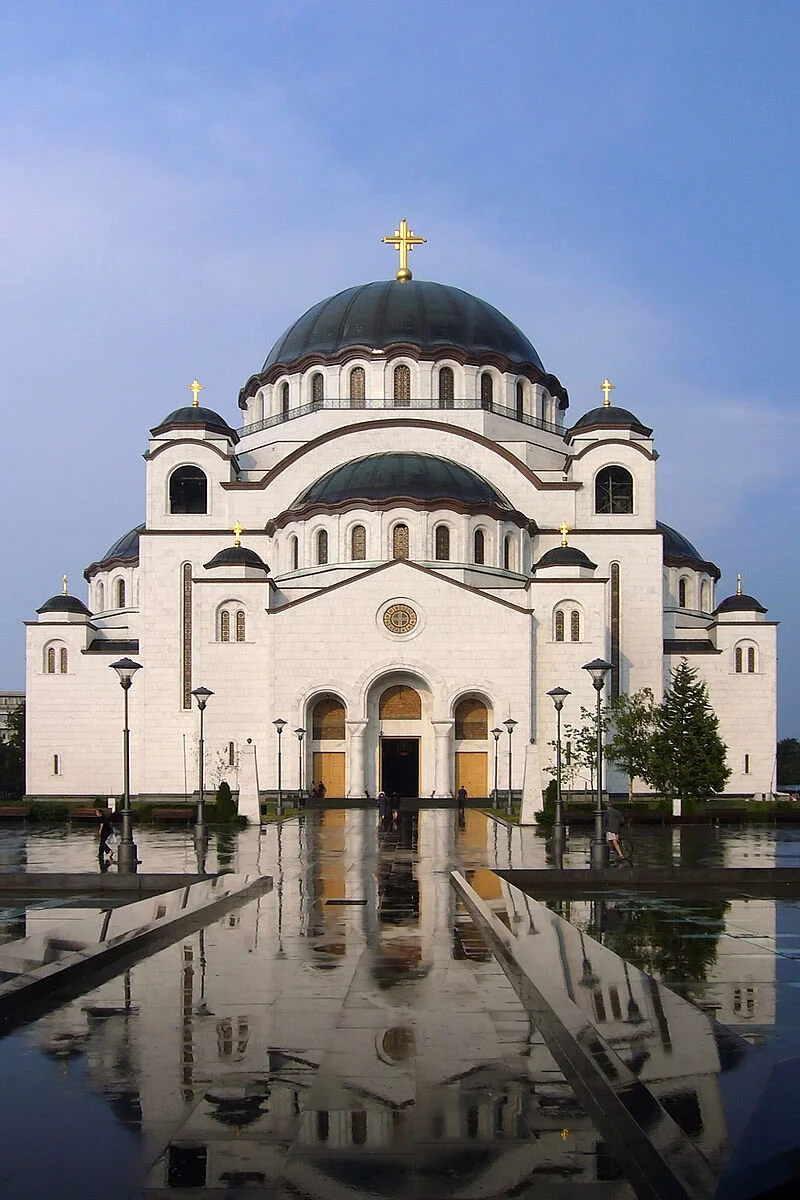
Temple of Saint Sava
By Vol de nuit - Own work, CC BY-SA 4.0, https://commons.wikimedia.org/w/index.php?curid=3958433
My beloved spiritual children in Christ Our Only True God and Our Only True Savior,
CHRIST IS IN OUR MIDST! HE WAS, IS, AND EVER SHALL BE.
+
ORTHODOX CHURCH ARCHITECTURE (Part II)
History
While sharing many traditions, East and West in Christianity began to diverge from each other from an early date. Whereas the basilica, a long aisled hall with an apse at one end, was the most common form in the West, a more centralized style became predominant in the East. These churches were in origin 'martyria' focused on the tombs of the Saints--specifically, the Martyrs who had died during the persecutions, which only fully ended with the conversion of Emperor Constantine. They copied pagan tombs and were roofed over by a dome which symbolized heaven. The Central Dome was then often surrounded by structures at the four points of the compass producing a cruciform shape--these were themselves often topped by towers or domes. The centralized and Basilica structure were sometimes combined as in the church of Hagia Sophia in Constantinople. The Basilican East end then allowed for the erection of an iconostasis, a screen at those points in the Liturgy when its doors are opened.
A variant form of the centralized church was developed in Russia and came to prominence in the 16th century. Here the dome was replaced by a much thinner and taller hipped or conical roof which, it is said, originated from the need to prevent snow from remaining on roofs. One of the finest examples of these tented churches is Saint Basil's in Red Square in Moscow.
For a long time, churches and aristocratic palaces were dominating in the art of architecture therefore the evolution of Orthodox churches are presented in great detail in articles "Byzantine architecture" and "Russian architecture."
Unlike Western Christian architecture with its tendencies of modernity (see e.g. Liverpool Metropolitan Cathedral or Notre Dame du Haut). Orthodox architecture style remains largely conservative and traditional. One notable and architecturally important exception is Frank Lloyd Wright's of Annunciation Greek Orthodox church in Wauwatosa, Wisconsin, in the US.
Terminology
The words "church" and "temple", are interchangeable; however, the term "church" (Greek: εκκλησία) is far more common in English. The term "temple" (Greek: ναός) is also commonly applied to larger churches. Some famous churches which are occasionally referred to as temples include Hagia Sophia, Saint Basil's Cathedral, Cathedral of Christ the Savior, Temple of Saint Sava.
Some churches have a special status. In Greek, Diocesan sees are referred to as καθεδρικός ναός (Cathedral church or temple).
The major church in a monastery is called a catholicon, and may be served for major services, lesser services being celebrated in other churches in the monastery.
A church independent of local eparchy is called "stavropegion" (Greek stavropegion means "mounting of the cross").
Orthodox church buildings have the following basic shapes, each with its own symbolism:
* Elongated: rectangle, rounded rectangle (oval), symbolizing the ship as a means of salvation (Noa's Ark)
* Cruciform (cross shaped)
* Circular
The cupola instead of a flat ceiling symbolizes the sky. The Altar (Sanctuary) is situated in the Eastern part of the church, regardless of its shape. A bell tower is attached to (or built separately by) the Western part of the church.
The church building has many symbolic meanings; perhaps the oldest and most prominent is the concept that the Church is the Ark of Salvation (as Noah's Ark) in which the world is saved from the flood of temptations. Because of this, most Orthodox Churches are rectangular in design. Another shape, especially for churches with large choirs is cruciform or cross-shaped. Architectural patterns may vary in shape and complexity, with chapels sometimes added around the main church, or triple altars (Liturgy may only be performed once a day on any particular altar), but in general, the symbolic layout of the church remains the same.
A major difference of traditional Orthodox churches from Western churches is absence any pews in the nave. In some ethnic traditions of Orthodoxy, it was deemed disrespectful to sit during sermons. However in some churches in the West and particularly in the diaspora churches in the USA, pews and kneelers were introduced, under the influence of other Christian traditions.
Narthex
The Narthex is the connection between the Church and the outside world and for this reason catechumens (pre-baptized Orthodox) and non-Orthodox are to stand here (note: the tradition of allowing only confirmed Orthodox into the Nave of the church has for the most part fallen into disuse). In monastic churches it is usual for the lay people visiting the monastery to stand in the Narthex while the monks or nuns stand in the Nave. Separating the Narthex from the Nave are the Royal Doors (from the time of the Byzantine Empire, when the Emperor would enter the main body of Hagia Sophia, the Church of Holy Wisdom, through these doors and proceed up to the Altar to partake of the Holy Eucharist). On either side of this portal are large brass candlestands called manoualia which represent the pillars of fire that went before the Hebrews into the Promised Land.
Nave
The Nave is the main body of the church where the people stand during the services. In most traditional Easter Orthodox churches there are no seats or pews as in the West, but rather stacidia (a high-armed chair with arm rests high enough to be used for support while standing); these are usually found along the walls. Traditionally there is no sitting during services with the only exceptions being during the reading of the Psalms, and the priest's sermon. The people stand before God. However, many exceptions to this can be found in Western countries, especially the US, where familiarity with Catholic and Protestant churches has led to similarities in church furnishings. It is not uncommon to encounter both pews and kneelers.
The walls are normally covered from floor to ceiling with holy icons or wall paintings of Saints, their lives, and stories from the Holy Bible. Because the church building is a direct extension of its Jewish roots where men and women stand separately, the Orthodox Church continued this practice, with men standing on the right and women on the left. With this arrangement, it is emphasized that we are all equal before God (equal distance from the Altar), and that the man is not superior to the woman. In many modern churches, this traditional practice has been altered and families stand together.
Above the Nave in the Dome of the church is the holy icon of Christ the Almighty (Παντοκράτωρ/Pantokrator, "Ruler of All"). Directly hanging below the Dome (in more traditional churches) is usually a kind of circular chandelier with depiction of the Saints and Apostles, called the horos. (Wikepedia)
___________________________
"Glory Be To GOD For All Things!" - Saint John Chrysostom
+++
With sincere agape in His Holy Diakonia (Ministry)
The sinner and unworthy servant of God
+Father George