
November 25 - Saint Katherine the Great Martyr
Katherine, the glorious great martyr of Christ, came from the metropolis of Alexandria. She struggled during the reigns of the ungodly and pagan Emperors Maximian (306-308 A.D.), Maxentius (308-312 A.D.), and Maximinus (308-314 A.D.). The blessed one's life and martyrdom is so marvelous, sweet, and compunctious that each soul who reads it with care and attention will greatly rejoice and be refreshed by the fruit garnered there from.
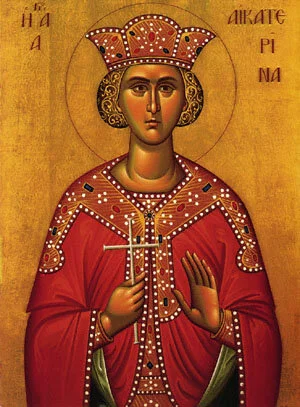
My beloved spiritual children in Christ Our Only True God and Our Only True Savior,
CHRIST IS IN OUR MIDST! HE WAS, IS, AND EVER SHALL BE.
+
ON THE 25TH OF NOVEMBER, THE HOLY CHURCH COMMEMORATES THE HOLY AND GLORIOUS GREAT-MARTYR KATHERINE OF ALEXANDRIA
Katherine, the glorious great martyr of Christ, came from the metropolis of Alexandria. She struggled during the reigns of the ungodly and pagan Emperors Maximian (306-308 A.D.), Maxentius (308-312 A.D.), and Maximinus (308-314 A.D.). The blessed one's life and martyrdom is so marvelous, sweet, and compunctious that each soul who reads it with care and attention will greatly rejoice and be refreshed by the fruit garnered there from.
The anticipation of reaping a good crop gives confidence to the farmer, and, as a result, he counts as naught the labor, toil, and hardship of winter. He braves wind and rain, and even the frigid snows. He awaits the harvest season with the utmost eagerness to enjoy the fruits of his labors. The expectation of financial gain leads merchants to defy all hardships and dangers of land and sea, so as to increase their capital, oft-times to no profit, and many brave soldier who, in the hope of enjoying glory and honor, takes no account of the peril in which he places his life, nor the sufferings he must undergo, contends to vanquish the enemies of his king, so as to be honored and rewarded by him according to his acts of valor.
Hence, they persevere in so many hardships, toils, and sufferings to acquire the perishable and effete things which today exist and tomorrow vanish away; moreover, oft-times the wretched ones fail and do not attain their goal, as we have seen various times and places. The farmer toils extensively and scatters his seed upon the earth, expecting it to increase tenfold. Yet, many times he does not reap what he sows. Again, the merchant expends sums and embarks on a voyage to double his capital, and many times the unfortunate one casts his goods overboard to avoid falling into the hands of pirates who might rob him, and oftentimes he, too, will lose his life. Furthermore, the soldier goes into battle, and the poor one is slain. Therefore, if they expose their lives and souls to innumerable dangers for transient and vain things, how much more should we Christians struggle, who undoubtedly understand that we are to inherit so many good things in the kingdom of the heavens, wherein we shall delight eternally?
Knowing this, the people of past generations, being well-intentioned and prudent, strived according to their strength to be deemed worthy of this blessedness. Some imposed extreme asceticism and discipline upon themselves, fleeing the world and dwelling in mountains and caves, praying alone unto God. Others, ardent in piety and zealots of our True Faith, rejected their wealth and property. They gave up their lives to receive death for the sake of their boundless love which they had toward the most desired Jesus Christ. Indeed, the more they saw the bloodthirsty tyrants devising various means of torture, the more so did they, of their own volition, desire death.
More amazing is that not only men, who are aided by the bodily strength with which they were endowed by nature, but also even tender young hearts aflame with love for the heavenly Bridegroom, putting aside the frivolities of young womanhood. Undaunted by the brutality of rulers and tyrants, neither were they perturbed by fierce tortures, nor did they take pity on their bloom and youthful beauty, but instead disdained every transient enjoyment and carnal pleasure. Indeed, of their own volition they hastened to death, knowing that through martyrdom they would be granted eternal life and blessedness. She whom we joyously commemorate on November 25th is the most beautiful and all-praised bride of Christ the heavenly King. She exceeds all the rest in wisdom, beauty, and in many qualities: the renowned and all-wise queen, Katherine.
This ever-memorable daughter of the earthly ruler of Alexandria, Constas (Kestou), was tall in stature, incomparably beautiful, and exceedingly kind. She was instructed in the wisdom of the Greeks, learning all the works of the poets and philosophers, including Home, Virgil, Aristotle, and Plato. Not only was she well-versed in philosophy, but she also knew the medical writings of Asklepios (Aesculapius), Hippocrates, and Galen. Indeed, the maiden was a master of all the nuances of many languages, surpassing all others in rhetoric and logic. All who saw and heard Katherine marveled at her scholarship. Many of the wealthy and leading men of the Senate besought Katherine's mother for her daughter's hand in marriage.
Now her mother was a Christian, but a secret one because of the great persecutions brought about by the followers of Maximian. Both the maiden's relatives and mother counseled her to marry, so that her father's estate should not fall to another, thus cutting her off altogether. But Katherine, on account of her many philosophical studies, cherished her virginity and protested, giving many excuses; for she had no wish whatsoever to wed. However, when she saw that they troubled her greatly over the matter, she proposed the following--actually to divert them--so as not to be further importuned: "Present unto me a young man who is like unto me in the four virtues in which you claim that I am peerless among women, and I will take him as my husband; for I will not condescend to be yoked to one who is unworthy or inferior. Therefore, search here and abroad for one who is equal to me in rank, wealth, wisdom, and beauty--if such an individual exists. Yet, if he is deficient in any of these areas, he is unsuitable."
Now they knew that it would be quite impossible to find such a qualified suitor. They suggested the son of the Roman emperor and other possible candidates of exalted rank and even greater wealth, but they were inferior to her in the categories of erudition and appearance. She stubbornly persisted in her refusal to contract a marriage with an unlettered man. However, her mother had a most holy spiritual confessor who was in hiding outside the city limits. She took her daughter to visit the Geronda (Elder) to seek his counsel. The ascetic, perceiving Katherine's modesty and proper deportment, gave close attention to her judicious and well-spoken words. He resolved to bring her to the knowledge of Christ, the heavenly King, and said: "I am acquainted with a unique Man Who incomparably transcends all those attributes thou has mentioned and countless others. His comeliness eclipses the radiance of the sun; His wisdom governs those things both perceptible by the senses and the intelligence; the world of His treasures is distributed to the ends of the earth, yet never diminishes, but rather increases; His nobility is indescribable, infinite, inconceivable, and incomprehensible!"
The Venerable Geronda (Elder) expounded on this and many other salutary virtues. Now the maiden presumed all the while that he referred to an earthly prince; whereupon, her expression changed, and she questioned him in detail if all the commendations and praises were indeed true attributes. The maiden asked, "Whose Son is this Man Whom thou dost laud?" He asserted, "He has no father on earth; but He was born of a most noble and holy grace-filled virgin in a manner, surpassing our understanding and transcending the nature of generation; she was deemed worthy by her sublime sanctity to abide both in soul and body, being taken up into the highest heavens, wherein our Lady is venerated by the holy Angels as Queen of all creation." Further interested, Katherine continued, "Is it possible to see the Youth?" The old man responded, "If thou wilt do as I say, thou shalt be deemed worthy to behold the radiant splendor of His splendid countenance!" Katherine replied, "I perceive thee to be a faithful witness and a venerable elder. I believe all thou hast revealed to me; therefore, I am prepared to follow thine instructions implicitly." Then, the ascetic gave her an icon depicting the Most Holy Theotokos holding the Divine Child. He then called Katherine's attention to it, and said, "This is the Ever-virgin Mother of the One Whose wonders I have extolled. Take this sacred image and close the door of thy bedchamber; pray all night with profound reverence to her whose name is Mary. Implore her to condescend to reveal her Son; and I believe, if thou wilt pray with faith, she will hearken and show thee Him Whom thy soul desires!" (Source: The Great Synaxaristes of the Orthodox Church)
(To be continued)
___________________
DIVINE SERVICES FOR WEDNESDAY, NOVEMBER 25th:
Orthros (Matins) at 9:00 a.m.
Divine Liturgy at 10:00 a.m.
___________________
"Glory Be To GOD For All Things!" - Saint John Chrysostomos
+++
With sincere agape in His Holy Diakonia (Ministry),
The sinner and unworthy servant of God
+Father George
Preparing Spiritually for the Holy Nativity of Lord and Savior Jesus Christ
While preparing spiritually through fasting, worship, repentance, prayer and living a more virtuous life we, the Orthodox Christian believers, should also meditate on who is Jesus Christ, the Son of God. Who is, as we confess and believe the awaited Messiah and Redeemer of the world. In our secular society and world the celebration of His Birth, Christmas, has been obscured and deliberately violated and distorted. It is actually referred as the distorted image of Christ.

My beloved spiritual children in Christ Our Only True God and Our Only True Savior,
CHRIST IS IN OUR MIDST! HE WAS, IS, AND EVER SHALL BE.
+
PREPARING SPIRITUALLY FOR THE HOLY NATIVITY OF OUR LORD AND SAVIOR JESUS CHRIST
While preparing spiritually through fasting, worship, repentance, prayer and living a more virtuous life we, the Orthodox Christian believers, should also meditate on who is Jesus Christ, the Son of God. Who is, as we confess and believe the awaited Messiah and Redeemer of the world. In our secular society and world the celebration of His Birth, Christmas, has been obscured and deliberately violated and distorted. It is actually referred as the distorted image of Christ.
The center of Christianity is the Lord Jesus Christ Himself. In fact, He is the centerpiece of all history. But the world struggles with His identity. Who is He? Is He God? Is He man? Both?
THE INCARNATION OF THE SON OF GOD
"In the beginning was the Logos/Word and the Logos/Word was with God, and the Logos/Word was God. The same was in the beginning with God. All things were made by Him, and without Him was not anything made that was made...And the Logos/Word was made flesh, and dwelt among us..." (John 1:1-3, 14).
Thus does the Evangelist John announce the glad tidings and theologize in the first lines of his Gospel. The Orthodox Church places this account at the head of all the Gospel readings, offering it to us at the Divine Liturgy on the day of Holy Pascha, and beginning the yearly cycle of readings from the Gospel with the one.
"Great is the mystery of godliness: God was manifest in the flesh" (I Timothy 3:16).
The unutterable, unknowable, invisible, unattainable God, the Second Person of the Holy Trinity, became man in the form of the God-Man, the Lord Jesus Christ, and dwelt among men on earth.
The preaching of the God-Manhood of the Incarnate Son of God constitutes the content of the words of the Savior Himself, the content of the whole message of good tidings (news) announced by the Holy Apostles, the essence of the four Gospels and all of the apostolic writings, the foundation of Christianity, and the foundation of the teaching of the Church.
THE LORD JESUS CHRIST: TRUE GOD
The good tidings of the Gospel are the good tidings (news) of the Incarnate Son of God Who became man, having come down from heaven to earth.
Faith in Jesus Christ--that He is the Son of God is the firm foundation or rock of the Church, according to the Lord's own words: "upon this rock I will build my Church" ( Matthew 16:18).
With these good tidings (news) the holy Apostle Mark begins his account: "The beginning of the Gospel of Jesus Christ, the Son of God" (Mark 1:1).
With this same Truth of faith the Evangelist John concludes the main text of his Gospel: "But these are written, that ye might believe that Jesus is the Christ, the Son of God, and that believing ye might have life through His name" (John 20:31; the last verse of the next to the last chapter)--that is, the preaching of the Divinity of Jesus Christ was the aim of the whole Gospel.
"That holy thing which shall be born of thee shall be called the Son of God" (Luke 1:35)--the Archangel Gabriel addressed the Virgin Mary.
At the Baptism of the Savior these words were heard: "This is My beloved Son;" the same thing was repeated at the Lord's Transfiguration (Metamorphosis) (Matthew 3:17, 17:5).
Simon confessed, "Thou art the Christ, the Son of the living God" (Matthew 16:16), and this confession served for the promise that the Church of Christ would be built upon the rock of this confession.
The Lord Jesus Christ Himself testified that He is the Son of God the Father: "All things are delivered unto Me of My Father: and no man knoweth the Son, but the Father; neither knoweth any man the Father, save the Son, and he to whomsoever the Son will reveal Him" (Matthew 11:27). Here Christ speaks of Himself as the only Son of the only God the Father.
In other words that the words, "the Son of God," might not be understood in a metaphorical or conditional sense, the Sacred Scripture joins to them the expression, "Only-begotten" -- that is, the Only one begotten of the Father: "And the Logos/Word was made flesh and dwelt among us, (and we beheld His glory, the glory as of the only begotten of the Father,) full of grace and truth" (John 1:14; see also John 1:18).
"For God so loved the world, that He gave His only begotten Son, that whosoever believeth in Him should not perish, but have everlasting life" (John 3:16).
Likewise, the Holy Scripture uses the word "true," calling Christ the True Son of the True God: "And we know that the Son of God is come, and hath given us an understanding that we may know Him that is true; and we are in Him that is true, even in His Son Jesus Christ. This is the true God, and eternal life" (I John 5:20).
Similarly, the word "His own" is used in connection with the Son of God: "He Who did not spare His own" (in the Greek, idion) Son, but delivered Him up for us all, how shall He not with Him also freely give us all things?" (Romans 8:32).
The Only-begotten Son of God is True God even while in human flesh: "Whose" (that is, the Israelites) "are the fathers, and of whom as concerning the flesh Christ came, who is over all, God blessed forever. Amen" (Romans 9:5).
Thus, all the fullness of Divinity remains in the human form of Christ: "For in Him dwelleth all the fullness of the Godhead bodily" (Colossians 2:9).
The First Ecumenical Synod (Council) of Nicea was convoked for the confirmation of this truth in the clear awareness of all Christians, as the foundation of the Christian faith, and for this purpose it composed the symbol of faith (the Creed) of the Ecumenical Church.
THE HUMAN NATURE OF THE LORD JESUS CHRIST
Being perfect God, Christ the Savior is at the same time also perfect man. (Source: The Orthodox Dogmatic Theology by Father Michael Pomazansky)
(To be continued)
__________________________
"Glory Be To GOD For All Things!" - Saint John Chrysostomos
+++
With sincere agape in His Holy Diakonia (Ministry),
The sinner and unworthy servant of God
+Father George
November 23 - Saint Amphiliochius, Bishop of Iconium
A fellow-countryman and friend of Saint Basil the Great and other great Saints of the 4th century. Amphilochios early forsook the bustle of the world and withdrew to a cave where, as a solitary, he lived in asceticism for 40 years. The episcopal throne in Iconium then fell empty, and Amphilochios was chosen in a wonderful way and consecrated Bishop of Iconium.

23rd NOVEMBER - THE FEAST OF SAINT AMPHILOCHIUS, BISHOP OF ICONIUM
A fellow-countryman and friend of Saint Basil the Great and other great Saints of the 4th century. Amphilochios early forsook the bustle of the world and withdrew to a cave where, as a solitary, he lived in asceticism for 40 years. The episcopal throne in Iconium then fell empty, and Amphilochios was chosen in a wonderful way and consecrated Bishop of Iconium. He was a marvelous shepherd and a great defender of the purity of the Orthodox faith and took part in the Second Ecumenical Synod (Council) in 381 A.D. He fought zealously against heretic Macedonios, and against the heretic Arians and the Evnomians (Eunomians). He personally begged Theodosios the Great to drive the Arians out of every city in the Empire, but the Emperor did not comply with his request. After a few days, Amphilochios came before the Emperor again. When the bishop was taken into the presence-chamber, the Emperor was sitting on his throne with his son Arcadios, whom he had taken as co-Emperor, sitting at his right hand. Entering the room, Amphilochios did reverence to Theodosios, but ignored Arcadios as though he were not there. Infuriated by this, the Emperor Theodosios commanded that Amphilochios be instantly driven from court. The Saint then said to the Emperor: 'Do you see, O Emperor, how you do not tolerate a slight paid to your son? In the same way, God the Father does not tolerate dishonor paid to His Son, turning with loathing from those who blaspheme against Him, and being angered at that accursed Arian heresy.' Hearing this, the Emperor understood the reason for Amphilochios's seeming disrespect towards his son, and marveled at his wisdom and daring. Among many other works, Saint Amphilochios wrote several books on the Faith. He entered into rest in 395 A.D. in great old age, and went to immortal life.
+
FOR CONSIDERATION
God permits misfortune to come upon the righteous, to their greater glorification; for misfortune overcome reveals both the glory of God and the glory of the righteous. Holy Gregory of Agrigentum was in all things righteous and pleasing to God. God let misfortune come upon him, a like misfortune to that which overtook, Saint Athanasios and Saint Makarios: two Priests, Sabinos and Crescens, to whom Gregory had done much good, could not abide his virtue (for such is the nature of guilt, that it cannot abide in virtue. Sabinos and Crescens, then, found a notorious harlot and bribed her to slander Gregory, saying that he had had immoral relations with her. Once, when Gregory was in church, the woman hid in his bedroom and, when he came out of church with the people, this woman appeared from his room. These two priests then began to revile Gregory as an immoral man. Gregory was calm, and prepared for whatever suffering might come. They shut him up in prison, and then took him under escort to Rome. The Pope believed his slanderers, and kept Gregory in prison for two years without trial. A Council was then summoned to look into the affair, but, before judgment was given by men, God gave His. The woman became mad, and was brought before the Council as one demented. As a madwoman, she was not able to testify. Gregory the miracle-worker prayed to God for her and she was healed, the evil spirit leaving her forthwith. She testified through her tears that she had been bribed to slander the man of God and that, after this slander, an evil spirit had taken up residence in her and put her in its power. Sabinos and Crescens, along with the other slanderers--more than a hundred of them--suddenly found their faces turned coal-black and they were punished with exile. Saint Gregory was returned to his Diocese, and received with great exultation by his people.
HOMILY
--ON GRACE AND GIFTS.
"But unto everyone of us is given grace according to the measure of the gift of Christ" (Ephesians 4:7).
Here is the beginning of differentiation among Christians. The holy Apostle first set down that which unites us: "one Lord, one faith, one baptism, one God and Father of all". Now he cites that which separates us quite involuntarily. That is: the measure of the gift of Christ separates us, the measure according to which the grace of the Holy Spirit is given. Christ is the Head of the great body that is called the Church. He creates that body, and differentiates every member of that body; He is the Creator, and He alone knows the blueprint. He does not allow one part of His building to be disproportionately great or small; He gives the measure of each and all. Thus, He gives to one five talents, to another two and to another one. Let no-one grumble and no-one be jealous. He who has received the less will have the less to answer for. Let no-one be jealous: whatever any man has more, it is not his but God's. If he has much, much will be asked of him, as the lord Himself said when talking about the talents.
Oh, my brothers and sisters, let every one of us be conscious of the measure of our gift and our responsibility, for they are all gifts of and from God.
O Lord Jesus, Thou Great Giver of divers gifts, to Thee be glory and praise forever. Amen. (Source: The Prologue from Ochrid)
__________________
"Glory Be To GOD For All Things!" - Saint John Chrysostomos
+++
With sincere agape in His Holy Diakonia (Ministry)
The sinner and unworthy servant of God
+Father George
On the Revealing of the Wisdom of God to the Heavenly Powers
Are the Angels all-knowing, my brethren? They are not; for, if they were, they would be gods. God is one, my brethren, and the Angels are His glorious servants. The mystery of the Incarnation were likewise unknown to the Angels before they were revealed in the Church. The Church is, then, a new revelation for the Holy Angels themselves.

Martyr Michael, Prince of Tver
"To the intent that now unto the principalities and powers in heavenly places might be made known by the Church the manifold wisdom of God" (Ephesians 3:10)
+
ON THE REVEALING OF THE WISDOM OF GOD TO THE HEAVENLY POWERS.
Are the Angels all-knowing, my brethren? They are not; for, if they were, they would be gods. God is one, my brethren, and the Angels are His glorious servants. The mystery of the Incarnation were likewise unknown to the Angels before they were revealed in the Church. The Church is, then, a new revelation for the Holy Angels themselves. The Church is, on one hand, a new revelation of the wisdom, power, and love of God and, on the other hand, a revelation of man's love for God and his spiritual endeavor to show that love. The Angels themselves did not know beforehand how God would abase Himself and how man would be uplifted. This was shown in the Church and was, through the Church, made known to the Angels. The holy Apostle speaks of this to the Ephesians in the words quoted above. The 'Principalities' and;'Powers' are the Chief among the Angels, to whom all was not known beforehand. The 'manifold wisdom of God' is the wisdom formerly unrevealed, and unknown to the Angels, that is now, in the Church shown forth in innumerable ways.
Oh, my brethren, the two greatest of God's works that have yet been revealed are the creation of the world and the creation of the Church. In both the one and the other, man is the chief object of God's love. Let us be thankful, thankful with every breath, to God.
O Our Gracious God, O Our Compassionate God, to Thee be glory and praise forever. Amen. (Source: The Prologue from Ochrid)
_________________
"Glory Be To GOD For All Things!" - Saint John Chrysostomos
+++
With sincere agape in His Holy Diakonia (Ministry),
The sinner and unworthy servant of God
+Father George
On the Soul's Thirst for God
"My soul is athirst for God, the strong, the living God; when shall I come to appear before the presence of God?" (Psalm 41:42)
As we continue our forty-day Lenten journey to the Holy Nativity of our Lord and Savior Jesus Christ, the Son of God, we, as Orthodox Christians, prepare for this Theophany through spiritual ascesis i.e., prayer, fasting, repentance, and adhering to the Divine commandments of God.

My beloved spiritual children in Christ Our Only True God and Our Only True Savior
CHRIST IS IN OUR MIDST! HE WAS, IS, AND EVER SHALL BE.
+
ON THE SOUL'S THIRST FOR GOD
"My soul is athirst for God, the strong, the living God; when shall I come to appear before the presence of God?" (Psalm 41:42)
As we continue our forty-day Lenten journey to the Holy Nativity of our Lord and Savior Jesus Christ, the Son of God, we, as Orthodox Christians, prepare for this Theophany through spiritual ascesis i.e., prayer, fasting, repentance, and adhering to the Divine commandments of God.
Our Creator guides with a marvelous compassion those who give themselves over to His Holy Will and His care. He inspires those who believe in Him to be attentive to their souls and seek His grace to cleanse, heal, and save it.
When even a spark of love for God is lit in the heart of a person, let him not quench it but leave it to burn, and he will see a marvel. That spark will flare up into a torch of unseen fire, and the light and heat from it will be very great. In the light of his love for God, a person will feel himself/herself in this world at a thick darkness, and in the heat he will feel an unquenchable thirst-- the thirst for God, to be near Him and see Him. This thirst is likened by king and Prophet David, the lover of God, to the thirst of a hart (deer) for the watersprings: "My soul is a thirst for God, the strong, the Living God." Are we not surrounded by infirmity? Does not everything around us quickly change to corruption? We snatch at shadows, and embrace corpses. We pray today for tomorrow's filth with silver and gold, and sometimes with our honor and conscience and even with our lives. This is not love, but the foulness of vice. A great soul seeks an object worthy of love, an object not subject to the destruction, corruption and disintegration of the transitory body. Therefore King David, in his love for God, proclaims: "...the strong and Living God." Who is truly strong and living but God." God has endowed His Angels and Saints with strength and life, and it is all of Him and from Him. "When shall I come to appear before the presence of God?" Here is the irresistible yearning of True love (agape) for God. Let all those be ashamed who say that they believe in God and love God, while the very thought of death, of departing from this world, puts them in a frenzy.
O Lord Our God, Thou Holy, Strong, and Living God. Thou Fount of strength and of life--illumine us and inflame us with love for Thee. To thee be glory and praise forever. Amen. (Source: The Prologue from Ochrid)
__________________
"Glory Be To GOD For All Things!" - Saint John Chrysostomos
+++
With sincere agape in His Holy Diakonia (Ministry)
he sinner and unworthy servant of God
+Father George
On the Transfer of Love from the Self to Christ
If we move out of our self, whom do we encounter? asks Saint Theophan the Recluse. He supplies the answer at one: We meet God and our neighbor. It is for this very reason that "denying oneself" is a stipulation, and the chief one, for the person who seeks salvation in Christ: only so can the center of our being be moved from self to Christ, who is both God and our neighbor.

Venerable Gregory Decapolite
My beloved brothers and sisters in Christ Our Only True God and Our Only True Savior,
CHRIST IS IN OUR MIDST! HE WAS, IS, AND EVER SHALL BE.
+
ON THE TRANSFER OF LOVE FROM THE SELF TO CHRIST
If we move out of our self, whom do we encounter? asks Saint Theophan the Recluse. He supplies the answer at one: We meet God and our neighbor. It is for this very reason that "denying oneself" is a stipulation, and the chief one, for the person who seeks salvation in Christ: only so can the center of our being be moved from self to Christ, who is both God and our neighbor.
This means that all the care, concern and love that we know lavish on ourselves is then quite naturally and without our noticing it transferred to God and thereby to our fellowmen. Only so is the left hand kept from knowing "what thy right hand doeth, and your alms (charity)" are actually given "in secret" (Matthew 6:3-4).
Until this has come to pass, we cannot "be filled with all knowledge, able also to admonish one another" (Romans 15:14) in a real, non-material way. Our attempts along this line must be false because they are our own and spring from our will to please ourselves. It is especially necessary to understand this for otherwise we become easily confused on the road of specious helpfulness and smug well-meaning that leads inevitably to the swamp of self-satisfaction.
Refrain from busying yourself, therefore, with charity bazaars, sewing meetings and other such occupations. Busyness over many things is, in all its forms, chiefly a poison. Look within, examine yourself accurately, and you observe that many of these apparently self-giving deeds spring from a need to deafen your conscience: that is, from your uncontrollable habit of satisfying and pleasing yourself (see Romans 15:1).
No, the God of agape (love) and peace and complete sacrifice does not care to live in the midst of bustling and ado to please oneself, even if this is carried on perhaps under some kind of pretense. There is one way to make a test: if your peace of mind is troubled, if you become dejected or perhaps a little angry if for some reason you have to give up performing the good deed you had planned, then you know that the spring was muddy.
Perhaps you ask, Why? Those who are experienced answer: external hindrance and opposition meet only the person who has not yielded his own will to God: and for God an obstacle is unthinkable. A truly unselfish act is not mine, but God's. It cannot be obstructed. Only for my own plans, my own wishes--to study, to work, to rest, to eat, or do a service to my fellowman--can some external circumstance "get in the way", and then I am grieved. But for the person who has found the narrow way "that leads to life", that is to God, there is only one conceivable hindrance, and that is his own, sinful will. If he now wishes to do something but is not permitted to carry it out, how can he grieve? For the rest he is not making any plans (James 4:13-16).
But this is another of the Saint's secrets.
Do not be deceived. A Christian "ought himself also so to walk, even as he walked" (I John 2:6) who did not seek his own will (John 5:30), but, was born on straw, fasted forty days, watched in prayer long nights through, healed the sick, drove out evil spirits, had no place to lay His head, and Who finally let Himself be spat upon, scourged and crucified.
Think how far you are from that. Ask yourself continually anew: Have I watched in prayer a single night? Have I fasted a single day? Have I driven out a single evil spirit? Have I unresistingly let myself be insulted and beaten? Have I truly "crucified the flesh" (Galatians 5:24), and not sought my own will?
Keep all this freshly in mind.
For what is denying oneself? He who truly denies himself does not ask, am I happy? or, Shall I be satisfied? All such questions fall away from you if you truly deny yourself, for by so doing you have also given up your will for either earthly or heavenly happiness.
This obstinate will to personal happiness is the cause of unrest and division in your soul. Give it up and work against it: the rest will be given you without effort. (Source: The Way of the Ascetics by Tito Colliander)
______________________
"Glory Be To GOD For All Things!" - Saint John Chrysostom
+++
With sincere agape in His Holy Diakonia (Ministry)
The sinner and unworthy servant of God
+Father George