
December 2 - Holy Prophet Habakkuk
The Holy Prophet Habakkuk belonged to the Tribe of Simeon. He was born in the kingdom of Judah and was the son of Asaphat. Because of his virtuous life, God granted him the gift of prophecy, and he foretold the conquest of Jerusalem, the destruction of the Temple, and the enslavement of the Jews. When Nebuchadnezzar, king of Chaldea, attacked Jerusalem, Habakkuk fled to the land of Ishmaelites. After capturing the city, Nebuchadnezzar returned to his own land. Habakkuk then went back to Judah and became a farmer.

My beloved spiritual children in Christ Our Only True God and Our Only True Savior,
CHRIST IS IN OUR MIDST! HE WAS, IS, AND EVER SHALL BE.
+
ON DECEMBER 2nd OUR HOLY ORTHODOX CHRISTIAN CHURCH COMMEMORATES THE HOLY PROPHET HABAKKUK
The Holy Prophet Habakkuk belonged to the Tribe of Simeon. He was born in the kingdom of Judah and was the son of Asaphat. Because of his virtuous life, God granted him the gift of prophecy, and he foretold the conquest of Jerusalem, the destruction of the Temple, and the enslavement of the Jews. When Nebuchadnezzar, king of Chaldea, attacked Jerusalem, Habakkuk fled to the land of Ishmaelites. After capturing the city, Nebuchadnezzar returned to his own land. Habakkuk then went back to Judah and became a farmer.
Once, at the time of harvest, Habakkuk prepared soup for those working in the fields. Taking some of the soup and bread, which he placed on a platter, he said to his servants, "I shall take food to the reapers. If I do not return soon for more, continue taking it to them yourselves."
He left the house, and on the way, was met by an Angel of the Lord, who commanded him to take the meal to Daniel, who was in the lion's den in Babylon (Daniel, Chapter 14). Habakkuk replied, "My lord, I do not know the way to Babylon. Seizing him by the hair, the Angel lifted and carried him through the air. He set Habakkuk down before the lions' den in Babylon, which was 1,300 miles away. Habakkuk called out, "Daniel, take the food I have brought you."
Daniel cried, "O God, Thou did not forget me; Thou never forsake them that love Thee!" Then he arose and ate, and the Angel of the Lord straightway returned Habakkuk to his house in the land of Judah.
Prophet Habakkuk also prophesied concerning the return of the Jews from Babylon, the birth of Christ, and the end of the dispensation of the ancient Law. Two years before his people came back from captivity, he died and was burned in the village where he had lived.
_______________
ON THE SAME DAY - THE PASSION OF THE HOLY MARTYR MYROPE
The holy virgin Myrope was born to Christian parents in the city of Ephesus. Enlightened in Holy Baptism after her father's death and reared by her mother in the fear of God, she frequently visited the sepulcher of one of the daughters of the holy Apostle Philip, the holy Martyr Hermione, from whose holy relics gushed healing myrrh. Myrope would take the oil from the grave of Saint Hermione, give it to the sick, and they would be healed.
In those days the Roman Empire was ruled by Decius, a persecutor of the Christians. Taking her daughter, Myrope's mother departed for Chios, where she owned land she had inherited. There she took refuge with her daughter in a house on her property and devoted herself to prayer. About that time Prince Numerianus came to the island and arrested the blessed Isidore, a pious Christian soldier. Since Isidore refused to renounce Christ and would not worship the pagan idols, the Prince subjected him to various tortures and had him beheaded. Saint Isidore's holy relics were thrown into a thicket to be consumed by wild animals and birds, and a watch was set to prevent the Christians from taking them but moved by divine zeal, the holy virgin Myrope came secretly by night with her servants and succeeded in removing the body. After sensing it reverently, she buried it in a suitable place.
Learning that Isidore's corpse had been stolen, the Prince had the guards clapped in irons and questioned under torture. Then they were forced to search the island for the body. They were told if it was not found within a stated number of days, they would be beheaded. Saint Myrope saw what was done to the guards, and feeling pity for them, said to herself, "It will not go well with me before the judgment of God if these men are tortured and beheaded because of what I have done. My soul will be delivered to torment if I am the cause of their death." Unable to remain silent any longer, she cried out, "I took the body while you were sleeping!"
The soldiers immediately dragged her off to Prince Numerianus and announced, "Lord, this woman stole the corpse!" "Is this true?" the Prince asked Myrope. "It is," the Saint replied. Numerianus demanded, "How did you dare do this wretch?" "I did it because I hate your unbelief, and spit upon it!" she declared.
The haughty Prince was enraged by her boldness and commanded that she be beaten mercilessly with a stave. After she had been flogged for a long time, she was dragged by the hair throughout the island. Every part of her body was tortured, and she was left scarcely alive. Finally, she was cast into prison.
At midnight, while the Saint was praying, a Light shone in the cell and a Choir of Angels singing the Thrice-Holy Hymns appeared to her. In their midst stood Saint Isidoros, who looked down and greeted the virgin, "Peace be unto you! Your prayers have reached God. You shall join our company and receive your crown."
As soon as Saint Isidore said this, the holy Martyr Myrope joyfully surrendered her spirit into God's hands. The prison filled with ineffable fragrance, which amazed the guards and cause them to tremble with fear. One of them went to a Presbyter, related everything to him, accepted Holy Baptism, and was later deemed worthy of a martyric death. The Christians took the body of Saint Myrope and buried it in an honorable place, giving glory to God. (Source: The Great Collection of The Lives of the Saints)
______________________
"Glory Be To GOD For All Things!" - Saint John Chrysostomos
+++
With sincere agape in His Holy Diakonia (Ministry)
The sinner and unworthy servant of God
+Father George
The Nativity Fast: [Nov 15 - Dec 24]: Repentance, Fasting and Prayer (Part II)
Prayer is a universal phenomenon, the fundamental and inseparable element of every religion and every personal piety...The believer not only believes that the infinite and invisible God exists, but that He also reveals Himself to people. It is through this revelation (apocalypse) of God that it becomes possible for man to have a personal communion with God.

My beloved spiritual children in Christ Our Only True God and Our Only True Savior,
CHRIST IS IN OUR MIDST! HE WAS, IS, AND EVER SHALL BE.
+
THE NATIVITY FAST (November 15 - December 24): REPENTANCE, FASTING, AND PRAYER (Part II)
On Prayer
Prayer is a universal phenomenon, the fundamental and inseparable element of every religion and every personal piety...The believer not only believes that the infinite and invisible God exists, but that He also reveals Himself to people. It is through this revelation (apocalypse) of God that it becomes possible for man to have a personal communion with God. When, therefore, the believer prays, he or she speaks directly to God and becomes aware of a communion with Him. Consequently, prayer presupposes faith in the reality and the presence of God, and means primarily that living relationship between man and God, which is nothing less than a direct and real spiritual contact and personal conversation between persons, between an "I" and a "You". The person who prays is the "I" and the God Who is addressed in prayer is the "You."
"...Prayer, as the mystery of the unity of man with God, is truly an incomprehensible miracle of miracles which can become a daily experience in the soul of the pious believer who prays with attention and sincerity. Saint John Chrysostomos emphasizes that prayer is the most powerful thing in the life of a person, and nothing can be compared with prayer. Prayer is the unique and priceless gift of the Creator to man, because it is through this most important Divine gift of prayer that the creature is raised up to the Creator and the finite human person is empowered to converse with the infinite God and Creator.
Our Lord and Savior Jesus Christ has taught us to pray in this manner:
Our Father, Who art in heaven, hallowed be Thy Name, Thy Kingdom come, Thy will be done on earth as it is in heaven. Give us this day our daily bread, And forgive us our transgressions as we forgive those who transgress against us. And lead us not into temptation, But deliver us from the Evil One.
This is the Lord's Prayer, which our Lord Himself taught His Disciples to say when they asked Him: "Lord, teach us to pray" (Luke 11:1). The Lord's Prayer is the foundation of all prayers and supplications.
"...We should from the start confess that prayer is essentially a daring and dangerous undertaking for man. When a person conscientiously attempts to encounter the Living God and converse with Him, admittedly such a person is actually undertaking an awesome adventure! Every encounter with God is also a crisis, an ultimate event, because truly "it is a fearful thing to fall into the hands of the living God" (Hebrews 10:31). When we seek to enter into the presence of God through prayer, we are actually approaching Divine fire, which at the same time both attracts us and repels us. During the time, of prayer we are required to place ourselves without reservation, but with humility, contrition and love, before this Divine fire and to become like that biblical bush that burned but was not consumed (cf. Exodus 3:2). This daring undertaking means that we must remove from our old selves everything that separates us from God, that we may rediscover our life anew and regenerated in Christ God.
"...As Saint John Chrysostomos and many other Holy Fathers of the Church remind us, the difficulties and the obstacles we encounter in prayer come primarily from Satan, who seeks to distort and to falsify prayer, thus making it often unenlightened and useless. Satan can be defeated by the persons, who turn to God in prayer, and seek conscientiously to do His Will in their life and in the world. We all know, of course, from personal experience, how the bodily and mental passions and the wily machinations of fantasy create constant difficulties and obstacles in our efforts to pray. When we say passions, we mean those sinful desires, through which Satan seeks to ensnare us, to cause us to neglect our duties, to betray our spiritual nature and to commit sin. All of the passions, both the bodily and the mental, have their root in selfishness, in the love of self, in egotism (pride). It is impossible to hope for any ascent upon the ladder of spiritual prayer if we do not undertake a determined and persistent struggle against these passions. The way toward prayer is always a moral and spiritual way, which presupposes discipline of the will and of the whole personality. The vision of God and the purity of the heart are inseparable realities. "Blessed are the pure in heart for they shall see God" (Matthew 5:8).
"...It becomes very clear then that our prayer must be grounded in our real and authentic life. And yet our sins should not stop us from prayer. We should be ashamed of our sins, but they should not keep us from our prayers. If our life is contrary to our prayers, or if our prayer is not related consistently with our real life, then, unfortunately, we must say that our prayer is inauthentic, only an empty shell, a dead and false form. Still, we must approach God with prayer and give Him the opportunity to forgive our sins. From this perspective of personal ethics and spiritual life, prayer has indeed, difficulties and serious demands. Prayer is also something possible and achievable and certainly most beautiful and sacred, something which by nature the spiritual person fervently seeks and often achieves with the grace and blessing of God. Amen. (Source: An Anthology of Orthodox Prayers by Father Peter A. Chamberas)
____________________
The Lenten Prayer of Saint Ephraim the Syrian
O Lord and Master of my life, Give me not a spirit of laziness, of aimless curiosity, A spirit of lust for power over others and of vain talk.
Rather, grace me, Your servant, With the spirit of purity, humility, patience and love.
Yes, O Lord King, Grant me discernment to see my own faults, And not to judge and condemn my fellow human beings.
For You are Blessed unto the ages. Amen.
_________________________
"Glory Be To GOD For All Things!" - Saint John Chrysostomos
+++
With sincere agape in His Holy Diakonia (Ministry)
The sinner and unworthy servant of God
+Father George
The Nativity Fast [Nov 15 - Dec 24]: Repentance, Fasting and Prayer (Part 1)
Do you fast?
Do you fast? Give me proof of it by your works. If you see a poor man, take pity on him. If you see a friend being honored, do not envy him. Do not let only your mouth fast, but also the eyes and the ears and the feet and the hands and all the members of our bodies. Let the hands fast, by being free of avarice. Let the eyes fast, by disciplining them not to glare at that which is sinful. Let the ears fast, by not listening to evil talk and gossip.
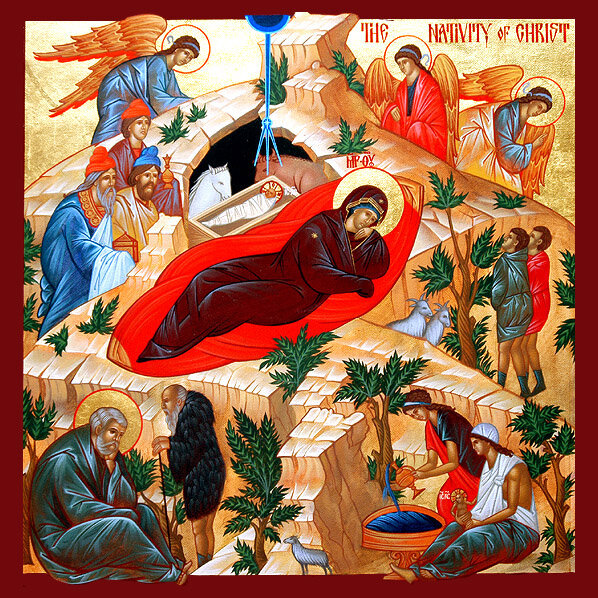
My beloved spiritual children in Christ Our Only True God and Our Only True Savior,
CHRIST IS IN OUR MIDST! HE WAS, IS, AND EVER SHALL BE.
+
THE NATIVITY FAST (November 15-December 24): REPENTANCE, FASTING, AND PRAYER
On Fasting
Saint John Chrysostomos writes:
Do you fast?
Do you fast? Give me proof of it by your works. If you see a poor man, take pity on him. If you see a friend being honored, do not envy him. Do not let only your mouth fast, but also the eyes and the ears and the feet and the hands and all the members of our bodies. Let the hands fast, by being free of avarice. Let the eyes fast, by disciplining them not to glare at that which is sinful. Let the ears fast, by not listening to evil talk and gossip. Let the mouth fast from foul words and unjust criticism. For what good is it if we abstain from fowl and fishes, but bite and devour our brothers and sisters? May He Who came to the world to save sinners strengthen us to complete the fast with humility, have mercy on us and save us.
Also,
"The evil speaker eats the flesh of his brother and bites the body of his neighbor. Because of this Saint Paul utters the fearful saying, 'If you bite and devour one another, take heed that you are not consumed by one another (Galatians 5:15). You have not fixed your teeth in his flesh, but you have harmed in a thousand ways yourself and him and many others, for in slandering your neighbor, you have made him who listens to the slander worse...Besides this, you have struck at the common welfare of the Church herself, for all those who hear you will to only accuse the supposed sinner, but the entire Christian community..."
_______________
Fasting is more than abstaining from eating certain foods, it is actually the struggle between flesh and spirit (soul) that takes place within a Christian believer.
Saint Tikhon of Zadonsk writes that "every Christian hast two births, the old and fleshly, and the spiritual and new, and each is opposed to the other. The fleshly birth is flesh and the spiritual birth is spirit. "That which is born of the flesh is flesh, and that which is born of the Spirit is spirit" (John 3:6).
Because each of these births is opposed to the other then from this arises a conflict and a struggle between a Christian's flesh and spirit. "The flesh lusteth against the spirit, and the spirit against the flesh" (Galatians 5:17). The flesh desires to kill the spirit, and the spirit the flesh. The flesh desires to bring the spirit to submission, and the spirit the flesh. The flesh desires to rule the spirit, and the spirit the flesh...
"...The flesh desires to fornicate and to commit adultery, but the spirit is repelled by it and desires to be chaste...the flesh desires to be malicious, to flatter, to lie, to be crafty, to deceive, and to be hypocritical, but the spirit hates this and desires to be truthful and to be straightforward in all dealings. The flesh desires to hate a man, but the spirit desires to love him...The flesh desires to wander, to be drunk, and to arrange banquets and feasts, but the spirit turns away from this and desires to live either moderately or to fast.
The flesh desires to seek glory, honor, and riches in this world, but the spirit scorns all this and strives only for eternal blessings, and so on...A Christian should live not according to the flesh, but according to the spirit, and should subjugate the flesh to the spirit, according to the Apostolic injunction, "walk in the Spirit, and you shall not fulfill the lust of the flesh" (Galatians 5:16). And this is "to crucify the flesh with the affections and lusts" (Galatians 5:24) "...Abstain from fleshly lusts, which war against the soul" (1 Peter 2:11). "Walk in the newness of life" (Romans 6:4). Let us not allow sin to reign in us, but let us live for Christ "Who died for us, and arose again" (2 Corinthians 5:15).
Beloved Christians, let us see whether we have this warfare, whether we take part in this saving struggle, whether we walk in the newness of life, whether we oppose the inclinations and desires of the flesh, and whether we do not allow sin to reign over us and to rule us. For only those who have "crucified the flesh with its passions and desires" are Christians. What use is it to be called Christians, yet not truly be Christians? It is not the name of Christian that shows the True Christian, but the struggle against the flesh and against every sin. We must not permit the flesh everything it demands. It demands food, it demands drink, it demands clothing, it demands rest, and more: let us give what is needful, but when it desires what is contrary to the will of god and to his law let us not permit it, that we may be Christians not only in name but also in fact. (Source: Journey to Heaven. Counsels on the particular duties of every Christian by Saint Tikhon of Zaconsk)
____________________
"Glory Be To GOD For All Things!" - Saint John Chrysostomos
+++
With sincere agape in His Holy Diakonia (Ministry)
The sinner and unworthy servant of God
+Father George
The Nativity Fast: Repentance, Fasting and Prayer
The Mystery (Sacrament) of Repentance is a grace-giving rite in which, after the faithful offer repentance of their sins, the remission of sins is bestowed by the mercy of God through the intermediary of a pastor (priest) of the Church, in accordance with the Savior's promise.

My beloved spiritual children in Christ Our Only True God and Our Only True Savior,
CHRIST IS IN OUR MIDST! HE WAS, IS, AND EVER SHALL BE.
+
THE NATIVITY FAST: REPENTANCE, FASTING, AND PRAYER
Repentance (Metanoia)
The Mystery (Sacrament) of Repentance is a grace-giving rite in which, after the faithful offer repentance of their sins, the remission of sins is bestowed by the mercy of God through the intermediary of a pastor (priest) of the Church, in accordance with the Savior's promise.
In the Mystery of Repentance, the spiritual afflictions of a man are treated, impurities of the soul are removed, and a Christian, having received forgiveness of sins, again becomes innocent and sanctified, just as he came out of the waters of Baptism. The Mysterion of Repentance is sometimes referred to as "the second baptism." Therefore, the Mystery of Repentance is called a "spiritual medicine."
One's sins, which draw a man downward, which dull his mind, heart, and conscience, which blind his spiritual gaze, which make powerless his Christian will-are annihilated and one's living bond with the Church and with the Lord God is restored. Being relieved of the burden of sins, a man (person) again comes to life spiritually and becomes able to strengthen himself and become perfected in the good Christian path.
The Mystery (Sacrament) of Repentance consists to two basic actions: (1) the confession of his sins before a priest of the Church by the person coming to the Mystery; and (2) the prayer of forgiving and remitting them, pronounced by the priest.
This Mysterion (Sacrament) is also called the Mysterion of Confession (even though the confession of sins comprises only the first, preliminary part of it), and this indicates the importance of the sincere revelation of one's soul and the manifestation of one's sins.
Confession--that is, pronouncing aloud--is the expression of "inward repentance," its result, its indicator. And what is repentance (metanoia)? Repentance is not only "awareness" of one's sinfulness or a simple "acknowledgement" of oneself as unworthy (anaxios); it is not contrition or regret (although all these aspects should enter into repentance). Rather, it is an act of one's "will for correction," a desire and firm intention, a resolve, to battle against evil inclinations; and this condition of soul is united with a petition for God's help in the battle against one's evil inclinations. Such a heartfelt and sincere repentance is necessary so that the effect of this Mysterion (Sacrament) might extend not only to the "removal" of sins but so that there might also enter the opened soul a grace-giving "healing" which does not allow the soul again to become immersed in the filth of sin.
The very uttering aloud of one's spiritual afflictions and falls before a spiritual father--the confession of sins--has the significance that by means of it there are overcome (a) pride, the chief source of sins, and (b) the despondency of hopelessness in one's correction and salvation. The manifestation of the sin brings one already near to casting it away from oneself.
Those who approach the Mysterion of Metanoia (Repentance) prepare themselves for it by an effort of prayer, fasting, and entering deeply within themselves, with the aim of uncovering and acknowledging their sinfulness.
The mercy of God goes out to meet the repenting Christian, testifying through the lips of the spiritual father, that the Heavenly Father does not reject one who comes to Him, just as He did not reject the prodigal son and the repentant publican. This testimony consists of the words of the special prayer and the special words of remission which are pronounced by the Priest. (Orthodox Dogmatic Theology)
As every Orthodox Christian understands the Mysterion (Sacrament) of Repentance/Confession is absolutely necessary for forgiveness of sins and in preparation of receiving the Divine Eucharist, the Holy and Precious Body, and Blood of our Savior.
None of the Mysteria (Sacraments) of the Church should be ever marginalized or disrespected. They were instituted by our Lord Jesus Christ to save us from sin and death, to reconcile us to God and to establish communion with Him.
_______________________
"Glory Be To GOD For All Things!" - Saint John Chrysostomos
+++
With sincere agape in His Holy Diakonia (Ministry)
The sinner and unworthy servant of God
+Father George
November 30 - Saint Andrew the First-Called (Part II)
Stratocles took Maximilla to the prison, where the holy one was kept under the guard of Aegeates' sentries. They entered St. Andrew's cell and fell at the Saint's feet, imploring the Apostle to strengthen and support them in the True Faith of Christ. The holy Andrew exhorted them at length, and, afterward, he ordained Stratocles as Bishop of Old Patras. He then blessed them and sent them on their way to peace. He then sat down, patiently awaiting the judgment of the ungodly Aegeates. The Proconsul, meanwhile, realized that it was impossible to share living quarters with Maximilla, despite his pleadings and threats; and Satan entered his heart and blinded him with anger.

My beloved spiritual children in Christ Our Only True God and Our Only True Savior,
CHRIST IS IN OUR MIDST! HE WAS, IS, AND EVER SHALL BE.
+
ON NOVEMBER 30th OUR HOLY ORTHODOX CHRISTIAN CHURCH COMMEMORATES THE HOLY APOSTLE ANDREW THE FIRST-CALLED (Part II)
Stratocles took Maximilla to the prison, where the holy one was kept under the guard of Aegeates' sentries. They entered St. Andrew's cell and fell at the Saint's feet, imploring the Apostle to strengthen and support them in the True Faith of Christ. The holy Andrew exhorted them at length, and, afterward, he ordained Stratocles as Bishop of Old Patras. He then blessed them and sent them on their way to peace. He then sat down, patiently awaiting the judgment of the ungodly Aegeates. The Proconsul, meanwhile, realized that it was impossible to share living quarters with Maximilla, despite his pleadings and threats; and Satan entered his heart and blinded him with anger.
Enraged, Aegeates ordered that the holy Apostle Andrew be crucified on a cross, his hands and feet bound. He, at first, did not wish him affixed by nails, lest he should die in but a short time; for he thought that by hanging him bound, he might subject him to greater tortures.
"...When he reached the place where he was to be crucified, seeing from some distance the cross being prepared for him, he cried with a loud voice, 'Hail, O cross sanctified by the flesh of Christ and adorned by His members as with pearls!...Take me from among men and give me to my Teacher, that, through thee, He Who redeemed me through thee may receive me."
Thus saying, he removed his clothing and gave it to the torturers. They lifted him up on the cross, nailing and binding his hands and feet with cords; and thus they crucified him head-downward and suspended him. Around him stood a multitude of the people, about 20,000 of them; and among them was also Stratocles, the brother of Aegeates. Saint Andrew strengthened those who believed in Christ and exhorted them to endure transitory sufferings, teaching that no torment can compare with the reward earned by it.
Then Aegeates, fearing the people, went straightway with them to take Andrew down from the cross...When the servants went to unfasten him from the cross, they were unable to touch him. Indeed, a great many other people, one after another, tried to untie him but were unable, because their hands became numb. Thereafter, the holy Andrew cried with a loud voice, 'O Lord Jesus Christ, do not allow me to be taken down from the cross on which I have been suspended for Thy name; but receive me, O my Teacher, Whom I have loved. Whom I have known, Whom I confess, Who I desire to see, through Whom I have become what I am! O Lord Jesus Christ, receive my spirit in peace, for the time has come for me to go to Thee and look upon Thee Whom I have so ardently desired! Receive me, O Good Teacher, and do not permit me to be taken down over-soon from the cross, before Thou receives my spirit!'
When he said this, a light like lightning from heaven illumined him in the sight of all and shined round about him, so that the eye of corrupt man was unable to look upon him. This heavenly Light shined around him for the space of half an hour, and when the Light departed, the holy Apostle surrendered his spirit and departed, amid brilliant Light, to stand before the Lord.
Maximilla, a woman of noble lineage, who lived a virtuous and holy life, when Saint Andrew had departed to the Lord, took down his body with a great honor. She embalmed it with costly ointments and laid it in the tomb in which she herself had intended to be interred.
This took place on the last day of the month of November, in the city of Patras, in Achaia, Greece, where, ever since, through the prayers of the holy Apostle, many benefactions are bestowed upon the people. The fear of God was upon all, and there was no one who did not believe in our God and Savior, Who desires to save all men and lead them to a knowledge of the Truth, to Whom be glory forever. Amen.
When many years had passed, the holy relics of the holy Apostle Andrew were translated by the Martyr Artemios to Constantinople. At the command of the holy Emperor Constantine the Great, and enshrined with those of the holy Evangelist Luke and Saint Timothy, the disciples of the holy Apostle Paul, in the most splendid Church of the Holy Apostles, within the sacred table of oblation.
After 500 years, the most precious skull of the glorious Apostle Andrew was sent by Basil I the Macedonian (867-886 A.D) to the city of Patras, Greece. Mehmed II (1421) during the Ottoman conquest of the Morea (Peloponnesos) gave the sacred skull of St. Andrew to Pope Pius II (1458-1464) in Rome. Then, in September of 1964, the pope returned the precious skull to Patras. The remaining holy relics of the holy Apostle Andrew and those of the Apostles Thomas, Luke, and Timothy were seized by the Crusaders during their conquest of Constantinople in 1204, and they were brought back to Rome.
Through the prayers of Thine Apostle, O Christ God, do Thou establish Thy faithful servants in Orthodoxy, and save us all. Amen.
__________________________
DIVINE SERVICES:
Sunday Evening: Great Vespers at 7:00 p.m.
Monday Morning: Orthros (Matins) at 9:00 a.m.
Monday Morning: Divine Liturgy at 10:00 a.m.
___________________________________
"Glory Be To GOD For All Things!" - Saint John Chrysostomos
+++
With sincere agape in His Holy Diakonia (Ministry)
The sinner and unworthy servant of God
+Father George
November 30 - Saint Andrew the First-Called
Andrew, the First-called holy Apostle of Christ, was the son of a Jew named Jonah and the brother of the holy preeminent Apostle Peter. He was a native of the Galilean town of Bethsaida. Disdaining the vanity of this world and preferring virginity to matrimony, he declined to enter into wedlock; and, hearing that the holy Forerunner John was preaching repentance by the Jordan River, he left everything, went to him, and became his disciple.

My beloved spiritual children in Christ Our Only True God and Our Only True Savior,
CHRIST IS IN OUR MIDST! HE WAS, IS, AND EVER SHALL BE.
+
ON NOVEMBER 30th OUR HOLY ORTHODOX CHRISTIAN CHURCH COMMEMORATES THE HOLY APOSTLE ANDREW THE FIRST-CALLED OF THE TWELVE HOLY APOSTLES
Andrew, the First-called holy Apostle of Christ, was the son of a Jew named Jonah and the brother of the holy preeminent Apostle Peter. He was a native of the Galilean town of Bethsaida. Disdaining the vanity of this world and preferring virginity to matrimony, he declined to enter into wedlock; and, hearing that the holy Forerunner John was preaching repentance by the Jordan River, he left everything, went to him, and became his disciple. Andrew beheld the holy Forerunner while he was pointing to Jesus as He passed by and saying, "Behold, the Lamb of God" (John 1:36). Saint Andrew, together with another disciple of the Forerunner John (whom many consider to have been the Evangelist John), left the Forerunner and followed after Christ. He sought out his brother Simon Peter and said to him, "we have found the Messiah (which is, being interpreted, The Christ") [John 1:41), and brought him to Jesus. Afterward, when he was fishing with Peter off the shore of the Sea of Galilee, and Jesus called to them, saying, "Come after Me, and I will make you fishers of men" (Matthew 4:19). Andrew, immediately leaving his nets when he heard the Lord's summons, followed after Christ with his brother Peter (Matthew 4:20). Andrew is known as the First-called because he became a follower and disciple of Jesus Christ before any of the other holy Apostles.
After the Lord's voluntary Passion and His Resurrection, the holy Andrew, with the rest of the Apostles, received the Holy Spirit. On the day of Pentecost, there appeared to the disciples tongues, as if of fire, being distributed upon each of them (Acts 2:3). When the countries were divided among them, it fell to him by lot to spread the Gospel in Bithynia, the Propontos, Chalcedon, Byzantium, Thrace, and Macedonia, all the way to the Black Sea and the River Danube, as well as the Thessaly, Hellas (Greece), Achaia, Amisos, Trebizond, Herakleia, and Amastris. Saint Andrew passed through these lands and cities, preaching the Christian Faith. In each city, he had to endure much affliction and pain; but, fortified by the Omnipotent help of God, he joyfully bore all such tribulations for Christ's sake.
His next center of activity was the city of Byzantium, where he performed miracles in abundance and instructed many in the knowledge of God. Instead, the people of Byzantium not only embraced the Light of the Truth but even erected a magnificent church in honor of the All-Holy Theotokos. As bishop for them, Andrew consecrated Stachys, one of the Seventy Apostles [Romans 16:9]. He traveled next to Herakleia of Thrace, which is situated to the West of Byzantium; and there he converted many to the Orthodox Faith, and ordained Apelles bishop [Romans 16:10].
The holy Andrew undertook Apostolic labors and endured pangs in the spreading of the Gospel of Christ. He passed on through Pontus, the seaboard of the Black Sea, Scythia, and the Chersonese. By God's Providence, he reached the River Dnieper in the land of Russia, and halting upon the shore beneath the hills of Kiev, he lay down to rest. When he arose from sleep in the morning, he said to his disciples who had accompanied him, "Believe me on these hills the grace of God will shine forth. There will be a great city here, and the Lord will raise many churches in this place and enlighten all of the Russian lands with holy Baptism." And ascending the hills, the Saint blessed them and set up a cross, prophesying that the people who dwelt there would receive the Faith from the Apostolic see he had established in Byzantium.
After passing through many lands, he reached the Peloponnesos, and, entering the Achaian city of Patras, he lodged with a certain respected man by the name of Sosios. He raised him up from his bed of sickness, and afterward, he converted the whole city of Patras to Christ.
At that time, Macimilla, the wife of the Proconsul Aegeates, fell prey to a grievous affliction of the eyes. Though she visited every physician, she revived no benefit from their ministrations. Aegeates, observing his wife's decline, fell into despair. One of his household, however, remembered the Apostle; for he himself had received healing at his hands earlier. Thus, he hastened and besought the Apostle's help of this master's wife. The Saint then came and placed his hand upon her, and her health was restored forthwith, and she rose up from her couch.
When Aegeates beheld this miracle, he went and brought forth a great sum of money and laid it at the feet of the Saint. Kneeling, he begged the holy one to accept this offering in gratitude for the healing. The Apostle, however, refused the money. He desired only the repentance of the people of Achaia and Patras; and thus he declined to accept any recompense. He said to Aegeates, "Our Teacher has said, "Freely you received, freely give" (Matthew 10:8). He then taught him many other things before he departed.
Shortly thereafter, the aforementioned Proconsul Aegeates went to Rome to appear before Caesar to submit a report of his administration and to receive further orders. Now, Stratocles, his brother, was a man of wisdom. In Aegeates' absence, he journeyed to the city of Patra to act as administrator. Traveling with him was a trusted servant whom he loved as a brother. But at this time, the servant suffered a violent epileptic seizure. This greatly distressed Stratocles for no physician was able to help the unfortunate one. When the sister-in-law, Maximilla, learned of this, she invited him to her home and said, "We have here in this city a foreign doctor, by the name of Andrew, who heals every sickness and charges no fee. If you will go to him, I am confident that he will cure your servant of this ailment immediately. The wise and learned Stratocles of Athens then summoned the Saint, and as soon as the Apostle entered his house--behold the miracle!--the demons departed and the servant recovered his health. When Stratocles and Maximilla beheld this miracle, they wasted no time disavowing their former pagan religion, and they glorified the True God and became Christians. They were baptized by the holy Apostle Andrew and cleaved unto him inseparably, desiring to hear his every word and teaching on the Christian Faith.
It was not long before Aegeates returned from Rome, however, Maximilla wished to avoid all association with her unconverted husband, but it was impossible for her to keep her secret forever. Certain servants approached him and said, "From the days of thy departure to Rome until this present moment, she has not taken her regular meals, but has kept a strict fast. Yes, and she utters blasphemies against our deities, preferring the worship the Christ preached by the stranger, Andrew. When Aegeates, heard this, he began to act like a man who had lost his mind, uttering insults and threats against the Lord's Apostle. He ordered his guard to arrest the Saint, while he considered what manner of death he should inflict upon him. (Source: The Great Synaxaristes of the Orthodox Church)
(To be continued)
____________________________
DIVINE SERVICES FOR THE FEAST OF SAINT ANDREW:
Great Vespers on Sunday, November 29th at 7:00 p.m.
Orthros on Monday, November 30th at 9:00 a.m.
Divine Liturgy at 10:00 a.m.
____________________________
"Glory Be To GOD For All Things!" - Saint John Chrysostomos
+++
With sincere agape in His Holy Diakonia (Ministry)
The sinner and unworthy servant of God
+Father George