
December 20 - Holy Hieromartyr Ignatios the God-bearer
Ignatios, our divine and God-bearing Father, was Bishop of Antioch during the reign of Emperor Trajan (98-117 A.D.). He was known as Theophoros, that is, "God-bearer" or "God-borne." This Saint is said to have been the small child taken into the holy hands of the Master Christ and set in the midst of His disciples. Jesus then said, "If anyone doth wish to be first, he shall be last of all and servant of all." And He took a little child and set him in their midst. And after He took him into His arms, He said to them, "whosoever shall receive one of such little children in my name, receiveth me; and whosoever shall receive me, receiveth not me, but the One Who sent Me forth" (Mark 9:35-37). Holy Tradition maintains that the Master most clearly manifested the seven-year-old lad's future progress and proficiency in the Apostolic Teaching.

My beloved spiritual children in Christ Our Only True God and Our Only True Savior,
CHRIST IS IN OUR MIDST! HE WAS, IS, AND EVER SHALL BE.
+
ON THE 20TH OF DECEMBER, THE HOLY ORTHODOX CHRISTIAN CHURCH COMMEMORATES THE HOLY HIEROMARTYR IGNATIOS THE GOD-BEARER
Ignatios, our divine and God-bearing Father, was Bishop of Antioch during the reign of Emperor Trajan (98-117 A.D.). He was known as Theophoros, that is, "God-bearer" or "God-borne." This Saint is said to have been the small child taken into the holy hands of the Master Christ and set in the midst of His disciples. Jesus then said, "If anyone doth wish to be first, he shall be last of all and servant of all." And He took a little child and set him in their midst. And after He took him into His arms, He said to them, "whosoever shall receive one of such little children in my name, receiveth me; and whosoever shall receive me, receiveth not me, but the One Who sent Me forth" (Mark 9:35-37). Holy Tradition maintains that the Master most clearly manifested the seven-year-old lad's future progress and proficiency in the Apostolic Teaching.
The blessed Ignatios became a disciple of the divine Evangelist John. Together with the sacred Polycarpos, commemorated by the Holy Church on the 23rd of February, who became Bishop of Smyrna. Ignatios was ordained to the Priesthood by the Holy Apostles. Thereafter, he was voted by them to become Bishop of Antioch. The divine Ignatios was instructed in all knowledge of the Faith and in every virtue by the Sacred Apostles. As zealous disciple of the Apostles, he underwent much suffering and persecution while heralding the word of the Faith. He ever showed himself to be a minister (diakonos) of Christ's mysteries and teacher to the nations.
The Saint loved the spiritual gatherings, when the faithful came together to celebrate the Divine Liturgy. He especially took spiritual delight in the chanting of psalms and hymns by the congregation. Saint Ignatios, third bishop of Antioch in Syria from the Apostle Peter, saw a vision of Angels hymning the Holy Trinity in alternate chants. Accordingly, he introduced the mode of chanting he had observed in the vision into the Antiochian Church; whence it was transmitted by tradition to all the other Churches...
"...During his reign, Trajan the pagan emperor engaged in a fierce war against the Christians. He attempted to compel them to pay homage to his pagan gods whom he believed has assisted him in gaining significant military victories. Epistles were dispatched to all the cities of the empire stating that, if the Christians refused to offer sacrifice to the idols, they were to suffer bitter punishment and then a pitiless death...
"...It was at this time that Saint Ignatius, engaged in his Pastoral duties, was reported to Emperor Trajan. The emperor was informed that the bishop was teaching the people to venerate the God Who of late had been crucified and suffered an evil death. Trajan also learned that Ignatios was exhorting the people to preserve their virginity (chastity) and to despise ease, comfort, and every sweet delight of this life. He received intelligence that the worst crime of Ignatius was his contempt for the deities and imperial ordinances. Trajan immediately sent to have Ignatius brought before him. Trajan, as seen on his commemorative column memorializing his victory in the Dacian Wars, was a tall and distinctive figure. He was energetic for a sixty-year-old man and was accustomed to suffering hardship and danger with the men under his command. As for Saint Ignatius, he was a man of Apostolic character in every way. He had been governing the Church of the Antiochenes during the storm of persecutions, even from the time of Domitian (81-96 A.D.). As a good pilot, he held the helm of the Church by means of prayer, fasting, assiduous teaching, and spiritual earnestness. He withstood the enemy's surge to gain the faithful, lest the helm lose any of the fainthearted or over-simple. Though there was a period of tranquility for the Church and the persecution abated somewhat, Saint Ignatius still thought to himself that since he had not suffered martyrdom, he had not yet attained to the complete rank of a disciple or shown true love toward Christ. He believed that martyrdom should attach him more closely to His Lord. God dispensed otherwise all those years, so that the holy Bishop should remain with the flock, as a lamp illuminating the minds of the faithful by his exposition of the sacred scriptures. Nevertheless, it was the Saint's ardent prayer that he make his confession by martyrdom. Now Trajan, being full of himself after gaining the military victory over the Dacians, was put out that the Christians were the only people not in complete subjection (a contemporary attitude of the secular state), unless they submitted to the service of the idols (currently i.e., wealth and pleasure), or more correctly, the devils. Therefore, the pious were constrained either to offer sacrifice or to die. Saint Ignatius, refusing such vile homage, therefore came forth of his own free will before Trajan.
As the two stood face to face, Trajan asked, "Who art thou, thou wretch of a devil, that art so ready to disobey our royal orders, whilst thou seduces others also, that they may come to an equally bad end?" Saint Ignatios answered, "No one who bears God can be called a wretch of a devil. I say this, on the one hand, because the devils stand aloof from the slaves of God, but, on the other hand, if thou sayest this because I am troublesome to the devils, then I concur. For since I have the heavenly King Christ, I confound the devices of the devils." Trajan said, "And who is he that bearest God?" Saint Ignatios answered "The one who has Christ in his heart." Trajan asked, "Dost thou not think then that we too have gods in our hearts, since we have them as allies against our enemies?" Saint Ignatios replied, "Thou art deceived when thou callest the demons of the nations gods. There is one God Who created the heaven and the earth and the sea and all things that are therein, and one Christ Jesus, the Only-begotten Son of the God and Father, Whose friendship I would be prepared to take risks to enjoy...
"...At a pagan holiday, the people assembled from all over. They converged in the Capital not only for the festival but also for a look at the holy man whose fame had spread abroad in every place. All knew that the Christian Archbishop of Antioch was to be shown and devoured by wild beasts. The crowds that attended to witness the spectacle were without number. The holy man of God was often escorted into the theater. The Saint then turned without hesitation to the multitude of spectators. Possessed of a valiant and fearless mind, he addressed them: "Men of Rome, witnesses of my contest: you need to know that neither have I committed a criminal act, nor have I transgressed in anything that is deserving of death. I, however, receive this sentence today voluntarily, gladly, and with rejoicing, that I might attain to the True God for Whom I thirst and yearn to enjoy; inasmuch as I am God's wheat, ground fine by the teeth of wild beasts that I might become pure and unblemished bread."
After the Saint addressed the crowd, the executioners released the lions. Even as Saint Ignatios had desired and entreated God, the lions caught sight of him, sprang upon him, and devoured the holy bishop. The creatures left only his large bones; therefore the bellies of the wild animals became his tomb. After the crowds dispersed from the theater and departed, the Christians remained behind that they might take up and bury the holy man's relics with honor and reverence. The holy relics were interred in a distinguished place on the 20th day of December. With the passage of time, the holy relics of Saint Ignatius were returned to Antioch. In the Synaxaristes of the Russians, from the codices at the Vatican Library in Rome, it is written that the lions left the heart of the Saint. The soldiers observing that the bishop's heart remained unharmed, cut open that organ, then--o the wonder!--they found an inscription of God written within, showing the name "Jesus Christ." Thus, we see that the Saint was true to his name God-bearer, in both the passive and active sense. The translation (anakomide) of the holy relics of Saint Ignatios is commemorated by the Holy Church on the 29th of January. He was buried in Daphne, and later, having been wrapped in linen removed to Antioch by Emperor Theodosios II (408-450 A.D.). Thus, an inestimable treasure was left to the Holy Church. When the Moslems captured the city of Antioch in 637 A.D., the holy relics of Saint Ignatios were moved to several places for safekeeping.
It is remarked upon that, at his martyric repose, the faithful wept at their loss of him. Their wailing was inconsolable as they devoted their time about his tomb, keeping vigil and chanting continually at the site. Now Saint Ignatios appeared to them in a vision. He embraced them and encouraged them, saying, "Cease lamenting, but rather rejoice." In this manner, he softened their pain and suffering. On other occasions, the faithful beheld him perspiring, even as he had undergoing the struggle of his martyric contest, and offering prayer for the salvation of the city and for all the Christians. (Source: The Great Synaxaristes of the Orthodox Church)
______________________
"Glory Be To GOD For All Things!" - Saint John Chrysostomos
+++
With sincere agape in His Holy Incarnation,
The sinner and unworthy servant of God
+Father George
The Nativity of Our Lord and Savior Jesus Christ: "Judge not..."
Saint Anthony the Great writes, "If you see your brother sin, do not disparage him, do not reject him and do not condemn him. Otherwise you will end up in your enemies' (Satan's) hands. Do not judge any mortal being lest the Lord should dismiss your prayers."

My beloved spiritual children in Christ Our Only True God and Our Only True Savior,
CHRIST IS IN OUR MIDST! HE WAS, IS, AND EVER SHALL BE.
+
THE NATIVITY OF OUR LORD AND SAVIOR JESUS CHRIST: "JUDGE NOT, THAT YE BE NOT JUDGED" (Matthew 7:1).
Saint Anthony the Great writes, "If you see your brother sin, do not disparage him, do not reject him and do not condemn him. Otherwise you will end up in your enemies' (Satan's) hands. Do not judge any mortal being lest the Lord should dismiss your prayers."
Abba (Father) Dorotheos writes: "Who troubles, judges and does harm than demons? So, it turns out, we help demons to ruin both our lives and the lives of our neighbors. Why does this happen? It happens because we have no charity. "For charity shall cover the multitude of sins" (1 Peter 4:8). Saints do not condemn one who sins, nor do they reject him, but rather sympathize with him, they are sorry for him, they instruct and comfort him, they heal him as if he were an ailing man, and do everything to save him."
Prayer of Saint Ephraim the Syrian
"Lord, grant me to see my own failings, and not to judge my brother (or sister).
Do not mock or judge someone who has fallen into sin, but rather pray lest you fall into sin. Do not pamper anyone while he is alive and do not lose hope in him before he dies. Do not laugh at one who has sinned, rather set him on his feet."
As we, as Orthodox Christian believers, continue on our spiritual journey to meet our Lord and Savior, as the shepherds and magi did on that Holy Day of His Birth, we must first examine our heart and free it from any impurity that has been collected there perhaps from previous years. One of the most serious sins which we may have committed, as a "self-righteous" individual, is to pass judgment on another person.
Our Lord Christ is very clear in his famous Sermon n the Mount: "Do not judge others so that you yourself will not be judged. For with judgment you judge, you will be judged, and with the measure you use, it will be measured back to you" (Matthew 7:1-2).
Jesus admonishes us and says, "Why do you look at the speck in your brother's eye, but do not see the plank in your own eye...you hypocrite. First remove the plank from your eye!" (Matthew 7:3-5).
We all need to have discernment and discernment is acquired, above all, by examination of oneself and one's own sins rather than those of others. And preoccupation with the sins of others may lead to blindness to one's own sins. We should not, however, confuse judging with condoning. We absolutely not judge our fellow man but we must not condone and approve sinful or evil conduct or actions. In other words "love the sinner but hate the sin."
We, as followers of Christ God, live in a world which condones all evil and condemns that which is good and holy. The world, as always, disagrees with the commandments of God and makes every effort to overturn and discourage anyone from following them or living by them. The secular world is a Godless world. A world without Divine Commandments, without faith, without Christian values, without ethics, without morality, without love, without self-control, without justice, without human dignity, without true peace, without harmony, without self-respect, without any accountability for evil actions, without God.
The Christian, the true Christian, is one who is obedient only to God, his Creator. He or she is one who follows His Teachings faithfully. He dedicates his life to following God's law in a very sincere and respectful manner.
Agape (love) and humility are the wings that lead to Paradise, Saint Kosmas Aitolos declared. We must love one another, even for those who have made wrong choices and fallen away from God. A humble and kind spirit reminds us that we are the ones who need to repent and turn back toward our Lord. We must never judge others, but we must judge ourselves and our actions. All good is from God, not us. And therefore all glory and praise goes to His Name!
Although everyone is distracted with the pandemic and even the political unrest within our country, we must not neglect our spiritual preparation for the Coming of the Savior of the world, and the celebration of His Holy Birth on earth. His Birth is the birth of Love, of Hope, of Peace, of reconciliation, of forgiveness, of regeneration, of restoration, of healing, of justice, of righteousness, of salvation and of the inheritance of His Eternal Kingdom.
"Glory to God in the highest, And on earth peace, good will toward men!" (Luke 2:14).
__________________________
"Glory Be To GOD For All Things!" - Saint John Chrysostomos
+++
With sincere agape in His Holy Incarnation,
The sinner and unworthy servant of God
+Father George
With My Own Eyes
My former fellow-prisoner the Romanian Orthodox Deacon John Stanescu, suffered in jail for his faith. Colonel Albon, director of the slave labor camp, was informed that someone had dared to preach in a cell. He entered the cell carrying a cane and demanded to know the culprit. When no one responded he said, "Well, then all will be flogged."

My beloved spiritual children in Christ Our Only True God and Our Only True Savior,
CHRIST IS IN OUR MIDST! HE WAS, IS, AND EVER SHALL BE.
+
WITH MY OWN EYES
By Pastor Richard Wurmbrand
[Pastor Richard Wurmbrand is an evangelical minister who spent fourteen years in Communist imprisonment and torture in his homeland of Romania. In 1945, when the Communists seized Romania and attempted to control the churches for their purpose, Richard Wurmbrand immediately began an effective "underground" ministry to his enslaved people and the invading Russian soldiers. He was eventually arrested in 1948. Richard spent three years in solitary confinement, seeing no one but his Communist torturers. Pastor Wurmbrand was released in a general amnesty in 1964. What follows is a small part of the many experiences he had with Orthodox clergy while he was imprisoned.]
My former fellow-prisoner the Romanian Orthodox Deacon John Stanescu, suffered in jail for his faith. Colonel Albon, director of the slave labor camp, was informed that someone had dared to preach in a cell. He entered the cell carrying a cane and demanded to know the culprit. When no one responded he said, "Well, then all will be flogged."
He commenced at one end of the cell, and there was the usual yelling and rising in tears. When he came to Stanescu, he said, "Not ready yet? Strip this minute!"
Stanescu replied, "There is a God in heaven, and He will judge you."
With this, his fate was sealed. He would surely be beaten to death. But just at that moment, a guard entered the cell and said, "Colonel, you are called urgently to the office. Some generals have come from the Ministry."
Albon left, saying to Stanescu, "We will see each other again soon." However, the generals arrested the colonel (Communists hate and jail each other for no reason), and after an hour Albon was back in the cell, this time as a prisoner.
Many inmates jumped to lynch him. Now Stanescu defended the defeated enemy with his own body, receiving many blows himself as he protected the torturer from the flogged prisoners. Stanescu was a real priest.
Later I asked him, "Where did you get the power to do this?" And he replied, "I live Jesus ardently. I always have Him before my eyes. I also see Him in my enemy. It is Jesus who keeps him from doing even worse things." Beware of a faith without a cross!
When I was in jail I fell very, very sick. I had tuberculosis of the whole surface of both lungs and four vertebra were attacked by tuberculosis, diabetes, heart failure, jaundice, and other sicknesses I can't even remember. I was near to death.
At my right hand was an Orthodox priest by the name of Iscu. He was Abbot of a monastery. This man, perhaps in his 40's, had been so tortured he was near to death. But his face was serene. He spoke about his hope of heaven, about his love of Christ, about his faith. He radiated joy.
On my left side was the Communist torturer who has tortured this priest almost to death. He had been arrested by his own comrades.
And so it happened that the Communist torturer who had tortured this priest nearly to death had been tortured nearly to death by his comrades. And he was dying near me. His soul was in agony.
During the night he would awaken me saying, "Father please pray for me. I can't die, I have committed such terrible crimes."
The I saw a miracle. I saw the agonized priest calling two other prisoners. And leaning on their shoulders, slowly, slowly, he walked past my bed, sat on the bedside of his murderer, and caressed his head--I will never forget this gesture. I watched a murdered man caressing his murderer! That is love - he found a caress for him.
The priest said to the man, "You are young; you did not know what you were doing. I love you with all my heart." But he did not just say the words. You can say "love," and it's just a word of four letters. But he really loved. "I love you with all my heart."
Then he went on, "If I who am a sinner can love you so much, imagine Christ, Who is Love Incarnate, how much He loves you! And all the Christians whom you have tortured, know that they forgive you, they love you, and Christ loves you. He wishes you to be saved much more than you wish to be saved. You wonder if your sins can be forgiven. He wishes to forgive your sins more than you wish your sins to be forgiven. He desires for you to be with Him in heaven. He is love. You only need to turn to him and repent."
In this prison cell in which there was no possibility of privacy, I overheard the confession of the murderer to the murdered. Life is more thrilling than a novel - no novelist has ever written such a thing. The murdered - near to death - received the confession of the murderer. The murdered gave absolution to his murderer.
They prayed together, embraced each other, and the priest went back to his bed. Both men died that same night. It was Christmas Eve. But it was not a Christmas Eve in which we simply remembered that 2000 years ago Jesus was born in Bethlehem. It was a Christmas Eve during which Jesus was born in the heart of a Communist murderer.
These are the things I have seen with my own eyes...
Christ is born; glorify Him! Christ comes from Heaven; go to meet Him! Christ is on earth; be exalted! Sing to the Lord, all the earth! And praise Him in gladness, O people; for He has been glorified! (Source: Orthodox Heritage)
_________________________
"Glory Be To GOD For All Things!" - Saint John Chrysostomos
+++
With sincere agape in His Holy Diakonia (Ministry)
The sinner and unworthy servant of God
+Father George
On Proper Fasting...
Bodily purity is primarily attained through fasting, and through bodily purity comes spiritual purity. Abstinence from food, according to the words of the son of grace, Saint Ephraim the Syrian, means: "Not to desire or demand much food, either sweet or costly; to eat nothing outside the stated times; not to give oneself over to gratification of the appetite; not to stir up hunger in oneself by looking at good food; and not to desire one or another sort of food."

My beloved spiritual children in Christ Our Only True God and Our Only True Savior,
CHRIST IS IN OUR MIDST! HE WAS, IS, AND EVER SHALL BE.
+
ON PROPER FASTING...
Bodily purity is primarily attained through fasting, and through bodily purity comes spiritual purity. Abstinence from food, according to the words of the son of grace, Saint Ephraim the Syrian, means: "Not to desire or demand much food, either sweet or costly; to eat nothing outside the stated times; not to give oneself over to gratification of the appetite; not to stir up hunger in oneself by looking at good food; and not to desire one or another sort of food." There is a great fallacy that abstinence from food and the eating of fasting foods are harmful to physical health. It is a known fact that those who fast are the longest-lived and the least prone to sickness. The holy Prophet Daniel and the Three Holy Children offer us an example of this. When the King commanded his eunuch to feed the young men on meat from the royal table, and give them good wine to drink, Daniel told the eunuch that they were not willing to take the meat and wine form the king's table, but wanted only herbs (for Daniel did not want to eat meat sprinkled with blood from the idolatrous sacrifices). But the eunuch was afraid that the young men would be weakened by the fasting food, and spoke of his fear to Daniel. Then the Prophet suggested that he make a test, to see whether the fasting food would weaken them or not: to give food from the king's table to the other young men at court, but to feed these four only on herbs for ten days, and then compare them. The eunuch did what Daniel advised. After ten days, the faces of the four young fasters were fairer and their bodies stronger than those of the Babylonian youth, who had eaten and drunk from the king's table. (The Prologue from Ochrid)
Thanks be to God!
+Father George
Are We Christians Without Christ?
When one holds a discussion with pseudo-Christians about hard asceticism of the body and spirit for the love of Christ, they become angered, calling you a hoaxer, a pagan or a barbarian.
If you want to test the faith of a Christian, talk to them about asceticism. The faithful will feel compunction, while the lukewarm, those who are fake and faithless, will protest.
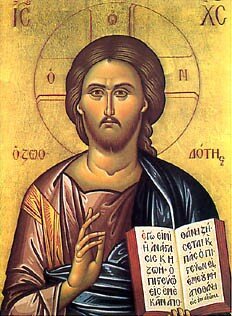
Christ the Lifegiver
My beloved spiritual children in Christ Our Only True God and Our Only True Savior,
CHRIST IS IN OUR MIDST! HE WAS, IS, AND EVER SHALL BE.
+
ARE WE CHRISTIANS WITHOUT CHRIST?
By Photios Kontoglou
When one holds a discussion with pseudo-Christians about hard asceticism of the body and spirit for the love of Christ, they become angered, calling you a hoaxer, a pagan or a barbarian.
If you want to test the faith of a Christian, talk to them about asceticism. The faithful will feel compunction, while the lukewarm, those who are fake and faithless, will protest.
What is then one to make of the following proclamations by Christ? "Blessed are they who have left all and followed Me, or the Kingdom of heaven suffers violence, and the violent take it by force, or In the world you will have sorrow, or Tight is the gate and narrow is the way that leads to life."
We want to be Christians without Christ, without spiritual sorrow, without lifting the difficult cross, and would rather walk along the wide road. Such false Christians, when you speak to them about a hard and impoverished life, about sacrifice, about asceticism, reply that Christ does not want such things, and that such things are antics.
But, O foolish man, in Christianity nothing can be overdone. For all human things one could say they are antics, but it is only within Christianity that antics do not exist. What antic is there in loving the one who killed your father? What antic is there in turning the other cheek? What antic is there in hungering and thirsting contempt, in doing what God asks of you, such as loving your neighbor, talking sweetly to one swearing at you, not judging the one who judges you, to be humble before the most destitute people, and while doing all these things you say that you are a worthless slave?
What antic is there in believing that our bodies will be raised as immortal at the blink of an eye, and how the whole world will change at once, and that a new world without corruption will come about? So is there anything in Christianity that is an antic?
Christianity is the most implausible of all that is outrageous, the most unbelievable of all things unbelievable.
This is why the door by which one enters the exotic country of Christ is only one--Faith. And in Faith there are no antics; unbelief, on the other hand, has sly prudence, moderation and compromise. This is why such pseudo-Christians cannot withstand the fire of Faith and have turned Christianity into a moral system, beneficial for worldly life, which is why it does not entirely need Christ Because the unbeliever is scared, but whoever believes is "bold as a lion," according to the Prophet.
Whoever loves God, is ablaze without showing it, rejoices without laughing, is crushed in the depths of their selves. The love taught to us by Christ is something else besides so-called philanthropy. This is why philanthropists do not taste of the love of Christ, which is "water that wells with eternal life." The philanthropy people make today is a social debt. These philanthropists, and whoever is a practical person, are not Christians.
Whoever loves Christ and His Gospel, loves that which is worth loving above everything else. In Christ they can find all worthwhile things: love (agape), humility, pain, gentleness, spiritual sorrow and spiritual joy--which are both sweet when done in the name of Christ.
"Come unto Me all of you who labor and are heavy laden, and I will give you rest." Give us rest? We do not want to even hear it. We want to be saddled with our passions, with our enemies, with our wars, with our cares for ambition, for the flesh, with contaminated blood, with pistols, with cannons, with bombs. What will we do without these things, Mr. Peacemaker? How can we live in rest? With what will we fill our emptiness, since for us life is only these things?
You give us peace, but peace is our death, because it is the death of our beloved passions! If You said "I will load you with other such burdens, that you do not recognize; I will enrich your souls with other such riches, that you may have no peace."
People nowadays want gods that will load us, vindictive ones, like Aries, Zeus, Cronos and deceivers like Hermes, and others. They want to live in wickedness, for it is alive and strong.
Yes, "come Lord!" cries out John with joy to Him who comes on the clouds at the Second Coming. You musts be a saint, righteous and perhaps like John in order to rejoice at the coming of Christ and wait for Him. We, on the other hand, cry out "do not come Lord." Because we are sinners, and the wrath of the Lord is coming upon us.
"...All of us fear that You will come "as a thief in the night." If you curse or slander people, or if you write something bad to them, there will come a time when they will forgive you. (Will they? Unlikely, brother, forget it!). One who does not forgive you for such a deed will hate you, and they live in such a way that they are embarrassed about their own life; may the voyage of your life be a rebuke of their own. Whoever has wholeheartedly tasted Christ's peace does not torture himself for being poor, since they willfully desire and accept poverty; such a person loses his joy when he acquires something beyond what is needed, even if it is the most worthless thing. And whatever is humble and poor and prudent, they love it secretly within their heart without saying anything to anyone, because "the humble people always love silence and obscurity. (Source: Orthodox Heritage)
(To be continued)
_______________________
"Glory Be To GOD For All Things!" -- Saint John Chrysostomos
+++
With sincere agape in His Holy Diakonia (Ministry)
The sinner and unworthy servant of God
+Father George
December 17 - Holy Prophet Daniel and the Three Children: Ananias, Azarius and Misael
All four of them were of the Royal Tribe of Judah. When Nebuchadnezzar destroyed and plundered Jerusalem, Daniel, as a boy, was taken off into slavery together with Jehoiachin, King of Judah, and many other Israelites. The account of his life, sufferings and prophecies can be found in detail in his book. Utterly given to God, Daniel from his early youth received from God the gift of great discernment. His fame among the Jews in Babylon began when he denounced two lecherous and unrighteous elders, and saved the Babylonians stemmed from the day when he solved and interpreted the dream of King Nebuchadnezzar.

My beloved spiritual children in Christ Our Only True God and Our Only True Savior,
CHRIST IS IN OUR MIDST! HE WAS, IS, AND EVER SHALL BE.
+
ON DECEMBER 17th OUR HOLY ORTHODOX CHRISTIAN CHURCH COMMEMORATES THE HOLY PROPHET DANIEL AND THE THREE CHILDREN: ANANIAS, AZARIAS AND MISAEL

All four of them were of the Royal Tribe of Judah. When Nebuchadnezzar destroyed and plundered Jerusalem, Daniel, as a boy, was taken off into slavery together with Jehoiachin, King of Judah, and many other Israelites. The account of his life, sufferings and prophecies can be found in detail in his book. Utterly given to God, Daniel from his early youth received from God the gift of great discernment. His fame among the Jews in Babylon began when he denounced two lecherous and unrighteous elders, and saved the Babylonians stemmed from the day when he solved and interpreted the dream of King Nebuchadnezzar. For this, the king made him a prince at his court. When the king made a golden idol in the Plain of Dura, the Three Children refused to worship it, for which they were cast into the burning fiery furnace. But an Angel of God appeared in the furnace and soothed the flames, so that the Children walked in the furnace untouched by the fire, and sang: "Blessed art Thou, Lord God of our fathers!" The king saw this wonder (miracle), and was amazed. He then brought the Children out of the furnace and did them great honor.
In the time of King Belshazzar, when the king was eating and drinking with his guests at a feast out of consecrated vessels taken from the Temple in Jerusalem, an invisible hand wrote these three words on the wall: "Mene, Tekel, Upharsin". No-one could interpret these words but Daniel. That night, King Belshazzar was killed. Daniel was twice thrown into a den of lions for his faith in the One, Living God, and both times God preserved him alive. Daniel saw God on His Throne with the Angelic Powers, often saw Angels, had insight into the future of certain people, of kingdoms and of the whole human race, and prophesied the time of the Coming of the Savior on earth. According to Saint Cyril of Alexandria, Daniel and the Three Children lived to great old age in Babylon, and were beheaded with the sword for the True Faith. When Ananias was beheaded, Azarias held out his robe and caught his head, then Misael caught Azarias's head and Daniel Misael's. An Angel of God carried their bodies to Judea, to Mount Gebal, and placed them under a rock. According to tradition, these four men arose at the time of the death of the Lord Jesus and appeared to many, then fell asleep again. Daniel is counted as one of the four great prophets (with Isaiah, Jeremiah, and Ezekiel). He lived and prophesied half-way through the thousand years before Christ. (Source: The Prologue from Ochrid)
________________________
"Glory Be To GOD For All Things!" - Saint John Chrysostomos
+++
With sincere agape in His Holy Diakonia (Ministry)
The sinner and unworthy servant of God
+Father George