
The Feastday of our Holy Father Saint Nektarios of Pentapolis
My beloved spiritual children in Christ Our Only True God and Our Only True Savior,
CHRIST IS IN OUR MIDST! HE WAS, IS, AND EVER SHALL BE.
+
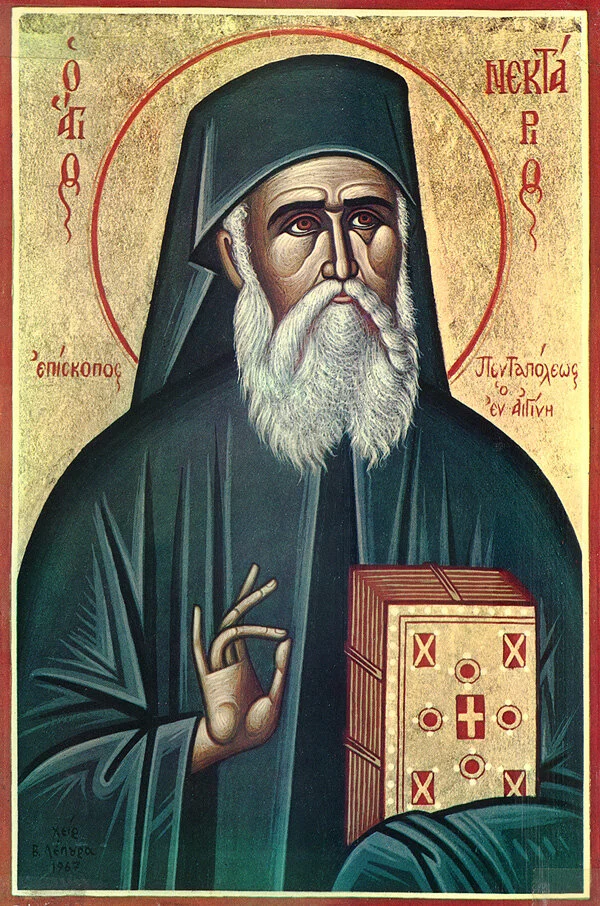
ON NOVEMBER 9th OUR HOLY ORTHODOX CHRISTIAN CHURCH COMMEMORATES OUR HOLY FATHER NEKTARIOS METROPOLITAN OF PENTAPOLIS.
The Holy Orthodox Christian Church shall not cease showing forth Saint until the completion of the age. This is undeniable proof that she is the depository of truth and Holy Tradition, which she observes and preserves free from adulteration, as a precious and sacred trust, and as "a fountain of water springing into eternal life" (Saint John 4:14). This water and bedews her pious children. The Holy Church, therefore, rejoices and speaks multitudinous achievements, virtues, and awesome wonders. Together with those Saints, she appeared luminaries who have become manifest in these times, especially committing sin. These newly-revealed holy ones, by their manner of life, have also shone forth abundantly in the virtues and in performing miracles, glorifying God. We ought to be following their example and imitating their faith, "observing attentively," says Saint Paul, who tread the heavens, "the end of their conduct; for Jesus Christ, the same yesterday, today and forever. Thus, let us cease being carried about by various and strange teachings (cf. Hebrews 13:7-8).
Such a newly-appeared star in the firmament of the Church and a Saint among the Saints is the renowned miracle-worker and illustrious hierarch, Saint Nektarios, Metropolitan of Pentapolis in Egypt. He is the special boast of godly Orthodox Christians, the sweetest nectar of the life of virtue, which gives joy and gladness, though its sanctifying grace, to reverent hearts, rendering them precious vessels of the Holy Spirit. Saint Nektarios is such a repository of grace, for he attained the heights and one preeminent in working miracles, we ardently beg his protection and intercession before God.
The God-bearing hierarch, Saint Nektarios, was born in Selyvria of Thrace. He was born to the pious Demos and Maria Kephalas, on the 1st of October, 1846, being the fifth of six children. In Holy Baptism he was name Anastasios. His father worked hard to provide for his family, laboring at times at sea. At that time Orthodoxy was enslaved by the Ottomans. The Saint's mother and grandmother exercised caution around the Turks, but always maintained hope for a better future. From his earliest youth, when his nails were still soft, he was manifesting how he would develop. He was prudent and wise and proved an obedient son to his parents, who nurtured him in the instruction and admonition of the Lord (Ephesians 6:4), together with all things reverent according to Christ. From his childhood, he avoided hurtful and evil pastimes, games, and associations. His soul, like a sponge, soaked up the streams of his parents' good guidance and instructions. He especially hearkened to the words of his extremely pious mother and grandmother, and to whatever was good and profitable for the soul. Characteristic of his yearning and eager disposition was his learning to recite the 50th (51) Psalm of David, "Have mercy on me, O God..." When he came to the verse which read, "I shall teach transgressors Thy ways, and the ungodly shall turn back unto Thee" (vs. 13), he would pronounce those words twice and even three times. He aspired early on to acquire theological knowledge that he might one day have as his mission the preaching of the Gospel, so that through teaching the law and will of the Lord, as many people as possible might be diverted from the path of lawlessness leading to perdition and be placed on the path of piety, virtue, and salvation.
When he reached the age of seven, he bought some paper and took pleasure in making books. Wishing to know what he was about, his mother inquired, "What art thou doing with the papers, son?" He answered, "I wish, mother, to make a book, that I might write down the words of God." His first lesson in general education was pursued in his hometown as an employee by a relation who had a shop in Constantinople. Since Anastasios' family was poor, he needed to have work in order to continue his education, so he accepted the position. Before his departure, his grandmother had given him a Cross to wear about his neck containing the holy relics of the Precious Cross of Jesus. The Saint left for the ship but had no fare for the ticket. The captain observed the lad, and asked, "Where art thou bound brave boy?" Anastasios replied, "To Constantinople, sir." The captain remarked, teasing, "Well, freeloaders are not welcome in the capital!" Anastasios answered nothing. The captain then gave the orders to put out to sea. The ship's engines, however, would not start. The crew was trying to ascertain the problem, while the captain was ready to break the wheel form his exasperation. Then, his eye caught the weeping Anastasios on the dock. The lad cried out, "Take me, captain, sir". The captain then motioned to him to get on board. The moment Anastasios' feet touched the deck, the engines started and the ship began to move. Later, before his arrival, when it came time for the passengers to show their tickets, Anastasios panicked. One of the passengers took pity on him and paid for his fare.
The man he was to see for his employment had left for Edessa, leaving Anastasios unemployed and homeless. He finally secured backbreaking work with a tobacco processing plant. His pay consisted mostly of his room and board. In the meantime, the young Anastasios' clothes and shoes were becoming worn and falling apart. When he asked his employer for assistance, he was told to write home to his parents. "But they are very poor, sir," Anastasios said. The employer had no time to listen to the youths' dilemma. He then thought he beheld the Lord Jesus Who was asking him why he was weeping. Anastasios attempted to speak to our Savior but was unable. When he arose, he decided to write a letter to Jesus Christ. He took up his pencil and wrote:
"My dearest Jesus: The reason that I am weeping continually is that my clothes and shoes are inadequate for winter. My employer turned me away. I cannot ask my poor family, to whom I have not been able to send even one coin. How shall I manage the deliveries in the bitter cold? I have mended my clothes many times, but they keep tearing. Forgive me for burdening Thee with this problem, but it is Thee Whom I worship and in Whom I have my hope. Thy faithful slave, Anastasios."
He addressed an envelope, writing: "To our Lord Jesus Christ in the Heavens." He then left early to post it. On the way, he was seen by the shop owner, Themistocles, whose store was opposite the tobacco establishment. "Where are you going so early, my Anastasios?" Themistocles asked, "To the post office, sir," Anastasios told him, "No need," said the man; "I shall post it for you. I see you are shivering in this cold, so return to the shop." Anastasios thanked him. The shop owner happened to look at Anastasios' envelope, and the name of the Addressee caught his immediate attention. Startled, he said, "O my! How can this be posted? In what desperate straits does that good lad find himself? He then took it upon himself to pause and open the envelope. He was so touched at the lad's words that he went and prepared a parcel with warm clothing, shoes, underwear, and some spending money. He then posted it, addressing it to Anastasios Kephalas at the tobacco shop. A note was placed inside, upon which was written the following message: "Christ to Anastasios." The parcel was delivered, to the boundless joy and gratitude of the child. His employer, however, suspected him of theft. He began beating him and calling him a thief. Anastasios kept trying to explain, but his boss kept striking him. The shopkeeper, who had received Anastasios' letter, happened to be passing by. He heard the commotion and came rushing to the boy's aid. The employer then desisted, fearing to create a fuss, which would certainly attract the attention of the Turkish authorities. Soon afterward, Anastasios was offered work at another shop, that of Themistocles, which he accepted. He stayed at his new establishment for a considerable time, finding decent conditions and time to study. (Source: The Great Synaxaristes of the Orthodox Church)
(To be continued)
DIVINE SERVICES FOR THE FEAST OF ST. NEKTARIOS:
Tonight, Friday, November 8th: Great Vespers and Holy Unction at 7:00 p.m.
Tomorrow, Saturday, November 9th:
Orthros at 9:00 a.m.
Divine Liturgy at 10:00 a.m.
Place of worship: Saint Nektarios Chapel
______________________________
"Glory Be To GOD For All Things!" -- Saint John Chrysostomos
+++
With sincere agape in His Holy Diakonia (Ministry),
The sinner and unworthy servant of God
+Father George