
The Feastday of our Holy Father Saint Nektarios of Pentapolis (Part II)
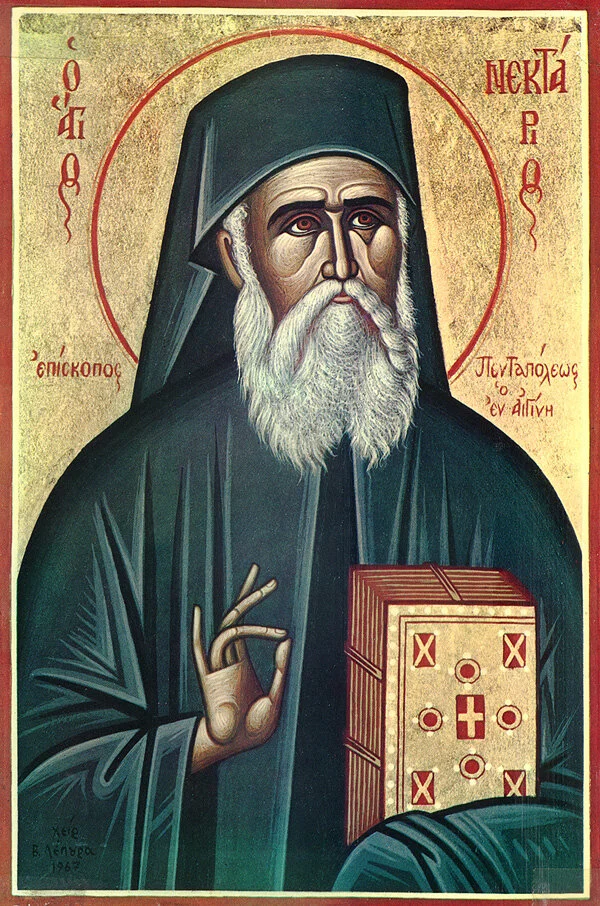
My beloved spiritual children in Christ Our Only True God and Our Only True Savior,
CHRIST IS IN OUR MIDST! HE WAS, IS, AND EVER SHALL BE.
+
THE LIFE OF SAINT NEKTARIOS, METROPOLITAN OF PENTAPOLIS IN EGYPT (Part II)
After working at Themistocles' store, Anastasios eventually found employment as a youth instructor at a school, which was a possession under the jurisdiction of the Holy Sepulcher. When Anastasios Kephalas reached twenty years of age, he received a letter of recommendation from the director of the school. He also accepted an appointment from Metropolitan Gregory, as a teacher in the village of Lythion on the island of Chios, Greece. His family had already moved to the island, so he prepared for his trip and a new post.
At Chios, he remained in that teaching position for seven years. He not only was teaching his pupils but also influenced and persuaded the villagers to pursue piety and virtue, which he was able to show them by his own example. His godly manner of life was simple, frugal, and rather ascetical, wherein he mastered self-control and governed his thoughts and diet. Whether inside the classroom or out, he emphasized the importance of schooling and studying the Holy Scripture. Anastasios was very much inspired by Saint Kosmas Aitolos, to whom he would often pray.
Being an ardent zealot and supporter of the Monastic life, he often visited the sacred Monastery of the Holy Fathers, where they were discussing the mystical progression of the Monastic life and spiritual philosophy according to Christ. At that time, the distinguished holy father and founder of the Monastery, the Elder (Geronda) Pachomios, who guided many upon the spiritual path, would engage in these spiritual talks with Anastasios. At length, Anastasios entered the Monastery of Neas Moni.
On the 7th of November, 1876, he was tonsured a monk. He was renamed, Lazarus. He stayed at the Monastery, where he undertook the obedience as secretary, at which he labored tirelessly. Then, on the 15th of January, 1877, Father Lazarus was ordained to the Diaconate by Metropolitan Gregory in the Church of Saints Menas, Victor, and Vikentios. It was then that the Metropolitan renamed him Nektarios.
Metropolitan Gregory invited Father Nektarios to his office. When he entered, he was introduced to John Horemis, a leading citizen of Chios. Upon meeting Father Nektarios, Horemis asked him how he came to Chios. Father Nektarios told him of his roots in Thrace and how he attempted to board a ship for the capital. He mentioned how the ship's engines stalled. He then spoke of how the ticket taker came while the captain was indisposed, leaving him with no one to vouch for his presence on the ship. "One kind gentleman," he said, "took pity on me and paid my fare." Tears then began welling up in Horemis' eyes. The Metropolitan thought something was wrong and went over to him. "So thou was the child," said Horemis. "We have often thought of you and longed to see you again, that is, my nephew and I." Horemis then disclosed that it was his nephew who helped him on the ship. Thank God we have found you. Now that you have been found, I shall ask his Eminence for a blessing that you might leave for Athens and complete your high school education at my expense. Father Nektarios gave glory to God and prepared to leave for Athens. Indeed, our God shall do the will of them that fear Him, and He hears their supplication, and He shall save them (Psalm 144:20).
Father Nektarios boarded a ship that was crossing the Aegean to the port of Athens, Piraeus. Divine Providence was at work here, and the blessed Nektarios knew it. Father Nektarios applied himself diligently day and night to his studies. He only knew two paths, the one leading to the school and the one going to church every Sunday and feast day. During his summer vacations, however, he did return to Chios.
Father Nektarios received his diploma, to the great pleasure of his benefactor. Horemis then recommended that Father Nektarios meet and visit with his personal friend, the Patriarch Sophronios of Alexandria. Father Nektarios fell in with his plans and embarked on a steamship for Egypt.
Patriarch Sophronios, nearly eighty, had previously been the Patriarch of Constantinople for three years. In 1870, he succeeded to the Alexandrian throne on account of unrest in the Balkans. The Patriarch took a liking of Father Nektarios, even as most did, and took him under his protection; but he advised Father Nektarios to enroll at the University of Athens.
Saint Nektarios then left again for Athens but was saddened upon his arrival when he learned of the death of his benefactor, John Horemis. Father Nektarios registered for theological studies in 1882 and finished his studies in 1885, receiving the degree in Theology. He then left for Alexandria and was welcomed again by Patriarch Sophronios. On Sunday, the 23rd of March, 1886, he was ordained Priest and confessor by the Patriarch, at the Patriarchal Church of Saint Savvas. Five months later he was given the title of Archimandrite at the Church of Saint Nicholas in Cairo, by the Metropolitan of Nubia. Shortly thereafter, he received the honor of being appointed preacher and secretary of the Patriarchate. Two months after receiving that post he was appointed a Patriarchal trustee. These sudden elevations caused the holy man some consternation, as he feared the rapid promotions might compromise his principles and belief.
In January of 1889, Metropolitan Nilos reposed, leaving the see of Pentapolis widowed. Since this seat was under the jurisdiction of the Alexandrian Patriarchate, on the 15th of January that year, Nektarios was consecrated a bishop. This elevation was completely unexpected by the holy man. Together with the Patriarch Sophronios, Metropolitan Anthony of Corfu and Metropolitan Porphyrios of Sinai participated at the consecration at the Church of Saint Nicholas. With extreme humility, the holy Nektarios accepted the dignity of the episcopacy. His ardent heart was filled with compunction and reverence, as a grateful slave before the will of the Lord; for he attributed all to Him. Afterword, he would say with much humility, "Why, O Lord, hast Thou elevated me to such a high dignity? I only asked of Thee to become a theologian and not a Metropolitan. From my youth, I was asking Thee to vouchsafe me to become a simple laborer of Thy Divine word; and Thou, O Lord, now hast put me to the test with such things. Nevertheless, I submit myself, O Lord, to Thy will, and I entreat that Thou wouldest cultivate in me humble-mindedness and the see of the rest of thy holy virtues, in a manner Thou knowest, and vouchsafe me to live the remainder of my days on this earth in symphony with the words of the blessed Paul who said, 'I have been crucified with Christ; and I no longer live, but Christ liveth in me; and the life that I now live in the flesh I live in faith, in that of the Son of God, who loved me and gave Himself for me" (Galatians 2;20). (Source: The Great Synaxaristes of the Orthodox Church)
(To be continued)
__________________________
"Glory Be To GOD For All Things!"--Saint John Chrysostomos
+++
With sincere agape in His Holy Diakonia (Ministry),
The sinner and unworthy servant of God
+Father George