
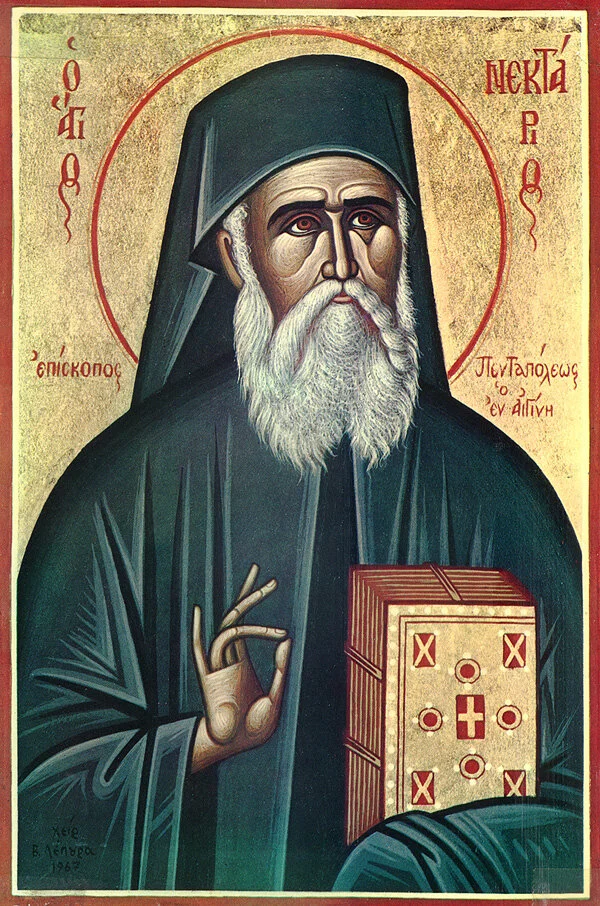
The Feastday of our Holy Father Saint Nektarios of Pentapolis (Part III)
My beloved spiritual children in Christ Our Only True God and Our Only True Savior,
CHRIST IS IN OUR MIDST! HE WAS, IS AND EVER SHALL BE.
+
THE LIFE OF OUR HOLY WONDERWORKING METROPOLITAN OF PENTAPOLIS NEKTARIOS (Part III)
The Saint's good fame flashed forth like lightning in all quarters. His popularity and genuine admiration among the people aroused the envy of a certain person in the Alexandrian Patriarchate. Rumors then arose that Metropolitan Nektarios wished to possess the Patriarchal throne, an ambition that never entered his mind. Many of his peers, not wishing to acknowledge his genuine virtue, slandered him to the Patriarch, saying that his popularity among the people was reaching such a pitch that Sophronios could easily be dethroned. Although the holy Nektarios discharged all his duties in a godly manner and sincerely showed love and reverence toward the Patriarch, whom he exceedingly honored as his benefactor, the Metropolitan's enemies swayed the Patriarch into thinking that his throne was in danger. As a man, the Patriarch feared and lost confidence; consequently, he compelled the holy Nektarios to leave his position. Metropolitan Nektarios, thus, on the 11th of July 1890, was removed from the Church of Egypt and told to go elsewhere. He was neither defrocked nor suspended from priestly functions, but he was removed from his throne and not given another.
The holy man accepted this injustice and bitter trial with much thanksgiving toward the Lord because he was accounted worthy to suffer calumny, unjust persecution and dismissal, without being responsible for the tiniest provocation. The majority of his persecutors, who drove him out, were the bishops of the Church--many who aspired to power and glory.
The meek, guileless, and humble holy father, without murmuring or speaking any word of reproof against his persecutors, much rather prayed for them. When he came out of Egypt, he was penniless, since whatever money he had gone either to the poor or toward his expenditures for printing religious writings. Indeed, many were making the following remarks: "With regard to the Metropolitan of Pentapolis and money, they are opposites." Though he lacked even pocket change to buy bread, he asked no one for assistance and hoped only in Divine intervention.
Saint Nektarios arrived in Athens in 1889 with the intention of going on to Mount Athos so as to lead the Monastic life, although many were pressing him to stay in Greece, especially the ever-memorable Bishop of Patras; for he knew the righteous man's holy life and his divinely inspired preaching. However, the holy Nektarios suffered much from both the Greek government and Church officials. Saint Nektarios spent all his time in prayer and fasting.
Phtiotis and Phokis
On the 19th of August, he was transferred to the prefecture of Phtiotis and Phokis, where he preached until 1894, having a holy ministry among the women and children. The area was filled with many widows, both young and old, who have lost their husbands to the sea.
At length, he fell ill with the flu. He was blessed with a visitation by the Ever-Virgin Mary. Upon beholding her, he said, "My Lady Theotokos, how could you condescend to see your servant?" She informed him that though the Angels were preparing to take him, the Lord decided that he should remain. "You shall continue on the sorrowful path." Saint Nektarios became afraid and told her as much. She replied, "Cease fearing. Keep struggling. The Lord shall stand by you." When the Saint recovered, he went on a preaching tour, though his health suffered.
The Rizarios School, Athens
Then, in the spring, he received news that he had been appointed Dean of the Rizarios Ecclesiastical School, established in 1844, for the training of men for the Priesthood. He departed amid a throng of grateful believers, including young girls bearing wildflowers and boy waving flags.
Saint Nektarios was made Director of the school on the 8th of March, 1894. When he was met by the ten-member governing committee, they beheld a man entering his 48th year, of average height, with a serene and pleasant countenance, bright blue eyes, and a beard beginning to turn grey.
When the holy man first entered the school, it was no easy task. The school was in turmoil regarding its direction, curriculum, and discipline. Furthermore, there were different attitudes, because some of the trustees wish to promote reforming the school to accommodate the modern world. The Saint, being a man of God with the kind of character that he possessed, put things in order with his peaceful and loving manner. The students developed a deep respect for him, and a profound honor and love grew in them for their ascetical Dean, whom they revered as a loving father.
When the custodian of the school failed in his duties on account of illness, the Dean, St. Nektarios, himself rose up at night and cleaned the student toilets lest that man should be fired. He frequently performed the chores of others that were left undone or forgotten. People from all over were coming to the school just to participate in the Divine Liturgy and hear his elevating and edifying sermons. The Chapel, filled to capacity, enjoined the school to have participants come by written invitation only.
His charities and fund-raising activities seemed never-ending. A catastrophic fire broke out in Sinope near the Black Sea. Saint Nektarios did not hesitate to gather funds, having in his mind's eye homeless and cold children. When he learned that there was poverty, no work, and a poor crop in Lithi on Chios, he again personally contacted those with the means to alleviate the disaster. If any students were suffering from sickness or tuition problems, he was a ready helper. During this time, he wrote a book, dedicating it to his students, entitled Christian Ethics of the Eastern Orthodox Church.
Many people were confessing to the Saint and coming to listen to his lectures. Some pious young women approached the Saint, and one of them, Crysanthe, was blind. The Saint was most impressed with her guilelessness and gifts of the Spirit. It was the women's desire to become nuns. He prayed for them and begged God to help him found a Women's Monastery near Athens. The young women found a place on the island of Aegina, not far from the port of Piraeus by ferry boat. There already was an old and deserted Monastery in ruins, dedicated to the Life-Giving Spring, the Theotokos. It was a difficult and thorny terrain to navigate, being some six and a half kilometers from where the ferry docked. A certain medical doctor, one Peppas, offered to assist the young women and donate the land. He was also the governor of the island and long had had the pious desire to see the Monastery flourish again.
Saint Nektarios first visited Aegina in the summer of 1904. The whole island was moved to meet him. The priest also went to greet him. Saint Nektarios spent the night at an inn, not wishing to inconvenience the priest, Father Michael. As he prepared to leave Xantos, a woman who had been hemorrhaging for six years knelt to kiss his rason (cassock). Saint Nektarios blessed her, and she sensed that her flow of blood had been stopped. She then gave glory to the Virgin Theotokos. All the people praised God.
When the Saint viewed the aspect of the future Women's Monastery (Convent), he was well pleased. However, at 58 years of age, he was concerned about the welfare and guidance of these young women who put their trust in him. The Saint committed the matter to God. The Saint wrote countless letters, pleading for assistance that the church and Women's Monastery in Aegina might be established. Finally, on the 1st of July, 1906, the groundbreaking ceremony took place. Saint Nektarios dedicated the new Monastery to the Holy Trinity. His fatherly love for the nuns knew no bounds. Every penny went for medicines and the other needs of those young women. At length he tonsured them, and Chrysanthe, the future Gerondissa (Abbess), became Mother Xene. The reverend Dean could not be absent from his duties as Director of the Rizarios Ecclesiastical School; so, in his absence from Aegina, Archimandrite Theodosios served the nuns. On Sundays, he would dispatch a priest to serve them. This arrangement would continue until 1908, when, in December, Dean Nektarios submitted his letter of resignation as Director of the Rizarios School. (Source: The Great Synaxaristes of the Orthodox Church)
(To be continued)
____________________________________
"Glory Be To GOD For All Things!" -Saint John Chrysostomos
+++
With sincere agape in His Holy Diakonia (Ministry),
The sinner and unworthy servant of God
+Father George