
The True Spirit of Fasting During the Preperation for the Holy Nativity of our Lord
"Moreover, when you fast, do not be like the hypocrites, with a sad countenance. For they disfigure their faces that they may appear to men to be fasting. Assuredly, I say to you, they have their reward. But you when you fast, anoint your head and wash your face. so that you do not appear to men to be fasting, but to your Father who is in the secret place; and your Father who sees in secret will reward you openly" (St. Matthew 6:16-18).
Beloved in Christ God,
WHAT IS THE TRUE SPIRIT OF FASTING?
According to the Holy Scripture, Christians should fast in the following manner:
"Moreover, when you fast, do not be like the hypocrites, with a sad countenance. For they disfigure their faces that they may appear to men to be fasting. Assuredly, I say to you, they have their reward. But you when you fast, anoint your head and wash your face. so that you do not appear to men to be fasting, but to your Father who is in the secret place; and your Father who sees in secret will reward you openly" (St. Matthew 6:16-18).
+
"Let the husband render to his wife the affection due to her, and likewise also the wife to her husband. The wife does not have authority over her own body, but the husband does. And likewise the husband does not have authority over his own body but the wife does. Do not deprive one another except with consent for a time, that you may give yourselves to fasting and prayer; and come together again so that Satan does not tempt you because of your lack of self-control" (1 Corinthians 7:3-6).
+
"For one believes he may eat all things, but he who is weak eats only vegetables. Let not him who eats despise him who does not eat, and let not him who does not eat judge him who eats; for God has received him. Who are you to judge another's servant? To his own master, he stands or fails. Indeed, he will be made to stand, for God is able to make him stand...He who observes the day, observes it to the Lord, and he who does not observe the day, to the Lord he does not observe it. He who eats, eats to the Lord, for he gives God thanks; and he who does not eat, to the Lord he does not eat, and gives God thanks" (Romans 14:2-6).
Our Lord Jesus Christ Tempted In the Wilderness
"Then Jesus, being filled with the Holy Spirit, returned from the Jordan and was led by the Spirit into the wilderness, being tempted for forty days by the devil. And in those days He ate nothing, and afterward when they had ended, He was hungry. And the devil said to Him, 'If You are the Son of God, command this stone to become bread.' But Jesus answered him, saying, "it is written, Man shall not live by bread alone, but by every word of God" (St. Luke 4:1-4).
__________________
Please note: In order for fasting to be of any spiritual value and a benefit to you, it must be done according to the guidelines of the Holy Scripture and the Holy Tradition of the Church. It is a matter of fact that very few Orthodox Christians fast and to what extent. I have heard of people that have adopted unorthodox foreign practices of fasting where they may give up, as they say, chocolate or smoking. The whole spirit of fasting has been distorted or entirely lost. Others attempt to find ways of subverting fasting by looking for loopholes and shortcuts. This type of attitude is no less than outright mockery.
It is better, to be honest, and avoid deceiving oneself and others. There are those who make a sincere effort but they are not totally successful. At least they make a good effort. Fasting is a form of spiritual discipline and a challenge. Fasting and prayer are inseparable partners.
According to Saint John Chrysostom, it is not what goes into the mouth that condemns one but what comes out of the mouth. Instead, "Let no corrupt word proceed out of your mouth, but what is good, for necessary edification, that it may impart grace to the hearers" (Ephesians 4:29).
May God bless all of you.
With agape,
+Father George
December 6 - Saint Nicholas the Wonderworker
The great wonder-worker, swift helper of those in need, and fervent intercessor before God. Christ's holy hierarch (bishop) Nicholas, was born in Patara, a city in the Province of Lycia. His parents were honorable, well-born, wealthy people and were Orthodox. Nicholas' father was named Theophanes and his mother Nonna who were adorned with every virtue. When their son was born, they gave him the name Nicholas, which means "victor of the nations," and truly, with God's help, he proved victorious over evil and became a benefactor of the whole world.

My beloved spiritual children in Christ Our Only True God and Our Only True Savior,
CHRIST IS IN OUR MIDST! HE WAS, IS, AND EVER SHALL BE.
+
ON DECEMBER 6th OUR HOLY ORTHODOX CHRISTIAN CHURCH COMMEMORATES SAINT NICHOLAS THE WONDERWORKER, ARCHBISHOP OF MYRA IN LYCIA
The great wonder-worker, swift helper of those in need, and fervent intercessor before God. Christ's holy hierarch (bishop) Nicholas, was born in Patara, a city in the Province of Lycia. His parents were honorable, well-born, wealthy people and were Orthodox. Nicholas' father was named Theophanes and his mother Nonna who were adorned with every virtue. When their son was born, they gave him the name Nicholas, which means "victor of the nations," and truly, with God's help, he proved victorious over evil and became a benefactor of the whole world.
As the child grew, his understanding increased, and he was instructed in the rules of good conduct by his parents. The seed of Christian teaching sprang up in his heart as though in a fertile field, every day bearing the fruit of excellent conduct. He quickly achieved a profound understanding of their contents. He frequently spent the whole day and night in the church, reading sacred books and engaging in mental prayer to God.
The blessed one had an uncle who was also named Nicholas and was Bishop of Patara. Seeing his nephew advancing in the life of virtue and distancing himself from everything worldly, the uncle advised Nicholas' parents to dedicate the young man to God's service. They agreed with him, presenting their son to the Lord Who entrusted him to them. The Bishop took the young elder and elevated him to the sacred rank of presbyter (priest).
As a priest Saint Nicholas added to his labors, always fasting and keeping vigil, praying without ceasing and striving to emulate the life of the bodiless powers although he was clothed in flesh. At that time his uncle, Bishop Nicholas, wished to visit Palestine and venerated the Holy Places there, and he entrusted the entire administration of the Church of Patara to his nephew. God's priest Nicholas gave to the Church's affairs the same close attention as did his uncle. While Saint Nicholas was administering the diocese, his parents departed this fleeting existence for life eternal. They left their wealth to their son, who distributed them among those who begged alms of him. And now the time has come to tell of one of his numerous deeds of compassion, as a testimony to his generosity.
There was a man living in Patara who was once wealthy and renowned, but his fortune waned. He fell into poverty and was scorned by those who before had regarded him highly. This man had three beautiful daughters, and when the necessities of life began to fail him, he decided to make his house a brothel and sell their bodies. Hearing of the father's poverty and learning by Divine revelation of his foul scheme, Nicholas felt pity for him and resolved to snatch him and his daughters from penury and sin as if from fire, by giving them generous alms. However, the Saint did not want to help the man openly, for two reasons. Firstly, obedient to the words of the Gospel, "Take heed that you do not your alms before them" (St. Matthew, Ch. 6), he sought to avoid praise of men. Secondly, since the man was once rich and had only recently fallen on bad times, Nicholas did not wish to humiliate him. Knowing how mortifying it is for someone who once enjoyed wealth and renown to accept alms (since he is reminded of his former prosperity), the Saint thought it best to obey Christ's words: "let not thy left hand know what thy right hand doeth". So great was Nicholas' desire to avoid praise that he attempted to hide even from those whom he assisted! He went at midnight to the man's home, threw a large bag of gold into the house through a window, and fled. The next morning, when he rose, the man found the bag and untied it. Seeing the gold, he became frightened, thinking it was an illusion since he knew of no one likely to aid him so generously. Ascribing his good fortune to providence, he thanked God unceasingly, glorifying the Lord Who cares for all men. Without delay, he married off his eldest daughter using the gold to provide her dowry. Learning what the man had done, the wondrous Nicholas was very pleased and prepared to assist the second daughter. He made ready another bag of gold, of the same value, and unknown to all went by night and threw it into the man's house through the same window. When the father rose the next morning and found the second bag, he was even more amazed than before, and falling to the floor, wept and cried, "O Merciful God, Who did purchase my salvation with Thy precious blood, Thou has ransomed my home and children from the snares of the enemy! I beseech Thee to reveal to me who it was that accomplished Thy will and served as minister of Thy kindness and love for man.
Thanking the Lord for his kindness, the man celebrated the wedding of his second daughter. He trusted that God would provide a lawful husband for his third child and again send him the money he needed. Because he wished to know who was bringing the gold, he did not sleep at night but watched in the hope of catching sight of his secret patron. It was not long before Christ's favorite came a third time, walking very quietly and again cast a bag of money through the window. The father heard it striking the floor and ran as fast as he could in pursuit of the Saint. When he caught up with him, he recognized Nicholas, who was known to all because of his virtuous life and noble ancestry. He fell at the holy priest's feet and kissed them, calling the Saint his helper and deliverer and the rescuer of souls. Only with the greatest difficulty did Nicholas succeed in raising him to his feet and compelling him to swear that he would tell no one what had occurred as long as his benefactor remained alive.
From this story, it is evident what deep sympathy Saint Nicholas had for the poor. It would be impossible to tell every example of his generosity to beggars or to enumerate the hungry people he fed, the naked he clothed, or the debtors he delivered form usurers.
When he embraced a life of solitude and silence, thinking to live in that way until his death, a voice from on high came to him: 'Nicholas, set about your work among the people if you desire to receive a crown from Me.' Immediately after that, by God's wondrous providence, he was chosen as Archbishop of the city of Myra in Lycia. Merciful, wise and fearless, Saint Nicholas was a true shepherd to his flock. He was cast into prison during the persecutions of the pagan emperor Diocletian and Maximian, but even there continued to instruct the people in the Law of God. He was present at the First Ecumenical Council in Nicaea in 325 A.D., and, in his zeal, struck Arius the heretic with his hand. For this act, he was removed from the Council and from his episcopal duties, until some of the chief hierarchs (bishops) had a vision of our Lord Christ and His Most Holy Mother showing their sympathy with Nicholas.
This wonderful Saint was a defender of the Truth of God and was ever a spirited champion of justice among the people. On two occasions, he saved three men from underserved sentences of death. Merciful, trustworthy and loving right, he walked among the people like an Angel of God. People considered him a Saint even during his lifetime and invoked his aid when in torment or distress. He would appear both in dreams and in reality to those who called upon him for help, responding speedily to them, whether close at hand or far away. His face would shine with light as Moses' did aforetime, and his mere presence among people would bring solace, peace, and goodwill. In old age, he became ill and went to his rest in the Lord after a life full of labor and fruitful toil. He now enjoys eternal happiness in the Kingdom of Heaven continuing to help the faithful on earth by his miracles and to spread the glory of God. He entered into rest on December 6th 343 A.D. (Sources: The Great Collection of The Lives of the Saints and The Prologue from Ochrid)
________________________
DIVINE SERVICES ON FRIDAY DECEMBER 6TH:
Orthros (Matins) at 9:00 a.m.
Divine Liturgy at 10:00 a.m.
The service of the Blessing of the Five Loaves of Bread, wheat, wine, and oil, immediately following the Divine Liturgy.
_______________________________
"Glory Be To GOD For All Things!" - Saint John Chrysostomos
+++
With sincere agape in His Holy Diakonia (Ministry),
The sinner and unworthy servant of God
+Father George
Saints in the Month of December
This famous follower of Christ was betrothed to Him from her early years. Her father, Dioscorus, was a pagan in the city of Heliopolis in Egypt and was famed for his wealth and standing. Dioscorus shut up his only daughter, who was both intelligent and beautiful, in a high tower, surrounded her with all possible comforts, gave her a host of attendants, set up idols for worship and built her a bathroom with two windows.
My beloved spiritual children in Christ Our Only True God and Our Only True Savior,
CHRIST IS IN OUR MIDST! HE WAS, IS, AND EVER SHALL BE.
+
SAINT COMMEMORATED IN THE MONTH OF DECEMBER: HOLY AND GREAT MARTYR BARBARA, SAINT JOHN DAMASCENE, HOLY FATHER SAVA THE SANCTIFIED AND SAINT NICHOLAS, ARCHBISHOP OF LYCIA
+
The Holy and Great Barbara.
This famous follower of Christ was betrothed to Him from her early years. Her father, Dioscorus, was a pagan in the city of Heliopolis in Egypt and was famed for his wealth and standing. Dioscorus shut up his only daughter, who was both intelligent and beautiful, in a high tower, surrounded her with all possible comforts, gave her a host of attendants, set up idols for worship and built her a bathroom with two windows. As she gazed through the windows of the tower upon the earth below and the starry sky above, Barbara's mind was opened by the grace of God, and she came to know Him as the one, True God and Creator, although she had no human teacher to bring her to the knowledge of Him. Once, when her father was away from the city, she came out of the tower and, by God's providence, met some Christians who told her about the True Christian faith. Barbara's heart was set on fire with love for Christ. She had a third window cut in the bathroom as a symbol of the Holy Trinity and traced a Cross with her finger on one wall of it, which etched itself deep in the stone as if cut by a chisel. A spring of water gushed forth from the bathroom floor from her footprint, and it later gave healing from sickness to many. When her father Dioscorus found out about his daughter's Christian faith, he beat her harshly and drove her from the tower, chasing after her to kill her, but a cliff opened and hid Barbara from her irate father. When she appeared again, Dioscorus took her to Marcian, the pagan governor of the city, but the Lord Himself appeared to her in the prison with many Angels, and healed her. A certain woman, Juliana, beheld this and conceived a desire for martyrdom herself. Both of them were fearfully tortured and taken around the city to be mocked, then their breasts were cut off and much blood flowed from them. They were finally led out to the place of execution, and Juliana was slain by soldiers while Saint Barbara was killed by her own father. On the same day, lightning struck Dioscorus's house, killing both him and Marcian. Saint Barbara suffered in 306 A.D., and her miracle-working holy relics are preserved in Kiev. Greatly glorified in the Kingdom of Christ, she has appeared many times down to our own days, sometimes alone and sometimes in the company of the Most Holy Mother of God, the Theotokos.
+
Saint John Damascene
Saint John Damascene was first a minister of Caliph Abdul-Malek and then became a monk in the Monastery of Saint Sava the Sanctified. For his ardent advocacy of the veneration of icons, while still a courtier during the reign of the iconoclast emperor Leo the Isaurian, he was slandered by the emperor to the Caliph, who had his right hand cut off. Saint John fell down in prayer before the holy icon of the Most Holy Mother of God, and his hand was re-joined to his arm and miraculously healed by the Theotokos. When he beheld this miracle, the Caliph repented, but Saint John no longer desired to remain at court as a nobleman but to withdraw to a Monastery. There, he was from the beginning a model of humility and obedience, and of all the works of asceticism prescribed for monks. He wrote the hymns for the Parting of the Soul from the Body, put together the Octoechos, the Irmologion, the Menologiion, and the Paschal Canon, and wrote many theological works of an inspired profundity. A great monk, hymnographer and theologian, and a great warrior for the Truth of Christ. Saint John Damascenos is counted among the Great Holy Fathers of the Church. He entered peacefully into rest in about 749 A.D., being 75 years old. (Source: The Prologue from Ochrid)
(To be continued)
________________________
"Glory Be To GOD For All Things!" -- Saint John Chrysostomos
+++
With sincere agape in His Holy Diakonia (Ministry),
The sinner and unworthy servant of God
+Father George
December 5 - Saint Savva the Sanctified
The unknown village of Mutalaska, in the providence of Cappadocia, became famous through this great light of the Orthodox Church, for Saint Savva was born there. He left the home of his parents, John and Sophia, at the age of eight and became a monk in a nearby Monastery called 'Flavian's'. After ten years, he moved to the Monasteries of Palestine, staying longest in the Monastery of Saint Efthimius (Euthymius) the Great (+ Jan. 20th) and Theoctistus. Efthymius, who had the gift of discernment, foretold that he would be a favor monk and leader of monks and that he would found a Monastery that would be greater than any other of that day.
My beloved spiritual children in Christ Our Only True God and Our Only True Savior,
CHRIST IS IN OUR MIDST! HE WAS, IS, AND EVER SHALL BE.
+
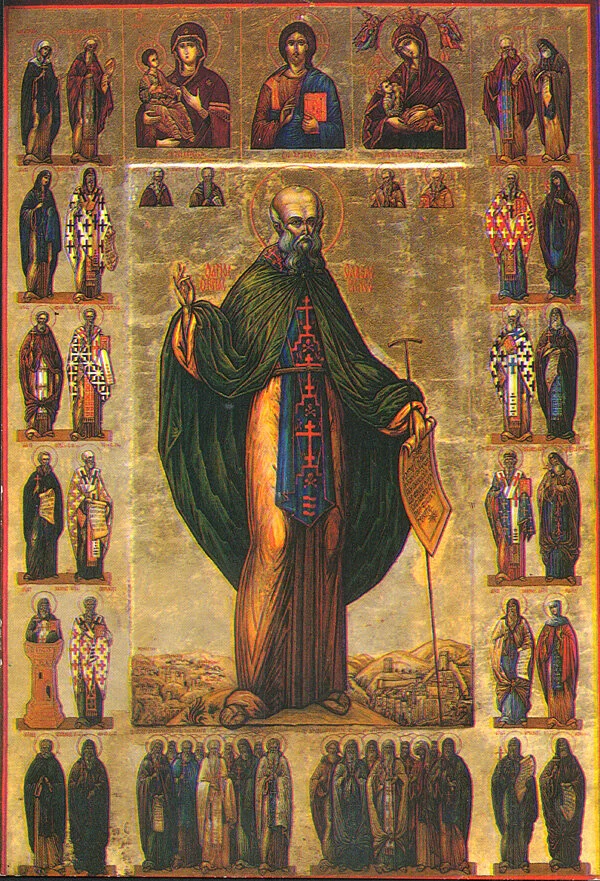
DECEMBER 5th OUR HOLY ORTHODOX CHRISTIAN CHURCH COMMEMORATES OUR HOLY FATHER SAVVA THE SANCTIFIED
The unknown village of Mutalaska, in the providence of Cappadocia, became famous through this great light of the Orthodox Church, for Saint Savva was born there. He left the home of his parents, John and Sophia, at the age of eight and became a monk in a nearby Monastery called 'Flavian's'. After ten years, he moved to the Monasteries of Palestine, staying longest in the Monastery of Saint Efthimius (Euthymius) the Great (+ Jan. 20th) and Theoctistus. Efthymius, who had the gift of discernment, foretold that he would be a favor monk and leader of monks and that he would found a Monastery that would be greater than any other of that day. After Saint Efthimiu's death, Savva went into the desert, where he lived for five years as a hermit in a cave which an Angel of God showed him. After that, when he had become a perfected monk, he began by Divine Providence to gather around him many desirous of the spiritual life. They very quickly grew in number, so that Savva had to build both a church and many cells. Some Armenians also came to him, and he set aside a cave for them, and they celebrated the services there in their own language. When his father died, his aged mother Sophia came to him and he made her a nun and gave her a cell away from the Monastery, where she lived in asceticism till her death. This Holy Father endured many attacks from those close to him, from heretics and from demons. But he overcame them all in these ways: those close to him he won over by his goodness and forbearance, the heretics by an unshakeable confession of the Orthodox faith, and the demons with the sing of the Cross and the invocation of God's aid. He had a particularly severe battle with the demons on the mountain of Castellium, where he founded the second of his seven Monasteries. He and his neighbor, Theodosius the Great, are considered to be the greatest lights and pillars of Orthodoxy in the East, kings, and Patriarchs were brought to the right Faith by them, and these holy and wonderful men, strong in the power of God, served each and every man as an example of humility. Saint Savva entered into rest in 532 A.D. at the age of 94, after a life of great labor and great reward.
Among all his other great and good works, let this be remembered above all: that he compiled the first Order of Services for use in Monasteries, now known as the Jerusalem Typikon.
+
FOR CONSIDERATION
A man may be great in some skill, as a statesman or a military leader, but no-one amongst men is greater than the man great in faith, hope and love. The greatness of the faith and hope in God held by Saint Savva the Sanctified is best shown by the following incident: One day the Monastery treasurer came to Savva and said he would not be able to sound the semandron the following Saturday and Sunday to summon the brethren for the common service and meal, because there was not a trace of flour in the Monastery, nor anything at all to eat or drink. The Saint replied without hesitation: 'I shall not cancel the Divine Liturgy because of a lack of flour. He Who commanded us not to be concerned for bodily things is faithful to His word, and is able to sustain us in a time of hunger.' And he placed some of the church vessels and vestments to be sold in the city, so that the divine services might not be foregone, nor the brothers' customary meal. But, before Saturday dawned, some men, moved by Divine Providence, brought thirty mules laden with wheat, wine, and oil to the Monastery. 'What do you say now, my brother?' Savva asked the treasurer. 'Shall we not strike the semandron and gather the fathers?' The treasurer was ashamed of his lack of faith and begged the Abbot's (Egoumenos) forgiveness. Saint Savva's biographer called him 'severe with demons, but mild with men.' Some monks rebelled against Saint Savva and were driven from the Monastery by order of Patriarch Elias. They built themselves huts on the bed of the Tekos River and lived there in dire straits without the bare necessities of life. Hearing that they were starving, Saint Savva loaded mules with flour and rook them to them himself. Seeing that they had no church, he built them one. At first the monks received him with hatred, but afterward, they returned his love with love and repented of their former evil toward him.
[Semandron -- is a long piece of flat wood, shaped for resonance, which is struck rapidly with a mallet. It became widely used in place of a bell under Turkish rule, when Christians were forbidden to ring bells.]
____________________________
"Glory Be To GOD For All Things!" - Saint John Chrysostomos
+++
With sincere agape in His Holy Diakonia (Ministry),
The sinner and unworthy servant of God
+Father George
The Proselyte (Part IV)
"We believe that the collective wisdom and understanding of God handed down through the generations is a vital part of our faith--and no less important than Scripture. In addition to Scripture, our faith is understood and celebrated in the Eucharist, through the teaching of the Church Fathers and the Saints, through the doctrines established at the Ecumenical Councils, and through private and communal prayer."
My beloved spiritual children in Christ Our Only True God and Our Only True Savior,
CHRIST IS IN OUR MIDST! HE WAS, IS, AND EVER SHALL BE.
+
THE PROSELYTE (Part IV)
The Holy Tradition of the Church
"We believe that the collective wisdom and understanding of God handed down through the generations is a vital part of our faith--and no less important than Scripture. In addition to Scripture, our faith is understood and celebrated in the Eucharist, through the teaching of the Church Fathers and the Saints, through the doctrines established at the Ecumenical Councils, and through private and communal prayer."
The Divine Revelation, God Himself came to earth incarnate in the Son of God, our Lord Jesus Christ, and spread the revelation to the whole earth through His Apostles and Disciples.
This Divine Revelation and its dissemination among people are preserved in the True, Holy Orthodox Church in two ways: by means of Holy Tradition and Holy Scripture.
The primary means of dissemination of Divine Revelation is Holy Tradition. From the beginning of the world until Moses there were no holy books. Teaching about belief in God was handed down by tradition, that is, by word of mouth and example, from one to another, from ancestor to descendant. Jesus Christ, Himself conveyed His Divine teaching and precepts to His Disciples by word of mouth, by preaching, and by the example of His life, not by books (scripture). By preaching and example, the Apostles first spread the faith and maintained the Christian Church.
Holy Tradition always precedes Holy Scripture. This is obvious because books are not useful for all people, but tradition is accessible to all without exception.
Eventually, so that God's revelation might be kept in complete faithfulness, by the inspiration of the Lord, several holy people wrote the most important aspects of tradition in books. The Holy Spirit helped them invisibly so that everything in these written books would be correct and true. All these books, written by the Spirit of God through people sanctified by God, Prophets, Apostles, and others, are called Holy Scripture, or the Bible.
The word "Bible" comes from the Greek word "Vivlos", and means "book." This name shows that the holy books, as coming from God Himself, surpass all other books.
"Hold on to the traditions which you have been taught, whether orally or through an epistle of ours." Also, Scripture says: "At the mouth of two or three witnesses shall every word, be established" (Deut. 19:15, cf., Matthew 18:16).
In the original precise meaning of the word, Sacred Tradition is the tradition which comes from the ancient Church of Apostolic times. In the second to the fourth centuries, this was called "The Apostolic Tradition."
One must keep in mind that the ancient Church carefully guarded the inward life of the Church from those outside of her; her Holy Mysteries (Sacraments) were profound--Baptism or the Eucharist--those outside the Church were not present; the order of the services was not written down, but was only transmitted orally; and in what was preserved in secret was contained the essential side of the faith. Saint Cyril of Jerusalem (4th century) presents this to us especially clearly. In undertaking Christians instruction for those who had not yet expressed a final decision to become Christians, the hierarchy precedes his teachings with these following words: "When the catechetical teachings with the following catechumens should ask you, 'What did the instructors say?' you are to repeat nothing to those who are without (the church). For we are giving to you the mystery and hope of the future age. Keep the Mystery of Him Who is the Giver of rewards. May no one say to you, 'What harm is it if I shall find out also?' Sick people also ask for wine, but if it is given at the wrong times it produces disorder to the mind, and there are two evil consequences; the sick one dies, and the physician is slandered" (Prologue to the Catechetical Lectures, Ch. 12).
In the following words Saint Basil the Greater gives us a clear understanding of the Sacred Apostolic Tradition: "Of the dogmas and sermons preserved in the Church, certain ones we have from written instructions, and certain ones we have received from the Apostolic Tradition, handed down in secret. Both the one and the other have one and the same authority for piety, and no one who is even the least informed in the decrees of the Church will contradict this. For if we dare to overthrow the unwritten customs as if they did not have great importance, we shall thereby imperceptively do harm to the Gospel in its most important points. And even more, we shall be left with the empty name of the Apostolic preaching without content. For example, let us especially make note of the first commonest thing: that those who hope in the Name of our Lord Jesus Christ should sign themselves with the Sign of the Cross. Who taught this in Scripture? Which of the saints left us in written form the words of invocation during the transformation of the bread of the Eucharist and the Chalice of blessing? For we are not satisfied with the words which are mentioned in the Epistles or the Gospels, but both before them and after them we pronounce others also as having great authority for the Mystery, having received them from the unwritten teaching. By what Scripture, likewise, do we bless the water of Baptism and the oil of the anointing and, indeed, the one being baptized himself? Is this not the silent and secret traditions? And what more? What written word has taught us this anointing with oil itself? Where is the triple immersion and all the rest that has to do with Baptism, the renunciation of Satan and his angels to be found? What Scripture are these taken from? Is it not from this unpublished and unspoken teaching which our Fathers have preserved in a silence inaccessible to curiosity and scrutiny, because they were thoroughly instructed to preserve in silence the sanctity of the Mysteries (Sacraments)? For what propriety would there be to proclaim in writing a teaching concerning that which it is not allowed for the unbaptized even to behold?" (On the Holy Spirit, Ch. 27).
From these words of Saint Basil the Great we may conclude first, that the Sacred Tradition of the teaching of faith is that which may be traced back to the earliest period of the Church, and, second, that it was carefully preserved and unanimously acknowledged among the Fathers and teachers of the Church during the epoch of the great Fathers and the beginning of the Ecumenical Councils. (Source: Orthodox Dogmatic Theology)
(To be continued)
____________________________
"Glory Be To GOD For All Things!" -- Saint John Chrysostomos
+++
With sincere agape in His Holy Diakonia (Ministry),
The sinner and unworthy servant of God
+Father George
The Proselyte (Part III)
The Holy Orthodox Christian Church was founded by our Lord and Savior Jesus Christ and maintains an unbroken continuity of faith that began with the Holy Apostles on the day of Pentecost. Throughout its two-thousand-year history, the Church has maintained, defended, and protected the doctrine and worship which was first established by the Holy Apostles and witnessed by their successors.

My beloved spiritual children in Christ Our Only True God and Our Only True Savior,
CHRIST IS IN OUR MIDST! HE WAS, IS, AND EVER SHALL BE.
+
THE PROSELYTE (Part III)
The Holy Orthodox Christian Church was founded by our Lord and Savior Jesus Christ and maintains an unbroken continuity of faith that began with the Holy Apostles on the day of Pentecost. Throughout its two-thousand-year history, the Church has maintained, defended, and protected the doctrine and worship which was first established by the Holy Apostles and witnessed by their successors.
A proselyte to the Orthodox Church not only understands that as an Orthodox Christian he or she inherits all the spiritual benefits of a believer but also certain responsibilities. One of the many responsibilities is to adhere and to conform to the sacred teachings of the One, Holy, Catholic, and Apostolic Church of Christ. All Orthodox Christians should have a strong knowledge of the Faith so as to teach it to others, to openly confess it, to be able to defend the Truth of the Gospel (Evaggelion), to protect its integrity from falsehood.
Historically countless Christian men and women of the Church not only fought to keep the faith pure and undefiled but gave their very lives to preserve it against heresy. The Seven Ecumenical and other Local Synods did just that. The Seven Ecumenical Synods of the Church held between the years 323 and 787 A.D. The Synods were comprised of the holy, God-inspired, brilliant Fathers and theologians of Christendom who under the guidance of the Holy Spirit formulated the doctrines and practices of our Holy Church. Toward the end of the first century and on into the second century, numerous heretical teachings about our Lord Christ were spread threatening the unity and stability of the Church.
An early brilliant and holy Father, Saint Irenaeus, Bishop of Lyons, wrote a most powerful work called Against Heresies which refuted the different forms of Gnosticism. The Holy Father and Bishop pointed out the crucial ways by which to distinguish heretical groups form true Christian Churches. The true Churches held always the same basic doctrines, known as the rule of faith. Where the heretical groups could not agree on what they believed among themselves.
Next, all the true Churches traced their origins back to one of the Holy Apostles, with their bishops coming down in direct descent from that Holy Apostle; this is known as apostolic succession. The heretics cannot make the same claim.
Finally, whereas the different Gnostic groups individually had their own scripture which they followed, the True (Orthodox) Churches only adopted the Gospels according to the Evangelists Matthew, Mark, Luke, and John to be divinely inspired.
The Holy Ecumenical Synods reflected the structure of the Church that is still in place today. All major decisions concerning Orthodox doctrine and liturgical tradition are conciliar in nature. That means they must be discussed and agreed upon within the setting of a Synod that involves all sister Churches with the understanding that the outcome is guided by the Holy Spirit. Originally it was a council of the Holy Apostles. Also, "conciliarity" means that the supreme authority in the Church lies in the Ecumenical Synod.
The Holy Orthodox Church is known as the Church of the Seven Ecumenical Councils (Synods). That means that our doctrine is unchanged from the pronouncements of these councils. The One, Holy, Catholic, and Apostolic Church remains true to the wisdom of these Seven Councils. This is why we claim that Orthodox Christianity preserves the Truth of the Christian faith in its fullest.
A true and most unfortunate fact is that a significant number of Christians, Orthodox or not, know very little of Church history. It is absolutely necessary for all Christians to be aware and to know very well the authentic history of our Christian faith. We must, however, be alert and careful about the legitimacy and validity of the historical sources that we use. Especially in more recent times, there are those who we referred to as revisionists of history. The revisionists have their own agenda which is to change the facts of history and including the theology of the Church so as to undermine the authenticity of the Church and cause fragmentation and confusion among the Christian faithful. We see this specifically among the thousands of Protestant denominations throughout the world that cannot agree among themselves on matters of faith and Gospel message.
One very important development and a blessed gift to our Holy Church is the formulation of the Nicene-Constantinopolitan Creed ("Symbol of faith") which reveals and confesses the authentic dogma and Theology of the Christian Church. It is the Creed that is recited by the Orthodox faithful at every Divine Liturgy. If one, a none-Orthodox Christian, desires to know what the Orthodox Church believes and teaches is to turn to the Creed. According to the Holy Fathers and Synods no one can either add or subtract anything from it and if one attempts to do it becomes anathema and a heretic.
__________________
"Glory Be To GOD For All Things!" -- Saint John Chrysostomos
+++
With sincere agape in His Holy Diakonia (Ministry),
The sinner and unworthy servant of God
+Father George