
The First Week of Great and Holy Lent: Monday to Friday
At Compline (Apodeipnos) on the first four days of Holy Lent, the Great Canon of Saint Andrew of Crete is read, divided into four sections; on Thursday in the Fifth Week, it will be read again, this time in continuous form. With its constant refrain, 'Have mercy upon me, O God, have mercy upon me', the Great Canon forms a prolonged confession of sin, an unremitting call to repentance. At the same time, it is a meditation on the whole body of Holy Scripture, embracing all the sinners and all the righteous from the creation of the world to the second coming Christ.
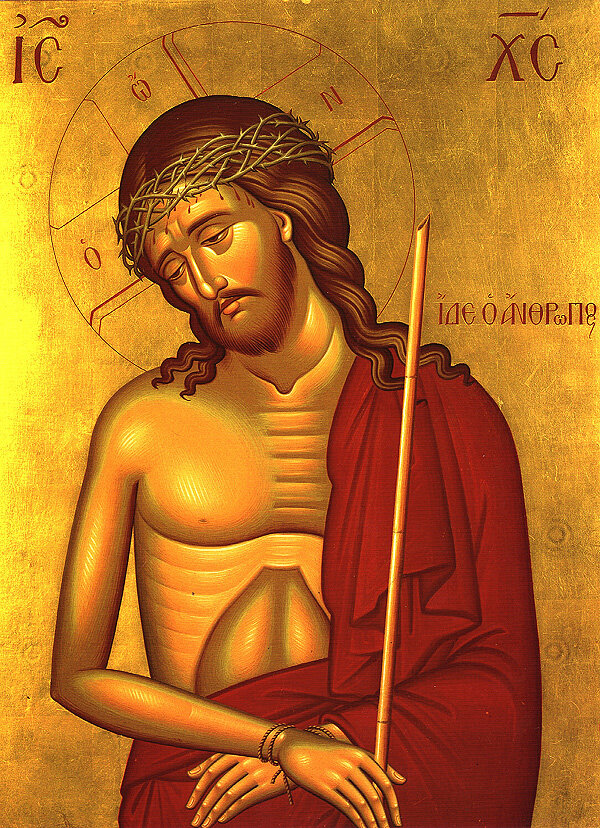
My beloved spiritual children in Christ Our Only True God and Our Only True Savior,
CHRIST IS IN OUR MIDST! HE WAS, IS, AND EVER SHALL BE.
+
THE FIRST WEEK OF GREAT AND HOLY LENT: MONDAY TO FRIDAY
At Compline (Apodeipnos) on the first four days of Holy Lent, the Great Canon of Saint Andrew of Crete is read, divided into four sections; on Thursday in the Fifth Week, it will be read again, this time in continuous form. With its constant refrain, 'Have mercy upon me, O God, have mercy upon me', the Great Canon forms a prolonged confession of sin, an unremitting call to repentance. At the same time, it is a meditation on the whole body of Holy Scripture, embracing all the sinners and all the righteous from the creation of the world to the second coming Christ. Here, more than anywhere else in the Triodion, we experience Lent as a reaffirmation of our 'Biblical roots'. Throughout the Great Canon the two levels, the historical and personal, are skillfully interwoven. 'The events of the Sacred History are revealed as events of my life; God's acts in the past as acts aimed at me and my salvation, the tragedy of sin and betrayal as my personal tragedy.' The appeal of the Great Canon is very wide.
The Monday that follows Cheese-fare Sunday is the first day of Great and Holy Lent itself. We have now begun on this succession of forty days which prepare us for the time of the Passion and for the time of Pascha. But before going into the details of these weeks of Holy Lent, let us give a little time to the consideration of some of its general characteristics.
The first of these characteristics is, of course, the fast. One cannot ignore or treat the question of fasting from food lightly. The Holy Fathers of the Church and the collective conscience of the faithful Orthodox Christians have discerned clearly the spiritual value - a value which is both penitential and purifying -- of abstention from certain foods. It would, however, be a serious mistake to think that this abstention constituted the only observance necessary to Holy Lent. Bodily fasting must be accompanied by another fast. In the first centuries, the discipline of the Church prescribed conjugal abstinence during Holy Lent; it forbade the participation of feasts and attendance at public festivals. This discipline has perhaps become weakened and is not presented to believers quite as forcefully as in the times of the Holy Fathers. All the same, it remains as a precious indication of the spirit, the intention of the Church. But most surely, this intention is that during Holy Lent we exercise stricter control over our thoughts, our words, and actions, and concentrate our attention on the person of the savior and what He requires of us. Almsgiving (charity) is also one of the forms of Lenten observance that the Holy Fathers of the Church recommended most highly. A fast that is pleasing to god is therefore a 'whole' which cannot be separated into inner and outward aspects; of the two the former are certainly the most important.
Furthermore, the Divine Liturgy which is celebrated on Sundays during Great and Holy Lent is not the Liturgy attributed to Saint John Chrysostom. It is the Divine Liturgy to Saint Basil the Great, Archbishop of Caesaria, in the 4th century. This Divine Liturgy is longer than that of Saint John Chrysostom and the text is sometimes slightly different.
On Wednesday and Friday during Great and Holy Lent, the liturgy called the 'Presanctified' is celebrated, that is to say, the liturgy for which the Holy Gifts have been consecrated in advance. It is not a Eucharistic liturgy in the full sense, as there is no consecration. It is a communion service in which the priests and congregation take Holy Communion with the elements which were consecrated during the previous Liturgy of Saint Basil or Saint John Chrysostom, and which have been preserved since then. The Liturgy of the Presanctified is added on to Vespers. That is why, in principle, it should be celebrated in the evening. It includes certain psalms, certain special biblical readings, and certain prayers borrowed from the Liturgy of Saint John Chrysostom. The latter is celebrated every Saturday morning.
On Friday evening during Great and Holy Lent the Hymn called the 'akathist' is recited or sung. It is a long poem of praise to the Most Holy Ever-Virgin Mary the Theotokos. It comprises twenty-four stanzas set out in alphabetical order and broken up into our portions. These portions are read one after another -- one each Friday -- during the First Four Fridays of Great and Holy Lent. On the fifth Friday, the Akathist is chanted in its entirety.
Finally -- and perhaps above all -- the admirable prayer of Saint Ephraim the Syrian must be mentioned. In this, neither poetry nor rhetoric plays any part. We are here faced with upsurge of the soul - short, sober, and full of ardor. This prayer, accompanied by prostrations (metanoies), is said for the first time on the evening of the Sunday which immediately precedes Great and Holy Lent (the evening service being counted as already belonging to Monday, the First Day of Lent ). It is repeated during most of the Lenten services, especially in the Liturgy of the Presanctified. The prayer of Saint Ephraim the Syrian is widely known by Orthodox Christian believers; this is it text:
'O Lord and Master of my life, give me not a spirit of sloth, vain curiosity, lust for power, and idle talk. But give to me, Thy servant, a spirit of chastity, humility, patience and love.
O Lord and King, grant me to see my own faults and not to judge my brother; for blessed art Thou unto the ages of ages. Amen.'
The prayer of Saint Ephraim sums up all that is essential in spiritual life. A Christian who used it constantly, who nourished himself from it during Great and Holy Lent, would be at the simplest and best school. Even someone who restricted himself to repeating and meditating on these words. 'Lord and Master of my life', would enter deeply into the reality of the relationship between God and the soul, the soul and its God. (Source: The Year of Grace of the Lord)
(To be continued)
__________________________
DIVINE SERVICE THIS EVENING (CLEAN MONDAY [KATHARA DEFTERA] ): THE CANON OF SAINT ANDREW OF CRETE AT 6:30 p.m.
Place of worship: Chapel of Saint Nektarios
______________________________
"Glory Be To GOD For All Things!" - Saint John Chrysostom
+++
With sincere agape in His Holy Diakonia (Ministry),
The sinner and unworthy servant of God
+Father George
Sin (Part II)
The Word of God says: "Sin is the transgression of the law" (I John 3:4). This means that sin is a violation of God's law. Every violated law, be it civil or natural, entails punishment. Sin, as transgression of the highest law--the will of God, leads to most heavy punishments. These punishments can be temporary or eternal. The temporary ones are sent by God to bring us to our senses and for correction. If we repent and are reconciled with God, we will save ourselves in our sins, if we do not want to repent of them, if we persist in our rebellion against God, He will let us go our own way.

My beloved spiritual children in Christ Our Only True God and Our Only True Savior,
CHRIST IS IN OUR MIDST! HE WAS, IS, AND EVER SHALL BE.
+
SIN (Αμαρτία) [Part II ]
The Word of God says: "Sin is the transgression of the law" (I John 3:4). This means that sin is a violation of God's law. Every violated law, be it civil or natural, entails punishment. Sin, as transgression of the highest law--the will of God, leads to most heavy punishments. These punishments can be temporary or eternal. The temporary ones are sent by God to bring us to our senses and for correction. If we repent and are reconciled with God, we will save ourselves in our sins, if we do not want to repent of them, if we persist in our rebellion against God, He will let us go our own way.
The end result of sin is an ultimate separation from God. And since God is the happiness of the human heart, separation from God is the deprivation of that happiness, or eternal sorrow. If sin is such a terrible evil, why do all of us commit sin so carelessly? How have we gotten to the point of befriending our sins most intimately, of getting used to them to such a degree that most of us today think that sin is unavoidable in life? How have we been able to stand, and still stand, the filth, dust, and cobwebs in the rooms of our hearts, living with a dull insensibility in this disorder, amid the stench of our lawlessness? All this is simply inexplicable. But it is a fact. Hardened, morally dulled, we have become indifferent toward the call of our own conscience and toward the concern for our salvation....And this indifference has come to the point where we underestimate the weight and the fatefulness o four wickedness. We think that we are not doing anything really bad when we sin. Oh, if we could measure the whole weight of our sins and if we would feel clearly that this weight is pulling us toward the bottom of hell, we would rather agree that the earth swallow us and that the rocks bury us than for us to sin and anger God.
If we picture a pair of scales and put human sins on one of the dishes and on the other--the holiness of all the bright spirits of heaven and of all the righteous people who have lived on earth, then all the holiness in heaven and earth would not be able to lift up the dish of human sinfulness. Only the power of God can lift it up. That is why God sent to earth His Only-Begotten Son Who was to atone for human sin with His Sacrifice on Golgotha. Since then, all the sins of man from all times can be forgiven if repentance for them is offered. Since then, there is no sin which weighs more than the weight of God's mercy. "For God so loved the world, that He gave His Only begotten Son, that whosoever believeth in Him should not perish, but have everlasting life" (John 3:16). "Behold the Lamb of God which taketh away the sin of the world" (John 1:29).
Take courage, sinners! There is deliverance for us! Jesus Christ, Who carried on His shoulders the sin of all humanity and Who paid our debts to God with his death on the Cross, can take our sin on His shoulders as well. Is it not because of this that Saint Andrew of Crete prays in the name of all of us who sin before God: "Take my heavy sinful burden away from me and give me tears of repentance!" We must shed tears of repentance, because there are only two kinds of water which can wash away the filth of sins: the water of baptism and the tears of repentance. Furthermore, as Saint John Climacus asserts: "greater than baptism itself is the fountain of tears after baptism, even though it is somewhat audacious to say so. For baptism is the washing away of evils that were in us before, but sins committed after baptism are washed away by tears. As baptism is received in infancy, we have all defiled it, but we cleanse it anew with tears. And if God in His love for mankind had not given us tears, those being saved would be few indeed and hard to find." (Source: The Forgotten Medicine. The Mystery of Repentance by Archimandrite Seraphim Aleksiev)
__________________________
"Glory Be To GOD For All Things!" -- Saint John Chrysostomos
+++
With sincere agape in His Holy Diakonia (Ministry),
The sinner and unworthy servant of God
+Father George
Sin
We are created for God, and only in Him do we find the paramount bliss for which our heart is constantly yearning. Nothing other than God can make our souls happy! Give a man everything which he desires. He will enjoy it for a while, but afterward, he will become indifferent to it, because he feels that something else, much more elevated, is missing. Is it not in that way that the child, too, enjoys every new toy until it grows hungry? Then it abandons the toy and looks for food. A certain inextinguishable inner hunger for truth, joy, and peace in the Holy Spirit (cf. Romans 14:17) torments our soul and does not give us peace, even among the best pleasures of life and among the most enviable achievements in the world.

My beloved spiritual children in Christ Our Ony True God and Our Only True Savior,
CHRIST IS IN OUR MIDST! HE WAS, IS, AND EVER SHALL BE.
+
SIN (Αμαρτία)
We are created for God, and only in Him do we find the paramount bliss for which our heart is constantly yearning. Nothing other than God can make our souls happy! Give a man everything which he desires. He will enjoy it for a while, but afterward, he will become indifferent to it, because he feels that something else, much more elevated, is missing. Is it not in that way that the child, too, enjoys every new toy until it grows hungry? Then it abandons the toy and looks for food. A certain inextinguishable inner hunger for truth, joy, and peace in the Holy Spirit (cf. Romans 14:17) torments our soul and does not give us peace, even among the best pleasures of life and among the most enviable achievements in the world.
The blessed hunger is a hunger for God. Blessed Augustine is right in his Confessions before God: "Thou madest us for Thyself, and our heart is restless until it repose in Thee."
The only guest who can make our soul happy is God. And if God is our paramount bliss, it is clear that that which obstructs the way to God must be the greatest of evil for us. Such an evil is sin (Αμαρτία).
It is in vain that some unenlightened people seek this greatest evil for man somewhere else, rather than in sin. Some consider disease to be the greatest evil, others--poverty, and other--death. But neither disease, nor poverty, nor death, nor any other earthly disaster can be such a great evil for us as sin is. These earthly misfortunes do not separate us from God if we are seeking Him sincerely, but, on the contrary, they bring us closer to Him...
"Disease is not the greatest evil for man, because the disease of the body endured with humility, faith, and patience can cure the soul sick with sin and bring it closer to God--the greatest good for man.
And death is not frightening for the believer, because through it, as through a door, one goes to the beloved and loving God Who hath prepared for them that love Him that which eye hath not seen, nor ear heard, neither have entered into the heart of man (cf. I Corinthians 2:9).
But sin is the most wretched poverty of the heart--poverty blocking the treasure of grace. Sin is a deadly sickness of the soul, a sickness which deprives us both of the joys of earth and the joys of heaven. Sin is a terrible and most lamentable spiritual death which separates us eternally from the joy of the heavenly inhabitants in Paradise and buries us in the darkness of hell.
There is no greater evil for man than sin. It destroys both body and soul. It makes both this life and eternal life bitter. It causes discord in families, quarrels among neighbors and disagreements among relatives. It starts the fire of malice among people. It makes the soul proud and embittered. It poisons the heart with envy. It drives out holy feelings from the breast and invites the demons to settle there. It separates us from God. It extinguishes everything bright in our hearts. It teaches us to lie, to be gluttonous, and to be selfish and greedy. It makes us slander and judge our neighbors. It incites our hand to steal. It fills us with anger and rage. It whispers to us to seek revenge. It commits all outrage, debaucheries, and crimes. It causes all disease, suffering, injustice, violence, bloodshed, and war. It has filled the souls of all of us with an unbearable spiritual stench. It pours this stench into the relationships among us.
Have you asked yourself why is it so stifling in the world? Why is it hard to live? Why can we not put up with each other? The answer is: because sin has poisoned the atmosphere of life. We are all sick with sin. And if untreated body wounds emit an intolerable stench, how much more terrible is the stench of sin!
Just as the diseases of the body can be external (visible) and internal (hidden) so, the sins, as diseases of the soul, can be visible and invisible. We often comfort ourselves with the fact that we can hide the sinful wounds of our soul from the eyes of those around us. We pass for good and respectable people in their eyes. But we cannot hide anything from God. His eyes are brighter than the sun and penetrate everywhere. If we could take pictures of, or, with the help of some spiritual x-rays, see the hidden spiritual condition of each of us or of the whole of mankind as God sees it, we would be terrified!
Sin is an infinite evil because it is an insult to the infinite God.The Lord has commanded us not to sin. But we sin, and thus we insult the infinite greatness of the Creator. (Source: The Forgotten Medicine. The Mystery of Repentance by Archimandrite Seraphim Aleksiev)
(To be continued)
__________________________
"Glory Be To GOD For All Things!" - Saint John Chrysostomos
+++
With sincere agape in His Holy Diakonia (Ministry),
The sinner and unworthy servant of God
+Father George
Cheesefare Sunday - Forgiveness
The last of the preparatory Sundays has two themes: It commemorates Adam's expulsion from Paradise, and it is also the Sunday of Forgiveness. There are obvious reasons why these two things should be brought to our attention as we stand on the threshold of the Great Fast. One of the primary images of the Triodion is that of the return to paradise.

My beloved spiritual children in Chris Our Only God and Our Only Savior,
CHRIST IS IN OUR MIDST! HE WAS, IS, AND EVER SHALL BE.
+
CHEESE-FARE SUNDAY - FORGIVENESS
The last of the preparatory Sundays has two themes: It commemorates Adam's expulsion from Paradise, and it is also the Sunday of Forgiveness. There are obvious reasons why these two things should be brought to our attention as we stand on the threshold of the Great Fast. One of the primary images of the Triodion is that of the return to paradise. Lent is a time when we weep with Adam and Eve before the closed gate of Eden, repenting with them for the sins that have deprived us of our free communion with God. But Lent is also a time when we are preparing to celebrate the saving event of Christ's Death and Rising, which has reopened paradise to us once more (St. Luke 23:43). So sorrow for our exile in sin is tempered by hope of our re-entry into Paradise.
The second theme, that of forgiveness, is emphasized in the Gospel reading for this Sunday (St. Matthew 6:14-21) and in the special ceremony of mutual forgiveness at the end of vespers on Sunday evening. Before we enter the Lenten fast, we are reminded that there can be no true fast, no genuine repentance, no reconciliation with God, unless we are at the same time reconciled with one another. A fast without mutual love is the fast of demons. As the commemoration of the ascetic Saints on the previous Saturday has just made clear to us, we do not travel the road of Lent as isolated individuals but as members of a family. Our asceticism and fasting should not separate us from our fellow men but link us to them with ever stronger bonds. The Lenten ascetic is called to be a man for others. (The Lains Triodion)
The Epistle of Saint Paul to the Romans (Romans 13:11-14, 4), read at the Sunday Divine Liturgy, exhorts us to cast off the works of darkness and to put on the armor of Light, to walk honestly as in the day, fleeing drunkenness, debauchery and the lusts of the flesh. Saint Paul links this theme of the flesh to the theme of fasting. One person believes that he may eat all things; another eats only herbs. Let not him that eats despise him who does not, and let not him who does not eat judge him who does. Who are you to judge another? Both you and he are dependent on the same Master.
The Lord Jesus advises those who fast not to look gloomy or to be of a sad countenance like those hypocrites who want to be noticed when they fast. "Thou, when thou fastest, anoint thy head and wash thy face.' The Father, Who sees in secret, shall reward thee openly. Let thy treasure and thy heart be not on earth, but in heaven.
The chants for Vespers (Esperinos) and Matins (Orthros) contrast the blessedness of Paradise with the wretched state of man after the fall. But Moses, through fasting, so purified his eyes that they were able to see the Divine Vision. In the same, may our fasting, which will last forty days as did that of Moses, help us to repress the passions of the flesh and free us so that we may 'with light step...set out upon the path to heaven'. Let us pay attention to the words with 'light step'. Our penitence must not be something heavy and burdensome. We must go through Great and Holy Lent lightly, and airily, in a way that somehow makes us kin to the Angels.
(To be continued)
_________________________
"Glory Be To GOD For All Things!"--Saint John Chrysostomos
+++
With sincere agape in His Holy Diakonia (Ministry),
The sinner and unworthy servant of God
+Father George
Great and Holy Lent: The Forty Days (Part II)
My beloved spiritual children in Christ Our Only True God and Our Only True Savior,
CHRIST IS IN OUR MIDST! HE WAS, IS, AND EVER SHALL BE.
+
HOLY AND GREAT LENT: THE FORTY DAYS (Part II)
Saturday in the First Week. After the penitential fasting of the first five days of Lent, Saturday and Sunday are kept as feasts of joyful thanksgiving. On Saturday we commemorate the Great Martyr and Saint Theodore Tyron or Tire, we commemorate the 'Recruit', a Roman soldier in Asia Minor, martyred in the early 4th century under the pagan emperor Maximian (286-305 A.D.). Here may be seen at work a rule applied by the Church since the 4th century: as the full Liturgy cannot be offered on weekdays in Lent, Saints' memorials which in the fixed calendar occur during the week are transferred to Saturday or Sunday. So the memorial of Saint Theodore, whose feast falls on 17 February, has been transferred to the First Saturday. The texts for the day in the Triodion make frequent reference to the literal meaning of the name Theodore, "Gift from God'.
There is a specific reason why Saint Theodore has come to be associated with the first week of Lent. According to the Tradition recorded in the Synaxarion, the emperor Julian the Apostate (reigned 361-3), as part of his campaign against the Christians, attempted to defile their observance of the first week of Lent by ordering all the food for sale in the market of Constantinople to be sprinkled with blood from pagan sacrifices. Saint Theodore then appeared in a dream to Evdoxios, Archbishop of the city, ordering him to warn his flock against buying anything from the market; instead, so the Saint told him, they should boil wheat (kolyva) and eat this alone. in memory of this event, after the Presanctified Liturgy on the first Friday, a Canon of intercession is sung to Saint Theodore and a dish of kolyva is blessed in his honor.
But, quite apart from this historical association of the Great Martyr Theodore with the first week of the Fast, it is also spiritually appropriate that he should be commemorated during these days. The Great Fast is a season of unseen warfare, of invisible martyrdom when by our ascetic dying to sin we seek to emulate the self-offering of the martyrs. That is why, in addition to such commemorations as that of Saint Theodore n the First Saturday, there are also regular hymns to the martyrs on all the weekdays of Lent. Their example has a special significance for us in our ascetic efforts during the Great Forty Days. (Source: The Lenten Triodion)
(To be continued)
_________________________
"Glory Be To GOD For All Things!"-- Saint John Chrysostomos
+++
With sincere agape in His Holy Diakonia (Ministry),
The sinner and unworthy servant of God
+Father George

My beloved spiritual children in Christ Our Only True God and Our Only True Savior,
CHRIST IS IN OUR MIDST! HE WAS, IS, AND EVER SHALL BE.
+
HOLY AND GREAT LENT: THE FORTY DAYS (Part II)
Saturday in the First Week. After the penitential fasting of the first five days of Lent, Saturday and Sunday are kept as feasts of joyful thanksgiving. On Saturday we commemorate the Great Martyr and Saint Theodore Tyron or Tire, we commemorate the 'Recruit', a Roman soldier in Asia Minor, martyred in the early 4th century under the pagan emperor Maximian (286-305 A.D.). Here may be seen at work a rule applied by the Church since the 4th century: as the full Liturgy cannot be offered on weekdays in Lent, Saints' memorials which in the fixed calendar occur during the week are transferred to Saturday or Sunday. So the memorial of Saint Theodore, whose feast falls on 17 February, has been transferred to the First Saturday. The texts for the day in the Triodion make frequent reference to the literal meaning of the name Theodore, "Gift from God'.
There is a specific reason why Saint Theodore has come to be associated with the first week of Lent. According to the Tradition recorded in the Synaxarion, the emperor Julian the Apostate (reigned 361-3), as part of his campaign against the Christians, attempted to defile their observance of the first week of Lent by ordering all the food for sale in the market of Constantinople to be sprinkled with blood from pagan sacrifices. Saint Theodore then appeared in a dream to Evdoxios, Archbishop of the city, ordering him to warn his flock against buying anything from the market; instead, so the Saint told him, they should boil wheat (kolyva) and eat this alone. in memory of this event, after the Presanctified Liturgy on the first Friday, a Canon of intercession is sung to Saint Theodore and a dish of kolyva is blessed in his honor.
But, quite apart from this historical association of the Great Martyr Theodore with the first week of the Fast, it is also spiritually appropriate that he should be commemorated during these days. The Great Fast is a season of unseen warfare, of invisible martyrdom when by our ascetic dying to sin we seek to emulate the self-offering of the martyrs. That is why, in addition to such commemorations as that of Saint Theodore n the First Saturday, there are also regular hymns to the martyrs on all the weekdays of Lent. Their example has a special significance for us in our ascetic efforts during the Great Forty Days. (Source: The Lenten Triodion)
(To be continued)
_________________________
"Glory Be To GOD For All Things!"-- Saint John Chrysostomos
+++
With sincere agape in His Holy Diakonia (Ministry),
The sinner and unworthy servant of God
+Father George
Great and Holy Lent: The Forty Days
The two preceding Sundays, of the Last Judgment and of Forgiveness, together constitute - albeit in reverse order - a recapitulation of the whole range of sacred history, from its beginning point, Adam in Paradise, to its end-point, the Second Coming of Christ, when all time and history are taken up into eternity. During the Forty Days that now follow, although this wider perspective is never forgotten, there is an increasing concentration upon the central moment in sacred history, upon the saving event of Christ's Passion and Resurrection, which makes possible man's return to Paradise and inaugurates the End. Great and Holy Lent is, from this point of view, a journey with a precise direction; it is the journey to Pascha.

My beloved children in Christ Our Only and True God and Our Only True and Savior,
CHRIST IS IN OUR MIDST! HE WAS, IS, AND EVER SHALL BE.
+
HOLY AND GREAT LENT: THE FORTY DAYS
The two preceding Sundays, of the Last Judgment and of Forgiveness, together constitute - albeit in reverse order - a recapitulation of the whole range of sacred history, from its beginning point, Adam in Paradise, to its end-point, the Second Coming of Christ, when all time and history are taken up into eternity. During the Forty Days that now follow, although this wider perspective is never forgotten, there is an increasing concentration upon the central moment in sacred history, upon the saving event of Christ's Passion and Resurrection, which makes possible man's return to Paradise and inaugurates the End. Great and Holy Lent is, from this point of view, a journey with a precise direction; it is the journey to Pascha. The goal of our journey is concisely expressed in the closing prayer at the Liturgy of the Presanctified: '... may we come uncondemned to worship at the Holy Resurrection'. Throughout the forty days, we are reminded that we are on the move, traveling on a path that leads straight to Golgotha and the Empty Tomb. So we say at the start of the first week:
Let us set out with joy...Having sailed across the great sea of the Fast, May we reach the third-day Resurrection of our Lord. Let us hasten to the Holy Resurrection on the third day...While our journey proceeds, as travelers we regularly call to mind how far we have progressed: As we begin the second day...
During each week of Great and Holy Lent, our faces are set towards the objective of our journeying: the Savior's suffering and triumphant Passover.
The Forty Days' journey of Great and Holy Lent, in particular, the forty years in which the Chosen People journeyed through the wilderness. For us, as for the children of Israel, Lent is a time of pilgrimage. It is a time for our liberation from the bondage of Egypt, from domination of sinful passions; a time for progress by faith through a barren and waterless desert; a time for unexpected reassurance, when in our hunger we are fed with manna from heaven; a time when God speaks to us out of the darkness of Sinai; a time in which we draw near to the promised land, to our true home in paradise whose door the crucified and Risen Christ has reopened for us.
The weekdays of Great and Holy Lent. A characteristic ethos is given to the weekdays of Lent by the frequently repeated prostrations, used especially in conjunction with the Prayer of Saint Ephraim, 'O Lord and Master of my life...' Brief, sober, yet remarkably complete, this prayer takes us to the very heart of what Lent means.
Another distinctive feature of Lenten weekdays is the Liturgy of the Presanctified, celebrated according to present practice on each Wednesday and Friday, but at one time on every weekday of Lent. Strictly speaking, the term 'Liturgy' is a misnomer, for there is no Eucharistic consecration at this service; it is simply the office of Vespers, followed by the distribution of Holy Communion from elements consecrated on the previous Sunday. The full celebration of the Divine Eucharist, being always a festive and triumphant event, is felt to be inconsistent with the austerity of the weekday Lenten Fast; and so already in the 4th century, it was laid down that there should be no complete celebration of the Liturgy during Lent except on Saturday and Sunday. But so as to enable the faithful to receive Communion on weekdays in Lent - for in the ancient Church it was normal to communicate frequently, and in some places even daily - the order of the Presanctified Liturgy was devised.
Many moments in the Presanctified Liturgy recall the period when Lent was a time of final training before the reception of Baptism, the sacrament of light or 'illumination'. Thus between the two Old Testament lessons, the priest, holding the censer and a lighted candle, blesses the congregation, saying: 'The Light of Christ shines upon all'; and, following the Litany for the Catechumens and their dismissal, there is a second half of Lent an additional Litany 'for those who are ready for illumination'. Each time we take part in the Liturgy of Presanctified, we should ask ourselves: In a world that is increasingly alienated from Christ, what have I done since last Lent to spread the light of the Gospel? And where are the catechumens in our Orthodox churches today?
On Wednesdays and Fridays in Lent, as indeed throughout the year, the normal hymns to the Mother of God knowns as 'Theotokia' are replaced by 'Stavrotheotokia', that is, hymns referring both to the Cross and to the Theotokos, and describing the Mother's grief as she stands beside the Cross of her Son. Through these hymns, we are made conscious of the Blessed Virgin's participation in our observance of Lent.
Let us now consider the sequence of the forty days in greater detail:
(a) The first week of Lent: Monday to Friday. At Compline on the first four days of Lent, the Great Canon of Saint Andrew of Crete is read, divided into four sections; on Thursday in the fifth week, it will be read again, this time in continuous form. With its constant refrain, 'Have mercy upon me, O God, have mercy on me', the Great Canon forms a prolonged confession of sin, an unremitting call to repentance. At the same time, it is a meditation on the whole body of Scripture, embracing all the sinners and all the righteous from the creation of the world to the coming of Christ. Here, more than anywhere else in the Triodion, we experience Lent as a reaffirmation of our 'Biblical roots'. Throughout the Great Canon the two levels of the sacred history are revealed as events of my life; God's acts in the past as acts aimed at me and my salvation, the tragedy of sin and betrayal as my personal tragedy.' The appeal of the Great Canon is very wide: the Scots Presbyterian Alexander Whyte found it 'very finest thing; the thing, at any rate, that I most enjoy in all the Office-books of the Greek Church'. (Source: The Lenten Triodion by Mother Mary and Metropolitan Kallistos Ware)
(To be continued)
______________________
"Glory Be To GOD For All Things!"--Saint John Chrysostomos
+++
With sincere agape in His Holy Diakonia (Ministry),
The sinner and unworthy servant of God
+Father George