
The Akathist Hymn to the Most Holy Theotokos and Ever-Virgin Mary
The "Akathist Hymn" is a profound, devotional poem, which sings the praises of the Holy Mother of God and Ever-Virgin Mary. While it is a composite work by more than one of our Ecclesiastical Hymnographers as we know it today, it was formally recited, or rather prayed in the year 626 A.D., in the church of the Theotokos of Vlachernae in Constantinople, on the occasion of the deliverance of the "Queen City" from the siege by the Barbarians.
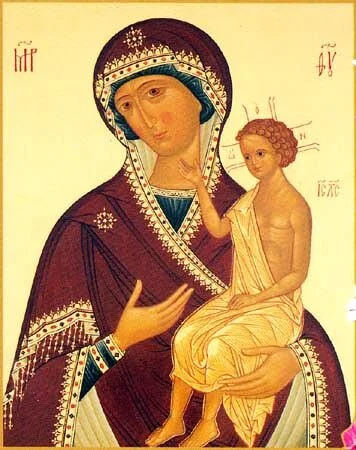
Icon of the Mother of God “The Nurturer”
My beloved spiritual children in Christ Our Only True God and Our Only True Savior,
CHRIST IS IN OUR MIDST! HE WAS, IS, AND EVER SHALL BE.
+
THE AKATHIST HYMN TO THE MOST HOLY THEOTOKOS AND EVER VIRGIN MARY
The "Akathist Hymn" is a profound, devotional poem, which sings the praises of the Holy Mother of God and Ever-Virgin Mary. While it is a composite work by more than one of our Ecclesiastical Hymnographers as we know it today, it was formally recited, or rather prayed in the year 626 A.D., in the church of the Theotokos of Vlachernae in Constantinople, on the occasion of the deliverance of the "Queen City" from the siege by the Barbarians.
The "Akathist Hymn" is a very important and indeed an integral part of our spiritual and ecclesiastical life. It is chanted in all the Orthodox Churches throughout the world, during the first 5 Fridays in Great and Holy Lent and constitutes a very concrete spiritual preparation for the Great and Holy Week and Paschal divine services. When we are present during the first Friday Service, we firmly realize that we commence ascending the spiritual steps of the lengthy Lenten period, to finally reach Our Lord's Glorious Resurrection.
The devotional Hymns to the Ever-Virgin Mary are as ancient as the first Christian Church. The Byzantine Empire from its very inception, closely allied itself to the Ever-Virgin Mary the Theotokos and always sought Her protection. This we see from the Prayer Services to the Theotokos in the 5th, through the 8th centuries. The "Akathist Hymn", which has more than one Author, existed for the most part even before the established year of 626 A.D. The Kontakion "To the Invincible Champion...we ascribe the victory" was added then and came to be recognized as the "Akathist Hymn", because of the following miracle attributed to the Mother of God.
While the Emperor of Byzantium Heracleos was on an expedition to fight the aggression of the Persians on their own grounds, there appeared outside the walls of Constantinople barbaric hordes, mostly Avars. The siege lasted for a few months, and it was apparent that the outnumbered Christian troops of the Queen City were reaching desperation.
However, as history records, the faith of the Orthodox Christians worked the impossible. The Venerable Patriarch Sergius with the Clergy and the high Official of Byzantium Vonos, endlessly marched along the great walls of the city of Constantinople with the Holy Icons of the Theotokos in hand and bolstered the faith of the defenders of victory. The miracle came very soon. Unexpectedly, as the chronicler narrates, a great storm with huge tidal waves destroyed most of the fleet of the enemy, and full retreat ensued.
The Orthodox Christians of Constantinople spontaneously filled the Church of the Theotokos at Vlachernae on the Golden Horn, and with the Patriarch Sergius officiating, they prayed all night chanting the praises of the Ever-Virgin Mary without sitting. Hence the title of the Hymn "Akathistos", the Greek word for "not seated."
This is the great Glory of our Holy Orthodox Church! Faith in the Almighty God was primary and all-important. Our dependence on God was always beyond question, and from this faith, we should always strive never to stray. Therefore, Services like the "Akathist Hymn", should be a must, and attended by all. Moreover, this particular divine Service links us so beautifully with a great and glorious period of our Christian history; it is also a very live tradition, which has never ceased in the Orthodox Church since the official year of the Hymn, 626 A.D.
Living in these trying times, when we are besieged by many forces of evil, it is my hope that the "Akathist Hymn" as well as our other divine Services may become the bulwark to withstand, and indeed to overcome these evil forces. (Source: Translation by Father George Papadeas)
Brief Outline
The "Akathist Hymn" is composed of 24 Stanzas as "Oikoi". The starting letter of each of the 24 Stanzas in sequence is a letter of the Greek Alphabet, Alpha to the Omega. Twelve of the Stanzas are lengthy and end with "Hail! O Bride Ever-Virgin", and the other twelve are rather short and conclude with "Alleluia", a Hebrew word meaning "Praise the Lord".
The Hymn is divided into 4 main parts, and briefly, the content is as follows:
The first 6 Stanzas recount:
a. The Annunciation to the Virgin Mary.
b. The Virgin Mary's purity.
c. The Virgin Mary's visit to Elizabeth.
d. The doubts of Joseph the protector, and his joy upon learning of the supernatural Conception.
Stanzas 7-12 tells us of:
a. The Shepherds hearing the Angels praising the Birth of the Lord and their visit in the Manger.
b. The adoration of the Magi.
c. The flight of the Holy Family to Egypt and the falling of the Idols.
d. The receiving of the Infant Jesus by the Prophet Symeon in the Temple on the 40th Day.
Stanzas 13-18 relate:
a. The new "Creation" which was wrought by the Incarnate Lord through the Theotokos.
b. The call for the uplifting of our minds to Heaven from where God descended.
c. The Lord's Omnipresence, that while He came to Earth, He was no less in Heaven.
d. The confounding of the philosophers and orators, who were at a loss to explain God's condescension.
The last Stanzas 19-24 speak of:
a. The Theotokos as a protectress of all the devout, and those who choose to flee unto Her.
b. God coming as one of us, amongst us, to draw us near to Him.
c. Our inability to adequately sing the praises of God, whose mercies are countless.
d. The Lord canceling all the ancient spiritual debts, and the granting of His Grace to all.
e. Our prayers and petitions to the Holy Mother of God to protect us from misfortunes and save us from the future condemnation.
All through the points outlined above, there is a plethora of beautiful portrayals of the Holy Mother of God and Ever-Virgin Mary, alluding to Her role in the Incarnation of the Lord and Savior Jesus Christ, for the Salvation of Mankind.
__________________
"Glory Be To GOD For All Things!" -- Saint John Chrysostom
+++
With sincere agape in His Holy Diakonia (Ministry),
The sinner and unworthy servant of God
+Father George
The Divine Service of the Great Compline
The Greek word for "Compline" is "Apodeipnon" which literally means "after dinner." There are many prescribed intervals of prayer during the day, and one of them is prayer before sleeping. There is a 'service' of the "Small Compline" which can be read by anyone. It does not require a priest and it does not need to be read in a church. There are many pious Orthodox Christians who pray the "Small Compline" throughout the year.

Venerable Theophanes the Confessor
My beloved spiritual children in Christ Our Only True God and Our Only True Savior,
CHRIST IS IN OUR MIDST! HE WAS, IS, AND EVER SHALL BE.
+
THE DIVINE SERVICE OF THE GREAT COMPLINE
The Journey to the Cross and Resurrection of Christ
The Greek word for "Compline" is "Apodeipnon" which literally means "after dinner." There are many prescribed intervals of prayer during the day, and one of them is prayer before sleeping. There is a 'service' of the "Small Compline" which can be read by anyone. It does not require a priest and it does not need to be read in a church. There are many pious Orthodox Christians who pray the "Small Compline" throughout the year.
The "Great Compline" (Gk. "Mega Apodeipnon") is a service reserved for the period of Great and Holy Lent. It is traditionally prayed in the evening. In most parishes, if it is done, it is celebrated on Monday, Tuesday, and/or Thursday evenings. On Wednesday and Friday evenings the parishes conduct the Pre-Sanctified Liturgy. Also, on Friday of Great and Holy Lent, we celebrate the service of the Akathist or Salutations to the Ever-Virgin Mary the Theotokos.
The Great Compline divine service lasts approximately an hour. The curtain of the Royal Doors (the "Royal Doors") located in the center of the iconostasis leading into the Holy Altar.), is generally closed during this service, until the very end, obscuring the altar from view. There is very little movement in this service by the priest, and there are no Gospel readings (except for the first week of Lent). The divine service of Great Compline consists of about dozen Old Testament Psalm readings, several prayers, and several hymns. The most well-known hymn of the divine service is called "Kyrie ton Thenameon" or "Lord of the Powers" and includes the following words:
"Lord of the Powers, be with us, For in time of distress, we have no other help but thee." "Lord of the Powers, have mercy on us."
The Great Compline divine service is one of the most comforting, and reassuring services of our Holy Orthodox Church because we come to realize God's protection and love for all of humanity. It is quite simple but yet contains much spiritual substance and inspiration. The believing Orthodox Christian feels touched by our Lord's grace and as a sinner is lead to contrition and repentance. All of our holy services, including for course, the Great Compline service, bestow healing of soul and body.
No true Orthodox Christian can ever marginalize the divine services of our Holy Church and reduce them to just "rituals." The Orthodox Christian not only attends a divine service but participates personally in it. The purpose is to always remain in His presence and commune with Him through worship, prayer and the Mysteries (Sacraments). He or she understands that the local consecrated church is a "hospital." It is indeed the "spiritual ICU." We are restored there by God and our injuries and spiritual and physical illnesses are cured.
In the prayer of Manasses, King of Judah we pray, "...Thou are God, the God of those who repent, and in me, Thou shall show all Thy goodness; for even though I am unworthy, Thou shall save me according to the multitude of Thy mercy, and I shall praise Thee without ceasing all the days of my life. For every heavenly power sings Thy praises, and Thine is the glory unto the ages of ages. Amen."
___________________
"Glory Be To GOD For All Things!" - Saint John Chrysostomos
+++
With sincere agape in His Holy Diakonia (Ministry),
The sinner and unworthy servant of God
+Father George
Holy Communion in the Orthodox Church
The Holy Eucharist is the Mystery (Sacrament) in which the bread and wine of offering are changed by the Holy Spirit into the true Body and true Blood of our Lord Jesus Christ, and then the believers receive Communion of them for a most intimate union with Christ and eternal life. This Sacrament is composed, thus, of two separate moments: (1) the changing or transformation of the bread and wine into the Holy Body and Precious Blood of the Lord, and (2) the Communion of these Holy Gifts. It is called "the Eucharist," "the Lord's Supper," "the Mystery of the Body and Blood of Christ." The Body and Blood of Christ in this Mystery are called the "Bread of heaven and the Cu of life" or the "Cup of salvation"; they are called the "Holy Mysteries," "the Bloodless Sacrifice." The Holy Eucharist is the greatest Christian Mystery (Sacrament).

My beloved spiritual children in Christ Our Only True God and Our Only True Savior,
CHRIST IS IN OUR MIDST! HE WAS, IS, AND EVER SHALL BE.
+
HOLY COMMUNION IN THE ORTHODOX CHURCH
The Holy Eucharist is the Mystery (Sacrament) in which the bread and wine of offering are changed by the Holy Spirit into the true Body and true Blood of our Lord Jesus Christ, and then the believers receive Communion of them for a most intimate union with Christ and eternal life. This Sacrament is composed, thus, of two separate moments: (1) the changing or transformation of the bread and wine into the Holy Body and Precious Blood of the Lord, and (2) the Communion of these Holy Gifts. It is called "the Eucharist," "the Lord's Supper," "the Mystery of the Body and Blood of Christ." The Body and Blood of Christ in this Mystery are called the "Bread of heaven and the Cup of life" or the "Cup of salvation"; they are called the "Holy Mysteries," "the Bloodless Sacrifice." The Holy Eucharist is the greatest Christian Mystery (Sacrament).
The Savior's Words before the Establishment of the Mystery
Before the first performance of this Mystery at the Mystical Supper (the Last Supper), Christ promised it in His conversation concerning the Bread of Life on the occasion of the feeding of the five thousand men with five loaves. The Lord taught, "I am the living Bread which came down from heaven: If any man eat of this Bread, he shall live forever; and the Bread which I will give is My Flesh, which I will give for the life of the world" (John 6:51). The Jews evidently understood the words of Christ literally. They began to say to each other, "How can this man give us His flesh to eat?" (John 6:52). And the Lord did not tell the Jews that they had understood Him incorrectly, but only with greater force and clarity He continued to speak with the same meaning: "Verily, verily, I say unto you, except ye eat the Flesh of the Son of Man, and drink His Blood, ye have no life in you. Whoso eateth My Flesh, and drinketh My Blood, hath eternal life, and I will raise him up at the last day. For My Flesh is meat indeed, and My Blood is drink indeed. He that eateth My Flesh, and drinketh My Blood dwelleth in Me, and I in him" (John 6:53-56).
The Changing of the Bread and Wine in the Mystery of the Eucharist
In the Mystery (Sacrament) of the Divine Eucharist, at the time when the priest, invoking the Holy Spirit upon the offered Gifts, blessed them with the prayer to God the Father: "Make this bread the Precious Body of Thy Christ; and that which is in this cup, the Precious Blood of Thy Christ; changing them by Thy Holy Spirit" --the bread and wine actually are changed into the Body and Blood by the coming down of the Holy Spirit. (This moment of the Invocation of the Holy Spirit is called epiclesis. Metropolitan Kallistos Ware writes: "According to Orthodox theology, the act of consecration is not complete until the epiclesis.) After this moment, although our eyes see bread and wine on the Holy Table, in their very essence, invisibly for sensual eyes, this is the true Body and true Blood of the Lord Jesus, only under the "forms" of bread and wine.
This Truth is expressed n the "Encyclical of the Eastern Patriarchs" in the following words: "We believe that in this Sacred rite our Lord Jesus Christ is present not symbolically (typikos), not figuratively (eikonikos), not by an abundance of grace, as in the other Mysteries (Sacraments), not by a simple descent, as certain Fathers say about Baptism, and not through a 'penetration' of the bread, so that the Divinity of the Logos/Word should 'enter' into the bread offered for the Eucharist, as the followers of Luther (Protestants) explain it rather awkwardly and unworthily--but truly and actually, so that after the sanctification of the bread and wine, the bread is changed, converted, transformed, into the actual true Body of the Lord...the wine is changed into the actual true Blood of the Lord, which at the time of His suffering on the Cross was shed for the life of the world. Yet again, we believe that after the sanctification of the bread and wine there remains no longer the bread and wine themselves, but the very Body and Blood of the Lord, under the appearance and form of bread and wine" (par. 17). (Source: The Orthodox Dogmatic Theology by Protopresbyter Michael Pomazansky)
_______________
As you can see from our Orthodox Theology, the Holy Gifts are Sacred, in that they have become imbued with the fullness of God's presence and Grace, and they are divine (not human) gifts, "for every good and perfect Gift is from above, coming from (Thee) the Father of lights" (Prayer behind the Amvon in the Divine Liturgy). If we truly believe in Christ, we know very well that the Almighty and Merciful God would never allow harm to come to us, most especially in the reception of Holy Communion.
Finally, it is important that we never forget that the Holy Sacraments are for the healing of both body and soul. As a priest of fifty years, I have never worried about consuming what remains of Holy Communion after everyone has received. "With the fear of God, with faith, and love draw near."
_________________
"Glory Be To GOD For All Things!" -- Saint John Chrysostomos
+++
With sincere agape in His Holy Diakonia,
The sinner and unworthy servant of God
+Father George
On the Thrice-Holy Hymn: "Holy God, Holy Mighty, Holy Immortal, Have Mercy Upon Us."

Saint John of Khakhuli the Oqropiri, also called Chrysostom
My beloved spiritual children in Christ Our Only True God and Our Only True Savior,
CHRIST IS IN OUR MIDST! HE WAS, IS, AND EVER SHALL BE.
+
ON THE THRICE-HOLY HYMN: "HOLY GOD, HOLY MIGHTY, HOLY IMMORTAL, HAVE MERCY UPON US"
By the saintly bishop of Florina Augoustinos Kantiotes (+ 2010)
The hymns which are chanted following the Small Entrance, and we hear the exclamation of the priest: "For Thou Our God art Holy, and to Thee, we ascribe glory, to the Father and to the Son and to the Holy Spirit, now and ever, unto the ages of ages." The Thrice-Holy hymn is then chanted: "Holy God, Holy Mighty, Holy Immortal, have mercy upon us."
This hymn has great importance for the Church. A historian of Byzantium, Theophanes, mentions the following event concerning this hymn. When Proclos (433 A.D.), a student of Saint John Chrysostom, was Patriarch of Constantinople, the city was shaken by earthquakes continuously for four months. The inhabitants, terrified, ran outside the walls of the city to a place called Campoi, and there prayed, and with tears in their eyes asked God to stop the earthquakes.
One day, when the earth was trembling and the people were crying, "Kyrie eleison" (Lord, have mercy), an unseen power carried off a child from the midst of the people, raising him towards heaven. And when the child came to earth, he said that he heard a Divine voice which ordered him to tell the bishop that intercessions must be chanted as follows: "Holy God, Holy Mighty, Holy Immortal, have mercy upon us." Patriarch Proclos ordered that this hymn be chanted. And when they began chanting it, the earthquakes stopped.
With prayer, with the Holy God...the earthquakes stopped. Perhaps someone who is educated, and boasts of his science, will laugh upon hearing this, and say: "What's this you're saying to us? An earthquake is a natural phenomenon and has nothing to do with God..." But the word of God assures us that earthquakes and all the other natural phenomena which take place in the world are dependent on God's power. The Psalm says: "Who looketh on the earth and maketh it tremble, Who toucheth the mountains and they smoke" (Psalms103:35). Saint John Chrysostom says that the cause of earthquakes is God's wrath, and the cause of God's wrath is the sins which people do continuously, young and old, clergy and laity...
"...There is a need to return to the piety of our ancestors. We must return to the ways of ancient times when Christians chanted the Thrice-Holy Hymn with tears in their eyes. For when the Christian is taught and knows what is meant by all that is said and takes place in the Divine Liturgy, there is hope that this Christian shall feel the grandeur of Sacred Worship.
Holy God. We spoke about the Saints in previous homilies. But by comparison with God, what is even the most holy man? One drop in comparison with an endless ocean. One ray in comparison with the sun. God only is holy and absolute degree; God is the source of holiness and sanctification. Man is enlightened by God and receives the power (from God) in order to live a life of holiness, which no matter what great heights it reaches, is small and unimportant in comparison with the infinite holiness of God. No one is holy like God.
Holy Mighty. Power is another attribute of God. Man is also called mighty. But man's power, no matter how great it is, no matter what mighty things he can do--even if he flies to the stars of the heavens--is small and unimportant in comparison with the All-Mightiness of God. The lord of Power is God. From Him comes every power and energy in the world. As a certain poet says, "One of God's looks has the power to shake the earth;" it is possible for the universe to dissolve into the elements "from which it was made" and a new world to be created.
Holy Immortal. Another attribute of God is immortality. God is immortal. What does immortality mean? While all things waste away and are destroyed, God remains unaltered, imperishable, eternal, immortal. He is life. He is the source of life. And if man is immortal, he is immortal not because of himself, not, that is to say, because of his own power, but because God created him "according to His image and likeness and gave him the gift of immortality. Man is immortal in soul, perishable in body, because of sin. But this perishable body shall become imperishable and eternal in the Kingdom of Heaven.
In the Thrice-Hymn, the word Holy is repeated three times. This threefold repetition is done purposely to show the three Persons of God, that Great Mystery of our faith that God is three hypostases (or persons). We worship and glorify one Divinity in three Persons. These three Persons--the Father, the Son, and the Holy Spirit--are one Divinity. That is why we do not say in the Thrice-Holy Hymn: "You (plural) have mercy on us," but "have Thou (singular) mercy on us." The three attributes we have mentioned--holiness, mightiness, and immortality--are attributes of the Father, of the Son, and of the Holy Spirit. "As Father, as Son, as Holy Spirit, O Holy Trinity, glory to Thee!"
My dear readers! We have seen the miracle that took place in Constantinople. We have seen the meaning of the Thrice-Holy Hymn. Priests, chanters, and laity: let us be careful during the time of the Thrice-Holy Hymn, and let us pray to the Triune God with pious contrition and a spirit of humility. (Source: Orthodox Heritage)
______________________
"Glory Be To GOD For All Things!" -- Saint John Chrysostomos
+++
With sincere agape in His Holy Diakonia (Ministry),
The sinner and unworthy servant of God
+Father George
Preparing Your Family for Great and Holy Lent
Great and Holy Lent is the Church's 40-day period of preparation for its greatest feast--the Resurrection of our Lord and Savior Jesus Christ. It is the annual period that calls us back to God--a time of reflection and repentance. While no two families ready themselves during Great and Holy Lent exactly alike, there are time-tested spiritual disciplines the Church prescribes in order to direct our senses to God's presence.

My beloved spiritual children in Christ Our Only True God and Our Only True Savior,
CHRIST IS IN OUR MIDST! HE WAS, IS, AND EVER SHALL BE.
+
PREPARING YOUR FAMILY FOR GREAT AND HOLY LENT
Great and Holy Lent is the Church's 40-day period of preparation for its greatest feast--the Resurrection of our Lord and Savior Jesus Christ. It is the annual period that calls us back to God--a time of reflection and repentance. While no two families ready themselves during Great and Holy Lent exactly alike, there are time-tested spiritual disciplines the Church prescribes in order to direct our senses to God's presence. In Preparing Your Family for Great Lent, Father Armatas and Elissa Bjeletich talk with Melissa Tsongranis in an engaging discussion that offers parents practical ways to make Great Lent a transformative family experience. May your Lenten journey be blessed--one arriving at a glorious Pascha!
Preparing Your Family for Great Lent highlights:
Seeing Great Lent as an opportunity, not as an imposition
The importance of simplifying and 'slowing down' during Great Lent
There's more to Great Lent than avoiding certain foods--there are opportunities for prayer and charitable works that round out the fast.
Ways parents can make the Church come alive in the home during Great Lent
Discussion Points:
Reflect upon the following quote from Father Alexander Schmemann that conveys the need for a change of priorities during Great Lent and consider the proceeding question: "We understand that it is simply impossible to pass from our normal state of mind made up almost entirely of fuss, rush, and care, into this new one without first 'quieting down,' without restoring in ourselves a measure of inner stability."
While necessary responsibilities such as jobs, home management, school, and other activities continue during this time, how can your family attempt to address the voluntary "fuss, rush, and care" that would prevent your family from "quieting down" and shifting our minds and hearts toward the will of God?Parents, you are leaders, the primary role models for your children's spiritual development. What an awesome responsibility! How can you best encourage your family--in its unique circumstances and abilities--to make a "doable and keep-able" plan for Great Lent in your home? Consult with your parish priest or spiritual adviser for further guidance.
As mentioned, fasting is only one of the spiritual disciplines that we pursue during Great Lent. There are also opportunities for prayer (private and corporate) and charitable acts that ground and complete the adjustments made to our diets.
Determine when your family can pray daily together for a few minutes in the morning and/or evening. Have a prayer rule everyone can participate in and become familiar with--make that "doable and keep-able too!
Determine when your family will attend the extraordinary Lenten services--Pre-Sanctified Liturgy, Salutations (Akathist) to the Theotokos, etc.
Determine when of-age members of the family can schedule, and prepare for, the Sacrament of Holy Confession during Great Lent.
Perhaps by accessing some of the resources mentioned (listed), determine someone creative ways to practice almsgiving (charity)--in Elissa's beautiful phrasing, "to bless someone else"-- during Great Lent that appeal to your family?
Remembering that we experience Great Lent also as united members of the Body of Christ, are there ways to enhance your family's Great Lent journey by interacting with fellow 'travelers,' sharing joys, struggles, and other topics--perhaps, over a meal of lentil soup?
Prayer of Saint Ephraim the Syrian
O Lord and Master of my life! Take from me the spirit of sloth, faint-heartedness, lust of power, and idle talk.
But give rather the spirit of chastity, humility, patience, and love to Thy servant.
Yes, Lord and King! Grant me to see my own errors and not to judge my brothers (or sister), for Thou are blessed unto the ages of ages. Amen.
Prayer for Children
O Lord, help me not to want to have my own way all the time. Help me to love others. Keep me from being jealous, and help me to know when I am wrong. Amen.
(Source: Guardian Angel Children's Prayer Boo, An Introduction to the Divine Liturgy and Prayers for the Young Child by Fr. T. Lozynsky...page 105
______________________
"Glory Be To GOD For All Things! - Saint John Chrysostomos
+++
With sincere agape in His Holy Diakonia (Ministry),
The sinner and unworthy servant of God
+Father George
The Beast of Anger
The spiritual-cognitive component of anger were long recognized by our Church Holy Fathers, Saint Basil the Great recognized the loss of reason in anger. "It makes a man completely bestial...in fact, it does not even allow him to be a man at all, because he no longer has the help of his reason."

My beloved spiritual children in Christ Our Only True God and Our Only True Savior,
CHRIST IS IN OUR MIDST! HE WAS, IS, AND EVER SHALL BE.
+
THE BEAST OF ANGER
By Father George Morelli
[Very Reverend Father George Morelli Ph.D. is a licensed Clinical Psychologist and Marriage and Family Therapist]
The spiritual-cognitive component of anger were long recognized by our Church Holy Fathers, Saint Basil the Great recognized the loss of reason in anger. "It makes a man completely bestial...in fact, it does not even allow him to be a man at all, because he no longer has the help of his reason."
An interesting spiritual issue arises in this context. In order for us to perceive ourselves to be "intruded on" to the extent that it justifies, anger, vengeance, and retaliation we have to see ourselves as 'important.' Saint Basil the Great tells us "Anger nurses a grievance. The soul, itching for vengeance, constantly tempts us to repay those who have offended" (Saint Basil the Great, Homily 10). I am so important, so above others, I have the "right" to act uncharitably toward others.
What is the root of this reaction? The passion and sin of pride. Saint Mark, the Ascetic (Philokalia V. I) wrote: "The passion is strengthened especially by pride. And as long as it is so strengthened it cannot be destroyed...Thus the structure of evil in the soul is impossible to destroy so long as it is rooted firmly in pride." From the Shephard of Hermas (Book II Commandment 5) who saw the Holy Spirit choked by anger: "For he is choked by the vile spirit, and cannot attend on the Lord as he wishes, for anger pollutes him. For the Lord dwells in long-suffering, but the devil in anger." Abba (Father) Agathon wrote that anger can produce spiritual death: "An irascible man, even if he is capable of raising the dead, will not be received into the Kingdom of Heaven." Another holy desert Father Abba (Father) Poimen saw anger as obliterating he who would consider himself a monk: "A complaining, vindictive monk, prone to anger, cannot exist." That is to say that, any who have such faults are not actually monks, even if they wear the schema."
Mankind is created in the image of God and as creatures of God, we are called to be "like" Him. (Genesis 1:26). The Church Holy Fathers define the image of God in us as our free will and intelligence. To be like Him meant that mankind must choose "the good." For our first parents, choosing good was to obey their Creator -- not to make themselves into gods by tasting the fruit of knowledge of good and evil (Genesis 2:17). Noting mankind coveted a spiritual power above its created nature Blessed Augustine interpreted this passage to mean that Adam and Eve thought of themselves as having the knowledge of God.
When God further revealed His Will in the form of the Law: the Ten Commandments (Deuteronomy 5:6-21), and other proscriptions listed for His people. When the fullness of time had come and God sent His "Only Begotten Son" our Lord God and Savior Jesus Christ, He revealed to us the fullness of what it was to be "like" Him. Our Lord tells us "And now I give you a new commandment: love one another. As I have loved you so you must love one another" (St. John 13:34, 35).
What greater love could the Father have for us that even though He is God, nevertheless, send His Son to take on our nature so we -- all mankind -- can be lifted up to Him? "For God so loved the world that He gave His Only Begotten Son: that whosoever believeth in Him may not perish, but may have life everlasting" (St. John 3:16). Let us ponder some of the things our Lord has told us about love. "If you forgive the faults of others your Heavenly Father will forgive you. If you do not forgive the faults of others, neither will your Heavenly Father forgive you" (St. Matthew 6:14-16). "My son your sins are forgiven" (St. Mark 2:5). "If you want to avoid judgment, stop passing judgment" (St. Matthew 7:1).
How do we achieve this love shown to us by the Father and His Son, our Lord, God, and Savior Jesus Christ? Saint Paul tells us: "Get rid of all bitterness, all passion, and anger, harsh words, slander and malice of every kind. In place of these, be kind to one another, compassionate, and mutually forgiving, just as God as has forgiven you in Christ" (Ephesians 4:31). Our calling as part of God's creation, as a member of Christ's body, the Church, is to grow and actualize ourselves; to find those imperfections in us that are barriers preventing us from being "like God"; that prevents us from loving and forgiving. In keeping with Saint Paul's words, our emotions, such as anger, are just such an imperfection or barrier. By making ourselves less angry we can grow in the love of God and our neighbor.
Current research psychology has helped us understand cognitive structure supporting and triggering anger. Besides aiding in helping us to understand how anger comes about, this research also helps us to employ psychological techniques that can aid in overcoming and preventing anger. The cognitive-behavioral model of emotional dysfunction has been shown to be effective in this regard...
We upset ourselves over people and events, by our "interpretations" of them, thereby making ourselves dysfunctionally angry, anxious or depressed or simply functionally annoyed, concerned and disappointed. If our thinking is clear, rational and non-distorted we have normal feelings like bearable nuisances, caring and livable letdowns. If our "interpretations" are irrational or distorted we get enraged, intensely worried and despondent.
From a spiritual perspective, we are to reflect on the life of our Lord. He was bruised, derided, cursed, defiled, and died for our salvation. He Himself told us: No servant is greater than his master (St. Matthew 10:24)--why would we expect to be treated any differently than our Lord. It is a blessing if we are treated and honored, but we have no guarantee...
"...We can reflect on the words of Saint Mark the Ascetic: "Do you want the tree of disorder--I mean the passion of bitterness, anger, and wrath--to dry up within you and become barred so that with the ax of the Spirit it may be 'new down and cast into the fire' together with every vice (Matthew 3:10)...If this is really what you want keep the humility of the Lord in your heart and never forget it...Call to mind Who He is, and what He became for our sakes. Reflect first on the Divine Light of His Divinity revealed to the essence above [the Angels] (Ephesians 1:21)...Then think to what humiliation He descended in his ineffable goodness, becoming in all respects like us who were dwelling in the dwelling of darkness and the shadow of death (St. Matthew 4:16)." Petition our Lord's help in this way to help restructure.
This "time-out" can be accomplished by something as simple as going to the restroom. Restructuring should also be incorporated into evening prayer, especially during the examination of conscience and prayer for forgiveness of sins. This active approach toward our becoming like Christ is our vocation as Christians. Saint James tells us "So you see, then, it is his actions that a person is put right with God, not by his faith alone" (St. James 2:24). All the wishing or prayer we do, if it does not lead us to actively make ourselves like Christ is empty.
"Since you are God's dear children you must try to be like Him, Your life must be controlled by love..." (Ephesians 5:1-2). Work, vivified by prayer and sacraments, is the way to advance in our likeness in Christ. Only then will we be able to say with Christ: "Father forgive them for they know not what they do" (St. Luke 23:34). This is true anger management.
_____________________
"Glory Be To GOD For All Things!" -- Saint John Chrysostomos
+++
With sincere agape in His Holy Diakonia (Ministry),
The sinner and unworthy servant of God
+Father George