
"Have Mercy Upon Me, O God According to Your Lovingkindness..." (Psalm 50 [51])
This is a psalm of repentance and God's mercy, and a prophecy about salvation through baptism (vv. 2, 7). Of all 150 psalms, this is the one most used in Holy Orthodox Church. It is a psalm of repentance said three times daily--Orthros (Matins), Third Hour, and Compline--as well as in every Divine Liturgy, where it is recited by the Orthodox priest as s sign of repentance while he censes before the Great Entrance.
My beloved spiritual children in Christ Our Only True God and Our Only True Savior,
CHRIST IS IN OUR MIDST! HE WAS, IS, AND EVER SHALL BE.
+
HAVE MERCY UPON ME, O GOD ACCORDING TO YOUR LOVINGKINDNESS..." (Psalm 50 [51])
This is a psalm of repentance and God's mercy, and a prophecy about salvation through baptism (vv. 2, 7). Of all 150 psalms, this is the one most used in Holy Orthodox Church. It is a psalm of repentance said three times daily--Orthros (Matins), Third Hour, and Compline--as well as in every Divine Liturgy, where it is recited by the Orthodox priest as s sign of repentance while he censes before the Great Entrance.
The Orthodox Christian seeking to establish communion with His Creator approaches Him with profound humility and meekness. No one is worthy of addressing God without first repenting of one's sins and cleansed of them. We return to our heavenly Father the same way as the prodigal son by saying "I will arise and go to my Father, and will say to Him, Father, I have sinned against heaven and before You, and I am no longer worthy to be called your son. Make me like one of Your hired servants" (St. Luke 15:18-19).
I am penitent and not righteous. Great and Holy Lent is a time of penitence. In the first centuries of the Church, the 'penitents', or sinners who repented publicly, were solemnly reconciled with the community of the faithful during this period of Lent. Are we not all, in different degrees, sinners and penitents? This holy period which leads us toward Pascha is certainly a time that is very appropriate for repentance and cleansing. Holy Lent will, therefore, be an opportunity for us to truly examine our conscience and reconciliation with the Lord.
Holy and Great Lent is also a time of spiritual growth and of illumination. The weekday divine services of Great and Holy Lent are characterized by special Lenten hymns of a penitential character. The Royal Gates to the Altar area remain closed to signify man's separation through sin from the Kingdom of God. The church vesting is of somber color, usually purple. The daily hymns are also of an intercessory character, entreating the Almighty God through His Saints to have mercy on us sinners.
In Orthodox Spirituality, life's journey is a continuous devotion of self to our Lord and Savior Jesus Christ. It begins with the pre-baptismal prayers for infants and it ends with the funeral service. The Divine Mysteries (Sacraments), prayers and the ascetic way of life (fasting, purity and marital faithfulness) are means of sanctification that gives us a genuine taste of God's Heavenly Kingdom while still on earth.
A well-known prayer of the Orthodox Church speaks of the spirit of God being "present in all places and filling all things." This profound affirmation is basic to Orthodoxy's understanding of God and His relationship to the world. We truly believe God is with us. In the Compline service during Lent, we chant: "God is with us, know it you Nations and be submissive, For God is with us."
We, as Orthodox Christians, believe that God is truly near to us. Although He cannot be seen, God is not detached from the world that He created. Through the Persons of the Risen Lord and the Holy Spirit, God is present and active in our lives and in the creation around us. Everything about us testifies of His existence and reveals His unconditional love for the cosmos.
The Christian believer is personally touched by the grace of God through the Mysteries (Sacraments) of the Church. It is called having a Sacramental life. The energy of the Kingdom experienced in the Church is manifested through the divine Sacraments offered in faith. The Almighty and Loving God touches, purifies, illumines, sanctifies and deifies human life in His uncreated Divine energies through the sacraments.
By active participation in the Sacraments of the Church, the believer is prepared for future life when he or she will be in constant communion with God. The Holy Mysteria are at once inward and outward in character. Redeeming and sanctifying grace is transmitted by visible means. The material things are made into vehicles of the mysterious power of the Divine grace of God the Holy Spirit.
The divine Sacraments are indispensable for the salvation of the Christian believer. Salvation is accomplished by the Lord in cooperation (synergy) with humanity. It is important, however, to understand that the Mysteries are neither magic nor mechanical operations. Faith in the Triune God is essential and necessary for the sought after salvation.
During Great and Holy Lent the Orthodox Christian must prepare spiritually to receive the Mysteries of the Church and be sanctified, healed, and renewed. The Orthodox Christian approaches the Mysteries (Sacraments) with the "fear of God, with faith and with love." Care must be taken that one approaches the Holy Body and Precious Blood of the Lord Christ and spiritual understanding. In the New Testament, those who receive Christ's Holy Body and Precious Blood unworthily are said to bring condemnation upon themselves. "For this reason, many are weak and sick among you, and many sleep" (literally, "are dead"; 1 Corinthians 11:30).
_____________________
"Glory Be To GOD For All Things!" -- Saint John Chrysostomos
+++
With sincere agape in Christ's Holy Diakonia (Ministry),
The sinner and unworthy servant of God
+Father George
Celebrating the Triumph of Orthodox Christianity as One United Family in Christ
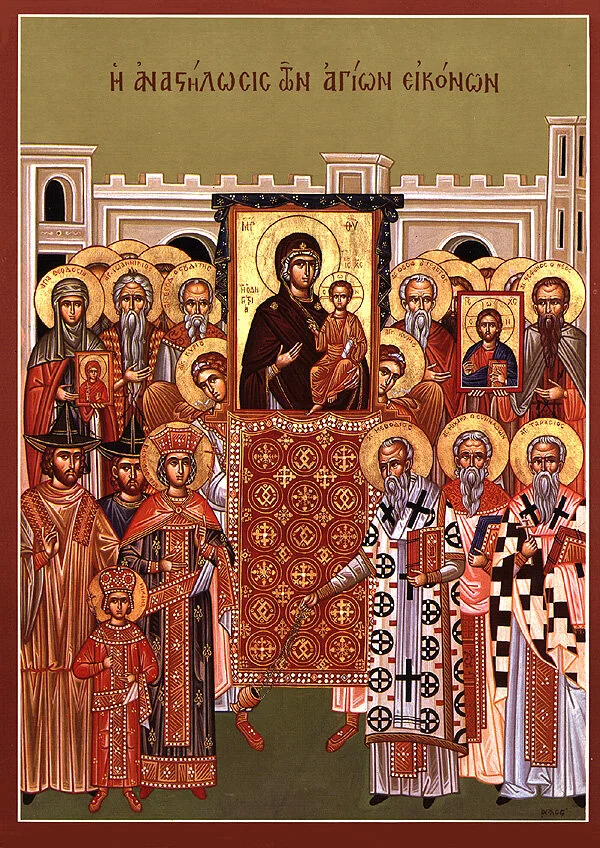
On the first Sunday of Great and Holy Lent is the Sunday of Orthodoxy, the triumph of the only true and authentic Church of Christ our Lord and Savior. The theme of this Sunday since 843 A.D. has been that of the victory of the holy icons. In that year the iconoclastic controversy, which had raged on and off since 726 A.D., was finally laid to rest, and holy icons and their veneration were restored on the first Sunday of Great and Holy Lent. Since then, this Sunday has been commemorated as the "Triumph of Orthodoxy."
My beloved spiritual children in Christ Our Only True God and Our Only True Savior,
CHRIST IS IN OUR MIDST! HE WAS, IS, AND EVER SHALL BE.
+
CELEBRATING THE TRIUMPH OF ORTHODOX CHRISTIANITY AS ONE UNITED FAMILY IN CHRIST
On the first Sunday of Great and Holy Lent is the Sunday of Orthodoxy, the triumph of the only true and authentic Church of Christ our Lord and Savior. The theme of this Sunday since 843 A.D. has been that of the victory of the holy icons. In that year the iconoclastic controversy, which had raged on and off since 726 A.D., was finally laid to rest, and holy icons and their veneration were restored on the first Sunday of Great and Holy Lent. Since then, this Sunday has been commemorated as the "Triumph of Orthodoxy."
The name of this Sunday reflects the great significance which holy icons possess for the Orthodox Church. They are not optional devotional extras, but an integral part of Orthodox Christian faith and devotion. They are held to be a necessary consequence of Christian faith in the Incarnation of the Logos/Word of God, the Second Person of the Trinity, in Jesus Christ. They have a sacramental character, making present to the believer the person or event depicted on them. So the interior of Orthodox churches is often covered with holy icons painted on walls and domed roofs, and there is always an icon screen, or iconostasis, separating the Sanctuary from the Nave, often with several rows of holy icons. No Orthodox Christian home is complete without an icon corner (iconostasion), where the family prays.
Holy icons are venerated by burning lamps and candles in front of them, by the use of incense and by kissing. But there is a clear doctrinal distinction between the veneration paid to holy icons and the worship due to God alone. The former is not only relative, but it is also in fact paid to the person represented by the holy icons. This distinction safeguards the veneration of holy icons from any accusation of idolatry.
The theme of the triumph of the holy icons, by its emphasis on the Incarnation, points us to the basic Christian truth that the One Whose death and Resurrection we celebrate at Pascha was none other than the Logos/Word of God Who became human in Jesus Christ.
On the evening of the Sunday of Orthodoxy, the area sister Orthodox churches, and fellow Orthodox Christians come together at the divine service of Vespers to celebrate together, as one Orthodox Christian family, the triumph of Orthodoxy. All Orthodox Christians bring with them a holy icon and participate in the procession of the icons. At the end of the service, people line up to venerate the holy icons held by the officiating priests.
The Pan-Orthodox Vespers will take place at our sister church of Saints Peter and Paul Serbian church on Sunday evening at 6:00 p.m. Father Vladimir Lang is the host priest and the homilist is Father Gregory Owen of the Bulgarian Orthodox Church. Following the holy service, the parish has prepared a Lenten supper for all attending.
I respectfully request that our parish of Saint Andrew is well-represented at Vespers. It is the only time that we as fellow Orthodox Christians come together. It is extremely important that we, as brothers and sisters in Christ, strengthen our friendship, brotherly love, and relationship with each other. We live in a very dangerous and uncertain world that continues to persecute our Christian faith. Persecution against our Lord and Savior Christ and His Holy Church continues throughout the world. The number of heresies are abundant and seek to undermine the Gospel of Christ and cause more divisions, confusion, hatred, and to distort the image of Christ. It is said that there are approximately 37,000 denominations worldwide among Protestant Christians. Most of us witness the systematic effort to dilute Christianity by and through secularization.
Let us turn to the only Head of the Church our Lord and Savior Jesus Christ the Founder of the Church, to guide, protect, inspire and strengthen us to continue our struggle against the forces of the Evil One.
May God bless you and keep you.
With love in His Divine Diakonia (Ministry),
+Father George
First Sunday of Great and Holy Lent - Sunday of Orthodoxy
"Rejoicing today in the triumph of Orthodoxy on this first Sunday of Lent, we joyfully commemorate three events: one event belonging to the past; one event to the present; and one event which still belongs to the future."
Rejoicing today in the triumph of Orthodoxy on this first Sunday of Lent, we joyfully commemorate three events: one event belonging to the past; one event to the present; and one event which still belongs to the future.

My beloved spiritual children in Christ Our Only True God and Our Only True Savior,
CHRIST IS IN OUR MIDST! HE WAS, IS, AND EVER SHALL BE.
+
FIRST SUNDAY OF GREAT AND HOLY LENT - SUNDAY OF ORTHODOXY
"Rejoicing today in the triumph of Orthodoxy on this first Sunday of Lent, we joyfully commemorate three events: one event belonging to the past; one event to the present; and one event which still belongs to the future."
Rejoicing today in the triumph of Orthodoxy on this first Sunday of Lent, we joyfully commemorate three events: one event belonging to the past; one event to the present; and one event which still belongs to the future.
Whenever we have any feast or joy in the Church, we Orthodox first of all look back -- for in our present life we depend on what happened in the past. We depend first of all, of course, on the first and the ultimate triumph--that of Christ Himself. Our faith is rooted in that strange defeat which became the most glorious victory -- the defeat of a man nailed to the cross, who rose again from the dead, who is the Lord and the Master of the world. This is the first triumph of Orthodoxy. This is the content of all our commemorations and of all our joy. This Man selected and chose twelve men, gave them the power to preach about that defeat and that victory, and sent them to the whole world saying preach and baptize, build up the Church, announce the Kingdom of God. And you know, my brothers and sisters, how those twelve men -- very simple men indeed, simple fishermen -- went out and preached. The world hated them, the Roman Empire persecuted them, and they were covered with blood. But that blood was another victory. The Church grew, the Church covered the universe with the True faith. After 300 years of the most unequal conflict between the powerful Roman Empire and the powerless Christian Church, the Roman Empire accepted Christ as Lord and Master. That was the second triumph of Orthodoxy. The Roman Empire recognized the one whom it crucified and those whom it persecuted as the bearers of truth, and their teaching as the teaching of life eternal. The Church triumphed. But then the second period of troubles began.
The following centuries saw many attempts to distort the faith, to adjust it to human needs, to fill it with human content. In each generation, there were those who could not accept that message of the Cross and resurrection and life eternal. They tried to change it, and those changes we call heresies. Again there were persecutions. Again, Orthodox bishops, monks, and laymen defended their faith and were condemned and went into exile and were covered with blood. And after five centuries of those conflicts and persecutions and discussions, the day came which we commemorate today, the day of the final victory of Orthodoxy as the True faith over all the heresies. It happened on the first Sunday of Lent in the year 843 in Constantinople. After almost 100 years of persecution directed against the veneration of the holy icons, the Church finally proclaimed that the truth had been defined, that the truth was fully in the possession of the Church. And since then all Orthodox people, wherever they live, have regarded this Sunday to proclaim before the world their faith in that truth, their belief that the Church is truly Apostolic, truly Orthodox, truly universal. This is the event of the past that we commemorate today...
"...Today, gathered here together, Orthodox of various national backgrounds, we proclaim and we glorify first of all our unity in Orthodoxy. This is the triumph of Orthodoxy in the present. This is a most wonderful event: that all of us, with all our differences, with all our limitations, with all our weaknesses, can come together and say we belong to that Orthodox faith, that we are one in Christ and in Orthodoxy. We are living very far from the traditional centers of Orthodoxy. We call ourselves Eastern Orthodox, and yet we are here in the West, so far from those glorious cities which were centers of the Orthodox faith for centuries--Constantinople, Alexandria, Antioch, Jerusalem, Moscow. How far are those cities? And yet, don't we have the feeling that something of a miracle has happened, that God has sent us here, far into the West, not just in order to settle here, to increase our income, to build up a community. He also has sent us as apostles of Orthodoxy, so that this faith, which historically was limited to the East, now is becoming a faith that is truly and completely universal...
"...As we approach the most important moment of the Eucharist, the priest says, "Let us love one another, that with one mind we may confess..." What is the condition of the real triumph of Orthodoxy? What is the way leading to the real, the final, the ultimate victory of our faith? The answer comes from the Gospel. The answer comes from Christ Himself and from the whole Tradition of Orthodoxy. It is love. Let us love one another, that with one mind we may confess...confess our faith, our Orthodoxy. Let us, from now on, feel responsible for each other. Let us understand that even if we are divided in small parishes, in small dioceses, we, first of all, belong to one another. We belong together, to Christ, to His Body, to the Church. Let us feel responsible for each other, and let us love one another. Let us put above everything else the interests of Orthodoxy in this country. Let us understand that each one of us today has to be the apostle of Orthodoxy in a country which is not yet Orthodox, in a society which is asking us: "What do you believe?" "What is your faith?" And let us, above everything else, keep the memory, keep the experience, keep the taste of that unity which we are anticipating tonight...
Today is the triumph of Orthodoxy, and a hymn sung today states solemnly and simply: "This is the Apostolic faith, this is the Orthodox faith, this is the faith of the Fathers, this is the faith that is the foundation of the world." My dear brothers and sisters, this is also our own faith. We are chosen. We are elected. We are the happy few that can say of our faith, "Apostolic," "universal," the faith of our fathers," "Orthodoxy," "the truth." Having this wonderful treasure, let us preserve it, let us keep it, and let us also use it in such a way that this treasure becomes the victory of Christ in us and in His Church. Amen. (Source: Orthodox Church in America)
______________
"Glory Be To GOD For All Things!" -- Saint John Chrysostomos
+++
With sincere agape in His Holy Diakonia (Ministry),
The sinner and unworthy servant of God
+Father George
Adult Orthodox Religious Education Ministry (Diakonia)
Saint Nikolai Velimirovic emphasized the significance of the continuing adult education and how crucial to the spiritual health of the faithful and community around us when he said, "The better one knows our Orthodox faith, the more he loves it." (Missionary Letters)

Saint Nikolai Velimirovic
My beloved spiritual children in Christ Our Only True God and Our Only True Savior,
CHRIST IS IN OUR MIDST! HE WAS, IS, AND EVER SHALL BE.
+
ADULT ORTHODOX RELIGIOUS EDUCATION MINISTRY (DIAKONIA)
Saint Nikolai Velimirovic emphasized the significance of the continuing adult education and how crucial to the spiritual health of the faithful and community around us when he said, "The better one knows our Orthodox faith, the more he loves it." (Missionary Letters)
We, at Saint Andrew, take adult education seriously. For years there has been an online adult religious education on a daily basis, we have a weekly Adult Bible Catechetical Class, we have an Orthodox Parish Library, all of our faithful are able to purchase religious items and books on the various aspects of our Faith from the Saint Andrew Bookstore, and various Orthodox pamphlets free of charge on spiritual topics as well as synopsis of the Mysteries (Sacraments), Church History, and the numerous traditions, social issues, etc.
I congratulate all of you who show such great interest and willingness to enrich your knowledge of our Christian Faith. "The gate by which we enter the Kingdom of God is increasingly becoming narrow, and we need to have ongoing instruction, guidance, encouragement, inspiration, support and, where necessary and importantly, correction."
Many of our Christian converts to the Orthodox Faith have described the discovery of Orthodoxy as "discovering gold". Other converts have described finding "the light of the early Church" that still shines in Orthodoxy." Others have described Orthodox Christianity as the "fullness of the Christian faith."
It is my hope that these classes and the religious education offered to our people will afford them the opportunity to discover this "gold", this "light of Christianity", this "fullness". Our goal at Saint Andrew is not only one of discovery, but also one of learning how to experience this fullness of life in Christ through the fullness of the Christian faith retained without alteration in the Orthodox Christian Church, the authentic Church of Christ.
Saint Peter the Holy Apostle writes, "...you are a chosen generation, a royal priesthood, a holy nation, His own special people, that you may proclaim the praises of Him Who called you out of darkness into His marvelous light; who once were not a people but are now the people of God, who had not obtained mercy but now have obtained mercy" (1 Peter 2:9-10).
A blessed Great and Holy Lent to all.
With agape in Christ God,
+Father George
Rules for a Saving Confession
All Christians without exception must go to Confession if they wish to be saved. But how should the truly faithful Confession occur? Many do not know this, and that is why is necessary to discuss this question more thoroughly. Here we will look at the following three parts of Confession:
a) What we should do before we go to the confessor.
b) What we should do when we are with the confessor.
c) What we should do when we come out of Confession.

My beloved spiritual children in Christ Our Only True God and Our Only True Savior,
CHRIST IS IN OUR MIDST! HE WAS, IS, AND EVER SHALL BE.
+
RULES FOR A SAVING CONFESSION
All Christians without exception must go to Confession if they wish to be saved. But how should the truly faithful Confession occur? Many do not know this, and that is why is necessary to discuss this question more thoroughly. Here we will look at the following three parts of Confession:
a) What we should do before we go to the confessor.
b) What we should do when we are with the confessor.
c) What we should do when we come out of Confession.
What should we do before we go to the confessor?
The first and the last of the Apostles of Christ sinned gravely. Peter denied Christ; Judas betrayed Him. But Peter was forgiven and Judas perished. Peter regained his Apostolic dignity, but the condemnation of the ages is still weighing on Judas. What saved Peter, and what destroyed Judas? What should have this wretch done? Should he have confessed the sin after he committed it? But, technically speaking, he confessed when he went to the scribes and elders and told them, "I have sinned in that i have betrayed the innocent blood" (St. Matthew 27:4), and with the confession gave back the thirty silver pieces to them. Is this not enough? Alas, no! A confession by itself does not save. Besides a broken heart, a live faith in God's grace is needed. Judas despaired of his salvation; that is why he hung himself after his confession. His body hung on a tree, and his soul went to hell for eternal torment.
Peter did not do so. In the yard of Caiaphas he denied Christ, his Benefactor, and Teacher, three times: "I do not know the man" (St. Matthew 26:74). But at the third denial, when he heard the rooster crow, he remembered what Christ had prophesied, realized his sin, and humbled his heart. He went out of that yard, got out of the bad company of the servants of the high priest, and, most importantly, began to shed bitter tears--tears of sincere, heartfelt, deep repentance. According to one tradition, throughout his whole life, whenever he heard a rooster crow Peter remembered his heavy sin, and his eyes turned into two springs of most repentant tears. Peter did not despair; he believed in God's mercy and thus saved himself.
Saint Peter has left us a living lesson: to turn again to God after our fall into sin. It is faith in God's mercy which drives away ever despair. God is love (agape). However grave our sin may be, He will forgive it, provided we repent from the heart. Even if our sins are as high as the mountains, they will sink in the ocean of God's mercy. However, if a man despair, he is lost. Despair is the triumph of the devil. In short, let us protect ourselves from despair because if we despair no one can save us.
We should imitate the holy Apostle Peter in another respect, as well. As he realized his sin, he immediately went out of the accursed yard of the high priest where he had denied Christ. And you, brother or sister when you want to confess and come back to God, come out of that accursed yard of sin where you have been until now and where you have denied Christ not three times, but thirty-three times. Come out with your body, with your heart, and with your mind! Peter went away from the servants of the high priest. You, too, abandon the friendship with those who teach you to sin or who unwittingly serve as a temptation to you.
What should we do when we are with the confessor?
We have to do the following:
1) Remember that we have come to Christ's infirmary. Here, the visible doctor is the priest, and the invisible--Christ Himself;
2) Confess our sins without false shame;
3) Not seek excuses for our sins;
4) Consciously conceal absolutely nothing;
5) Do not confess with general phrases which have no meaning;
6) Confess briefly, but precisely, the character of each of our sins;
7) Not reveal other people's sins, and conceal, whenever possible, the names of the persons who have tempted us or who have sinned with us through our fault;
8) Not to boast before the priest of any virtues of ours;
9) Not to transfer the blame on others, but only on ourselves; and
10) Have a sincere desire not to sin again.
(Source: The Forgotten Medicine: The Mystery of Repentance by Archimandrite Seraphim Aleksiev)
(To be continued)
_____________________
THIS EVENING:
The Canon of Saint Andrew of Crete at 6:30 p.m.
Chapel of Saint Nektarios
____________________
"Glory Be To GOD For All Things!"
+++
With sincere agape in His Holy Diakonia (Ministry),
The sinner and unworthy servant of God
+Father George
Reflections on the Mysterion (Sacrament) of Confession
For each conscientious priest, Confession is without any doubt one of the most difficult and frustrating aspects of his ministry. It is here, on the one hand, that he encounters the only real object of his Pastoral care: the human soul, man, as he stands sinful and miserable, before God. But it is here, on the other hand, that he realizes to what degree nominal Christianity has pervaded our Church life. The basic Christian notions of sin and repentance, reconciliation with God and renewal of life, seem to have become irrelevant. If the terms are still used, their meaning is certainly quite different from that, on which our whole Christian faith is based.

My beloved spiritual children in Christ Our Only True God and Our Only True Savior,
CHRIST IS IN OUR MIDST! HE WAS, IS, AND EVER SHALL BE.
+
REFLECTIONS ON THE MYSTERION (SACRAMENT) OF CONFESSION
By Protopresbyter Alexander Schmemann
For each conscientious priest, Confession is without any doubt one of the most difficult and frustrating aspects of his ministry. It is here, on the one hand, that he encounters the only real object of his Pastoral care: the human soul, man, as he stands sinful and miserable, before God. But it is here, on the other hand, that he realizes to what degree nominal Christianity has pervaded our Church life. The basic Christian notions of sin and repentance, reconciliation with God and renewal of life, seem to have become irrelevant. If the terms are still used, their meaning is certainly quite different from that, on which our whole Christian faith is based.
Another source of difficulties is the theoretical, or even theological, confusion as to the nature of the Sacrament of Penance. In practice, a purely formal and juridical understanding of it, clearly Western and "romanizing" in its origin, coexists paradoxically with an equally doubtful reduction of confession to psychology. In the first case, the man comes to the priest, confesses transgressions of Christian law, and receives absolution which entitles him to the second sacrament "of obligation" - Holy Communion. Confession proper is reduced here to a minimum, and in some churches even replaced by a general formula to be read by the penitent. If the first case reveals "romanizing" tendencies, the second can be termed "protestantizing". Confession is regarded as "counseling," as helping and solving difficulties and problems and is a dialogue not between man and God, but between man and a supposedly wise and experienced advisor with ready answers to all human problems. Both tendencies, however, obscure and deform the truly Orthodox understanding and practice of Confession.
The existing situation is due to many factors. And, although it is obviously impossible to enumerate all of them here and to even outline the very complicated historical development of the Mysterion (Sacrament) of Penance/Confession, a few remarks are necessary before we discuss possible solutions.
a) Originally the Sacrament of Penance/Confession was understood and practiced as reconciliation of those excommunicated, i.e., banished from the "Ecclesia" -the Assembly of the People of God and its fulfillment in the Divine Eucharist which is the "Koinonia" of the Body and Blood of Christ. The excommunicated is the one who cannot offer and, therefore, cannot receive. This reconciliation was a long process and the absolution -- its final seal, the sign or "image" of repentance, i.e., of the rejection and condemnation by the penitent of his sin and alienation from God, of its real confession (manifestation, recognition) as sin. The power of absolution was not thought of as a "power in itself", virtually independent from repentance. It was indeed the Sacramental sign of an acceptance and that God has accepted it, has "reconciled and united" the penitent with the Church. Whatever changes occurred in the practice of the Sacrament, this first and essential meaning, is still the starting point of its Orthodox Christian understanding.
(To be continued)
________________________
"Glory Be To GOD For All Things!" -- Saint John Chrysostom
+++
With sincere agape in His Holy Diakonia (Ministry),
The sinner and unworthy servant of God
+Father George