
Second Sunday of Pascha - Thomas Sunday
When Mary Magdalene brought her news to the Disciples, it is likely that they reacted in one of two ways: either they did not believe her, or, if they did, they were crestfallen because they were not deemed worthy to see Christ. Meanwhile, fear of the Jews was increasing the Disciples' longing to see the only One Who could relieve their anxiety.

My beloved spiritual children in Our Risen Lord, Our Only True God and Our Only True Savior,CHRIST IS RISEN! TRULY HE IS RISEN!
+
THE SECOND SUNDAY OF PASCHA. THOMAS SUNDAY (John 20:19-31)
By Saint Theophylact, Archbishop of Ochrid and Bulgaria
When Mary Magdalene brought her news to the Disciples, it is likely that they reacted in one of two ways: either they did not believe her, or, if they did, they were crestfallen because they were not deemed worthy to see Christ. Meanwhile, fear of the Jews was increasing the Disciples' longing to see the only One Who could relieve their anxiety. And so the Lord appeared to them that very evening when all of them were gathered together. It is written that He appeared when the doors were shut, meaning, He entered through locked doors. This was to show that He had risen in the very same manner, while the entrance to the tomb was shut with a stone. One would think they might have taken Him for a ghost, but Mary Magdalene's testimony had greatly strengthened their faith. Also, He manifested Himself in such a way as to calm their tumultuous thoughts: "Peace be unto you," He said gently, meaning, "Be not afraid." This was to remind them of what He had told them before the crucifixion, "My peace I give unto you" (John 14:27). Then were the Disciples glad, when they saw the Lord. This too, He had foretold before His death: "I will see you again, and your heart shall rejoice" (John 16:22). It was well that He should say to them again, Peace, for the Disciples were now engaged in a desperate struggle with the Jews. As He said, "Rejoice to the women" (Matthew 28:9), because sorrows were their lot, so he grants peace to the Disciples, who were now, and would always be, at war with the Jews...
"... It is worth considering why Saint John records only that Christ appeared to His Disciples in Jerusalem, while Sts. Matthew and Mark say that He promised to appear to them in Galilee (see Matthew 26:32; Mark 14:28). Some have explained it this way: "Christ never said He would appear to the Disciples only in Galilee, and not in Jerusalem. In Jerusalem, He appeared to the Twelve, whereas in Galilee, He appeared to all His Disciples, in accordance with His promise. The fact that He showed Himself many times to the Twelve indicates that He honored them more highly than the others." From this, we again see that there are no irreconcilable disagreements between the accounts of the Evangelists.
Thomas...was not with the Disciples, perhaps because he had not yet returned from where he was hiding after the Disciples had scattered. Elsewhere, we learned that the Hebrew name "Cephas" means "Rock" (Πέτρος, see John 1:42); here we are told that "Thomas" means "Twin" (Δίδυμος). The Evangelist provides the meaning of the name here to indicate that Thomas was prone to be of two minds--a doubter by nature. He doubted the news brought to him by the others, not because he thought they were liars, but because he considered it impossible for a man to rise from the dead. And his doubt made him excessively inquisitive. Gullibility is a sign of light-mindedness, but stubborn resistance to truth is a sure indication of thick-headedness. Thomas would not even trust his eyes, but demanded proof by touch, the least discriminating of the senses; "except I shall...thrust my hand into His side." How did Thomas know there were wounds in Christ's hands and side? Because the other Disciples had told him. And why does the Lord wait eight days before appearing to him? To allow time for each of Thomas' fellow Disciples to tell him what they had witnessed. Hearing the same story from each one individually made him more willing to believe, and increased his desire to see the Lord. In order to show that He was invisibly present eight days earlier, when Thomas had expressed disbelief, the Lord does not wait for Thomas to speak. Instead, He straightway proposes exactly what Thomas desired, quoting his very words.
First He rebukes Thomas, saying, "Reach hither thy hand;" then He admonishes him: "and be not faithless, but believing." From this it is clear that Thomas' doubt was caused by lack of faith, and not because he was careful to verify the facts (as some say, wishing to put him in better light). But as soon as Thomas touched the Lord's side, he was revealed as a superb theologian, proclaiming the two natures and single hypostasis of the one Christ. Thomas refers to the Human Nature of Christ, calling Him Lord; for the term, "Lord" (Κύριος) is applied not just to God, but to men as well. (Thinking that Jesus was the gardener, Mary Magdalene had said to Him, Sir (Κύριε), "if thou have borne Him hence..." (v. 15). But when Thomas cries out, "...and My God," he confesses Christ's Divine essence, and affirms that the names Lord and God refer to one and the same Person. By declaring "blessed those who have not seen, and yet have believed," the Lord teaches us that faith means the acceptance of things not seen. He is referring, first to the Disciples who believed without touching His side or the print of the nails and second to those who would later believe (without any physical confirmation). He is not depriving Thomas of his share of blessedness but encouraging all who have not seen. There was a common saying, "Blessed are the eyes that I have seen the Lord." Christ, however, praises those who will believe without seeing, declaring them to be truly blessed.
A question arises: how can an incorruptible body display the mark of nails and be touched by human hands? The answer is that such things are possible as part of the Divine Economia (dispensation): they are manifestations of God’s condescension and love for man. By entering the room when the doors were shut, Christ makes it absolutely clear that after the Resurrection His body is altered: it is now light and subtle, free of all material coarseness. But to confirm that it is indeed their Lord and Master Who has appeared to them, He permits His Resurrected body, bearing the words of the Crucifixion, to be touched. For the same reason, when He walked on the water before the Passion (see Mark 6:48), His body was unchanged from when He was walking about on land, and this reassured the Disciples. But though He allows His Resurrected body to be touched, it is now impassible and incorruptible. When Christ eats now with the Disciples, it is no longer to satisfy any physical demand of His body (for there were none). Food once eaten is altered in the stomach and passes out into the drain (see Matthew 15:17). But it was not so with Christ after the Resurrection. The food He ate during that time was consumed by an invisible, divine power. His only purpose in eating was to confirm the reality of His Resurrection, and He permitted His incorruptible body to bear the mark of nails, and to be handled, for the same reason. Do you see, O reader, how, in order to save one doubting soul, the Lord did not spare His own dignity, but condescended to bare His side? Neither should we despise even the least of our brethren.
________________________
DIVINE SERVICES TOMORROW SUNDAY:
Orthros at 9:00 a.m.Divine Liturgy at 10:00 a.m.
_______________________
"Glory Be To GOD For All Things!" -- Saint John Chrysostom
+ + +
With sincere agape in Our Risen Lord,
The sinner and unworthy servant of God
+ Father George
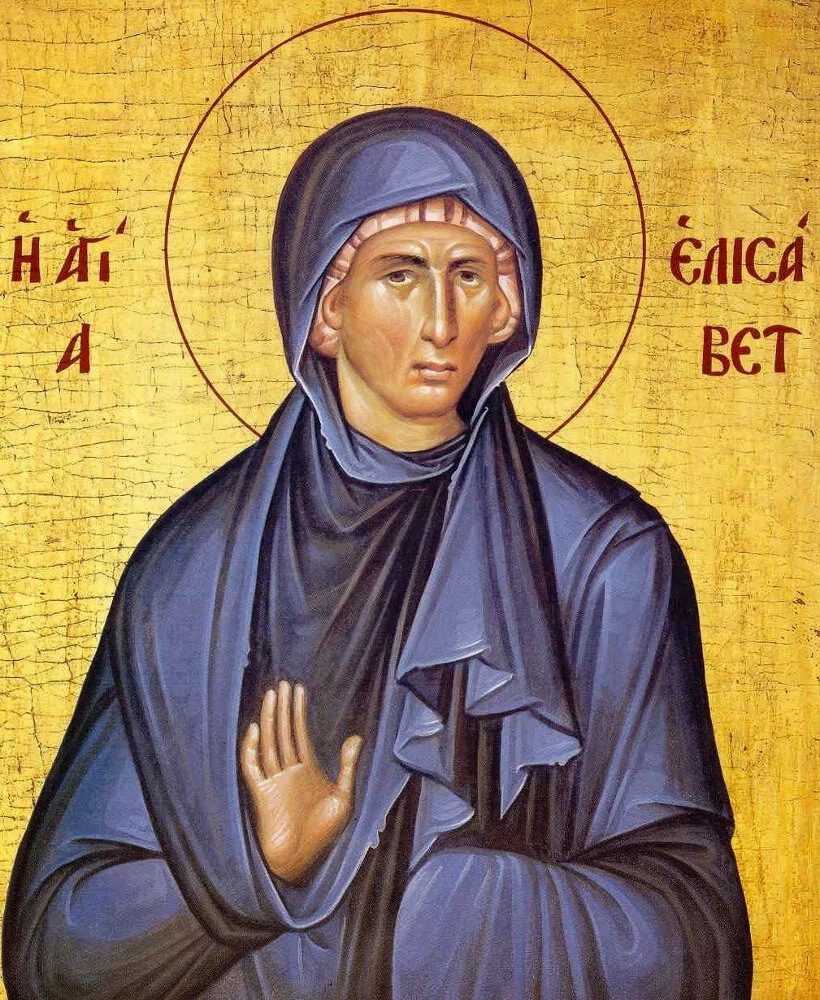
April 24 - Saint Elizabeth the Wonderworker (Part II)
By the age of three, Elizabeth's father had already given her over to learning the sacred letters, that is, religious texts. The little girl exhibited much skill and ability in her lessons so that she was able to recite the lives of the Saints only after hearing their accounts once. Once she closed her twelfth year, Ephemia, the maiden's mother, departed this life. Evnomianus, her father, wished to arrange her marriage, but Elizabeth could not bear to hear about a match for herself. Her yearning was rather to be wedded to the Immortal Bridegroom, Christ.
My beloved spiritual children in Our Risen Lord, Our Only True God and Our Only True Savior,CHRIST IS RISEN! TRULY HE IS RISEN!
+
SAINT ELIZABETH THE WONDER WORKER (Part II)
By the age of three, Elizabeth's father had already given her over to learning the sacred letters, that is, religious texts. The little girl exhibited much skill and ability in her lessons so that she was able to recite the lives of the Saints only after hearing their accounts once. Once she closed her twelfth year, Ephemia, the maiden's mother, departed this life. Evnomianus, her father, wished to arrange her marriage, but Elizabeth could not bear to hear about a match for herself. Her yearning was rather to be wedded to the Immortal Bridegroom, Christ. Thus the matter was at a standstill for the next three years, that is, until her father was translated to the Lord. The blessed maiden, thereafter, was left alone. She entrusted her life to God, the Father of the orphans. (Psalm 67:5) Since she still longed for the solitary life and poverty, she distributed the inheritance left her by her parents, which estate included gold and silver. There were also other belongings and properties--and they were considerable--which she dispensed. Thus, she offered her fortune to God through the hands of the needy. As for her menservants and maidservants, she gave them their freedom.
Elizabeth then repaired for the queen of cities, that is, Constantinople, without one backward glance. She made haste and went directly to the sacred philosophical school, that is, the Women's Monastery of the Holy and Great-Martyr George of "the little hill" as it was called. Elizabeth's paternal aunt was the Egoumene or Abbess. Thus, Elizabeth, in her early youth, undertook to tread the path of ascetic struggles and to dedicate her life as a bride of Christ. When she entered that hallowed place, she was already resolved to forsake the world and renounce the things of this world. She desired to become one of the assembly of pious nuns. She was clad in the Angelic Schema of the monastics, to which conduct of ascetic struggle she went forth with all her soul. Mother Elizabeth succeeded in attaining every kind of virtue, so as to become replete with all the gifts of the Spirit. Nourished on better hopes, she engaged in lengthy fasts and mortifying her body with hardships so as to bring it into subjection. In imitation of the Great Moses and Elias the Thesbite, she ofttimes engaged in forty-day fasts, without partaking of food. She never partook of oil, but was nourished solely upon the heavenly bread alone, that is, the Divine Eucharist. Since she was continually adorned with exalting humility and noetically contemplated divine beauty with the eyes of the heart, she did not wish to lift her eyes to heaven at all...
"...Two years after her sojourn in the Women's Monastery, her father's sister departed from this present life after appointing the Righteous Elizabeth as her successor. The office of Egoumene (Abbess) of the Monastery was confirmed by the great Gennadios, who was then steering the Patriarchate. This appointment was in accordance with the tradition of that time for the installation of the Gerondissa. By her godly labors, she manifested the superiority of her excellence and the height of her extreme virtue and perfection. She was accounted worthy by God of such divine energy that she was enabled to heal incurable diseases and dispel demons by invoking Christ.
Saint Elizabeth performed many and countless miracles by healing the sick, the demon-possessed. Those who invoke her name with simplicity, faith, and right intention immediately receive healing, by her holy intercessions, for whatsoever disease afflicts them. It is reported that even the soil about her tomb has proved to be a remedy for every sickness.
Such were the life, the works, and the spiritual gifts by which the Master of all glorified her both while she lived and after she was translated to the realms on high. Through her intercessions, many all of us, who desire to have rendered to us her protection and help, ever be preserved and held above both bodily and spiritual passions! Thus, in this way, may we escape harm from the scandals and stumbling blocks of the invisible and visible enemies. And having finished the present life in peace, may we attain thence that blessedness in Christ Jesus our Lord, to Whom belongs all glory, honor, and veneration, now and ever and to the ages of ages! Amen.
____________________
"Glory Be To GOD For All Things!" - Saint John Chrysostom
+ + +
With sincere agape in His Holy Resurrection,
The sinner and unworthy servant of God
+ Father George
CHRIST IS RISEN! TRULY HE IS RISEN!
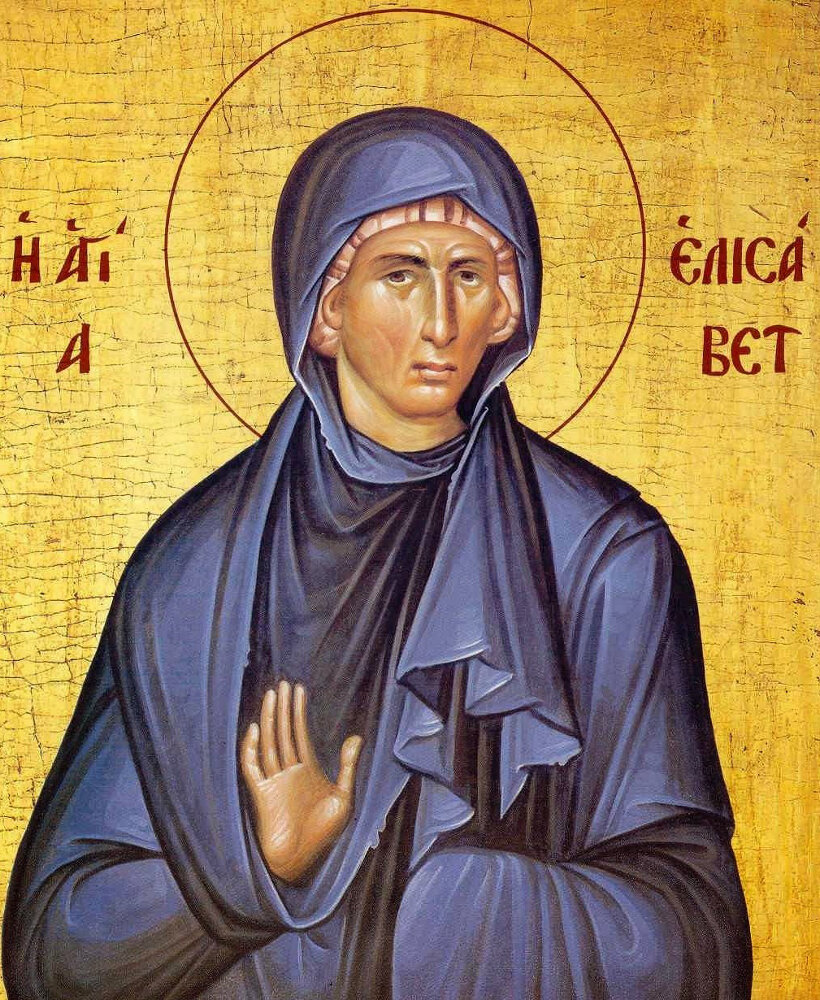
April 24 - Saint Elizabeth the Wonderworker
Elizabeth, the Wonder-worker, and our venerable mother was famed for her asceticism and miracles (Gk. thavmata). From her birth, Elizabeth was revealed by God to be an elect vessel. Now that "many daughters have wrought mightily, and many have obtained wealth" was spoken of in prophecy by the most wise Solomon. By this, he was saying that, at sundry times, not only men but also women would shine forth radiantly with the comely gifts of the Divine Spirit, thereby working, in a marvelous manner, mysterious and extraordinary prodigies and signs in all the inhabited world.
My beloved spiritual children in Our Risen Lord, Our Only True God and Our Only True Savior,CHRIST IS RISEN! TRULY HE IS RISEN!
+
ON APRIL 24TH OUR HOLY ORTHODOX CHRISTIAN CHURCH COMMEMORATES OUR VENERABLE MOTHER ELIZABETH THE WONDER-WORKER
Elizabeth, the Wonder-worker, and our venerable mother was famed for her asceticism and miracles (Gk. thavmata). From her birth, Elizabeth was revealed by God to be an elect vessel. Now that "many daughters have wrought mightily, and many have obtained wealth" was spoken of in prophecy by the most wise Solomon. By this, he was saying that, at sundry times, not only men but also women would shine forth radiantly with the comely gifts of the Divine Spirit, thereby working, in a marvelous manner, mysterious and extraordinary prodigies and signs in all the inhabited world. For the Holy Scripture also presents myriads of women, without number, both during the law and after with the advent of grace, exchanging weakness for manly courage. Furthermore, by means of self-control, continence, and ascetic toil and pangs, they have valiantly put down our foremother Eve's ancient supplanter, who strikes the heel and who is the universal enemy of our race. Such a woman was Elizabeth, who wrought such things by the power of the Most High, so that she was crowned with the splendor of victory.
The ever-memorable and wondrous Elizabeth was indeed distinguished as one of these women. Elizabeth hailed from the great Thracian city of Herakleia. Her parents were not obscure and insignificant. Much rather they were wellborn and possessed of lofty virtue. The Saint's father, named Evnomianos, the namesake of law-aiding and virtuous action, held the title of dishypatos (the title mentioned for the first time at the beginning of the 9th century). Her mother's name was Ephemia, whose Greek name bespoke her good repute. Both parents lived up to their names, distinguished for God-loving and God-pleasing lives.
For 16 years of marriage, they remained childless. In their sore distress, they uninterruptedly supplicated God, Who knows the heart, to dissolve their grief of childlessness and to grant them a child, so as to obtain an heir of their lineage and wealth. The Lord, Who does the will of those fearing Him, heard their supplication. He did not look askance at their entreaty but hearkened favorably.
Now there was a custom of old in that place. The natives would come together every year for the commemoration of the gloriously victorious Martyr Glykeria, the patroness of Herakleia. The second-century Martyr Glykeria, who suffered under Antoninus Pius, is commemorated by the Holy Church on the 13th of May. Elizabeth's venerable parents also attended and participated in processions and the night vigils of hymns of glorification to this Saint. The faithful walked throughout the city, bearing aloft the sacred relics of Saint Glykeria's head. She had been beheaded for the sake of Christ. The Divine Liturgy was conducted in the church called Theesavros, meaning "Treasure," which sacred precinct was dedicated to the Theotokos (Mother of God). Now Evnomianos gazed at the holy relic of the venerable Martyr Glykeria. He perceived that sometimes she appeared cheerful and smiled, whereas other times she looked sullen. He considered this to be a vivid symbol of his trust in the martyr, which divided his soul with both joy and sorrow.
Both Evdomianos and Ephemia fervently entreated the contestant of Christ, Glykeria, to release them from the bond of barrenness. They kept constant in prayer into the night but at midnight they lay down on the floor of the church for a little nap. Then--O the ineffable and awesome mysteries of God! -- that most sweet martyr, the namesake of sweetness, Glykeria, stood before the husband and uttered these words to him, "Why, O man, dost thou render me toils?" Why dost thou seek from me what only God is able to give? Nonetheless, if thou will promise me in truth that thou shalt acquire in thyself a contrite heart and humble spirit, and not be lifted in thy heart above thy neighbors, then the generous Lord shall speedily grant thee a female child. Thou shall call her Elizabeth, for she shall be of like habit with the mother of the Forerunner and Baptist John. Evnomianos vowed to struggle as he was bidden. The Saint then made the sign of the Cross over him and departed from his presence. Evnomianos, immediately, awakened from his slumber. He recounted to Ephemia the vision he had been vouchsafed. She also confirmed that she beheld the same vision. Then the God-loving archbishop, who was accounted worthy of the gift of clairvoyance, concurred with the words of the martyr of Christ. He then exhorted the couple. Now after the feast day of the martyr, the Prelate offered them hospitality for three days. He then blessed them and dismissed them to return to their own home in peace.
Ephemia quickly conceived a child. After she completed her term of nine months, she gave birth to a girl, in accordance with the true prophecy of the martyr. When forty days elapsed, the time arrived for the churching of the mother and newborn. Evnomianos, thereupon, took the child with her mother to the city. They entered the temple of the unforgettable martyr and drew near to her august holy icon, which was placed on the right side. Evnomianos prostrated himself to the floor before the holy icon, tearfully offering his thanks to the Venerable Martyr with a heart full of joy. He expressed his gratitude fittingly, as he gazed upon that sacred countenance of Saint Glykeria. It was then that he beheld a sight both strange and extraordinary. The Saint's face shone brilliantly like the sun. Her lips then moved gently as she uttered, "The time is come, O Evnomianos, for thee to pay thy vows to God." Evnomianos was filled with fear and trembling. Great astonishment was instilled in his soul. Then the couple approached the most venerable Archbishop and gave him the customary greeting. He vouchsafed the child the seal in Christ. Then after having given some instruction or catechism to the parents, he baptized the girl, naming her Elizabeth, as the martyr foretold. The hierarch prayed at length for the infant just baptized, after which he spoke to the newly illumined Elizabeth and said, "Through thee, child, may the Lord be gracious to me, granting me forgiveness of my sins." The parents then returned to their home rejoicing. The child kept on advancing in wisdom and stature. (Source: The Great Synaxaristes of the Orthodox Church)
(To be continued)
____________________
"Glory Be To GOD For All Things!" - Saint John Chrysostom
+ + +
With sincere agape in Our Lord's Resurrection,
The sinner and unworthy servant of God
+ Father George
Some Miracles of Saint George the Great Martyr and Trophy-Bearer
Many are the miracles that are wrought by the Saint's sacred relics and his holy icons. The blind are granted their sight; the disabled are healed; and, simply put, all those who hasten to the Saint with faith find bodily cures and receive the requests of their hearts. Many and diverse were the feats and exploits of Saint George, which we have summarized.

My beloved spiritual children in Our Risen Lord, Our Only True God and Our Only True Savior,CHRIST IS RISEN! TRULY HE IS RISEN!
+
SOME MIRACLES OF SAINT GEORGE THE GREAT MARTYR AND TROPHY- BEARER
Many are the miracles that are wrought by the Saint's sacred relics and his holy icons. The blind are granted their sight; the disabled are healed; and, simply put, all those who hasten to the Saint with faith find bodily cures and receive the requests of their hearts. Many and diverse were the feats and exploits of Saint George, which we have summarized.
1. The Miracle of the Widow's Column
In the region of Syria, there is a city called Ramel (an ancient Roman colony of Diospolis or Lydda). The native Christians, as well as Emperor Constantine (306-337 A.D.), were desirous to build a great and beautiful church in memory of the Great-Martyr George. The land in those parts, nevertheless, did not have marble for the columns and the floor and pavement. A ship, therefore, was commissioned in order to collect marble and columns from different places for the new edifice. The ship set sail, stopping at various ports, and took up the appropriate marbles for the work specified. A widow of one such city that was visited heard of the new construction. She wished to donate a column for the Great-Martyr's new church. She purchased one column that was very beautiful and lofty. She had it conveyed to the dock where the ship was loading other columns. She found the ship's captain and petitioned him in this manner: "I beseech thee, captain, sir since thou art transporting these other columns, load mine also and I will pay the freight charge. I am donating the column to that new church, so that it shall abide as a memorial for my soul." The captain, however, did not wish to include it with his cargo and said to the woman, "The ship's hold is full and nothing else fits on the cargo deck."
The following morning, the ship laden with the new pillars weighed anchor and set sail bound for Ramel. The widow wept and lamented from her sorrow. During that same night, while she lay asleep, Saint George appeared to her and asked, "Why weepest thou, O woman?" She answered, "I am grieving because the captain did not take my column on board. He refused to convey it to the Church of Saint George." The Saint then said, "And where shouldest thou like to have it placed?" The widow replied, "To the right side of the church, milord." The Saint spoke again and directed her saying, "Take up the column at one end and help me lift it. I shall send it there." The widow then beheld in her dream that together they easily lifted the column and cast it into the sea. In the morning, when the widow rose from her sleep, she went straight to the harbor. Since she did not see her column, she began to glorify God. By the Saint's assistance, the column in very deed crossed the sea until it reached Ramel. In fact, it arrived before the ship's captain arrived. Men from the building project went down to the dock. They saw the column and observed that it had a written inscription clearly marked: "Place the column of the widow in the right section of the temple." Thus it came to pass, even as Saint George had written on the bill of lading. When the ship's captain finally dropped anchor and conveyed his pillars to the church, he was filled with fear when he beheld the widow's column in the church. He implored the Saint to forgive his lack of charity. Afterward, the widow herself went to Ramel to visit the newly built church. She wished to venerate her favorite and thank the Saint for personally accepting her offering. She recounted her dream and the miracle wrought on her behalf.
2. The Miracle of the Prisoner of War Rescued from Captivity
Hear another extraordinary wonder (miracle or Gk. Thavma) wrought by our Lord through His Great-Martyr George. The Christians of Paphlagonia (a Roman Province), of Northern Asia on the Black Sea, possessed profound love and faith in the Saint. Great and many churches were built in his honor. Yearly his celebration was commemorated in the region of Amastris, a city on the coast of the Black Sea. The nearby river, Ikiakos, from times of old, had a nearby church dedicated to the Great-Martyr George. Whosoever besought the Saint with faith at that shrine received freely his request. Now there was a certain man of those parts, named Leo, who was pious and feared God. He was married to a most Orthodox and honorable woman, named Theano. Husband and wife were much alike in the virtues and acts of philanthropy. The couple harbored profound faith and love in the Great-Martyr, so that they were never absent from the holy services of the Saint's church. They specially celebrated the feast of the Saint's martyrdom, that is, the 23rd of April.
Leo was a soldier, who served in his profession honorably. Leo and Theano had one child. On account of the couple's deep love for the Saint, the child was named George. The parents reared the child well and educated him. He was much beloved by both parents and kinfolk alike who hailed with satisfaction his comeliness and knowledge. Now a burdensome war broke out when the Bulgarians rose up against the Byzantines. The Bulgarians had allies--Hungarians, Scythians, Medians, and Turks--whom they made their leaders. Their horde attacked Byzantine cities and despoiled them. The Byzantine commander, Phokas, then at Constantinople, sent out orders calling up soldiers to military service in order to counter the inroads of the Empire's enemies and barbarians. Meanwhile, in Paphlagonia, the old soldier Leo was recalled to active service. The time drew near when he needed to report for duty. Since by now Leo was elderly, he decided to send to war, as was accepted custom at that time, his son, George in his place. George was barely twenty years old when the day arrived for him to receive his orders and depart. His father took him by the hand, with his mother following along, and brought him to the Church of the Great-Martyr George. Leo stood before the holy icon of Saint George and began praying as he wept, "O Saint of God, Great Martyr George, to thee do we commend our beloved son of the same name as thyself. Do thou guard him, govern him, and bring him home again healthy, even as we have committed him, that we might glorify thy holy name every day henceforth."
While the recruit George and his comrades-in-arms of the imperial were guarding a certain place at night, they were surrounded by the enemy. Most of the Byzantines were slaughtered, while some managed to flee for their lives. There were others, however, who were captured and made to recant their Christian faith. Some, nevertheless, refusing to deny piety, were left to die of hunger and thirst. The recruit George, with the help of God and the prayer and blessing of his parents, was preserved from death, injury, and denial of the Faith. The adversary took him prisoner, however, and led him before the Bulgarian chief. The infidel, beholding the handsome lad and finding him dexterous and tactful, did not keep him as a prisoner; instead, he put him into service and had him perform chores.
The parents of George, meanwhile, kept asking about their son. When they received tidings that the army suffered heavy losses, they still could not find out any further information on the status of their son. When they went to the church of Saint George, they shed many tears and entreated the Saint and implored him saying, "If our son is alive, do thou, O Saint George, deliver him from captivity!"
Meanwhile, George was among the Bulgarians. He, too, remembered past holy days for Saint George which was also his own name day. He cried bitterly and with eyes misted over, he began to say, "Indeed they are rejoicing and being glad for the memory of Saint George, for which we had a tine dinner after church services. He prayed to the Saint thusly, "O Saint of God, George, I beseech thee to behold my parents again, do thou bring this to pass right quick." So spoke George, at the same time that he needed to heat some water for his master to wash his hands. This was so because it was the dinner hour and his master asked to have the table readied.
While George was ascending the ladder, holding the vessel of cold water and its cover, there suddenly appeared the Great-Martyr George mounted on a white steed, who addressed the prisoner and said, "Come, mount up here, the back part of the horse." Young George then jumped and climbed up, sitting behind the Saint. Then, that same instant--lo, the wonder!--the young man found himself in his house in the midst of the dining room. All those in attendance, upon catching sight of him, cried out, "Lord, have mercy!" George's parents, from their elation and surprise, fell speechless to the floor. In utter astonishment, all asked with one voice, "Whence comest thou?" The shocked young man took some time before he could compose himself and give an answer. After considerable time, the parents were able to rise up from the floor and give glory to God and His Great-Martyr George.
When they recovered and came to themselves somewhat from being taken unawares, they all went together to the church of the Great-Martyr George. They spent the entire night in the church, overflowing with gratitude toward the Saint and saying, "We give thanks to thee, O Saint of God, for thy quick assistance, because thou hast not turned askance at our tears and sighs, but as a speedy and ready helper thou hast fulfilled our desire. With regard to these things, nevertheless, O Saint, we beg thee to pardon us, if, as humans, we faulted thee. It was not that we looked down upon thee, but from our much-trying tribulation we said unbecoming words we ought not to have spoken." Then, in the morning, after the Divine Liturgy, Leo and Theano invited all the dwellers of Paphlagonia. As for the covered vessel ( a small pot) which the young man still had in his hand, he donated it to the church of the Great-Martyr George for the service. (Source: The Great Synaxaristes of the Orthodox Church)
These, of course, are just very few miracles of the countless miracles performed by the Great-Martyr Saint George.
CHRISTOS ANESTI! ALETHOS ANESTI! CHRIST IS RISEN! TRULY HE IS RISEN!
Bright or Renewal Friday: Theotokos of the Life-Giving Spring
Outside of the Queen City of Constantinople, towards the district of the Seven Towers, there was in ancient times a very large and most beautiful church named in honor of the Theotokos (Mother of God); it had been built about the middle of the 5th century by the Emperor Leo the Great (also called "Leo of Thrace,") he is commemorated on January 20th). Before he became Emperor, he had encountered a blind man, who being tormented with thirst asked him to help him find water. Leo felt compassion for him and went in search of a source of water but found none.

My beloved spiritual children in Our Risen Lord Jesus Christ and Our Only True God and Our Only True Savior,CHRIST IS RISEN! TRULY HE IS RISEN!
+
BRIGHT OR RENEWAL FRIDAY: THEOTOKOS OF THE LIFE-GIVING SPRING
Outside of the Queen City of Constantinople, towards the district of the Seven Towers, there was in ancient times a very large and most beautiful church named in honor of the Theotokos (Mother of God); it had been built about the middle of the 5th century by the Emperor Leo the Great (also called "Leo of Thrace,") he is commemorated on January 20th). Before he became Emperor, he had encountered a blind man, who being tormented with thirst asked him to help him find water. Leo felt compassion for him and went in search of a source of water but found none. As he became downcast, he heard a voice telling him there was water nearby. He looked again and found none. Then he heard the voice again, this time calling him "Emperor" and telling him that he would find muddy water in the densely wooded place nearby; he was to take some water and anoint the blind man's eyes with it. When he had done this, the blind man received his sight. After Leo became Emperor as the Most Holy Theotokos had prophesied, he raised up a church over the spring, whose waters worked many healings and cured maladies by the grace of the Theotokos; from this, it came to be called the "Life-Giving Spring." The Church of Christ celebrates the consecration of this church on this day.
After the fall of the imperial city, this church was razed to the ground and the materials from it were used for building the mosque of Sultan Bayezid. Nothing remained of that church's ancient beauty, except for a small and paltry chapel, almost completely buried in the ruins. This chapel had twenty-five steps going down into it, and a transom window on the roof, wherefrom it received little light. Toward the western side of the chapel was the aforementioned holy Spring, fenced about with a railing, and with fish swimming in it. Such was the condition of the Spring until 1821. Then even that little remnant was destroyed, occasioned by the uprising of the Greek Nation against the Ottoman Empire; the Sacred Spring was buried with it and disappeared altogether.
But in the days of Sultan Mahmud, when those subject to him were rejoicing in their freedom to practice their religion, permission was sought by the Orthodox Christian community to rebuild at least part of the chapel. Thus the work was begun on July 26, 1833. When the excavation had been made, and the foundations of the ancient church were found, there was rebuilt -- by a later writ of permission from the Sultan -- not merely a chapel of the holy Spring, but another new church, constructed upon the foundations of the ancient one. The building of this spacious, beautiful, and the most majestic temple began on September 14, 1833, and the work was completed on December 30, 1834. On February 2, 1835, the Ecumenical Patriarch Constantine II, serving the Liturgy together with twelve hierarchs and a great company of clergy, as well as a boundless multitude of Christians, performed the consecration of this sacred church and dedicated it to the glory of the Mother of God. On September 6, 1955, however, it was desecrated and destroyed again by the Moslem Turks; it has been restored again, but not to the former magnificence.
Apolytikion of Renewal Friday - Life-Giving Spring of the Theotokos. First Tone
O Theotokos, your church is like the Garden of Paradise, since it pours out healings and cures like Ever-Living rivers. We come to it with faith, and we draw strength and eternal life from its water, through you who are the Spring that received Life himself. For you intercede with Christ our Savior, Who was born from you, and you entreat Him to save our souls.
Kontakion of the Feast. Plagal of the Fourth Tone
O Lady graced by God, you reward me by letting gush forth, beyond reason, the Ever-flowing
waters of your grace from your perpetual Spring. I entreat you, who bore the Logos/Word, in
a manner beyond comprehension, to refresh me in your grace that I may cry out, "Hail
redemptive waters."
(Source: Icon - Athanasius Clark)
_______________________________
"Glory Be To GOD For All Things!" - Saint John Chrysostom
+ + +
With sincere agape in Our Risen Lord Jesus Christ,
The sinners and unworthy servant of God
+ Father George
April 23 - The Feast of Saint George the Great Martyr and Trophy-Bearer
This Great and wonderful athlete of Christ was the son of a wealthy and high-ranking Cappadocian family. George having lost his father at the age of ten, his mother Polychronia, who had become a Christian without her husband's knowledge, returned to Palestine, her homeland, and brought up her son in the evangelical virtues. Handsome, intelligent, and refined in manner, George embarked on a military career at the age of eighteen. He pleased his superiors and was quickly promoted to the rank of Tribune in the Imperial guard, and then, it would appear, to that of Prefect. Returning to Cappadocia after a victorious campaign and passing through the region of Attalia in Pamphylia, he freed the king's daughter, who had been left at the mercy of a dangerous dragon, and killed the beast with a divine strength that he was given by his faith. Marveling at this demonstration of the strength given by Christ to His faithful ones against the forces of evil, the local pagans were all converted to Christianity.

My beloved spiritual children in Our Risen Lord Jesus Christ, the Only True God and the Only True Savior,CHRIST IS RISEN! TRULY HE IS RISEN!
+
ON APRIL 23rd OUR HOLY ORTHODOX CHRISTIAN CHURCH COMMEMORATES THE LIFE AND FEAST OF SAINT GEORGE THE GREAT MARTYR AND TROPHY BEARER.
This Great and wonderful athlete of Christ was the son of a wealthy and high-ranking Cappadocian family. George having lost his father at the age of ten, his mother Polychronia, who had become a Christian without her husband's knowledge, returned to Palestine, her homeland, and brought up her son in the evangelical virtues. Handsome, intelligent, and refined in manner, George embarked on a military career at the age of eighteen. He pleased his superiors and was quickly promoted to the rank of Tribune in the Imperial guard, and then, it would appear, to that of Prefect. Returning to Cappadocia after a victorious campaign and passing through the region of Attalia in Pamphylia, he freed the king's daughter, who had been left at the mercy of a dangerous dragon, and killed the beast with a divine strength that he was given by his faith. Marveling at this demonstration of the strength given by Christ to His faithful ones against the forces of evil, the local pagans were all converted to Christianity.
At the time of the Great Persecution unleashed by the pagan Roman Emperor Diocletian (c. 304), when the Emperor had summoned all the Eastern Governors to Nicomedia to make them privy to his decrees against the Christians. Saint George, sensing that the moment had come for him to make a public confession of Christ, gave all his goods away to the poor, freed his slaves and went to court. He appeared in the midst of the assembly and reproached the sovereign for unjustly shedding the innocent blood of Christians. Diocletian in stupefaction ordered his second-in-command Magnentius to interrogate this insolent young man about his faith. George replied that it was because he believed in Christ the True God that he had come without fear to reproach them. Having recovered from his amazement the Emperor, fearing a disturbance among those present, offered to heap honors on the Saint on condition that he sacrifice to the pagan gods of the Empire. George replied: Your reign will become corrupt and will quickly disappear at no gain to you, but those who offer a sacrifice of praise to the King of Heaven will reign with Him for all eternity! At the sovereign's orders, the guards beat the Saint on the stomach with their lances. His sacred blood flowed down but, at the first blows, their weapons became twisted as though they were made of some soft material. Christ's soldier was then thrown into prison with a heavy stone on his chest. The next day, he appeared once more before the tyrant and showed the same firmness. They, therefore, tied him to a wheel suspended over sharp instruments of torture, so that, when the wheel was turned, the Saint's body would gradually be cut to pieces. Overcoming the pain with his overflowing love for God, Saint George unceasingly gave thanks to God. A voice was then heard from heaven, saying: "Fear nothing, George; I am with you! And a white-clad Angel more resplendent than the sun descended to loose him and heal his wounds. When he appeared safe and sound before the Emperor, two officers of the guard, Anatolius, and Protoleon, confessed Christ with loud voices. They were beheaded at once. Empress Alexandra (+ April 21st) also declared herself to be a Christian, but Magnentius constrained her to the palace. They then threw the Saint into a ditch filled with quicklime; but, like the Three Young men in the Babylonian furnace, he emerged unharmed after three days, greeted by the crowd with the cry, "Great is George's God!" The Emperor, still remaining insensible before all these demonstrations of Christ's power, ordered that the Martyr be forced to walk in shoes studded with red-hot nails. Run, George, towards the object of our desire! said the Saint, invoking the Lord's help. And once again he presented himself, whole and radiant with grace, before the tyrant.
By the grace of God, he also escaped a poison prepared by a sorcerer called Athanasius. When the latter and those of his sort were still incredulous and reckoned that George was using magical arts, he, at their request, raised a dead man who had been buried for three hundred years. The man prostrated before the Saint and, declaring that he had been wrested from hell at George's prayers, he confessed Christ. The defeated sorcerer then fell at the feet of the servant of God and, in his turn, proclaimed the True faith. Diocletian ordered that Athanasius and the resurrected man be beheaded without delay.
Not a few of those who had come to believe in Christ as a result of Saint George's miracles found the means to visit him in prison, in order to be instructed in the truths of the Gospel or to receive the healing of their ills. The Saint had compassion on the sufferings of each of them and even restored to life a bull belonging to a peasant called Glycerius, who was then arrested and beheaded without any sort of trial.
The next day, Diocletian had George appear in the Temple of Apollo before a fairly large crowd. Pretending that he intended to offer sacrifice, the Martyr went into the temple and confronted the idol, making the sign of the Cross. The demons that lived in the idol then confessed in terror that Christ alone is the True God, and they escaped with a great hubbub, leaving the inert statues to fall to the ground. The pagan priests and the pagans then drove the Saint out with loud cries and took him back to the palace. Attracted by the tumult, Empress Alexandra came out and forced her way through the crowd, crying out: God of George, come to my aid! and she fell at the Saint's feet. Unable any longer to contain his fury, the tyrant, whose heart was hardened as Pharaoh's had been of old, ordered that they both be beheaded. But, some time before the execution, Alexandra peacefully gave her soul into God's hands in prison.
When the day arrived, Saint George went to the place of execution followed by a large crowd. He gave thanks to God for His benefits, bent his neck under the sword, and went to carry off the trophies of eternal glory.
Carrying out the Saint's desire, his servants took his precious and holy relics back to his country, to Lydda (Diospolis) in Palestine, where innumerable miracles worked in the great church that was built in his honor.
The veneration of Saint George enjoyed enormous popularity throughout the Christian world, both East and West. He was chosen to be the protector of countries like Georgia and England; thousands of churches have been dedicated to him and every Christian soul sees in him the incarnation of the virtues of valor, patience in affliction and trust in the help of grace that Christ, the Leader in battle, has enjoined on all the soldiers enrolled in His army of devotion. (Source: Synaxarion: The Lives of the Saints of the Orthodox Church, Vol. 4, compiled by Hieromonk Makarios of Simonos Petra)
Apolytikion (Dismissal) Hymn: Fourth Tone
Liberator of captives, defender of the poor, physician of the sick, and champion of kings, O trophy bearer, Great Martyr George, intercede with Christ God that our souls be saved.
Kontakion: Fourth Tone
Cultivated by God, you became manifest as an honorable tiller gathering for yourself the sheaves of virtue. For you sowed with tears but reaped with gladness; in the contest you completed with your blood and came away with Christ. By your intercessions, O Holy One, all are granted
forgiveness of sins.
__________________
"Glory Be To GOD For All Things!" - Saint John Chrysostom
+ + +
With sincere agape in Our Risen Lord Jesus Christ,
The sinner and unworthy servant of God
+ Father George