
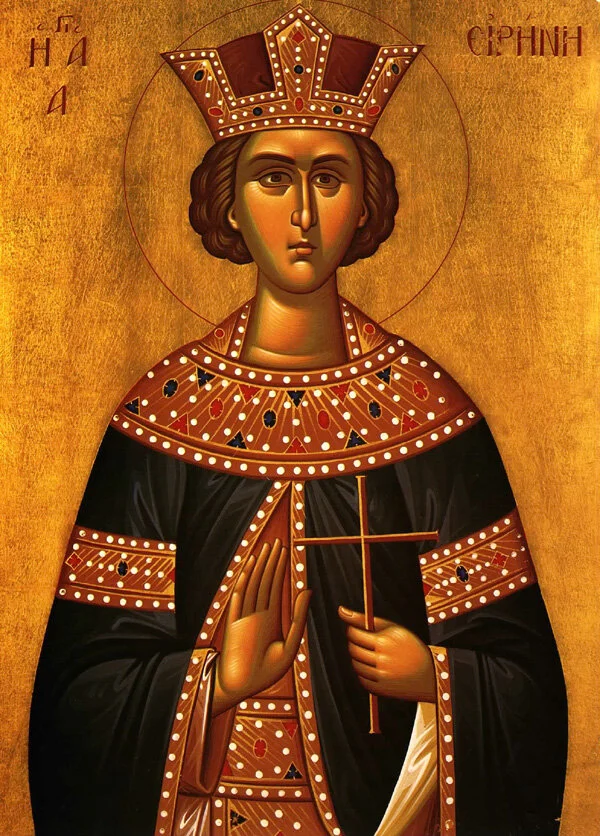
May 5 - Saint Irene of Thessaloniki the Great Martyr
Saint Irene, the holy Great-Martyr, was born in the city of Magedon or Magedo. She lived during the reign of Saint Constantine the Great (306-337 A.D.). She was the sole offspring of her pagan parents, Licinius, who was a certain kinglet, and Licinia. Irene had been given the name of Penelope at birth. Since she was the fairest of maidens and surpassed in beauty all the other of the day, her father, who feared for his daughter, built a lofty tower to isolate Penelope. He also lodged thirteen other young maidens with her, amid whom she lived in luxury and wealth. She received such items as a throne, a table, and a lamp made of solid gold. She was six years of age when her father confined her to the tower. He also assigned a certain elderly Apellianos to supervise his sheltered little daughter's education.
My beloved spiritual children in Our Risen Lord, Our Only True God, and Our Only True Savior,
CHRIST IS RISEN! TRULY HE IS RISEN!
+
ON 5TH MAY, THE HOLY ORTHODOX CHRISTIAN CHURCH COMMEMORATES THE HOLY AND GREAT-MARTYR IRENE.
Saint Irene, the holy Great-Martyr, was born in the city of Magedon or Magedo. She lived during the reign of Saint Constantine the Great (306-337 A.D.). She was the sole offspring of her pagan parents, Licinius, who was a certain kinglet, and Licinia. Irene had been given the name of Penelope at birth. Since she was the fairest of maidens and surpassed in beauty all the other of the day, her father, who feared for his daughter, built a lofty tower to isolate Penelope. He also lodged thirteen other young maidens with her, amid whom she lived in luxury and wealth. She received such items as a throne, a table, and a lamp made of solid gold. She was six years of age when her father confined her to the tower. He also assigned a certain elderly Apellianos to supervise his sheltered little daughter's education.
One day, the Saint observed that a dove had entered the tower. The dove, bearing an olive branch in its beak, placed it on the golden table. Subsequent to this, she beheld an eagle fly into the tower. The creature was holding a wreath of plaited flowers in its beak, which it deposited on the table. Following close upon this delivery, she then noticed that a raven came in through the window, carrying a snake, which it also dropped on the golden table. Witnessing all this, the blessed virgin was perplexed and wondered at the meaning of these signs.
Apellianos interpreted all these signs for her, saying, "The dove makes known thy superior education; the olive branch signifies many wondrous events and is a symbol of Baptism. The eagle, being the king of birds, foretells, by the royal crown of flowers, future success in notable endeavors. But the raven and serpent disclose thy future sufferings and anguish." By these hidden meanings, the elderly teacher revealed the great struggle of martyrdom, which the Saint was to undergo one day for the sake of her love for God. All the events that followed concerning the holy Irene, which have been committed to writing, are indeed supernatural and paradoxical.
It is said that an Angel of the Lord gave her the name of Irene, changing it from Penelope. The incorporeal being instructed her in the Faith of the Christ and foretold that myriads of souls would be saved by means of her. Furthermore, Holy Apostle Timothy, a Disciple of Saint Paul, would visit her in a paradoxical manner and baptize her. When this latter prophecy was fulfilled, the blessed Irene cast her father's idols to the ground, shattering them. At first, the blessed Irene was questioned by her father who, upon seeing that she persisted in the beliefs of the Christian Faith, was intensely dissatisfied. He ordered that she be bound, Irene was then cast between many horses that they might trample upon her. However, one of the horses, instead of harming the Saint, turned on Licinius. It struck him down, crushing his right hand and slaying him. The horse then magnified the Saint with a human voice!
The Martyr was thereafter released from her bonds. At the request of the bystanders, she prayed and resurrected her father. Licinius came to believe in God, as did his wife Licinia. In fact, another three thousand people received holy Baptism. Thenceforth, Saint Irene's father abandoned his dominion and lived in the tower which he had built for his daughter, passing the rest of his life in repentance.
After her father renounced this world, another kinglet, named Sedekias, rose to power. He attempted to force the Saint to sacrifice to idols. Since she opposed his demand, he ordered that the blessed maiden be cast healing into a deep pit filled with a nest of venomous snakes and reptiles. After fourteen days, she emerged unscathed. Next, the idolaters bound her to a wheel that turned by the force of water. When the waters miraculously ceased flowing, the sacred damsel remained unharmed. As a result of this miracle, eight thousand people came to believe in Christ Jesus.
The Saint came to a city called Kallinikos (Callinicus). It was the seat of Numerianos the kinglet, the son of Savastianos. Once there, Irene appeared before him and proclaimed Christ. He, as a result, confined her to the interior of three bronze oxen, which figures were heated until they glowed red. He then had her transferred from the first to the second, and from the second to the third. The third ox, albeit it was inanimate, walked miraculously and then split asunder. The Saint, thereupon, exited uninjured, without the least trace of a burn or singed hair and attire.
By 330 A.D., the fame of the Saint's miracles reached the impious ears of Shapur II the Great, king of Persians, who ordered the beheading of the Saint. The victorious champion of Christ, Irene, was apprehended and her head was struck off. Though the Holy Martyr was interred, yet was she was resurrected by an Angel of God. He magnified her because she had been martyred for Christ. Moreover, those who honor her name and commemorate the day of her martyrdom also bring blessings upon themselves. After her resurrection, it is said that she entered the city of Mesembria, bearing an olive branch in her hand. Saint Irene appeared before the kinglet who, upon seeing her, straightaway, accepted Christ and was baptized with myriads of other people by the Priest Timothy. When the holy one returned to her parental home in Magedon, she mourned the death of her father. After visiting and bidding farewell to her mother, Saint Irene was caught up in a cloud and traveled to Ephesus, carrying many miracles. She was honored there as an Apostle. Thereafter, she also saw her teacher Apellianos.
Since Saint Irene had taught and exhorted the populace of Ephesus, she departed thence in the company of six followers, including Apellianios. Not too far from its outskirts, she came upon a newly constructed tomb wherein none had lain. She entered the tomb, and Apellianos sealed it with a stone. While Saint Irene was still among the living, the Saint ordered that, for four days, no one was to move the stone which Apellianos had placed over the grave. Two days later, he returned to the tomb, and--lo, the miracle!--he discovered the stone overturned and the body of the Saint missing. All these accounts may seem improbable to the limited intelligence of man, but to God, they are possible.
Myriads were brought to repentance and embraced Christ by her preaching and example. (Source: The Great Synaxaristes of the Orthodox Church)
CHRONIA POLLA TO ALL THOSE WHO CELEBRATE ON THE FEAST DAY OF SAINT IRENE THE GREAT MARTYR.
_______________________
"Glory Be To GOD For All Things!" - Saint John Chrysostom
+++
With sincere agape in Our Risen Lord,
The sinner and unworthy servant of God
+Father George
The Life and Sufferings of Holy Prophet Isaiah

My beloved spiritual children in Our Risen Lord and Our Only True God and Our Only True Savior,
CHRIST IS RISEN! TRULY HE IS RISEN!
+
ON MAY 9th OUR HOLY ORTHODOX CHRISTIAN CHURCH COMMEMORATES THE LIFE AND SUFFERINGS OF THE HOLY PROPHET ISAIAH
"Having seen and been taught of the divine Seraphim, who unceasingly glorify the single dominion of the Godhead in three Hypostases (Isaiah 6:2-3), thou wast assured of the grace of prophecy, O wondrous one; wherefore, celebrating thy most sacred memory, we bring thee before Christ as a most powerful advocate."
Saint Gregory (335-395 A.D.), Bishop of Nyssa, believes that the Prophet Isaiah "knew more perfectly than all others the mystery of the religion of the Gospel." Blessed Jerome (342-420 A.D.) also lauds the Prophet, Isaiah, saying, "He was more of an Evangelist than a Prophet because he described all of the mysteries of the Church of Christ so vividly that you would assume he was not prophesying about the future, but rather was composing a history of past events."
The Isaiah (pronounced Esaias in Greek), whose Hebrew name is an approximate translation of the abbreviated form Yesha' yah, is derived from the fuller and older form Yesha, Yahu, meaning " 'J' is salvation." It is therefore synonymous with Joshua or Jeshua (Jesus) or "God is salvation" or "God of salvation." This Great Prophet, born in 765 B.C., hailed from Jerusalem. His family was related to the imperial house of Juda. He was the son of Amos (Isaiah 1:1), who was the brother of King Amessias or Amaziah (796-767 B.C.) of Juda. From his writings, it is safe to presume he was well educated and that he probably came from an upper-class family. Israel and Juda, under Jeroboam II (793-753 B.C.) and Ozias or Uzziah (791-739 B.C.), enjoyed a time of prosperity during the Prophet's boyhood, with little interference from foreigners. He was called to the prophetic ministry at a young age, in his twenties, through a divine vision during the last year of the reign of King Ozias or Uzziah (Isaiah 6:1), in about 740 B.C. Isaiah was married to a woman described as "the Prophetess" (Isaiah 8:3). They had two sons, naming one Jasub meaning "A remnant shall return" (Isaiah 7:3) and the other Maher-Shalal-Hash-Baz, meaning "Spoil quickly, plunder speedily" (Isiah 8:3).
Prophet Isaiah admits, "The instruction of the Lord, even the Lord, opens mine ears, and I do not disobey, nor dispute" (Isaiah 50:5)." "Comprehend what the Prophet means," says Blessed Jerome, "The Lord has given me an ear. Because I did not possess that ear which is of the heart, He gave me one that I might hear God's message. Whatever the Prophet hears, therefore, he hears in his heart."
Possessed of considerable literary skill by the grace of the Holy Spirit, the Prophet's devotion to God is manifest. He is one of the four major Prophets, that is, those with longer writings extant. His prophesy is the third-longest book in the Holy Bible, sixty-six chapters, being exceeded only by the books of the Prophet Jeremiah and the Psalms. His long ministry, approximately forty-years, extended from about 740 B.C. until at least 701 B.C. (Isaiah 37-39). The life and times of the Prophet are also mentioned in two other books of Holy Scripture, namely Chronicles (32:20, 32) and 4 Kings (20:1-19). He is depicted in sacred icons as approaching old age and having gray hair and a long pointed beard.
The Son of God
1. "I am" (Isaiah 41:4)
Prophet Isaiah prepared the people for the Coming One. He speaks of the One Who spoke to Moses and reveals His Divine Name, saying, "I am the Being; He said, 'Thus shall ye say to the children of Israel, the Being has sent Me to you" (Exodus 3:14). God's parousia shall be for all the human race. "Who has wrought and done these things? He has called it Who called it from the generations of old; I God, the first and to all futurity, I am" (Isaiah 41:4). Saint Justin explains the name: "God cannot be called by any proper name, for names are given to mark out and distinguish their subject-matters, because these many and diverse; but neither did anyone exist before God Who could give Him a name, nor did He Himself think it right to name Himself, seeing that He is One and unique, as He Himself also by His own Prophet testifies (Isaiah 44:6). On this account, God did not, when He sent Moses to the Hebrews, mention any name, but by a participle, He mystically teaches them that He is the One and Only God. "For, "14) says He, 'I am the Being' (Exodus 3:14); manifestly contrasting Himself, 'the Being,' with those who are not (not-beings)...(B)y the participle "Being" He might teach the difference between God Who is and those who are not (that is, the God-being and not-beings).
Saint Ambrose says that "the Son of God had no beginning, seeing, seeing that He already was at the beginning, nor shall He come to an end, Who is the Beginning and the End (Alpha and Omega) of the Universe; for being the Beginning, how could He take and receive that which He already had, or how shall He come to an end, being Himself the End of all things so that in that End we have an abiding-place without end? The Divine Generation is not an event occurring in the course of time, and within its limits, and therefore before it, time is not, and in it time has no place."
2. "There is No Other God Beside Me" (Isaiah 45:5)
Not wishing the Jews to fall into polytheism, "this is why the Prophets revealed the Son of God to the Jews in a somewhat dim and scantly fashion," says Saint John Chrysostom, "rather than with clear and obvious statements. After the Jews had just been set free from the error of polytheism, they would have fallen back into the same disease if they were again to have heard of one person is God and another person who is God and another person who is God. This is why, throughout the Old Testament, the Prophets are constantly saying, "there is one God except for Him (cf. Deut. 4:35; Isaiah 45:5, 21). The Prophets were not denying the Son--God forbid!--but they wished to cure the Jews of their weakness and meanwhile, to persuade them to give up their belief in the many gods which did not exist. (Source: The Lives of the Holy Prophets)
________________
"Glory Be To GOD For All Things!" -- Saint John Chrysostom
+++
With sincere agape in His Holy Resurrection,
The sinner and unworthy servant of God
+Father George
The Definition of Prophesy According to Our Holy Orthodox Christian Church (Part II)
At the Annunciation (Evanggelismos) of the Ever-Virgin Mary, we chant, "Today is the crown of our salvation and the manifestation of the mystery that is from all eternity. The Son of God becomes Son of the Virgin." The Holy Prophets foretold that He was to become a child, taking flesh from the Virgin, being joined to men and seen by those on earth, even as Baruch proclaimed: "This is our God, and there shall none other be accounted of in comparison of Him. He hath found out all the way of knowledge and hath given it unto Jacob His servant and to Israel His beloved. Afterward, did He show Himself upon the earth, and conversed with men" (Baruch 3:35-37). Jesus is the "expectation of nations" (Genesis 49:10).

My beloved spiritual children in Our Risen Lord and Our Only True God and Our Only True Savior,
CHRIST IS RISEN! TRULY HE IS RISEN!
+
THE DEFINITION OF PROPHECY ACCORDING TO OUR HOLY ORTHODOX CHRISTIAN CHURCH (Part II)
The Coming of Christ
At the Annunciation (Evanggelismos) of the Ever-Virgin Mary, we chant, "Today is the crown of our salvation and the manifestation of the mystery that is from all eternity. The Son of God becomes Son of the Virgin." The Holy Prophets foretold that He was to become a child, taking flesh from the Virgin, being joined to men and seen by those on earth, even as Baruch proclaimed: "This is our God, and there shall none other be accounted of in comparison of Him. He hath found out all the way of knowledge and hath given it unto Jacob His servant and to Israel His beloved. Afterward, did He show Himself upon the earth, and conversed with men" (Baruch 3:35-37). Jesus is the "expectation of nations" (Genesis 49:10).
"All the Prophets," says Saint Irenaeus, "announced two advents: One, indeed, in which He became man subject to stripes and knowing what it is to bear infirmity (Isaiah 53:3), and when He sat upon the foal of an ass (Zachariah 9:9), and was a stone rejected by the builders (Psalm 117:22), and was led as a sheep to the slaughter (Isaiah53:7), and destroyed Amalek (Exodus 17:11) by the stretching forth of His hands, while He gathered from the ends of the earth into His Father's fold the children who were scattered abroad (Isaiah 11:12), and remembered His own dead ones who had formerly fallen asleep, and came down to them that He might deliver them; but the second time He will come on the clouds (Daniel 7:13), bringing on the day which burns as an over (Malachi 4:1), and smiting the earth with the word of His mouth (Isaiah 11:4), and slaying the impious with the breath of His lips, and having a winnowing fan in His hand, and thoroughly purging His threshing floor, and gathering the wheat indeed into His storehouse, but burning the chaff with fire unquenchable (Matthew 3:12; Luke 3:17).
The Prophets and the Apostles
The Venerable Prophets proclaimed the way of salvation, and in the sufferings conformed to the Passion which they foretold. They served as mediators of the New Covenant (New Testament) of Christ. The grace of the Holy Spirit shone in the Holy Apostles. For the Hebrew nation, the Prophets were to foretell the Messiah's Coming and to lead them to the knowledge of God. The Holy Apostles proclaimed the Christ's deeds, and enlightened the nations. According to Saint Justin, "Righteousness is not placed in Jewish rites, but in the conversion of the heart given in Baptism in Christ." On the day of Pentecost, the Comforter descended in all fullness upon the Apostles and the faithful with them.
The Sufferings and Rewards of the Holy Prophets
The Divinely-inspired Prophets preached in word and deed, and they received as their reward life without end. They renounced the whole world for the sake of God's Word and His Law. They endured many trials and afflictions and some were martyred. Prophet Amos received a blow to his brain which led to his repose; Prophet Isaiah was sawn asunder; Prophet Ezekiel was bound to the tails of horses and rent asunder; and, Prophet Jeremiah was stoned. Saint Paul makes mention of their sufferings, writing: "They received trial of mockings and of scourgings, and, moreover, of bonds and of imprisonment. They were stoned, they were sawn asunder, were tempted; they died by murder of the sword. They went about in sheepskins, in goatskins, being in need, afflicted, ill-treated--of whom the world was not worthy. They were made to wander in deserts, and in mountains, and in caves, and in the holes of the earth" (Hebrews 11:36-38).
As a further encomium to their labor and sufferings, Saint Hyppolytos (+ 170-235 A.D.), Bishop of Rome, lauds the Holy Prophets: "With how many mouths and tongues would I praise you, or rather the Logos/Word Who speaks in you! You died with Christ, and you will live with Christ. Hear and rejoice: behold, the things announced by you have been fulfilled in their time. For you saw these things yourselves first, and then you proclaimed them to all generations. You ministered the oracles of God to all generations. You Prophets were called that you might be able to save all. For then is one a Prophet indeed, when, having announced before time things about to be, he can afterward show that they have actually happened. You were the Disciples of a Good Master. These words I address to you as if alive, and with propriety. For you hold already the crown of life and immortality which is laid up for you in heaven" (cf. 2 Timothy 4:8).
The Synagogue (GK. Synagogy)
Saint John Chrysostom comments, "many have tried to destroy the Church, but they did not have the power to do so. Even though many were eager and tried to raise up the Temple again, they could not do so...How is it, then, that they could not build a single temple, especially since they saw that, with no temple, Jews were shackled and constrained from their worship all over the world? Did they not see that their customary ritual had disappeared? Did they not see that their sacrifices, offerings, and other religious rites in which the Law prescribed had been destroyed and ceased to exist? For the Jews were not permitted to erect an altar, nor offer sacrifice, nor pour libations, nor immolate the sacrificial lamb, nor offer incense, nor read the Law, nor celebrate any festival, nor do any other thing connected with their ritual and worship unless they were within the precincts of the temple." (Source: The Lives of the Holy Prophets)
_____________________
"Glory Be To GOD For All Things!" -- Saint John Chrysostom
+++
With sincere agape in His Holy Resurrection,
The sinner and unworthy servant of God
+Father George
The Definition of Prophesy According to Our Holy Orthodox Christian Church (Part I)
On May 1st our Holy Orthodox Christian Church commemorates the Venerable Prophet Jeremiah but who are the Prophets and what is Prophecy? The Greek word προφήτης, derived from the Greek word πρόφημι (propheme), means foretell, that is, to tell beforehand. In Hebrew, the word "prophet" meant not necessarily one who foretold the future, but one commissioned by God to speak to man.

My beloved spiritual children in Our Risen Lord and Our Only True God and Our Only True Savior,
CHRIST IS RISEN! TRULY HE IS RISEN!
+
THE DEFINITION OF PROPHECY ACCORDING TO THE HOLY ORTHODOX CHRISTIAN CHURCH
On May 1st our Holy Orthodox Christian Church commemorates the Venerable Prophet Jeremiah but who are the Prophets and what is Prophecy? The Greek word προφήτης, derived from the Greek word πρόφημι (propheme), means foretell, that is, to tell beforehand. In Hebrew, the word "prophet" meant not necessarily one who foretold the future, but one commissioned by God to speak to man.
Prophet Jeremias prophesied among the captive Jews transported to Babylon, and foretold their freedom. He also prophesied against nations and cities, including Egypt, Philistia, Moab, Ammon, Edom, Damascus, Kedar, and Hazor, Elam, and Babylon.
This ever-memorable Prophet endured insults, hardships, and bore chains and imprisonment by contemporary false prophets. Almost as a solitary during this tragic period of his nation's history, he exposed immoralities, superficial reforms, and fanatical reliance in the temple. When he spoke of the coming destruction of the temple, he incurred the insults and abuse of temple priests (Jeremiah 20:2). He was even in danger of his life from his own townsmen (Jeremiah 11:21), the priests and false prophets of the temple (Jeremiah 33:8), the wayward and erratic king, and also the military (Jeremiah 45:4).
Nonetheless, he received homage from some of his people. There was also the Ethiopian slave, Abdemelech, who was stirred to help the man of God when he was cast into prison (Jeremiah 45:7). The Egyptians revered him as a Prophet while he was among them, and long after his repose.
In Orthodox Christian iconography, the Prophet is characterized as being elderly, small in bodily size, and having a beard wide at the top and narrow at the tip.
Saint Gregory the Dialogist (540-604 A.D.) distinguishes for us the various modes of prophecy used in expressing distinctions of time: "prophecy has three tenses: THE PAST, OF COURSE, THE PRESENT, AND THE FUTURE...We shall speak more truly of the three tenses of prophecy if we quote the evidence of Holy Scripture. The prophecy concerning the future: "Behold, the Virgin shall conceive in the womb, and shall bring forth a son" (Isaiah 7:14). The prophecy concerning the past: "In the beginning, God made the heaven and the earth" (Genesis 1:1). For a man speaks of a time when man was not. A prophecy about the present is when Saint Paul the holy Apostle says, "But if all keep on prophesying, and some unbeliever or one unlearned should come in, he is reproved by all, he is examined by all. And thus are the secrets of his heart become manifest; and so falling upon his face, he will make obeisance to God, reporting that God is verily among you" (1 Corinthians 14:24-25). Indeed, when it is said, "the secrets of his heart are made manifest," it is truly shown that through this mode of prophecy the Spirit does not predict what the future will be, but reveals what is. How then may it be called the spirit of prophecy which lays bare no future event but reports the present? In this case, attention must be paid to what is rightly described as prophecy, not because it predicts future events, but because it uncovers hidden truths."
Who is it that prophesies? According to Saint Basil the Great (330-379 A.D.), "the prophetic gift shines clear in souls pure and cleansed from all defilement. In a foul (dirty) mirror, you cannot see what the reflection is, neither can a soul preoccupied with cares of this life, and darkened with the passions of the lust of the flesh, receive the rays of the Holy Spirit. Every dream is not a prophecy even as it is written: "The speakers have uttered grievous things, and the diviners have seen false visions, and they have spoken false dreams" (Zachariah 10:2). Saint Anthony the Great (251-356 A.D.) maintains that in general, visions and revelations were given to the saints only in mountains and in the wilderness."
The Prophet spoke as they saw and heard, "But the prophetic ear was not the ear "of man." says Saint John Chrysostom, "for not as men did they hear, but as prophets." Thus Isaiah says, "He hath added unto me an ear to hear" (Isaiah 50:4), meaning by 'addition,' that which was from the Spirit. From whence it was plain that before hearing it had not entered into the heart of man, as it is written: "From of old we have not heard, neither have our eyes have seen" (Isaiah 64:4). For after the gift of the Spirit, the heart of the Prophets was not the heart of man, but a spiritual heart, as also Saint Paul says, "we have the mind of Christ" (1 Corinthians 2:16) as if he would say, "Before we had the blessing of the Spirit and learned the things which no man can speak, none of us nor the Prophets conceived them in his mind. How should we since not even Angels know them?" Now "prophecy is especially the work of God." Saint John Chrysostom informs us, "which devils cannot even imitate, though they strive exceedingly. For in the case of miracles there may be delusion, but exactly to foretell the future belongs to that pure Nature alone; or if devils ever have done so, it was by deceiving the simpler sort, whence their oracles are always easily detected."
The Appearance of Christ in the Old Testament
Saint Irenaeus says that "all visions of His speaking with men and being with them, such as when Jacob sees Him (Genesis 28:12-15), signify the Son of God; for it is not the Father of all, Who is not seen by the world...It is not He Who would stand circumscribed in space and speak with Abraham (cf. Genesis 18:2), but the Logos/Word of God, Who was always with mankind, and foretold what was to come to pass in the future, and, acquainted man with God."
In the Epistle (Letter) to the Hebrews, Saint Paul writes: "God, Who of old, in many parts and in many ways, spoke to the Fathers, through the Prophets, did in these last days speak to us through the Son, Whom He appointed heir of all things, by Whom also He made the ages" (Hebrews 1:1-2)." Saint John Chrysostom tells us that "this expression "in many parts and in many ways" is the same as, "And I will speak to the Prophets, and I have multiplied visions, and by the means of the Prophets I was represented" (Hosea 12:10). That it was Christ Who in the Old Testament theophanies, and not God the Father, is borne out by the Lord Himself, "The Father Who sent Me, Himself hath borne witness concerning Me. Ye have neither heard His voice at any time nor have seen His form" (John 5:37). When the holy Apostle Philip said, "Show us the Father" (John 14:8), Christ put him in the right way, persuading him to gain the knowledge of the Father through Himself. Jesus said to him, "The one who hath seen Me hath seen the Father" (John 14:9). (Source: The Lives of the Holy Prophets)
(To be continued)
_______________________
"Glory Be To GOD For All Things!" - Saint John Chrysostom
+++
With sincere agape in His Holy Resurrection,
The sinner and unworthy servant of God
+Father George
April 28 - Nine Martyrs at Kyzikos
Theognis, the holy Martyr of Christ, and those with whom he suffered martyrdom in Kyzikos were Rufus, Antipater, Theostichos, Artemas, Magnus, Theodoulos, Thavmasios, and Philemon. These nine men, some country folk, and other city dwellers hailed from various places. They were not in the same group. They also held different positions and occupations: some were in the military or clerical ranks. They nevertheless possessed the same mind and sentiment in matters of the Faith. The Church at predominantly pagan Kyzikos was small. Many of the pagan citizens were drawn into the pit of lawlessness. Some of the Christians had fled before the persecution, while others kept their belief in Christ, secret. But today's nine Christians boldly declared their faith in Christ and prayed for the building up of the Church.

My beloved spiritual children in Our Risen Lord and Our Only True God and Our Only True Savior,CHRIST IS RISEN! TRULY HE IS RISEN!
+
ON THE 28th OF APRIL, OUR HOLY ORTHODOX CHRISTIAN CHURCH COMMEMORATES THE HOLY NINE MARTYRS AT KYZIKOS: THEOGNIS, RUFUS, ANTIPATER, THEOSTICHOS, ARTEMAS, MAGNUS, THEODOULOS, THAVMASIOS, AND PHILEMON.
Theognis, the holy Martyr of Christ, and those with whom he suffered martyrdom in Kyzikos were Rufus, Antipater, Theostichos, Artemas, Magnus, Theodoulos, Thavmasios, and Philemon. These nine men, some country folk, and other city dwellers hailed from various places. They were not in the same group. They also held different positions and occupations: some were in the military or clerical ranks. They nevertheless possessed the same mind and sentiment in matters of the Faith. The Church at predominantly pagan Kyzikos was small. Many of the pagan citizens were drawn into the pit of lawlessness. Some of the Christians had fled before the persecution, while others kept their belief in Christ, secret. But today's nine Christians boldly declared their faith in Christ and prayed for the building up of the Church.
Since they denounced the deceit of idol worship, they were arrested and brought to trial before the ruler of the city. They were subjected to interrogation by the ruler regarding the Faith of Christ. The nine Confessors easily put to shame the ruler of Kyzikos, whose reverence of the idols was scorned by the Christians' noble understanding and valorous character. The ruler, mortified at hearing his superstitions disesteemed by the nine, ordered diverse tortures during their incarceration. All nine, to a man, preferred to offer themselves as living sacrifices to the living God, rather than offer sacrifice to the insensate graven images. Thus, they would be separated neither from Christ nor from one another, as they destroyed the whole legion of the devil. After several days of enduring painful wounds and torture, they were brought before the tribunal seat. Were they to renounce their Christ, they could expect their release. Nevertheless, the valiant nine continued to glorify the Lord Jesus. By the power of the Holy Spirit, they cast down the prompting of the iniquitous to sin. The exasperated ruler then sentenced all nine to have their heads removed by the sword. This took place in the third century, probably during the reign of the hostile polytheist Licinius, Augustus in the East from 308-324 A.D., who openly harassed the Christians after 316 A.D. The precious wonderworking (miracle-working) holy relics of the Nine Holy Martyrs were buried near Kyzikos.
In the year 324 A.D., after Licinius abdicated, the Eastern half of the Roman Empire was ruled by Saint Constantine the Great. The persecution against Christians ended. The faithful of Kyzikos removed the incorruptible bodies of the Nine Martyrs from the ground, translating (anakomide) them to a church built in their honor. Manifold miracles occurred by means of grace working in their holy relics. The infirm received healing and the mentally ill were brought to their senses. The Faith of Christ grew within the city, through the intercessions of these Nine Crowned-bearing Martyrs. Many of the benighted pagans, consequently, were enlightened and converted to Christianity.
Saints Theognis, Rufus, Antipater, Theostichos, Artemas, Magnus, Theodoulos, Thavmasios, and Philemon enlighten all with the effulgence of their miracles as they pour forth healings and deliver from cruel misfortunes. They have gained genuine renown as physicians who wash away the defilement of the passions and dispel them. They also drive away the gloom of the demons. They can be depended upon to ease and extinguish pain. A prominent man, reports Saint Joseph the Hymnographer, took recourse with love at the shrine of the right wondrous Martyrs and was healed of dropsy. He says that these Martyrs also were known for setting bones straight, especially bent arms. In another case, says Saint Joseph, a petitioner hastened to the precious reliquaries of the Saints and was freed from the legion of the Evil One. The Nine Holy Martyrs at Kyzikos, therefore, proved themselves to be unmercenary healers. The gates of heaven, thereupon, were opened to them by Christ Himself Who welcomed those who had suffered and received wounds for His Holy Faith. Those who fought bravely are now rejoicing, free from all pain, with the Angels. (Source: The Great Synaxaristes of the Orthodox Church)
___________________
"Glory Be To GOD For All Things!" -- Saint John Chrysostom
+ + +
With sincere agape in His Holy Resurrection,
The sinner and unworthy servant of God
+ Father George
The Holy Apostle Thomas (Part II)
On the Sunday of Thomas, the Second Sunday of Pascha, we celebrate the Antipascha, that is to say, the rededication of the Resurrection of our Lord and Savior Jesus Christ, and also commemorate the event of the Holy Apostle Thomas' touching the wounds of the Lord. Antipascha (the Greek prefix, anti, means "in place of")--that is the renewal of Pascha.

My beloved spiritual children in Our Risen Lord and Our Only True God and Our Only True Savior,CHRIST IS RISEN! TRULY HE IS RISEN!
+
THE HOLY APOSTLE THOMAS (Part II)
On the Sunday of Thomas, the Second Sunday of Pascha, we celebrate the Antipascha, that is to say, the rededication of the Resurrection of our Lord and Savior Jesus Christ, and also commemorate the event of the Holy Apostle Thomas' touching the wounds of the Lord. Antipascha (the Greek prefix, anti, means "in place of")--that is the renewal of Pascha.
"Peace be with you," says Jesus to His Disciples. He reveals to them and to us that the Cross has ushered in peace: "The Cross has brought peace: now I send you forth to proclaim it." To strengthen and embolden the Disciples, He declares, "As My Father hath sent Me, even so, send I you. It is My work you have undertaken, so do it boldly: I will be with you." Behold the authority of His command: "It is I Who sends you (΄Εγώ πέμπω υμάς)." No longer does He condescend to the limitations of their understanding, saying as He often did before the Resurrection, "I will ask My Father and He will send you." Now He breathes on them and gives them the Holy Spirit--but not the entirety of the gift He would bestow at Pentecost. "Receive ye the Holy Spirit, means, "Let this partial bestowal of grace make you ready to receive later the fullness of the Holy Spirit." The words,"Whose soever sins ye remit, they are remitted unto them", indicate the particular gift He gives the Disciples now: power to forgive sins. Later, on Pentecost, the Holy Spirit Himself would descend in all His Might, lavishing upon the Apostle every spiritual gift and power to work wondrous deeds, such as raising the dead.
This commemoration is due to the ancient tradition of rededicating important events. As a year would pass and the date of such an event would arrive, a commemoration was made so that the date of such an event would not be forgotten. This is why the Israelites celebrated the Passover at Gilgal, to commemorate the passing through the Red Sea. They also commemorated the consecration of the Tabernacle of Witness that was in the wilderness and many other holy events.
Since the Resurrection of our Lord is the greatest and most important event and beyond all thought, it is rededicated not only once a year, but also on every "eighth" day. The first rededication of the Resurrection was this past Sunday, the Sunday of Thomas, for it is truly both the "eighth" day and the "first." It is the eighth day after Pascha, and the first day, because it prefigures the unending day of the future age to come, which will be truly the “first”day and a day that is not divided by a single night. This is why this Sunday, the Sunday of Thomas, is called the Antipascha, which interpreted means "In the place of Pascha." We should also know that due to the honor given Sunday by the Lord's Resurrection, the Holy Apostles transferred the weekly day of rest from the Jewish Sabbath (Saturday) to this most honored day. Saint Gregory the Theologian writes, "The law of honoring the day of renewal is ancient and of good intent; or it would be better to say, to honor with the day of renewal a new act of goodness. But was not the first day of Resurrection, the Sunday which followed the holy and light-bearing night, the day of renewal? Why is that name given to the present day? That day was the day of salvation, and this day is the day of remembrance of salvation" (Homily 44, on the Sunday of Renewal).
The third appearance of our Lord Jesus Christ was at the Sea of Tiberias during the catching of the fish where He even ate a meal of broiled fish and honeycomb; this particular food, as He alone knew, was consumed by the Divine Fire. This event gave further proof of the Resurrection of the body - not only His, but ours in the Age to come. After this, He revealed Himself on the road to Emmaus. The fifth time He appeared was in Galilee to the elven, as it is written. From the Resurrection until His Ascension, He worked before His Disciples many signs that surpassed all nature. However, He did not reveal all these signs to very many, for it was impossible for men yet living in this world to hear such inexpressible wonders (thavmata).
The miracles before the Passion were performed in the presence of the multitude of people and revealed Jesus to all as the Son of God. The miracles after the Resurrection were performed while He was alone with His Disciples during the forty days: their purpose was to reassure them that He was still the Son of man, with human body, albeit one now incorruptible, more Godlike, and no longer subject to the laws of the flesh. Of the many miracles after the Resurrection, only these are written. They are not described ostentatiously, to vaunt the glory of the Only-begotten, but simply, as the Evangelist says--"that ye might believe". So what is the profit here, and to whom does it accrue? Certainly not to Christ, for what does He gain by our belief? It is we who gain. The Evangelist himself tells us that he wrote so that believing ye might have life through Jesus' name. When we believe that Jesus rose from the dead and lives, we win for ourselves Eternal Life. He arose and is alive, for our sake. But whoever imagines that Christ is dead and did not rise from the grave has no life in Him. Indeed, by thinking this he confirms and ensures his own eternal death and corruption.
___________________________
"Glory Be To GOD For All Things!"-- Saint John Chrysostom
+ + +
With sincere agape in HIs Holy and Glorious Resurrection,
The sinner and unworthy servant of God
+ Father George
CHRIST IS RISEN! TRULY HE IS RISEN!