
May 21 - Sts. Constantine and Helen
Constantine the Great and ever-memorable first emperors of the Christians, the Byzantine autocrat, and builder of Constantinople, was born at Naissus, present-day Nis of Dardania in the area that now belongs in today's Serbia and Croatia, 274 A.D.

My beloved spiritual children in Our Risen Lord and Our Only True God and Our Only True Savior,
CHRIST IS RISEN! TRULY HE IS RISEN!
+
ON THE 21st OF MAY, THE HOLY ORTHODOX CHRISTIAN CHURCH COMMEMORATES THE HOLY AND GLORIOUS GOD-CROWNED EMPERORS AND EQUALS-TO-THE-APOSTLES CONSTANTINE AND HELEN.
Constantine the Great and ever-memorable first emperors of the Christians, the Byzantine autocrat, and builder of Constantinople, was born at Naissus, present-day Nis of Dardania in the area that now belongs in today's Serbia and Croatia, 274 A.D. His father, Flavius Constantius, drawn from an Illyrian background, was then a general of the Roman government. Afterward, he was proclaimed Caesar of the westernmost part of the Empire, that is, Britannia, Galatia (Gaul), Spain, and other territories. On account of Constantius' pale countenance, he was surnamed Chlorus. The mother of Saint Constantine was the most pious and holy Empress Helen (Eleni) who, together with her son, is commemorated this day. The blessed Helen hailed from Bithynia of Asia Minor. She was born in a city called Drepanum which had the honor to be renamed Helenopolis (Elenoupolis), later, by the Great Constantine. On Constantine's mother's side, he was a nephew of Emperor Claudius II (268-270 A.D.)
Saint Helen
A daughter was born, 255 A.D., to an innkeeper at Drepanum of Bithynia on the Nicomedian Gulf. Her name was Helen. She was believed to be of humble parentage. She bore her poverty with dignity, Saint Ambrose, in his Oration de obitu Theodosii," referred to her as a stabularia or innkeeper. As she grew, the slender, blond lass helped her pagan parents attend to the needs of travelers who halted to find rest and refreshment at their establishment in Naissus. Life was not only difficult and primitive but there was also the threat of an invasion by hordes of Sarmatians and Goths. In June of 271 A.D., a twenty-three-year-old military Tribune named Flavius Constantius, entered Naissus. He was tall, thin, well-built, of fair complexion, and grey-blue eyes, with an elegant nose. He cut an impressive figure in uniform. He, too, was from a small village further north. His arrival together with his troops, animated the villagers. The distinguished Tribune would stay at the inn for several days. Sixteen-year-old Helen and her parents took care of their guests. Constantius feel in love with the gracious lass and asked for her hand in marriage. Helen soon conceived and bore Constantine. She raised him alone, as Constantius moved up the ranks in the legion commanded by Diocles, another Illyrian. Nine years had passed. Constantius was summoned to the tent of Emperor Carus (282-283 A.D.), the general the legions had chosen as Emperor after the slaying of Emperor Probus (276-282 A.D.) eight months later. Carus appointed Constantius to the governorship of Dalmatia, the Illyrian Province along the Adriatic. Helen and little Constantine were brought to Salonae and the governor's mansion. All chroniclers of the time agree that Flavius Constantius did marry Helen, but in a matrimonium concubinatum, a form of marriage the law allowed for one of the equestrian class to marry a peasant. Any child from the union was considered legitimate, but the son had limited rights when inheriting from his father. Divorce also was easier in such marriages. What was important to Flavius Constantius was that his son would be regarded as legitimate. Constantius arranged for tutors to teach both mother and son.
The Tetrarchy of the Roman Empire
During that era of the birth of the Great Constantine, the Roman Empire was in a most terrible state of chaos. The emperors, one after the other, were murdered. When one came to the throne, he was succeeded in but a short time by another. In the year 284 A.D., with the murder of Numerian (283-284 A.D.), Diocletian of Dalmatia was proclaimed emperor. He was to become a great persecutor of the Christians. Diocletian reigned for twenty years. Now two years after his accession, that is, in 286 A.D. he divided the Roman Empire into two. The Eastern part included Illyricum, Greece, Asia Minor, and Egypt. The capital was at Nicomedia of Asia Minor, where Diocletian had his residence and spent much of his time. The Western part included Rome and Italy, Gaul, Spain, Britannia, and North Africa. The capital was at Milan (Mediolana), where Diocletian established his trusted friend Maximian, surnamed Herculius (Hercules or Herakles), who hailed from Sirmium of Pannonia.
Much later, in 293 A.D., Diocletian appointed two others to assist in the exercise of power, who were called Caesars. The Caesars were co-emperors, helpers, and successors of the Augusti... Now Diocletian made arrangements that he might solidify the bonds of loyalty, thinking that, as a kinsman, Constantius would never raise up a war against the others of the tetrarchy. As further security, Diocletian retained, as a hostage, Constantine, the son of Constantius and Helen. Constantine was just entering puberty. Like Moses of old, Constantine was reared in the palaces of kings; and when his hour came, he was ready to free his people, the Christians, in like manner as Moses freed his people, the Jews. ( Source: The Great Synaxaristes of the Orthodox Church)
(To be continued)
___________________________
DIVINE SERVICES SAINTS CONSTANTINE AND HELEN
Orthros (Matins) at 9:00 a.m.
Divine Liturgy at 10:00 a.m.
(No Livestream)
__________________________
"Glory Be To GOD For All Things!" -- Saint John Chrysostom
+++
With sincere agape in His Holy Resurrection,
The sinner and unworthy servant of God
+ Father George
May 19 - Commemoration of the Holy Hieromartyr Patrick, Akakios, Menander, and Polyaenos the Presbyter
Patrick (Patrikios), the sacred hieromartyr, and his companions--the holy Martyr Akakios, Menander, and Polyaenos--were accounted worthy of the crown martyrdom at Prousa of Asia Minor during the rule of Julian the consular governor.

My beloved spiritual children in Our Risen Lord and Our Only True God and Our Only True Savior,
CHRIST IS RISEN! TRULY HE IS RISEN!
+
19th MAY - COMMEMORATION OF THE HOLY HIEROMARTYR PATRICK, AKAKIOS, MENANDER, AND POLYAENOS, THE PRESBYTER
Patrick (Patrikios), the sacred hieromartyr, and his companions--the holy Martyr Akakios, Menander, and Polyaenos--were accounted worthy of the crown martyrdom at Prousa of Asia Minor during the rule of Julian the consular governor. During that period, the holy Patrick, by reason of his virtue and wisdom which he possessed from a young age, became the Bishop of Prusa. On account of his espousal of the Christian Faith and his fiery zeal, he was accused before the authorities. He was arrested by Julian, the consular governor. Patrick censured the deception and the vanity of the idols before the consul's face. Julian, in order to persuade the holy Hieromartyr Patrick to deny the Christ, put him to the test with manifold and diverse tortures. All that Julian achieved was a further acknowledgment of the bishop's stalwart resolution to persevere for is Faith.
Now the city of Prusa had gained renown also by its famous hot springs and baths situated near the temple to Aesculapius and Hygieia. Julias, being at Prusa, visited the famous hot springs. He also offered sacrifice to Aesculapius and Hygieia. Julias began by saying to the bishop, "The hot waters that spring up from the earth are endued with therapeutic qualities by virtue of the gods' providence for the benefit and advantage of mankind. You, as one having been misled by foolish legends regarding invoking Christ, must now see the gods' divine care for us. Patrick, before a large and mostly pagan audience, remarked to the consul: "You have uttered many wicked things in but a few words." The consul responded: "I have spoken nothing bad in principle or practice. What have I declared other than that which is patently demonstrable? Acts of healing take place daily after the sufferers bathe in these mineral-rich thermal springs, even as we have witnessed them and experienced them. You must see that it is so; you are not some transient guest in this city." Patrick answered, "I never said that I dispute the therapeutic virtues of our hot mineral waters."
Then the holy Patrick, enlightened by God, answered, "Indeed, the hot springs have been bestowed for the benefit of mankind. Their creation, however, was not by the providence of the false gods; but rather, they came to be with the power of my Lord Jesus Christ. It was He Who determined two regions: one place is filled with many good things which the righteous shall enjoy in the future, whereas the other place is full of darkness and fire wherein the sinners shall be punished. This is to occur after the Resurrection. God granted us fire, not only in all that which is under the firmament but even in the heaven this event. It was God Who created the heaven and the earth. It was He Who gave the command and fire and water were created. Now the waters upon the earth are called a sea, while those below are called an abyss or great deep. Whensoever the fountains of the abyss are broken up and ascend as a water-spout, this results in the springs and the wells of our consumption and use. With regard to fire is found below the earth, it spouts up warm waters. As for those who are near to the source of the fire, the water gushing forth is warm; whereas, those who far off find them cool. This fire, which is in the lower parts of the earth, punishes the ungodly. The water beneath the surface, correspondingly, which is ice, and named Tartarus, is where punishment for eternity awaits both men and demons. The latter are those whom the idols worshippers have made into gods, but there will they join them later."
The hierarch continued and said, "That which I am refuting is the statement that your deities created these healing springs when, undeniably, these waters were made by the Logos/Word of God, Jesus Christ." The consul scoffed at these words and said, "You then assert that your Christ not only made these waters but also gave them their curative powers?" Saint Patrick answered, "Yes, indeed."
Enraged at these words, the consul charged that Saint Patrick be stripped and cast into the hot waters. As the soldiers carried out the order, the holy bishop supplicated God, uttering. "Lord Jesus Christ, help Thy servant!" As Saint Patrick was cast inside, several of the soldiers were scalded by the dashing of the waters. As for the holy bishop, he remained unharmed. Who can describe Julian's exasperation and embarrassment? He was angry that the Jesus Whom he previously railed at, and taunted Saint Patrick to ask for His protection, did, in fact, protect the holy Bishop who was swimming as if in a comfortable bath. Julian ordered that the bishop be taken out from the waters. He sentenced the holy Patrick to have his head severed. After uttering a short prayer, commending his soul to God, the holy Bishop went to his knees. Pursuant to the sentence, he was beheaded. The faithful that were present as witnesses managed to carry away his holy relics after the execution. He was interred discreetly after they gave him a modest burial near the high road. Both the Greek and Roman calendars speak of his companions--Saints Akakios, Menander, and Plyaenos, the presbyters --who were also beheaded for the Faith along with him. The blessed ones, therefore, received crowns of the contest. Their synaxis (liturgical gathering) and feast were celebrated in the Church of the Most Holy Theotokos, which was called Kyrou.
OTHER SAINTS WHICH ARE COMMEMORATED ON MAY 19th:
Holy Martyr Akolouthos of Egypt who was burned alive.
Holy Martyr Kyriake of Nicomedia who suffered martyrdom by fire.
Holy Martyr Theotime of Nicomedia who was slain by the sword.
(Source: The Great Synaxaristes of the Orthodox Church)
_________________________
"Glory Be To GOD For All Things!" -- Saint John Chrysostom
+++
With sincere agape in His Divine Resurrection,
The sinner and unworthy servant of God
+Father George
Fifth Sunday of Pascha - Sunday of the Samaritan Woman (Part II)
"The woman saith unto Him: 'I know that Messiah cometh, which is called Christ; when He is come, He will tell us all things.' Jesus saith unto her: "I that speaks unto thee am He..."
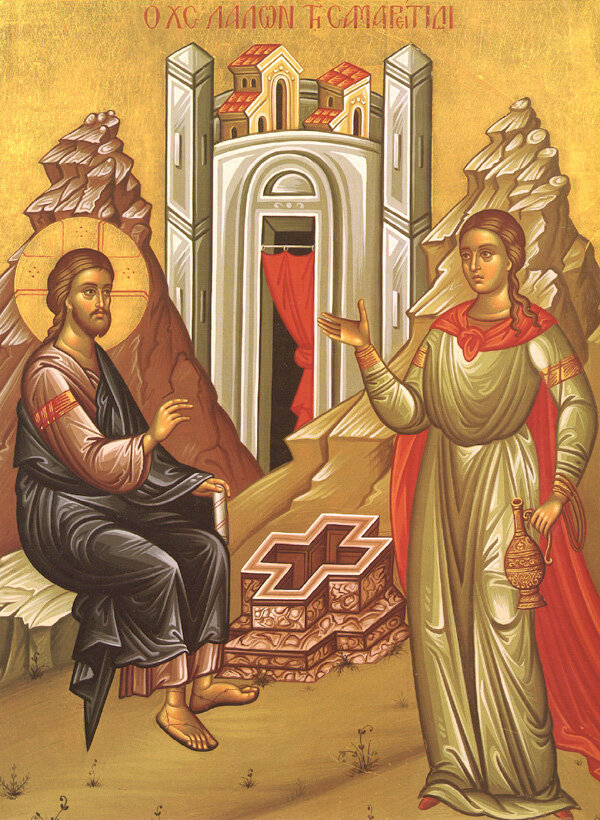
My beloved spiritual children in Our Risen Lord and Our Only True God and Our Only True Savior,
CHRIST IS RISEN! TRULY HE IS RISEN!
+
THE SAMARITAN WOMAN (Part II)
"The woman saith unto Him: 'I know that Messiah cometh, which is called Christ; when He is come, He will tell us all things.' Jesus saith unto her: "I that speaks unto thee am He..."
The Lord reveals that He is the expected Messiah - "I that speak unto thee am He." Rendered speechless by the wonder, the woman makes no reply to Him. The Apostles then return from the city and marvel at their Teacher's talking with the woman - an unbeliever, a Samaritan. And they are speechless with wonder.
"So when the Samaritans were come unto Him, they besought Him that He would tarry with them, and He abode there two days. And many more believed because of His own word."
The Lord responded to their plea and stayed for two days with them. And the harvest was truly abundant, for as well as those who believed in Him because of the woman's words, "many more believed because of the words" from His most pure lips.
And they said unto the woman: "Now we believe; not because of thy saying, for we have heard Him ourselves, and know that this is indeed the Christ, the Savior of the world." What the Lord said during these two days to the spiritually hungry and thirsty people is not known, as it has not been recorded. But that His words were "living water", having drunk of which a man thirsts no more, there is no doubt. This is seen, firstly, by the great number of those who came to believe in the Lord and, secondly, from their right confession of faith in Him: "This is indeed the Christ, the Savior of the world."
Among the many gods in whom the Samaritans believed, they did have some belief in the God of Israel. They held this belief, not because they knew Him but out of respect for Israel (Jacob), who has at one time lived among them. The Samaritan woman speaks of "our father Jacob". Doubtless, the Samaritans had heard the prophecy, linked with Jacob's name, about the star that would "come out of Jacob" (Numbers 24:17). When, at one time, Balak King of Moab went to war against the Israelites, he summoned Balaam, a soothsayer, to prophecy victory over Israel, and so encouraged his army. But when he tried to work his soothsaying magic and prophesy to Balak that which the king's heart desired, suddenly "the Spirit of God came upon him, and he began to prophesy, not what Balak wanted, but what God wanted, saying: "How goodly are thy tents, O Jacob, and thy tabernacles, O Israel!" When Balak heard these words, he began to rebuke Balaam, but Balaam was not afraid and continued: "Balaam the son of Beor hath said, and the man whose eyes are upon hath said: 'I shall see Him, but not now; I shall behold Him, but not nigh. There shall come a star out of Jacob and a scepter shall rise out of Israel!" (Numbers 24). And lo, He Whom Balaam saw from afar appeared. The star shone out of Jacob, brighter than the sun, and more beautiful than the loveliest dream. And the Samaritans saw it and rejoiced. They saw and believed. They drank to their fill of Living Water and became alive to eternal life.
But Christ the Savior did not give Living Water just to the Samaritans and the Jews. He gave it, and gives today, to each and every one who, in the desert of this life, is aware of his spiritual thirst. On one occasion, the Lord stood in Jerusalem and "cried saying: "if any man thirst, let him come unto me, and drink" (St. John 7:37). Do you hear how it is said: "He cried?" The Good Shepherd does not whisper; He shouts, calling His flock to water. He, in His love for mankind, stands in the searing desert of this world and "cries" to all the travelers exhausted by thirst. Blessed are they that hear the voice and draw near to him in faith. He will not question them about the language they speak or the nation to which they belong, their age or their riches, but will give them "living water", to strengthen and rejuvenate, renew, regenerate and revive them, and adopt them as sons, leading them out of the fiery furnace of this world into the garden of paradise. O Divine Drink, how wondrous Thou art! O sweet Savior, Thou cool and refreshing Well, how translucent, abundant, and Life-Giving Thou art! O Holy Spirit the Comforter draw to the Lord all those whose souls year for immortal life, and who cry in their thirst: "My soul is athirst for God; yea, even for the Living God!" O Lord Jesus, glory and praise be to Thee, together with the Father and the Holy Spirit - the Trinity consubstantial and undivided, now and forever, through all time and eternity. Amen. (Source: Homilies by St. Nikolai Velimirovic)
________________
Please note: For a very long time I have made it my personal task to enrich and inspire you, the stewards in the parish of St. Andrew, by bringing you the sacred writings of the Holy Fathers and Mothers of the Church, as well as, the official and authentic teachings of our Holy Orthodox Faith. No other Christian body can claim to possess the spiritual treasure of our Orthodox Church.
The goal or objective of this effort is to strengthen your understanding of the Faith and to encourage everyone who believes and follows faithfully Christ our Savior and God to live a more virtuous and holy life.
Sadly, however, the reality is much different. There is resistance, however, to any kind of positive spiritual change. Yet, our Lord Christ invites us to the "new life." A life in Christ that demands a change from our current worldly life. The Lord's conditions for one who is willing to follow Him are: "If anyone desires to come after Me, let him deny himself, and take up his cross and follow Me" (St. Matthew 16:24). The "cross" a dreadful instrument of punishment, is also a symbol of suffering by Christians in imitation of Christ. Self-denial is for the sake of Christ and the gospel, for a better life; it is not a punitive end in itself. Here Jesus states the central paradox of the Christian faith. In grasping the temporal, we lose the Eternal, in sacrificing everything we can know, we gain unimaginable riches. In dying, we live.
Avoid useless speculations and gossip. Stop all attempts to subvert the teachings of the Lord. Love your enemies and pray for them. Be a good instrument of Christ and strengthen unity and peace among your fellow Christians. Hypocrisy is wrong and destructive. In 1 Peter 2:1 the holy Apostle says, "Therefore, laying aside all malice, all deceit, hypocrisy, envy, and all evil speaking." The duty--the necessity-- for Christians to be holy in their conduct is the issue pursued in this passage. The Apostle Paul has written that all Christians are to put off the old manner of life, corrupted by evil and deception (Ephesians 4:22). Similarly, those addressed here are to turn away from evil.
___________________________
"Glory Be To GOD For All Things!" - Saint John Chrysostom
+++
With sincere agape in His Holy Resurrection,
The sinner and unworthy servant of God
+ Father George
Fifth Sunday of Pascha - Sunday of the Samaritan Woman
So He came to a city of Samaria which is called Sychar, near the plot of ground that Jacob gave to his son Joseph. Now Jacob's well was there. Jesus therefore, being wearied from His journey, sat thus by the well. It was about the sixth hour. A woman of Samaria came to draw water. Jesus said to her, 'Give Me a drink.' For His disciples had gone away into the city to buy food. Then the woman of Samaria said to Him, 'How is it that You, being a Jew, ask a drink from me, a Samaritan woman?' For Jews have no dealings with Samaritans. Jesus answered and said to her, "If you knew the gift of God, and who it is who says to you, 'Give Me a drink,' you would have asked Him, and He would have given you living water...' "

My beloved spiritual children in Our Risen Lord and Our Only True God and Our Only True Savior,
CHRIST IS RISEN! TRULY HE IS RISEN!
+
FIFTH SUNDAY OF PASCHA - THE SUNDAY OF THE SAMARITAN WOMAN
"So He came to a city of Samaria which is called Sychar, near the plot of ground that Jacob gave to his son Joseph. Now Jacob's well was there. Jesus therefore, being wearied from His journey, sat thus by the well. It was about the sixth hour. A woman of Samaria came to draw water. Jesus said to her, 'Give Me a drink.' For His disciples had gone away into the city to buy food. Then the woman of Samaria said to Him, 'How is it that You, being a Jew, ask a drink from me, a Samaritan woman?' For Jews have no dealings with Samaritans. Jesus answered and said to her, "If you knew the gift of God, and who it is who says to you, 'Give Me a drink,' you would have asked Him, and He would have given you living water...' "
THE SAMARITAN WOMAN AT THE WELL: THE LIVING WATER
Saint John Chrysostom writes:
"He shows that she is worthy to hear and not to be overlooked, and it is then He reveals Himself. For she, as soon as she had learned who He was, would immediately listen and attend to Him. This none can say of the Jews, for they when they were aware, asked nothing of Him; nor did they desire to be informed on any profitable matter. Instead, they insulted and drove Him away...Not without reason does she here call him, 'Lord', and assign high honor to Him...Do not wonder if she failed to perceive everything at once, for neither did Nicodemus...Now if a woman of Samaria is so eager to learn something profitable; if she stays with Christ though not yet knowing Him, what pardon shall we obtain?...We know Him...yet are unable to endure anything that is said, but are jaded in our knowledge." (Homily XXXI on John III, 4, 5.)
MY FOOD IS TO DO THE WILL OF HIM WHO SENT ME
Saint Nikolai Velimirovic writes:
"Here is love! Here is teaching! Here is acquiescence! Here is a model!...Those who love, they also serve. If you want to find out how great your love is toward God, then measure your obedience to the will of God, and you will immediately learn. Lack of positive obedience is a sign of a lack of love. Those who love, delight in fulfilling the will of the beloved. The Son of God so loved His Father, that He thought it to be preferable to food to fulfill the will of the Father. What is the will of the Father? The salvation of man. The Lord, Son of God felt an unquenchable hunger to carry out the will of the Father. And when He has saved [a soul] He felt nourished with the sweetest food. See how exalted is the spirituality of Christ!...
O my brothers and sisters, if you only knew how much Christ our Lord also hungers for our salvation!...We begin our own salvation which He offers to us. That is for Him the most gladsome food...O Lord Jesus, insatiable lover of men, have mercy on us and save us. Glory to You and praise forever. Amen. [Prolog, 7 September, p. 706]
+
"Like as the heart desireth the water-brooks, so longeth my soul after Thee, O God. My soul
is athirst for God; yea, even for the Living God" (Psalm 41/42:1-2).
This is not a cry by a poor and simple man, who had no way of refreshing his soul with human wisdom, worldly knowledge and skills, philosophy, and art: the knowledge of the fine threads from which the lives of men and nature are woven. It is not; but it is the sad and heartfelt cry of a king, rich with earthly riches, genial in mind, noble in the motions of his heart, and powerful in the strength and acts of his will. Refreshing his soul with all of these, for which the unfree and craves in this world. King David suddenly felt that his spiritual thirst was not only unquenched but had grown to such proportions that all this material universe was in no way able to quench it. He then felt himself to be, in this world, "in a barren and dry land, where no water is" (Psalm 62/63:2), and cried to God as the only Source of immortal drink, for which a rational, awakened soul yearns. "My soul is athirst for God; yea, even for the Living God!"
The body directly receives food that is in essentials identical to the body. The body is of the earth, and food for the body is of the earth. This is why the body feels at home, among its own, in the world. But the soul suffers; it is crucified and suffers; it is disgusted and protests at having to receive food indirectly, and this food is not identical to itself. The soul, therefore, feels itself, in this world, to be in a foreign country, among strangers.
That the soul is immortal, and that it, in its essence, belongs to the immortal world, is proved by the fact that, in this earthly world, it feels itself a discontented traveler in a foreign land, and that nothing in the world can feed and refresh it. And even were the soul to be able to pour the whole universe into itself like a glass of water, its thirst would not only not become less but would, of a certainty, become greater. For then there would not remain in it one single illusory hope that it would, beyond the next hill, light on an unsuspected source of water.
The human soul is alive; alive and ever athirst for life; and nothing can slake its thirst but life: basic, direct life. But such life is found in God, in the living God, alone. "My soul is athirst for God; yea, even for the living God!" This is not just a psalm, but is a plain fact, like the dry throat of a thirsty lion that roars in the desert, and whose roaring can seem to the birds at the oasis like a song, although to the lion it is not a song but a cry for help...
"...Give Me to drink." The Creator seeks this of His creature. These words resound through two thousand years; for He did not say these words only to the Samaritan woman, but to all generations of men to the end of time.
"Give Me to drink", He says today to each one of us - the Creator of water and the Disposer of seas and oceans, rivers and springs - does not say this because He is thirsty for water, but because He thirsts for our good will and love. Giving to Him, we give not of our own, but of His. Every glass of water on earth is His, for He created it; and every glass of well-water, which we give to one of His "least brethren", He has paid for with His Precious Blood. However, in His unexampled humility, He does not seek water from the woman as the Creator from a creature, but as one man would seek from another, showing His humility in this and witnessing in this way to His limited and needy human nature. Finally, He does this to teach us to serve with charity. A man has the right to seek from another; and a man has the duty of service of, and charity to, another. (Source: Homilies by St. Nikolai Velimirovic)
__________________
"Glory Be To GOD For All Things!" - Saint John Chrysostom
+++
With sincere agape in His Divine Resurrection,
The sinner and unworthy servant of God
+ Father George
May 14 - Holy Hieromartyr Therapon
Saint Therapon, the sacred hieromartyr, whom we commemorate today, possessed an origin and parentage that is unknown. We know neither the year in which he lived nor the governors and kings whom he confessed Christ and attained the laurel wreath of martyrdom. This dearth of information describing any anecdote from his life is due to the ravages of all-consuming time. Only by reason of his sacred icon, wherein he is depicted as a monk, do we deduce that he received the Schema of the monastics. The pious claim that he served as a bishop in Cyprus, offering himself to Christ as a martyr by which he met his end, is part of a tradition that has been handed down to us and survives to this day.

My beloved spiritual children in Our Risen Lord and Our Only True God and Our Only True Savior,
CHRIST IS RISEN! TRULY HE IS RISEN!
+
ON MAY 14th OUR HOLY ORTHODOX CHRISTIAN CHURCH COMMEMORATES THE FEAST OF THE HOLY HIEROMARTYR THERAPON.
Saint Therapon, the sacred hieromartyr, whom we commemorate today, possessed an origin and parentage that is unknown. We know neither the year in which he lived nor the governors and kings whom he confessed Christ and attained the laurel wreath of martyrdom. This dearth of information describing any anecdote from his life is due to the ravages of all-consuming time. Only by reason of his sacred icon, wherein he is depicted as a monk, do we deduce that he received the Schema of the monastics. The pious claim that he served as a bishop in Cyprus, offering himself to Christ as a martyr by which he met his end, is part of a tradition that has been handed down to us and survives to this day. We, too, believe is to be true, inasmuch as what is well known has been kept alive by oral transmission. The venerable man's holy relics were transferred to Constantinople when the Hagarnes were about to lay waste to Cyprus. It is said that the Saint appeared to those who guarded his holy relics, ordering them to transfer them to Constantinople. So it is now that the site where they are treasured is a source of miracles for those who flock to the Saint with faith.
+
THE HOLY MARTYR ALEXANDER AT KENTOUKELLAI
Saint Alexander, the holy martyr, lived during the reign of Maximian, who ruled between the year 286 and 305 A.D. He was a Roman by birth, serving in the army of the commander Tiberian. When Tiberian decided to sacrifice to the pagan idols with his entire host, the holy Alexander not only refused to sacrifice with them but also mocked them all as madmen wanting in understanding; for the pagan soldiers were as men who had lost their minds, inasmuch as they forsook the Creator of the world in order to worship unclean demons. Therefore, on account of his treating the order scornfully, he was led before Emperor Maximian.
As they escorted him, an Angel of the Lord appeared to Alexander. He spurred on Christ's soldier to martyrdom, giving him the courage and strength of Jesus Christ. But he toiled in vain; for Alexander, the athlete of Christ remained adamant in his convictions. Furthermore, it is also said that he witnessed the heavens having been opened. And, having beheld the Son of God sitting at the right of the Father, as did the First-Martyr Stefanos (Stephen), Alexander's face shone more than ever. Though he was handsome by nature, yet now he possessed the visage of an Angel. The Roman Emperor Maximian lost all hope of converting him. He had no wish to question him further. He, therefore, remanded him to Tiberian, whom he had appointed as Prefect and entrusted with the persecution of the Christian.
When Saint Alexander was delivered to Tiberian, the latter was commanded to punish him by many tortures, even on the way as they marched. If Alexander still could not be persuaded to sacrifice to the pagan idols, Tiberian was to put to death forthwith. When Tiberian began advancing on the road, he subjected the holy one to an interrogation. Since he, too, could not dissuade Alexander from his course, he had him tortured. His sides were burned with lit torches. Tiberian then ordered that the road be overland with prickly plants. The holy martyr was thrown upon them and beaten with rods. While this was carried out, an Angel of the Lord appeared and strengthened Alexander. The holy martyr endured all his tortures with ease, though his body was covered with wounds and lacerations.
Accompanying the holy martyr was his mother Pimainia. She was grieved and besought God on behalf of her son's plight. She was apprehensive lest he should cower for a moment. When they reached Philippopolis, the entire Christian population came out to greet the Saint. They even kissed his chains. The holy martyr gave thanks to God for such a kind of reception. As soon as they arrived at a place called Paremvolae, the Prefect subjected the martyr to further questioning and has him thrashed cruelly. As they approached Verea, the righteous one observed that there was no water in that vicinity. By his efficacious prayer, he caused water to spring forth from the ground. It is said that as the executioners were about to pour boiling oil upon his back and shoulders, the cauldron overturned. The boiling oil, then, spilled out and seriously burned many of the Prefect's servants.
Following this, the holy one was beaten with heavy and thick staves. Since he persisted in the Faith of Christ, he was cudgeled again. When they arrived at a Thracian site called Drizipara, the decision was made to dispatch him with a sword by the waters of the river. However, the executioner who was assigned to behead him at the Prefect's order, dare not raise his sword. This was due to his vision of Angels standing about and guarding the Saint. Therefore, the holy Alexander uttered a prayer and besought the Angels to stand off a little. After they withdrew from him, the headsman was able to behead him. Thus, the blessed Alexander ascended victoriously into the heavens. The translation (anakomide) of his holy relics and his commemoration is celebrated at a location called Kentoukellai. (Source: The Great Synaxaristes of the Orthodox Church)
__________________
"Glory Be To GOD For All Things!" - Saint John Chrysostom
+ ++
With sincere agape in His Holy Resurrection,
The sinner and unworthy servant of God
+ Father George
Using Time Wisely at Home During the Pandemic
We find that during this pandemic while our entire family is home bound it is good to find creative and imaginative ways and to use this unique opportunity to strengthen our relationship with each other and to pass this precious time wisely and beneficially for all.
My beloved spiritual children in Our Risen Lord and Our Only True God and Our Only True Savior,
CHRIST IS RISEN! TRULY HE IS RISEN!
+
USING TIME WISELY AT HOME DURING THE PANDEMIC
Christ is Risen! Truly He is Risen!
We find that during this pandemic while our entire family is home bound it is good to find creative and imaginative ways and to use this unique opportunity to strengthen our relationship with each other and to pass this precious time wisely and beneficially for all.
As Orthodox Christian believers we are truly blessed with a wonderful and rich and Holy Tradition and spiritual heritage that offers us incredible guidance and resources for the strengthening spiritually of our family. It would be of great spiritual benefit for us to turn to the reading passages from Holy Scripture, to become familiar with the virtues and holy Lives of the Saints of our Church, to study the sacred writings of the Holy Fathers and Mothers of the Church, to strengthen our communion with Our Creator and God through unceasing prayer.
There are many opportunities to form a strong connection with God. Our family strives always to be Christ-centered. Everything that we do revolves around our Lord and Savior Jesus Christ Who watches over us and Who desires to dwell within our hearts. When our family participates totally in the life of the church through worship, the mysteries, and virtues living, God bestows His grace and abundant blessings upon us.
There is no greater witness than to willingly follow Christ God. To place our complete trust in Him and to allow Him to lead us to salvation. Without Him, life has no meaning, no purpose. He is our everything! Our hearts must be pure and open to His grace and be willing to be obedient to His Divine Commandments.
Time here on earth is precious and we must always use it wisely. Our life should be a positive experience, fruitful, philanthropic, constructive, and meaningful. Just as we mature physically, emotionally, psychologically, we should also strive toward the attainment of spiritual maturity. To come to the point when we say as Saint Paul, "It is no longer I who live, but Christ lives in me" (Galatians 2:20). Just as living in the flesh involves the whole person, body, and soul, so living "in the faith" involves the whole person.
There are so many wonderful lessons to be learned while everyone is at home and how everyone can re-discover the path to Christ our Lord. Pray individually, and as a family, for spiritual strength and inspiration. Look up the words strength and strong in your Holy Bible's concordance and find passages related to godly strength. Also, see where the words humility, obedience, love, and sacrifice occur for greater connections to strength.
If you have never opened the Holy Bible open it now and don't be afraid. You do not have to be a biblical scholar or a theologian to read the Holy Scripture. You are not there to give a theological interpretation but to be edified by the word of God. Begin by reading the Gospels and gradually the Epistles (Letters) of Saint Paul. You are not under any pressure to go through it at a specific time. Know that when you turn to the Holy Bible you should approach it with faith, humility, and the understanding that our Lord is speaking to you through His Divine word. It actually becomes a loving dialogue between Him and you. Absorb everything that you read slowly and without any fear. In this way, you will find inspiration, comfort, hope, strength, inner peace, and courage.
Saint Theophan the Recluse wrote, "The final goal of man is communion with God. The path to this communion has been precisely defined: faith, and walking in the Commandments with the help of God's grace." We seek holiness and union with God as taught by the Holy Apostles and the Holy Fathers of the Church. Our Savior and Resurrected Lord came to save us and to open the gates of heaven for us. He showed us how to live through His Divine teaching and example. As you come closer to Him, you increase your capability to deal with the various challenges that you may face in life. You increase your ability to live according to the Christian virtues and precepts.
_____________
"Glory Be To GOD For All Things!"-- Saint John Chrysostom
+++
With sincere agape in His Divine Resurrection,
The sinner and unworthy servant of God
+Father George