
The Divine Ascension of Our Lord and Savior Jesus Christ Into Heaven
Forty days after His Resurrection Christ ascended into heaven, where He had been previously, according to His own words to the Disciples before His Passion: "Does this offend you? What then if you should see the Son of Man ascend where He was before? (St. John 6:61-62). Of course, this does not mean that Christ, as God, was not in heaven during the time of His incarnation, but that He would go up even with his human flesh. Moreover, His coming down from heaven is meant as Divine condescension and not as a change of place.

My beloved spiritual children in Our Risen Lord and Our Only True God and Our Only True Savior,
CHRIST IS RISEN! TRULY HE IS RISEN!
+
ON MAY 28th OUR HOLY ORTHODOX CHRISTIAN CHURCH CELEBRATES THE DIVINE ASCENSION OF OUR LORD AND SAVIOR JESUS CHRIST INTO HEAVEN
By Metropolitan of Nafpaktos HIEROTHEOS
Forty days after His Resurrection Christ ascended into heaven, where He had been previously, according to His own words to the Disciples before His Passion: "Does this offend you? What then if you should see the Son of Man ascend where He was before? (St. John 6:61-62). Of course, this does not mean that Christ, as God, was not in heaven during the time of His incarnation, but that He would go up even with his human flesh. Moreover, His coming down from heaven is meant as Divine condescension and not as a change of place.
In the time between His Resurrection and Ascension, He appeared many times to His Disciples, to whom He revealed the mysteries of the Kingdom of God, according to the words of Saint Luke: "to whom he also presented himself alive after his suffering by many infallible proofs, being seen by them during forty days and speaking of the things pertaining to the Kingdom of God" (Acts 1:3).
The feast of the Lord's Ascension has great meaning and importance for the Christian and spiritual life because it is connected with the theosis (deification) of every person. In what follows, presenting the central Christological points of this great feast of the Lord, we shall also establish its great value.
First, we must exactly what Holy Scripture says about this Divine Ascension. The Old Testament makes prophecies about this great event, and the New Testament presents it.
Just as we have prophecies about all the happening of the Lord in the Old Testament, this is true for the Divine Ascension as well. The Prophet Ezekiel saw a vision, which certainly refers to Christ's Ascension: "Then the glory of the Lord departed from the threshold of the temple and stood over the cherubim. And the cherubim lifted wings and mounted up from the earth in my sight" (Ezekiel 10:18-19).
In the teaching of Christ Himself and in His speech to the Disciples before His Passion He said the following: "I came forth from the Father and have come into the world, Again, I leave the world and go to the Father" (St. John 16:28). And in another situation Christ gave assurance: "No one has ascended to heaven but the one who came down from heaven, that is, the Son of Man who is in heaven" (St. John 3:13).
We see the Ascension in the stories of the Evangelists, who refer to this event. Concretely, it is told by the Evangelist Mark (St. Mark 16:19) and by Saint Luke, both in his Gospel (St. Luke 24:50-53) and in the Acts of the Apostles, which he himself wrote: (Acts 1:3 and 9-11). The details of the event of the Ascension and of the way in which it happened are described in the Book of the Acts of the Apostles...
"...The Apostle Paul, referring to the central points in Christ's work of absolution, the work of the Divine Economy, also includes the Ascension: "God was manifested in the flesh, justified in the Spirit, seen by the Angels, preached among the Gentiles, believed on in the world, received up in glory" (I Timothy 3:16). Referring to the power of the Father, he says that it "worked in Christ when he raised him from the dead and seated him at his right hand in the heavenly places" (Ephesians 1:20). Elsewhere we have said that the power of the Father is also the Son's power. After Christ cleansed us from sins "He sat down at the right hand of the Majesty on high" (Hebrews 1:3), and indeed Christ gave the promise to all who united with Him that they too would sit on the throne of His Father: "To him who overcomes I will grant to sit with me on my throne, as I also overcame and sat down with My Father on His Throne" (Revelation 3:21).
From these passages which have been cited it is very clear that the Church attaches great meaning to the event of the Divine Ascension, because Christ's Ascension expresses the deepest meaning of the spiritual life.
The icon of Christ's Ascension is splendid. The Disciples were astonished and watched with joy and wonder as He ascended into heaven. Saint Luke reports: "Now when He had spoken these things, while they watched, He was taken up... and while they looked steadfastly towards heaven as He went up..." (Acts 1:9-10).
According to Saint Athanasios the Great, the Holy Disciples did not see Him when He ascended to Heaven but were gazing steadfastly, which means that "the intent eye was fixed in the direction of the All-Seeing eye". It is essentially a matter of a continuous gaze. Their gaze was riveted, we would say, on Christ, Who had been received into heaven.
This posture, apart from the sense of the grandeur of the image of the ascended Christ also has the meaning that the Christians have the eye of the soul, the nous, fixed on heaven. It is in this light that we should view the liturgical exhortation of the priest "let us lift up our hearts" or in the Divine Liturgy of the brother of God James, "let us lift up our nous and hearts". And this is important because our citizenship is in heaven, from which we also eagerly wait for the Savior, the Lord Jesus Christ" (Philippians 3:20). And in another place the Apostle Paul sends word: "Set your mind on things above, not on things on the earth" (Col. 3:2). This fixed attention on Christ and lifting up of the nous to Christ is not unrelated to noetic hesychia, the hesychastic life, when the nous detaches itself from every earthly desire and is lifted up only to Christ..."
"...Since we are members of the Church in which the whole work of the Divine Dispensation is experienced, we have obligations. As citizens of the incorporeal we must be far removed from desires of the flesh. As members of holy humanity and temples of God we must live in holiness. Since God has granted us the royal house, the Church, instead of hell, we must make our peace with God (Proklos, Archbishop of Constantinople).
It is necessary to practice purity of the body and soul. A person must keep the eye of his soul as a watchful guard so that when the robber devil comes to pollute him with bodily sins, he will be ready to say: "I am not going to turn traitor to the Lord's possession" (Saint Epiphanios). That is to say, I will not betray the property which belongs to the Lord Christ.
After Christ's Disciples had passed through all the trials, the purification, the experience of the Cross, then they remained in the upper room and in this way received the Holy Spirit. And we, when we worship Christ, must return to Jerusalem, which means peace. We must make peace with ourselves and others. And not only should we return to Jerusalem, but we should wait in the Upper Room, which is our nous, where we should be in constant prayer and take care to purify ourselves from passions and base thoughts. In this way, we shall attain the visitation of the Comforter (Parakletos) and worship in truth the Father, Son, and Holy Spirit (Saint Gregory Palamas)..."
Christ's Ascension is the jewel of all the feasts of the Lord, the completion of all that Christ did for us, through the work of the Divine Dispensation. This consummate feast invites us to spiritual perfection and fullness, to participate in Christ's Ascension and the experience our own ascension. (Source: The Feasts of the Lord. An Introduction to the Twelve Feasts and Orthodox Christology)
___________________________
"Glory Be To GOD For All Things!"-- Saint John Chrysostom
+++
With sincere agape in His Divine Resurrection,
The sinner and unworthy servant of God
+Father George
Memorial Day - A Day of Love, Courage, and the Ultimate Sacrifice
On this Memorial Day celebrated in the United States, our beloved country, we honor the men and women who made the ultimate sacrifice for freedom, justice, and love of country. It is also a day of remembering the great courage with which they performed their duty to God and country. What a splendid example for young and old to emulate and to cherish. We are indeed inspired by their selflessness, devotion, and patriotism.

My good friends in Our Risen Lord,
Chris is Risen! Truly He is Risen!
On this Memorial Day celebrated in the United States, our beloved country, we honor the men and women who made the ultimate sacrifice for freedom, justice, and love of country. It is also a day of remembering the great courage with which they performed their duty to God and country. What a splendid example for young and old to emulate and to cherish. We are indeed inspired by their selflessness, devotion, and patriotism.
All of us need to learn from their example of courage and the willingness to sacrifice everything which they held dear and precious to defend the vulnerable and innocent from barbarism, totalitarianism, atheism, malevolent dictators, tyranny, enslavement, and executions. God created man to be free. Free to enjoy his/her inalienable rights, to worship Him without hindrance, to move freely, to be able to govern his/her life without fear of penalty, to determine his/her future according to one's ambition and ability, free to express one's political opposition and without the fear of retribution and imprisonment.
Even now, at this time, we need to have courage in the face of the threat the coronavirus brings. It takes courage to fight against the evil forces in the world and to shine a light on their evil agenda and dark plans. As Orthodox Christians, we have countless examples of true courage and sacrifice in the lives of the great martyrs of the Church. Christians that went to their martyrdom singing psalms and praising Our Almighty God. Orthodox Christians that have died in the hands of heretics which were determined to impose their heretical beliefs on our devout brothers and sisters in Christ as well as those of unbelievers and enemies of Christ and His Holy Church.
Our Church Ecumenical Councils were convened in order to defend and protect the Church from those who assaulted the authentic teachings of our Lord and Savior Jesus Christ. Since then the Orthodox Church has anathematized those who sought, over the centuries, to distort or corrupt Our Orthodox Christian Faith.
As long as we have God with us we should never fear anyone or anything. Above all, my beloved brothers and sisters in Christ, we must never fear the Precious Body and Blood of our Lord Jesus Christ as we approach the Holy Chalice. A believer is not afraid of any kind of virus but as the priest invites the faithful to partake of Holy Communion he says, "With the fear of God, with faith and with love draw near." Fear of God is not the same as the "fear" of a virus.
If there are any who truly fear Holy Communion then they must refrain from receiving. Receiving Holy Communion is a free and voluntary decision based on faith.
May you all have a safe and blessed Memorial Day.
With agape in Our Risen Lord Jesus Christ,
+Father George
May 21 - Sts. Constantine and Helen (Part IV)
It was also at that time that Saint Constantine the Great was vouchsafed a vision. For this reason, he sent his blessed mother Helen to Jerusalem that she might search for the Precious Wood of the Holy Cross. It was still buried or rather hidden away out of malice (hatred) in the Holy Land where our Lord Jesus Christ was crucified and buried, by the ungrateful people of the Jews. Socrates and Sozomen mention that the haters of Christ had covered the spot of the crucifixion. By design, they were instrumental in the construction of a temple to Aphrodite (Venus) that they might blot out the memory of Jesus. When the location came to be known to the St. Helen, she ordered the temple cast down and the earth removed.

My beloved spiritual children in Our Risen Lord and Our Only True God and Our Only True Savior,
CHRIST IS RISEN! TRULY HE IS RISEN!
+
SAINT HELEN'S EXPLOITS IN THE FINDING OF THE PRECIOUS CROSS OF CHRIST (Part IV)
It was also at that time that Saint Constantine the Great was vouchsafed a vision. For this reason, he sent his blessed mother Helen to Jerusalem that she might search for the Precious Wood of the Holy Cross. It was still buried or rather hidden away out of malice (hatred) in the Holy Land where our Lord Jesus Christ was crucified and buried, by the ungrateful people of the Jews. Socrates and Sozomen mention that the haters of Christ had covered the spot of the crucifixion. By design, they were instrumental in the construction of a temple to Aphrodite (Venus) that they might blot out the memory of Jesus. When the location came to be known to the St. Helen, she ordered the temple cast down and the earth removed.
Saint Theophanes tells us that "the emperor ordered Makarios I, Bishop of Jerusalem (314-333 A.D.), who was present at the First Ecumenical Synod at Nicaea, to search out, on his return, the site of the Holy Resurrection and that of Golgotha (Place of the Skull) and the Life-Giving Wood. In this year he crowned Helen, his God-minded mother, and assigned her as Empress the privilege of coinage. She had a vision commissioning her to go to Jerusalem and to bring to light the sacred sites buried by the impious. She begged her son Constantine to fulfill these commands sent to her by God. And he acted in obedience to her will."
Thus, this episode of the great moment began as follows: Saint Helen, of a pious mind, took along with her an army and multitude of generals and dignitaries. During her pilgrimage, she distributed much in the way of alms and imperial support of the Church and clergy. "Constantine," adds Theophanes, "sent his mother with money and soldiers, Makarios, Patriarch of Jerusalem, having met the Empress with due honor, made the search for the longed-for Life-Giving Wood along with her, in tranquility, with earnest prayers and fasting. When these things had been done, the site was quickly revealed to Makarios by God in the place where the pagan temple and statue of the impure demon Aphrodite stood. The divinely crowned Helen, using her imperial authority, immediately arranged for a large number of workmen to destroy the temple, which had been lavishly built by Emperor Aelius Hadrian (117-138). She razed it to its foundation and removed the excavated soil.
Empress Helen came to the site of the Lord's Passion. So she sought out those full of learning, not only Christians but also Jews in order to inform her of the Precious Holy relics whereabouts. The Augusta secured the help of a certain Jew named Juda, who was most familiar with the Holy Land. He, initially, was not cooperative. He was, consequently, cast into a dry well. He was not given any bread or water. Finally, after seven days, Juda could no longer bear the hunger and thirst. He cried out in a great voice, "Release me and I will reveal where the Christ was crucified!" Straightway, he was drawn out of the well. He made manifest the site, but he did not know exactly where the Cross was to be found. The Holy Helen offered up prayer to the Lord. Forthwith, there occurred a great earthquake that shook the depths of that place. An ineffable fragrance wafted forth, even as the scent of incense. The Empress charged the workers to dig. As the diggers went deeper into the earth, they began to detect a fragrant scent emanating from underground. The August gave orders for the digging to continue.
The general astonishment, but precisely as the Empress alone had believed, deep digging opened up cavities in the earth and revealed the secret of the hidden Cross of Christ. Helen and all marveled, as well as Juda. That Jew came to believe in Christ and gave thanks to Him. The earth yielded up three crosses, the placard, and the nails. The custom at that time was to bury the implements of torture close to the site of suffering. The inscription, however, had been wrenched from the True Cross and tossed aside. The Cross of Jesus had been cast aside with the others, without any distinction. Rufinus of Aquileia notes: "The three crosses were jumbled together. But Helen's joy at the discovery was darkened by the fact that the crosses were indistinguishable from each other. There was also found the inscription which Pilate had made with Greek, Latin, and Hebrew letters, but not even it showed clearly enough which was the Lord's gibbet." Saint Theophanes reports that "straightway the Holy Sepulchre and the Place of a Skull were revealed; and close by, to the East, there were buried three crosses. After searching, they even found the nails. But they were all at a loss to know which cross was the Lord's.
Empress Helen was filled with profound gladness upon the discovery. When Juda was asked, he knew not how to identify which one of the three crosses was the one upon which the Lord was crucified. It so happened, as if by the appointment of God, that a funeral procession was in progress. Juda, moved by a sanguine faith, summoned the mourners to bring the deceased before the Empress. The bier of the corpse was carried in and set down. As the body lay there, the first cross was placed on the dead person, but there was no response from the deceased. This took place again with the second cross and, once more, there was no sign. Nothing occurred because these were the crosses of the two thieves. Finally the Cross of our Lord Jesus Christ was placed on the corpse. O Thy wonder, Christ King! The dead man arose. By this great miracle was there revealed the power of the Honorable and Precious Cross of Christ. This miracle-working was witnessed by many Jews, who came to believe in Christ. Following this momentous event, the Empress summoned Juda who, in the interim, received Holy Baptism and was named Kyriakos. As Kyriakos and others were offering veneration to the Cross, the place was radiant. They dug a little further and discovered the nails.
Saint Theophanes adds another account that further testified to the True Cross. In their attempt to discover the Holy Cross of the Lord, while "Helen was particularly grieved, the well-named Makarios solved the problem by his faith. For by bringing each of the crosses to a distinguished lady who was in despair and near death, he discovered which of them was the Lord's. For barely had its shadow come close to the sick woman when she, though hardly able to breathe or move, suddenly and immediately through God's power leaped up and began glorifying God in a loud voice."
Greek Church historian Socrates, a lawyer, and native of Constantinople says that the "emperor's mother erected over the place of the Sepulchre a magnificent church, and named it New Jerusalem, having built it facing that old and deserted city. There she left a portion of the Cross, enclosed in a silver case, as a memorial to those who might wish to see it. The other part she sent to Emperor Constantine. He believed that the city would be perfectly secure where that holy relic should be preserved. He privately enclosed it in his own statue, which stands on a large column of porphyry in the Forum called Constantine's at Constantinople...The Emperor supplied all materials for the construction of the churches and wrote to Bishop Makarios to expedite these edifices. When the Emperor's mother had completed the New Jerusalem, she reared another church that was not at all inferior. It was over the cave at Bethlehem, where Christ as born according to the flesh. Nor did Helen stop here, but ordered churches be built at the Holy Sepulchre and at Calvary in the name of her son, where the Life-Giving Wood was discovered, and also at Bethlehem and on the Mount of Olives.
At Golgotha, Saint Helen was the first to venerate the holy Cross and kiss it. She fully intended to bring the Holy Relic of the Cross to the new city, as a gift for her son. Thus she had it sawn vertically, parallel to the front face, thereby retaining the form of the entire front and rear of the Cross. Hence, she had two Crosses, one of which was left in Jerusalem and the other which was taken, rejoicing, along with her, together with the Precious Nails, to her son the Emperor.
When Constantine learned that his mother was approaching the new city, he went out to meet her. With profound gladness, he venerated the Honorable Cross. He handed over to the bishop of the church both the Sacred Cross and the chest with the Precious nails. (Source: The Great Synaxaristes of the Orthodox Church)
____________________
"Glory Be To GOD For All Things!" - Saint John Chrysostom
+++
With sincere agape in His Holy Resurrection,
The sinner and unworthy servant of God
+Father George
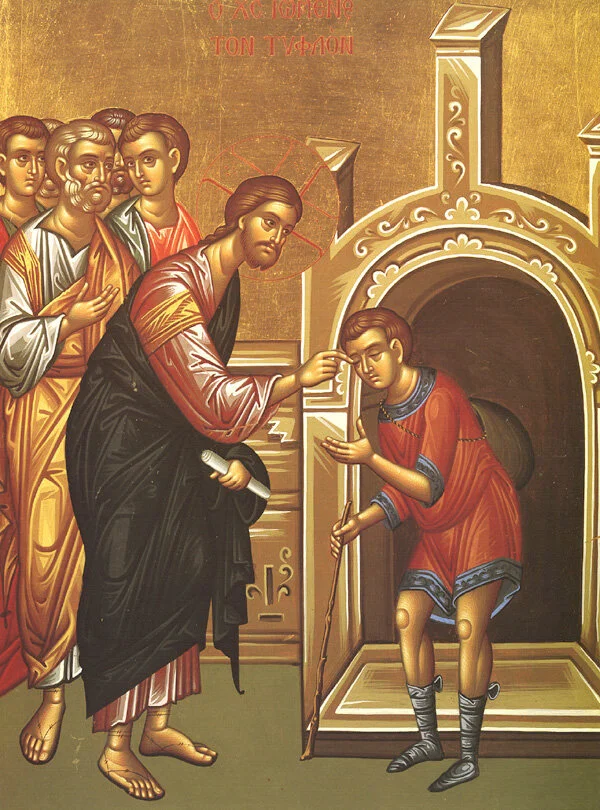
Sunday of the Miraculous Healing of the Man Born Blind (St. John 9:1-38)
My beloved spiritual children in Our Risen Lord, Our Only True God and Our Only True Savior,
CHRIST IS RISEN! TRULY HE IS RISEN!
+
SUNDAY OF THE GOSPEL ON THE MIRACULOUS HEALING OF THE MAN BORN BLIND (St. John 9:1-38)
"As Jesus passed by, He saw a man which was blind from his birth. And His disciples asked Him, saying: "Master, who did sin, this man or his parents, that he was born blind?" Jesus answered: "Neither hath this man sinned, nor his parents; but that the works of God should be made manifest in him..."
Today's Gospel describes one of the innumerable wonders (miracles or Gk. thavmata) wrought by God, through which Christ's love for suffering men is shown, and His Divinity once more revealed.
At that time, as "Jesus passed by, He saw a man which was blind from his birth." Before this, it says that the Jews took up stones to cast at the Lord in the Temple itself, because He had spoken the truth. But while the wicked Jews were thinking only how they might act maliciously towards the Lord, He was thinking only of how to do good to men. A man was sitting in front of the Temple, blind from birth, asking for alms. None of these wicked persecutors of Christ, the shameful leaders and elders of the people, was prepared to take any thought for this poor man. Even if one of them threw a few coins into his lap, this was ore to make a parade before men than out of love and compassion for the man. Right back in Moses' day, the Lord said of these people: "They are a very forward generation; children in whom is no faith" (Deuteronomy 32:20). The compassionate Lord stopped by this man, ready to be of real help to him.
"And His disciples asked Him, saying: "Master, who did sin, this man or his parents, that he was born blind?" Before this, the Lord had healed the paralyzed man at the Sheep Pool, and had said to him: "Sin no more, lest a worse thing come unto thee" (St. John 5:14), from which it is clear that that man, who had been sick so many years, had brought his suffering on himself by his own sins. But the case with the man born blind was unclear, and the disciples, therefore, asked for enlightenment: "Who sinned?"
The most wise Rabbi replied to the disciples' question: "Neither hath this man sinned nor his parents; but that the works of God should be made manifest in him." That is, as Saint John Chrysostom says: "that he sinned, or his parents, is not here the cause of his blindness". It is not said of Job that either he or his parents had sinned, but he was attacked by a terrible sickness so that he was constrained to cry out: "My flesh is clothed with worms... my skin is broken, and become loathsome" (Job 7:5). Apart from one's parents and one's own sin, there must be other causes of men's suffering on earth. In the case of the man born blind, the cause consisted in that "the works of God should be made manifest in him." Blessed are they in whom the works of God are made manifest; who feel them, and use them for their soul's salvation. Blessed is the poor man whom God's mercy makes rich and famous, and he feels this mercy of God's with thanksgiving...the works of God are manifest in all of us every day, for God is with us all our days on earth. These works of God in us are for the salvation of each one of us as individuals. But the works of God in the man born blind were for the salvation of many. It was, by these works, shown that there are, among men, many more blind in spirit than in body. It was further shown by them how a wise man, given a bodily gift by God, will use it to enrich his soul with True faith. Foreseeing all these fruits of the healing of the man born blind, the Lord said with great joy to His disciples: "Neither hath this man sinned, nor his parents; but that the works of God should be made manifest in him." As though to say: leave aside for now the question of who sinned: he or another. It is not important at the moment. If he and his parents have sinned, I have been able, at this moment, to forgive them, taking their sin on Myself and proclaiming them forgiven. All this is now secondary to that which is to be manifested. And the works of God--not one, but many-- are to be manifested in him and will be recorded in the Gospel for the salvation of many. Indeed, the years of suffering by the man born blind will be rewarded a hundredfold, the reward for those who suffer for God's sake even for a day, is imperishable. One wise commentator on the Gospel Nicephoros, says about this man born blind: "A man born blind, who had never had an idea of what sight could mean, would feel incomparably less sadness that a man who had once seen, and had then lost his sight. He had been blind and had later received the reward for this small and almost unfelt sadness. For he received a twofold sight: physical sight, by means of which he saw the world around him; and spiritual sight, by which he recognized the Creator of the world."
Woe to those who have seen Him eye to eye, and have not known Him, but have rejected Him and remained in their deadly darkness. But this reply of His is also for us; we are His contemporaries, for He is alive forever and ever. And today we have the confirmation of His words: "As long as I am in the world, I am the Light of the world." As long as He is in a man's soul, He is the Light of that man. As long as he is in the midst of a people, He is the Light of that people. As long as He is in a school, He is that Light of that school. As long as he is in a workshop, He is the Light of the work and the workers. Anywhere from He withdraws His presence, a total darkness prevails; the human soul without Him becomes hell; a people without Him become of famished and ravening wolves; a school without Him becomes a poison-factory of folly; a workshop without Him becomes a place of grumbling and hatred. And think of hospitals and prisons without Him--they become dark caverns of despair! Indeed, whoever thinks on the days of his life, of a day without Christ and days with Him, the man has in himself a witness to the truth of those words of the Lord's: "As long as I am in the world, I am the Light of the world."
Christ's Light, by which He illumines the world and enlightens men, reveals itself before our eyes in its true radiance only when we see it against human darkness. And what followed on from the miraculous healing of the blind man present, in very truth, the thickest and most-frozen darkness of the human heart and mind; a darkness that, in today's Gospel, lies like a deep shadow under the blazing Light of Christ the Sun. This is the terrible darkness of the blind and minds of the Pharisees. Not only did the Pharisees not rejoice that the blind beggar in front of their Temple could now see, but they were even insulted and embittered. This Temple of theirs had already been turned into a guardian of the Sabbath, in the same way that their whole faith had been turned into the worship of the Sabbath as a goddess.
"Jesus heard that they had cast him out, and when He had found him, He said unto him: 'Dost Thou believe in the Son of God?' The blind man who has been healed had passed the first test: he has shown himself to be meek (humble) and obedient when the Lord sent him with clay-smeared eyes to wash himself in the Pool of Siloam. That was the test of obedience. He then passed the second test: he showed himself to be persevering under temptation, and would not betray the Lord to the Pharisees' lies. This is the test of temptation. Then the Lord confronted him with the third and final test; the greatest test: that of true faith. "Dost thou believe in the Son of God?" And Jesus said unto him: 'Thou hast both seen Him, and it is He that talketh with thee." And he said, "Lord, I believe," and worshipped Him.
As his bodily eyes had earlier been opened, so now were his spiritual eyes. And he looked with both his bodily and spiritual eyes, and saw before him the God-Man. God in human flesh.
Our God is indeed great, and doeth wonders; and there is no end to the tale of His wonders. We also, believe, O Lord Jesus Christ Our Savior; we believe that Thou art the Son of God and the Light of the world. We, together with the choirs of Angels and Saints in heaven, and Thy whole Church on earth, worship Thee, O Most-gracious Lord: Thee and Thy Father and the Holy Spirit-the Trinity consubstantial and undivided, now and forever and through all time and eternity. Amen. (Source: Homilies by Saint Nikolai Velimirovic)
_______________________
"Glory Be To GOD For All Things!"--Saint John Chrysostom
+++
With sincere agape in His Divine Resurrection,
The sinner and unworthy servant of God
+Father George
May 21 - Sts. Constantine and Helen (Part III)
In July of 315 A.D., Rome celebrated the Decennalia, the tenth anniversary of Constantine since he had been proclaimed Augustus in Eboracum in the British Isles. He had, during the last ten years, lived in Mediolanum, August Treverorum, Arelate, and Sirmium. Constantine went to Rome and accepted all of the honors bestowed upon him, with one important exception. He refused to make the traditional sacrifices to the pagan gods.

My beloved spiritual children in Our Risen Lord and Our Only True God and Our Only True Savior,
CHRIST IS RISEN! TRULY HE IS RISEN!
+
EMPEROR AND SAINT CONSTANTINE THE GREAT (Part III)
Emperor Constantine the Great Becomes Involved in Ecclesiastical Affairs
In July of 315 A.D., Rome celebrated the Decennalia, the tenth anniversary of Constantine since he had been proclaimed Augustus in Eboracum in the British Isles. He had, during the last ten years, lived in Mediolanum, August Treverorum, Arelate, and Sirmium. Constantine went to Rome and accepted all of the honors bestowed upon him, with one important exception. He refused to make the traditional sacrifices to the pagan gods. He, rather, offered prayers of thanksgiving to God, the King of all, as sacrifices without flame and smoke. He did not, however, relinquish his title as Pontifex Maximus, for it gave him control over appointments of pagan priests. In August of that year, he appointed the aged pagan aristocrat Vettius Rufiniusto to be Prefect of Rome. By his appointment, Constantine was following what was written in the Edict of Milan; but he also wished to demonstrate to the Patrician pagans that he did not permit religious difference to interfere with affairs of state. He hoped by his example that others would follow suit. Many pagans did not care for Constantine's policy of admitting Christians into the aristocracy, but they could do nothing against such a powerful Emperor.
Saint Constantine, for a time, directed his attention to the legitimate and universal religion. He wished for unity among the Christians of the Supreme Deity. He was very generous with public funds to support his favorite religion, Christianity. His contribution to the Faith was not only of a financial nature but also of a personal commitment, using imperial authority to maintain the church's internal stability...He not only listened to the bishops but also intervened to preserve the order of the Church. He retained the Office of Pontifex Maximus among his imperial powers, in order to possess a legal right to supervise religious questions. The October following the Edict of Milan, Constantine appointed the Bishop of Rome, together with a committee of bishops, to inquire into the Donatist controversy (heresy) in the African Church. Constantine wrote to Bishop Miltiades of Rome "to investigate and close this matter according to injustice." He then concluded with these words: "It should not escape thy notice how much respect I render to the legitimate and catholic Church and that I do not intend to tolerate schisms or dissension anywhere. May the Divinity of the Great God protect thee for many years, most honorable!"
The Vision of the City
It was as early as 316 A.D. when Saint Constantine was vouchsafed a Divine vision. He was commanded to build a city in the parts of the East, a city which he was to dedicate to the Most Holy Theotokos. Thus, this holy command was ever with him as he hastened to perform the Divine Will...He traveled to Chalcedon, directly across the Bosporos, which suffered from the frequent ravages of barbarian raiders. The site of the maritime town pleased the Emperor, so he began building in that place. Since that location for a new city was not God's good pleasure, this was made evident when eagles swooped down and snatched the tools of the craftsmen. The birds cast them in Byzantion. The Great Constantine, seeing this marvel, departed Chalcedon and went to Byzantion. He looked over the topography and believed it to be appropriate, but he did not know how large to make the new city. During the night, he beheld a vision of an Angel who addressed him and said, "In the morning, when it is dawn, be thou following me. And wheresoever I should go, do thou mark the place and there lay the foundations." In the morning, Saint Constantine summoned the chief architect. He commanded him to follow him and to place landmarks wheresoever he passed through. They set off together. The Emperor could see the Angel, who was walking ahead with a brisk pace. Only the Emperor could see the Angel. Behind Constantine was the architect, who went about wherever the Emperor passed through and marked all the land where God had willed that the new city should be built. Afterward, Saint Constantine began building the city.
The Emperor appointed a certain skilled and experienced man, named Efratas, to undertake the study and planning of the city that it might be work both marvelous and God-pleasing. Saint Constantine handed over to him an abundance of gold for the expenditure. Efratas was capable and careful, so that he constructed and laid out the city beautifully, as was meet and as was borne out in chronographs at the time. The new city was so aptly and serviceably designed that it was similar to Rome in all the buildings. From Old Rome they transported a certain huge stone column of porphyry to the Forum, which may be seen to this day.
The First Ecumenical Synod
Constantine the Great, as Emperor over the Christians, with the help of Divine power, closed the temples of the idols so that the Church was in the open to the glory of God. The First Ecumenical Synod was held in Nicaea of Bithynia during his reign, in the year 325 A.D. Three hundred and eighteen (318) Holy Fathers attended. He offered the attendees the use of public means of conveyance, or afforded horses, for their transport. The bishops responded with utmost willingness to hasten thither, as though they would outstrip one another in a race. It was Constantine who decided to assemble the episcopal pastors from the entire civilized world for the first time since the days of Christ and the Apostles. He refrained from any misuse of his power, for he took a position at the synod only at the behest of the Fathers and, as the Synaxarion of the Triodion states, "He sat not upon a royal throne, but upon a seat of little note."
The Synod was assembled against Arius, who kept spreading his heresy and blasphemy, saying that the Son and Logos/Word of God was not coessential (homoousios) with the Father. Thus, Arius was declaring that Jesus is not true God but a creature (ktisma), a Greek word meaning anything that is built. No account of the synodal proceedings is extant, in either Greek or Latin, except a list of twenty canons issued by the synod, the Symbol of the Faith (Creed), and a synodal letter excommunicating the odious Arius. This Synod, rejecting Arius' ontological subordination of the Logos/Word to the Father, defined the incarnate Logos/Word as coessential. This Synod also declared the computation of the Paschal Date, by ordering this Feast of Feasts to be celebrated on the Sunday after the full moon following the vernal equinox. This Synod also recognized the jurisdiction of the Patriarchates of Rome, Alexandria, and Antioch. Though Hieromonk Alexander and Deacon Athanasios were not adorned with the dignity of the episcopacy, they nevertheless were first in the debates.
This Ecumenical Synod produced the Divine Symbol (Creed of the Faith) (the Nicene Creed of 325 A.D.), proclaiming the Son and Logos/Word of God, the Father Almighty, Maker of all things visible and invisible; and in one Lord Jesus Christ, the Son of the Father; God of God; Light of Light, True God of True God; begotten, not made; being of one essence with the Father; by Whom all things were made, including all things in the heaven and all things on the earth; Who for us men, and for our salvation, came down, and became incarnate, and became Man; and He suffered and arose on the third day; and ascended to the heavens and is sitting at the right of the Father; and He is coming again to judge the living and dead; and in the Holy Spirit. As for those who are saying that 'there was a time when he was not,' and 'He was not existent before He was born'; and who are saying that 'He came to be out of non-being,' or assert 'He is out of another hypostasis' or 'essence,' or that 'the Son of God is mutable or alterable,' the catholic and apostolic Church anathematizes them." Saint Constantine's object was to gain the agreement of as large a majority as possible so that Church unity could be preserved. The new Creed was read out by Bishop Hermogenes, on the 19th of July. It was indeed signed by the majority of bishops...Without the unity of will and ideal that Constantine sought, civilization and daily life could never be satisfactory or safe. (Source: The Great Synaxaristes of the Orthodox Church)
(To be continued)
___________________________
"Glory Be To GOD For All Things!" -- Saint John Chrysostom
+++
With sincere agape in His Divine Resurrection,
The sinner and unworthy servant of God
+ Father George
May 21 - Sts. Constantine and Helen (Part II)
Constantius died on the 25th day of July, in the year 306 A.D., at the age of fifty-five. Eusebius the Church Historian tells us that Constantine was forthwith appointed by Constantius, who thereupon breathed his last. He reposed on the imperial couch in the royal palace, giving thanks to God in all things. He was surrounded by a devoted circle of his loving sons and daughters.
My beloved spiritual children in Our Risen Lord and Our Only True God and Our Only True Savior,
CHRIST IS RISEN! TRULY HE IS RISEN!
+
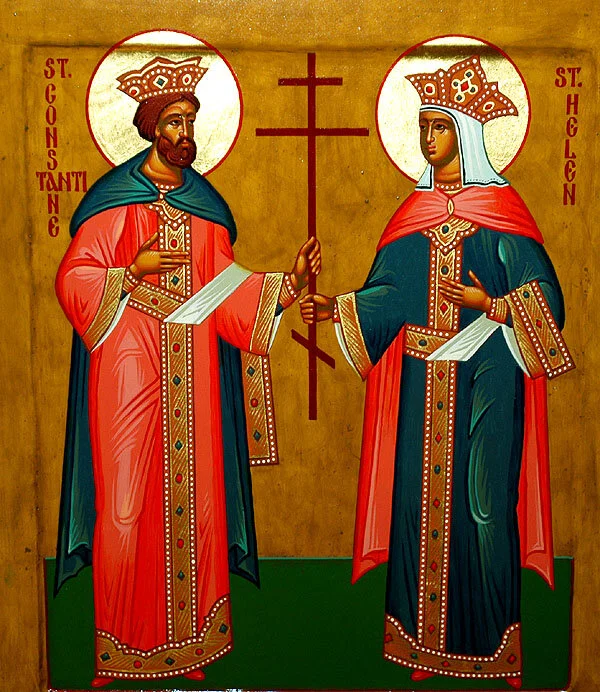
SAINTS CONSTANTINE AND HELEN (Part II)
Constantius died on the 25th day of July, in the year 306 A.D., at the age of fifty-five. Eusebius the Church Historian tells us that Constantine was forthwith appointed by Constantius, who thereupon breathed his last. He reposed on the imperial couch in the royal palace, giving thanks to God in all things. He was surrounded by a devoted circle of his loving sons and daughters.
Now before Constantius surrendered his soul, he disclosed from his deathbed, in the presence of Crocus and his senior commanders, that he wanted Valerius Aurelius Constantinus, Augustus!" Thus, at thirty-two years old, came the call for the elevation of Constantine to Augustus. As for his personal life, Constantine, earlier, at twenty-two, had met Minervina and wedded her in 295 A.D. He got a son, but the mother apparently died at childbirth or soon thereafter. The handsome infant with the curly dark hair was left with Helen to raise. Helen called the boy Crispus.
THE APPEARANCE OF THE CROSS
Constantine considered the rich and long-enduring heritage of his fellow countrymen's nationalist paganism and his own father Constantius' devotion to the strange and new Christian God. He perceived the singular blessedness of his father's life and the universally ill-fated destiny of his father's compatriots of the ruling class. His heart and soul were stirred to the depths when he meditated upon Christ's sinless life and sacrifice. Thus, he determined to seek Christ as his heavenly standard-bearer in the coming military battle with the undefeated armed forces of Maxentius. Added to this, there was the influence of Hosiusof Cordova, the saintly Spanish bishop who spent time at Arelate, even in the palace and at Augusta Treverorum, as the guest and confessor of his father's second wife, Theodora. Accordingly, Constantine prayed to the God of his father. Who was the God of the Christians, with fervent supplications. Constantine entreated Him to reveal to him Who He was and to stretch forth His right hand to help him in his present difficulties. While Constantine was yet praying, he beheld a cross of light in the heavens, above the sun, and bearing this inscription: "in this, conquer" (Gk. "En Touto Nika"). Both Constantine and his whole army saw this marvelous sign.
Constantine was a sane man and endowed with reasonable sensibilities. He was not inclined to flights of fancy. He was so humble-minded as to doubt whether an Almighty God would deign to vouchsafe such a miraculous vision to a sinful man like himself. He doubted within himself with honest self-abnegation, and not in any faithless manner at all. He wondered what this apparition could be. That night during sleep, Christ appeared to him with the same Sign of the Cross. He commanded him to raise a standard like unto it, by means of which he could safeguard himself in all his military campaigns and overcome all his enemies. Constantine, arising at dawn, communicated the marvel to his friends. Then, calling together the workers in gold and precious stones, Constantine sat in the midst of them. He began to describe to them the figure of the sign he had seen, bidding them represent it in such materials.
It consisted of a long spear and crossbar in the shape of a cross that was overlaid in gold. On top of it was an upright wreath of gold and precious stones, within the circle of which was the symbol of the Savior's name, two letters signifying His name (the first two letters of Christos): the letter 'X' (Greek Chi) overlaying the letter 'P. (Greek Rho), so that it looked like an 'X' superimposed upon the letter 'P.' The Emperor also wore, thereafter, the symbol of these two overlapping letters on his helmet...The Emperor constantly made use of this sign of salvation as a safeguard against every adverse and hostile power and commanded that others similar to it should be carried at the head of all his armies.
Constantine, hence, was so struck with amazement at the extraordinary vision that he was resolved to worship exclusively the Christ Whose symbol had appeared. Constantine sent for men learned in the mysteries of Christ's doctrines. He was given instruction about Christ and His Holy Cross, that it was the symbol of immortality and the trophy of that victory over death which Christ had gained in His Passion. He was instructed also in the cause of Jesus' advent, and the true account of His incarnation...He determined thenceforth to devote himself to the reading of the inspired writings. He also retained the Christian priests as his counselors. Thus spiritually fortified, he prepared himself for the impending battle.
The Great Synaxaristes says that Constantine was standing and pondering about the pending battle, being somewhat downcast when he beheld in the sky at about the hour of noon the sign of the Precious Cross. There were letters in Greek which read: "Constantine, in this conquer." As such, Constantine was told not to trust in his own human strength to vanquish the enemy; but in this sight of the cross, he would conquer the enemy in war. That same night, the crucified Christ appeared to him and said, "Rise up and construct a cross, even as the one thou dist behold. Hold it in battle with faith that thou mightest always overcome your opponents." Constantine then rose up from his sleep. He, again, during the night, saw in the sky above the trophy-bearing symbol. He then believed with all his soul in the True God, our Lord Jesus Christ. When dawn broke, he commanded the construction of a cross made of silver accordingly to the type that was made manifest to him. The men of his army always kept it before them.
Constantine, motivated by the love of his fellow man and reverence for God, invoked the name of Christ as His Divine Patron. With his royal standard to the fore, he marched on Rome. Maxentius barricaded all roads to Rome with divisions of soldiers. He resorted to his vile magic arts as he awaited Constantine's advance. Ever fearless at the head of his army, Constantine led his forces to victory after victory. He advanced undefeated against the first and second and third divisions of the tyrant's forces, vanquishing them all with ease; and thus, he made his way into the very interior of Italy.
The battle ended in the middle of the afternoon. Many died, but the heaviest losses were those among Maxentius' men. Countless suffered wounds or drowning. The city learned that Maxentius was dead and that Constantine had won. He was then forty years of age. The Historian Eusebius tells us that what had taken place was the most striking and miraculous chain of events. Maxentius, not content with sorcery, ordered a formidable war engine to be brought forward and mounted on a pontoon bridge over the Tiber River. Before Constantine could approach at the head of the army, the pontoon bridge began to sink; and Maxentius, and the soldiers and guards with him, went down into the depths like a stone.
The citizens of Rome, who had begged Constantine to come to their aid and were now released from the tyranny of the wicked Maxentius, garlanded the city and received with joy the victorious Constantine together with the victory-bringing Cross. The people proclaimed him as their Savior. After he gained control of Rome, Constantine ordered, before all else, that the relics of the holy martyrs be collected and handed over for a holy burial. The Roman celebrated a victory festival, honoring the Lord and the Life-Giving Cross. The festival, exalting Constantine, took place for seven days. (Source: The Great Synaxaristes of the Orthodox Church)
(To be continued)
_________________________
"Glory Be To GOD For All Things!" -- Saint John Chrysostom
+++
With sincere agape in His Divine Resurrection,
The sinner and unworthy servant of God
+Father George