
Sunday of the Holy Fathers of the First Ecumenical Council
On this Sunday our Holy Church celebrates the memory of just one small group of His disciples and followers. The Holy Orthodox Church brings before you only 318 of His sweet, fragrant, and undecaying fruits. A small but chosen group. These are the 318 Holy Fathers of the First Ecumenical Synod, which was held in Nicaea in 325 A.D., in the time of the Emperor Constantine the Great, for the defense, clarification, and confirmation of the Orthodox Christian Faith.

My beloved spiritual children in Christ Our Only True God and Our Only True Savior,
CHRIST IS IN OUR MIDST! HE WAS, IS, AND EVER SHALL BE.
+
ON SUNDAY MAY 31st OUR HOLY ORTHODOX CHRISTIAN CHURCH COMMEMORATES THE HOLY FATHERS OF THE FIRST ECUMENICAL COUNCIL
On this Sunday our Holy Church celebrates the memory of just one small group of His disciples and followers. The Holy Orthodox Church brings before you only 318 of His sweet, fragrant, and undecaying fruits. A small but chosen group. These are the 318 Holy Fathers of the First Ecumenical Synod, which was held in Nicaea in 325 A.D., in the time of the Emperor Constantine the Great, for the defense, clarification, and confirmation of the Orthodox Christian Faith. There had, at that time, appeared "grievous wolves" (Acts 20:29) under the guise of shepherds of the Church, who because of their dissolute lives, were unable to find a place for Christ's truth within themselves, but led the faithful astray, teaching them as dissolutely as they lived. The Holy Spirit, therefore, brought these Saints, the Holy Fathers, of God together at a Synod (Council), so that Christ's true teachers should be seen, as against the false, and that the might of those who fight for Christ should be seen over those who fight against Him; that the true, sweet fruit of the good Tree of which is Christ should be seen in contrast to the rotting and bitter fruits of the tree of evil. Like stars that shine in the sky, receiving light from the sun, so the Holy Fathers shone at Nicaea, receiving Light from Christ the Lord and the Holy Spirit. They were Christ-bearing men, for Christ lived and shone forth in each of them. They were citizens of heaven rather than of earth, more like Angels then men. They were, in very truth, "the temple of the living God; as God hath said: "I will dwell in them, and walk in them" (2 Corinthians 6:16). Is it not sufficient to mention just three of them, the best known in you, for you to have an idea of what the other three hundred and fifteen were like: our Holy Father Nicholas, Saint Spyridon, and Saint Athanasius the Great? Many of them came to the Synod bearing on their bodies wounds incurred for Christ's sake: Saint Paphnutius, for example, had lost an eye to his torturers. All of them shone with an interior Light that came from God, and in which the Truth was seen and known. As followers of Him Who was Crucified, they regarded their sufferings as nothing, because of which their fearlessness in defense of the Truth was boundless and inexpressible. By their God-given knowledge of the Truth and their fearlessness in defense of the Truth, these Holy Fathers disproved and stamped out the heresy of evil Arius the heretic, and established the Creed that we today hold and confess as God's saving truth.
Today's Gospel does not speak of this Synod, but of our Lord Jesus Christ's last prayer to His Heavenly Father. Why is it this prayer that we read in today's Gospel? Because it showed its effect on the First Ecumenical Council. Through the power of this prayer, God made the Holy Fathers at this Council devoted and fearless defenders of the Truth, and victors over questionings and malice by men and demons. This is that great prayer.
At that time, "Jesus lifted up His eyes into heaven, and said: 'Father the hour is come; glorify Thy Son, that Thy Son also may glorify Thee." All that the Lord taught men to do, He did Himself. He had taught men to pray to God thus: "Our Father, which art in heaven..." (St. Matthew 6:9). And he raised His eyes to heaven, where the Father dwells and said: "Father!" He does not say "our Father," as we do, but simply "Father!" He alone could say "My Father"; He and no other, in heaven or on earth, for He is the only begotten Son of the heavenly Father - while we are only adopted sons by God's mercy and grace. "He lifted up His eyes" - not only His bodily eyes also His spiritual ones - and firstly these latter. The Publican "would not lift up so much as his eyes unto heaven" (St. Luke 18:13), for he, felt his sinfulness. The Lord, though, freely "lifted up His eyes unto heaven." for He clearly saw this hour, the most terrible from the beginning to the end of time. He alone saw it clearly from the very beginning, and from the beginning, He foretold it and spoke about it to His disciples. But His disciples did not grasp it, nor did their hearts make it their own, right up to the time that the hour was no longer days, but minutes, away.
"Glorify Thy Son!" Glorify Him in this terrible hour as Thou hast glorified Him up to now. Glorify Him in death as Thou hast glorified Him in life. Glorify Him in humiliation and torment, as Thou hast glorified Him in mighty words and deeds. Glorify Him among men, as Thou hast down from the beginning glorified Him among the Angels. Glorify Thy Son, "that Thy Son also may glorify Thee." If it seems the first part of the sentence that the Son is lesser than the Father, we see clearly from this second part Their Equality and mutual activity in Their equal power. The Father glorifies the Son, and the Son glorifies the Father, with undivided power and undivided love. As the Seer saw and expressed it: "Whosoever denieth the Son, the same hath not the Father; but he that acknowledgeth the Son hath the Father also" (I John 2:23). The Father sent the Son into the world, the Son revealed the Father to the world. Nothing would be known of the Son without the Father, nor of the Father without the Son, as light would not be known, were it not to come from the sun; nor the sun, without the light revealing it. And the Apostle uses this comparison, calling Christ "the brightness of His (the Father's) Glory" (Hebrews 1:3). But the Lord does not seek this glorifying of Himself from the Father for his own sake, but for the sake of men. (Source: Homilies by Saint Nikolai Velimirovic)
__________________
"Glory Be To GOD For All Things!" -- Saint John Chrysostom
+++
With sincere agape in His Holy Diakonia,
The sinner and unworthy servant of God
+Father George
May 29 - The Commemoration of the Fall of Constantinople
It is no small irony that across the globe the edifice and image most widely associated with Turkey, Istanbul, and even perhaps Islam, is a sixth-century Orthodox Christian church--the magisterial Cathedral of Hagia Sophia, or "Holy Wisdom." Built by some 10,000 workers between 532 and 537 its patron, Byzantine Emperor Justinian I, inaugurated the construction of Hagia Sophia in the Imperial Capital of Constantinople with the proclamation that the Church of the Holy Wisdom would be a Cathedral like "one that has never existed since Adam's time, and one that will never exist again."

My beloved spiritual children in Christ Our Only True God and Our Only True Savior,
CHRIST IS IN OUR MIDST! HE WAS, IS, AND EVER SHALL BE.
+
THE COMMEMORATION OF THE FALL OF CONSTANTINOPLE
"The Uses and Abuses of Hagia Sophia: From the Fall of Constantinople in 1453 to Erodgan's Neo-Ottomanism in 2020"
By Alexandros K. Kyrou
It is no small irony that across the globe the edifice and image most widely associated with Turkey, Istanbul, and even perhaps Islam, is a sixth-century Orthodox Christian church--the magisterial Cathedral of Hagia Sophia, or "Holy Wisdom." Built by some 10,000 workers between 532 and 537 its patron, Byzantine Emperor Justinian I, inaugurated the construction of Hagia Sophia in the Imperial Capital of Constantinople with the proclamation that the Church of the Holy Wisdom would be a Cathedral like "one that has never existed since Adam's time, and one that will never exist again."
Remarkably, Justinian's boastful claims proved to be as accurate as they were visionary. For virtually a millennium Hagia Sophia was the unrivaled ecclesial hearth of the Christian Church before the Western schism, the physical epicenter of the Orthodox Christian world, and the wondrous breathtaking symbol of Byzantine grandeur and purpose. Indeed for both contemporaries and historians, Hagia Sophia constituted the greatest achievement of late ancient and medieval architecture, an enduring masterpiece that embodied Byzantine civilization's sophisticated respect and the quest for symphony and balance between the ethereal and the physical majesty and beauty, place and boundlessness, science and mystery, creative genius and humility. Despite Hagia Sophia's present diminished and abused condition, it is not difficult for even today's visitor to appreciate the description found in famous Russian ambassadorial report sent from Constantinople in 987 to Vladimir, Prince of Kiev, of what one encountered upon entering the Great Cathedral: "we did not know where we were, on heaven or on earth."
When Constantinople fell to the Ottoman Turks in 1453, virtually all of the city's surviving cathedrals and churches were--after being desecrated and thoroughly plundered--forcibly seized and turned over to the Turks' religious establishment to be converted to mosques and used as Muslim properties. The conquering sultan, Mehmet II, personally oversaw the conversion of Hagia Sophia. Crosses were demolished and exchanged for crescents, altars and bells were destroyed, icons were burned or hacked to pieces, mosaics and frescoes depicting Christian imagery were plastered over, and most of the cathedral's priests were killed or enslaved. In time, four colossal minarets were erected to surround Hagia Sophia, producing the iconic image that has come to e globally associated with Ottoman Constantinople and Turkish Istanbul.
Mehmet took great pride in his belief that he had fulfilled Mohammed's prophecy: "Verily you shall conquer Constantinople. What a wonderful leader he will be, and what a wonderful army will that army be!" Thereafter, Constantinople and Hagia Sophia represented for the Ottoman Turks much more than merely their empire's capital and preeminent mosque, respectively. The conquest of Christianity's greatest city and church was understood by Mehmet and his successors as divine proof of the leading role in the Muslim world to which the Ottoman Empire was entitled, a belief also manifested by the Turk's subsequent relocation of the Islamic Caliphate to Constantinople.
Indeed, the purpose for the construction of the massive minarets that now tower over Hagia Sophia was to project to the world Islam's triumph over Christendom's greatest empire, city, and church. The capture of Hagia Sophia confirmed and symbolized in the Ottomans' imagination their belief in the superiority of their state and faith over all other nations and all religions, a putative affirmation of their providential role and destiny in history. Hence, the Ottoman Turks formally dedicated their greatest, most celebrated single piece of loot--Hagia Sophia--as Great Faith Mosque, or "Great Conquest Mosque."
Despite the Turks' convictions that their mastery over the great, coveted prizes of Constantinople and Hagia Sophia signaled their inevitable conquest of the remainder of Christian Europe, the Ottoman state showed signs of weakness by the 16th century and by the 17th century began a long, miserable decline and recession that culminated in the complete dissolution of their empire in the early 12th century. Led by the Turkish nationalist, Mustafa Kemal, the Republic of Turkey, which emerged in the early 1920s succeeded the Ottoman Empire and to abolish the Caliphate, was officially premised on secularism. Kemal's modern Turkey rejected the Islamic theocratic system that he and his modernizing nationalists held responsible for the collapse of the old Ottoman order.
In modern Turkey, secularism has produced neither freedom for all faiths nor separation of church and state. Instead, Turkish secularism has meant state control of religion through official policies carried out y the Diyanet (The State Directorate of Religious Affairs), the governmental institution responsible for centralizing, regulating, and directing Islam in Turkish society. Likewise, the Kemalists' non-Western, non-democratic version of secularism has also meant that Turkey's non-Islamic communities and institutions (in particular, Turkey's Greek Orthodox Christians and the Ecumenical Patriarchate of Constantinople, respectively), inasmuch as they are regarded as impediments to universal "Turkishness," are viewed with suspicion, treated with hostility, and subjected to a policy of steady, systematic persecution, with the goal being their final elimination. Indeed, following the Turkish nationalists' genocide and population expulsions of Christian Armenians, Assyrians, and Greeks between 1914 and 1923, the Kemalist republic inaugurated the Eritme Programmi (Dissolution Program), which has been continued by every successive Turkish government and that aims to enthnically cleanse all remaining non-Muslim communities in Turkey. The Turkish state's implementation of this policy has included the targeted use of violence, intimidation, punitive taxation, property expropriation, and countless forms of discrimination and persecution, all intended to create unbearable conditions for Christians and Jews in order to produce their exodus from Turkey.
Clearly, the Turkish state's claims purporting its embrace of Western democratic and secular principles have not at any time aligned with Turkey's actual record of practice. Recognizing the need to produce the appearance of a secular democratic state and society when neither existed meant that secular symbols and symbolism became very important to the Kemalist nation-building project. It was, consequently, not a move that produced any resistance when Mustafa Kemal, presiding over Turkey's one-party "secular democracy," closed Hagia Sophia to Muslim worship in 1931 and reopened the historic structure as a museum in 1935. Just as Sultan Mehmet in the 15th century appreciated the symbolism of converting Hagia Sophia, the grandest of Christian Cathedrals, to an Ottoman mosque for the furtherance of his imperial ambitions, President Kemal in the 1930s understood the symbolic value of transforming Hagia Sophia from a mosque-- the quintessential iconographic symbol of the Ottoman Islamic past--to a Turkish museum for the advancement of his modern secular nation-building project at home and for the promotion of his country's Westernizing image abroad.
Since his rise to power beginning in 2002, Turkey's nationalist Islamist leader, Recep Tayyip Erdogan, has cautiously continued to pay homage to the authoritarian principles and legacy of Kemal, as his government more and more openly draws its inspirations and aims from an idealized version of the Ottoman imperial past. Under Erdogan, Islam is steadily becoming the core of a re-imagined Turkish identity, historical consciousness, and driver for state policy and purpose. According to Erdogan's neo-Ottoman agenda, Islam, through its expanding public role, will be increasingly revered and privileged by the state, while it will also be harnessed to help restore Turkey to its rightful place as a global force and as the leading state within the Islamic world.
Like Sultan Mehmet and President Kemal, Erdogan, who many observers describe as a president who acts like a sultan, recognizes the importance of symbols and symbolism for advancing Turkey's Ottoman revival. Much like Mehmet who used Hagia Sophia to showcase the superiority of Islam and the Ottoman Empire, or Kemal who employed Hagia Sophia to demonstrate the secularization and modernization of republican Turkey, Erdogan has steadily exploited Hagia Sophia to promote neo-Ottomanism and to mark the state's public embrace of Islam, the promise of a return to Turkish greatness and power. In this sense, the much-reported gradual re-Islamization of Hagia Sophia over the past decade has served as a deliberate signal by Erdogan to the masses of his Islamist supporters to realize a future in which Turkey, with Islam at the center of its public life, reigns supreme once more as a regional hegemon, a world power, and the leader of the Muslim community of nations.
In the final analysis, the importance and purpose of the Erdogan government's preparations for the second conversion of Hagia Sophia into a mosque can be fully understood only if one recognizes what the Great Fatah Mosque symbolically embodies for Turkish, especially Turkish Islamists, nationalists. For Erdogan and his followers, Hagia Sophia remains the most potent, visible reminder of Ottoman Turkey's might and glory, a rallying standard for a return to that former greatness, and a national icon to help forge neo-Ottomanism and to inspire Turkish society as its Islamist leaders move to fulfill their ambitions for Turkey in Europe, the Middle East, and the world. In that sense, the Turkish state's current exploitation of Hagia Sophia, only the most recent incarnation of the Turk's long history of use and abuse of the Great Christian Cathedral of the Holy Wisdom, stands as a troubling bellwether to states and peoples worldwide committed to peace and freedom. (Source: Alexandros K. Kyrou is Professor of History and Director of the Program in East European and Russian Studies at Salem State University, in Salem, Mass. where he teaches on the Balkans, Byzantium, and the Ottoman Empire)
______________________
"Glory Be To GOD For All Things!" -- Saint John Chrysostom
+++
With sincere agape in His Holy Diakonia,
The sinner and unworthy servant of God
+Father George
Holy and Inspiring Writings From the Holy Fathers of the Church

My beloved spiritual children in Christ Our Only True God and Our Only True Savior,
CHRIST IS IN OUR MIDST! HE WAS, IS, AND EVER SHALL BE.
+
HOLY AND INSPIRING WRITINGS FROM THE HOLY FATHERS OF THE CHURCH ON THE DIVINE IMAGES
By Saint John of Damascus
"Therefore, holding firm in thought to the preservation of the ordinances of the Church, through which salvation has come to us as a kind of keel or foundation...it seems to me a calamity that the Church should...the decline in the smallest degree from perfection, thus bearing a disfiguring mark in the midst of a face so exceeding fair, thus harming the whole by the slightest injury to its beauty. For what is small is not small, if it produces something big, so the slightest disturbance of the tradition of the Church that has held sway from the beginning is no small matter, that tradition made known to us by our forefathers, whose conduct we should look to and whose faith we should imitate...
Therefore I entreat the people of God, the holy nation, to cling to the tradition of the Church. For just as the removal of one of the stones of a building will quickly bring ruin to that building, so the removal, ever so little, of what has been handed down."
+
"On The Departure of the Soul According to the Teaching of the Orthodox Church"
By Saint John of Damascus
Death is indeed a mystery, but it is also dreadful as an event because it fills the soul with deep pain and bewilderment, numerous unanswered questions, distress, and uncontrollable fear. Death defeats common sense, breaks down our sentimental world, and exceeds human measures. One cannot comprehend it, bear it, or even deal with it. Only one thing can defeat faith, or even more so, faith in the resurrected Lord. When we chant the Paschal hymn, we say: "Christ is risen from the dead, by death hath He trampled down death, and upon those in the graves hath He bestowed life." The Resurrection of Christ marks the defeat of death and transforms it from a definite end and merciless threat into a passage to the true life. "O Death, where is thy sting?" exclaims Saint John Chrysostom. Man is made for life, not for death. That is why we so greatly honor the feast of the Resurrection of the Lord.
Death, apart from being a terrible mystery, is also beyond reach. Therefore, the only way to approach it is by the revelation and grace of God, not through intellectual theological contemplation. What happens to the body during the moment of death is of medical concern, yet, what happens to the soul, its state and course, is purely a matter of the Church, namely, of its theology and life, of the divine teaching and the experience of its Saints...
"...Within the Church, we experience death as the translation to eternity, the passage from this empheral world to the truth of the real life, to the eternal kingdom of God. That is why in the funeral service we chant to the departed: "Blessed is the way in which thou shalt walk today, O soul; for a place of rest is prepared for thee."
According to Orthodox Christian Theology, our life is the greatest gift from God; its beginning and end are entirely in His hands. In this life, the grace of God encounters the free will of man, and in this way, his salvation is effected. Time constitutes the guarantee of the bond between soul and body.
The moment of death is the par excellence moment during which the value of a human being is defined, and for this reason, we ought to deal with it with humility, awe, respect, and an awareness of our limits. In no way should we degrade the mystery to a mere event occurring in time. It is terrible to remove from the body the magnificent vestment of its dignity when at the same time it is being denuded of the protection of the soul. According to Orthodox Theology, death can be described in general terms, but it cannot be accurately defined, because it is more of an unknown mystery than any biological event. And when it comes, we welcome death, as it introduces us to a higher state of life.
In this sense, we are entitled neither to break the sacred bond between soul and body nor to shorten the lifespan of the psychosomatic union. Although life is a great gift, yet death may become a greater blessing. Therefore, we do no examine the event of death with boldness or excessive curiosity, based on our knowledge, but we stand before this unknown mystery with reservation, respect, and holy fear. (Source: The Departure of the Soul According to the Teachings of the Orthodox Church by Saint Anthony's Greek Orthodox Monastery, Phoenix, Arizona)
___________________
"Glory Be To GOD For All Things!" -- Saint John Chrysostom
+++
With sincere agape in His Holy Diakonia (Ministry),
The sinner and unworthy servant of God
+Father George
May 27, 2020 - The Feast of the Apodosis (Leavetaking) of Pascha
On Wednesday of the Sixth Week of the All-Holy Pascha, we celebrate the Apodosis (Leavetaking) of the Feast. While most holy Feasts have their Leavetaking (Apodosis) on the 8th day, Pascha, the Feast of Feasts, has its Leavetaking (Apodosis) on the Thirty-Ninth day. The Fortieth Day is the Great Feast of the Divine Ascension of our Lord, God, and Savior Jesus Christ, which marks the end of the Lord's physical presence on earth. He does not abandon us, however. He has promised to be with us always, even until the end of the age.

My beloved spiritual children in Our Risen Lord Jesus Christ, Our Only True God and Our Only True Savior,
CHRIST IS RISEN! TRULY HE IS RISEN
+
ON MAY 27th OUR HOLY ORTHODOX CHRISTIAN CHURCH CELEBRATES THE APODOSIS (LEAVETAKING) OF ALL-HOLY PASCHA
On Wednesday of the Sixth Week of the All-Holy Pascha, we celebrate the Apodosis (Leavetaking) of the Feast. While most holy Feasts have their Leavetaking (Apodosis) on the 8th day, Pascha, the Feast of Feasts, has its Leavetaking (Apodosis) on the Thirty-Ninth day. The Fortieth Day is the Great Feast of the Divine Ascension of our Lord, God, and Savior Jesus Christ, which marks the end of the Lord's physical presence on earth. He does not abandon us, however. He has promised to be with us always, even until the end of the age.
"...and lo, I am with you always, even to the end of the age" (St. Matthew 28:20). By saying He is "with you always," Jesus means His Resurrection is neither of the past, nor of the future. It is always present in our lives through the Holy Spirit our God. We know Him directly, here and now, in the present, as our Savior and our Friend. "To the end of the age" does not by any means imply that we are far to be separated from Him after the consummation. He is with us now, and forever, and unto the ages of ages. Amen. As we sing in the Kontakion hymn for Holy Ascension, "Thou didst ascend in glory, O Christ Our God, not being parted from those who love Thee, but remaining with them and crying: I am with You and no one will be against you."
The divine services today are celebrated just as on the Glorious Day of Pascha itself. Following the Dismissal at the Divine Liturgy, the Paschal Hymn is no longer chanted. The prayer "O Heavenly King" ("Vasilef Ouraniae...") is not said or chanted until the Great Feast of Pentecost. Even though today is a Wednesday fasting is not observed strictly.
On this day we also commemorate the finding of the Holy Icon of the Mother of God "Of the Meeting" in Kalamata in the Peloponnesos, Greece.
Apolytikion of Apodosis (Leavetaking) of the All-Holy Pascha
Christ is risen from the dead, by death, trampling upon death, and upon those in the tombs bestowing Life.
Kontakion Hymn of the Apodosis (Leavetaking) of the All-Holy Pascha
Though Thou went down into the tomb, Thou destroyed Hades' power, and Thou arose Victor, Christ God, saying to the myrrh-bearing women, "Hail" and granted peace to Thy disciples, Thou who raise up the fallen.
CHRISTOS ANESTI! ALETHOS ANESTI! CHRIST IS RISEN! TRULY HE IS RISEN!
KAI TOY CHRONOU!
___________________
With sincere agape in our Risen Lord and God Jesus Christ,
The sinner and unworthy servant of God
+Father George
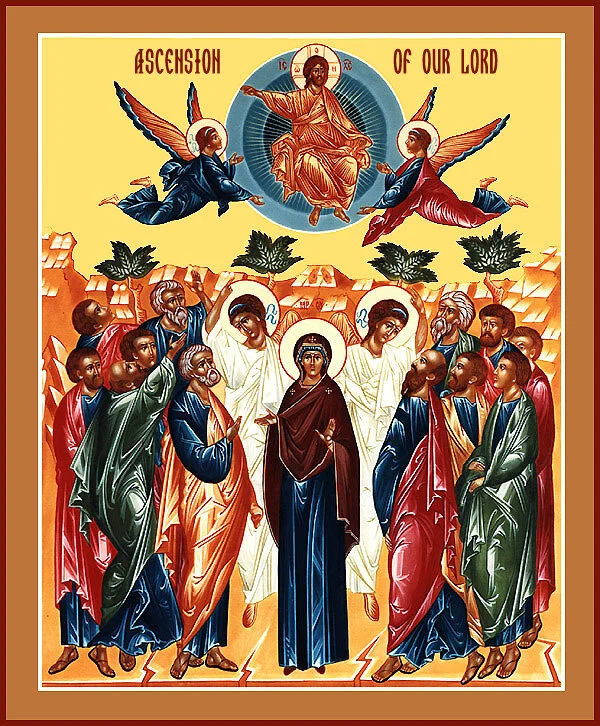
The Divine Ascension of Our Lord and Savior Jesus Christ into Heaven Part II)
"As they thus spoke, Jesus Himself stood in the midst of the disciples, and saith unto them: "Peace be unto you." But they were terrified and affrighted and supposed that they had seen a spirit...And He led them out as far as to Bethany, and He lifted up His hands and blessed them. And it came to pass while He blessed them, He was parted from them, and carried up into heaven. And they worshipped Him, and returned to Jerusalem with great joy; and were continually in the Temple, praising and blessing God. Amen." (St. Luke 24:36-53; Acts 1:3-14)
My beloved spiritual children in Our Risen Lord Our Only True God and Our Only True Savior,
CHRIST IS RISEN! TRULY HE IS RISEN!
+
THE DIVINE ASCENSION OF OUR LORD AND SAVIOR JESUS CHRIST INTO HEAVEN (Part II)
"As they thus spoke, Jesus Himself stood in the midst of the disciples, and saith unto them: "Peace be unto you." But they were terrified and affrighted and supposed that they had seen a spirit...And He led them out as far as to Bethany, and He lifted up His hands and blessed them. And it came to pass while He blessed them, He was parted from them, and carried up into heaven. And they worshipped Him, and returned to Jerusalem with great joy; and were continually in the Temple, praising and blessing God. Amen." (St. Luke 24:36-53; Acts 1:3-14)
When swallows run short of food and the cold weather is coming, they set off to warm climes, where there is plenty of sun and food. One swallow flies ahead, testing the air showing the way, and the rest of the flock follows after.
When our souls run short of food in the material world, and when the cold of death draws near - oh, is there a swallow like that one, to take us to a warm place, where there is plenty of spiritual warmth and food? Is there such a place? Is there, oh, is there such a swallow?
Outside the Christian Church, there is no-one who could give any sort of reliable answer to this. The Church alone knows, and knows with certainty. It has seen that part of Paradise for which our souls yearn in the frozen twilight of this earthly existence. It has also seen this blessed swallow, the first to fly to that yearned-for place, dispersing the darkness and cutting through the heavy atmosphere between earth and heaven with its powerful wings, opening the way to the flock behind it. Apart from this, the Church on earth can tell you of innumerable flocks of swallows that have followed the first Swallow and flown off with it to the blessed land, the land abounding will all good things - the land of eternal spring.
You will see from this that, by this saving Swallow, I am thinking of the Ascended Lord Jesus Christ. Has He not said of Himself that He is the Way? Did He not Himself say to His Apostles: "I go to prepare a place for you...and will...receive you unto Myself" (St. John 14:2-3)? And did He not say to them before this: "And I, if I be lifted up the earth, will draw all men unto Me" (St. John 12:32)? This that He Himself said began to be fulfilled a few weeks later, and has continued to be fulfilled right down to our own day, and shall be to the end of time. That is: being the beginning of the first creation of the world. He became also the beginning of the second creation or the blessed renewing of the old. Sin clipped Adam's wings and those of all his descendants, and they all fell away from God, went off, and were blinded with the dust from which their bodies were created. Christ, as the New Adam, the First Man, the Firstborn among men, was the first to rise up to heaven on spiritual wings, to the Throne of eternal glory and power, thus cleaving the way to heaven and opening all heaven's gates to His followers with their spiritual wings - as an eagle cleaves the way for its eaglets; as a swallow that goes ahead, showing the flock the way and breaking the air's heavy resistance...
"...The Lord's Ascension from earth to heaven is as unexpected to men as His coming down from heaven to earth and His birth in the flesh was to the Angels. What event in His life does not represent something unique and uniquely unexpected to the world?...each of us must look with wonder at the events of the Savior's life, beginning with the wondrous Annunciation to the Most Holy Ever-Virgin Mary by the Archangel Gabriel in Nazareth, and then through in order to His mighty Ascension on the Mount of Olives. It is all, at first sight unexpected, but, when they are made aware of the plan for the dispensation of our salvation, all rational men must shout for joy and glorify God's power. His Wisdom and his Love for mankind. You can take no single Great Event out of Christ's life and not disfigure the whole, as you cannot cut off a living man's arm or leg and not disfigure him, or remove the moon from the heavenly vault or blot out a part of the starry myriads, and not disfigure the order and beauty of the heavens. So do not think of saying: "It was unnecessary for the Lord to ascend!"
"And He led them out as far as Bethany, and He lifted up His hands, and blessed them. And it came to pass while He blessed them, He was parted from them, and carried up into heaven." What a magnificent and touching parting from the earth! There on the edge of the Mount of Olives, in sight of the mound beneath which dead Lazarus had been raised again to this transient life, the Risen Lord Ascended to the infinite heights of eternal life. He Ascended up, not to the stars but above them: He Ascended up, not to the Angels, but above them; and not to the heavenly powers, but above them; above all the immortal, heavenly hosts, above all the paradisiacal abodes of the Angels and the righteous; far, far above the Cherubim's eyes, to the very throne of the heavenly father, to the mysterious altar of the Holy and Life-giving Trinity. The measure of these heights does not exist in the created world; perhaps the only thing comparable, to the opposite direction, is the depths to which pride plunged Lucifer (Satan), the apostate from God; the depths into which Lucifer wanted the whole human race to be plunged. The Lord Jesus saved us from this endless ruin and, in place of the depths of the abyss, raised up to the divine heights of heaven. He raised us up, we say, for two reasons: firstly, because He rose as a man in the flesh, as we are; and secondly, because He rose not for His own sake but for ours, to open for us the path to peace with God. Ascending in his Risen Body, that men had killed and buried in the earth. He blessed with hands that bore the scars of the nails. O Most Blessed Lord, how Great is Thy mercy! The history of Thy coming into the world began with blessing, and it ends with blessing. Revealing Thy coming into the world, the Archangel Gabriel greeted the Most Holy Mother of God with the words: "Hail, thou that art highly favored...blessed art thou among women!" (St. Luke 1:28). And now, when Thou biddest farewell to those who received Thee, Thou openest wide Thy hands and pourest blessing on them. O Most Blessed among men! O Gracious Source of blessings! Bless us also, as Thou didst bless Thine Apostles!
We praise and bless the Lord who, by His Ascension, opened our understanding to see the path and goal of our life. We praise and bless the Father, Who responds to our love for the Son with His love, and makes His abode, together with the Son, in all who hold and confess the Lord's commandments. And we keep the Father and the Son constantly in mind, praising and blessing them - like the Holy Apostles in the city of Jerusalem waiting for the power from on high: the Spirit, the Comforter - to come upon us: He who comes upon us all at our baptism, but Who leaves us because of our sins. May the whole primal, heavenly man be renewed in us; may we, like the Apostles, be made worthy to receive the blessing of our glorified and ascended Lord Jesus Christ, to whom, be glory and praise, together with the Father and the Holy Spirit - the Holy Trinity consubstantial and undivided, now and forever, through all time and all eternity. Amen. (Source: Homilies by Saint Nikolai Velimirovic)
_______________________
"Glory Be To GOD For All Things!" -- Saint John Chrysostom
+++
With sincere agape in our Risen Lord,
The sinner and unworthy servant of God
+Father George
The Mystery (Sacrament) of the Holy Eucharist According to the Orthodox Church
"The Holy Eucharist (literally "thanksgiving") is the Mystery (Sacrament) in which the bread and wine of offering are changed by the Holy Spirit into the True Body and True Blood of our Lord Jesus Christ, and then the believers receive communion of them for a most intimate union with Christ and eternal life. This Mystery (Sacrament) is composed, thus of two separate moments: 1) the changing or transformation of the bread and wine into the very Body and Blood of the Lord, and (2) the Communion of these Holy Gifts. It is called "the Eucharist," "the Lord's Supper," the Mystery of the Body and Blood of Christ."

My beloved spiritual children in Our Risen Lord, Our Only True God and Our Only True Savior Jesus Christ,
CHRIST IS RISEN! TRULY HE IS RISEN!
+
THE MYSTERY (SACRAMENT) OF THE HOLY EUCHARIST ACCORDING TO THE HOLY ORTHODOX CHURCH
"The Holy Eucharist (literally "thanksgiving") is the Mystery (Sacrament) in which the bread and wine of offering are changed by the Holy Spirit into the True Body and True Blood of our Lord Jesus Christ, and then the believers receive communion of them for a most intimate union with Christ and eternal life. This Mystery (Sacrament) is composed, thus of two separate moments: 1) the changing or transformation of the bread and wine into the very Body and Blood of the Lord, and (2) the Communion of these Holy Gifts. It is called "the Eucharist," "the Lord's Supper," the Mystery of the Body and Blood of Christ." The Body and Blood of Christ in this Mystery are called the "Bread of heaven and the Cup of Life" or the "Cup of salvation"; they are called the "Holy Mysteries," "the Bloodless Sacrifice." The Eucharist Is the greatest Christian Mystery (Sacrament)..."
"...The words of the Savior at the Mystical Supper, "This is My Body, which is broken for you; this is My Blood of the New Testament, which is shed for many for the remission of sins." (Quoting from 1 Cor. 11:24 and Matthew 26:28) are completely clear and definite, and do not allow any other interpretation apart from the most direct one, namely, that to the Disciples were given the true Body and the True Blood of Christ. And this is completely in accordance with the promise given by the Savior in the 6th chapter of the Gospel of Saint John concerning His Body and Blood..."
The Changing of the Bread and Wine in the Mystery (Sacrament) of the Eucharist
"In the Mystery (Sacrament) of the Eucharist, at the time when the priest, invoking the Holy Spirit upon the offered Gifts, blesses them with the prayer to God the Father: "Make this bread the Precious Body of Thy Christ; and that which is in this cup, the Precious Blood of Thy Christ; changing them by Thy Holy Spirit"--the bread and wine actually are changed into the Body and Blood by the coming down of the Holy Spirit (the consecration of the Holy Gifts). After this moment, although our eyes see bread and wine on the Holy Table, in their very essence, invisibly for sensual eyes, this is the true Body and true Blood of the Lord Jesus, only under the "forms" of bread and wine..."
"...This Truth is expressed in the "Encyclical of the Eastern Patriarchs" in the following words: "We believe that in this Sacred rite our Lord Jesus Christ is present not symbolically (typikos), not figuratively (eikonikos), not by an abundance of Grace, as in the other Mysteries (Sacraments), not by a simple descent, as certain Fathers say about Baptism--but truly and actually, so that after the sanctification of the bread and wine, the bread is changed, transubstantiated, converted, transformed, into the actual true Body of the Lord, which was born in Bethlehem of the Ever-Virgin, was baptized in the Jordan , suffered, and was buried, resurrected, ascended, sits at the right hand of God the Father, and is to appear in the clouds of heaven; and the wine is changed and transubstantiated into the actual true Blood of the Lord, which at the time of His suffering on the Cross was shed for the life of the world. Yet again, we believe that after the sanctification of the bread and wine there remains no longer the bread and wine themselves, but the very Body and Blood of the Lord, under the appearance and form of bread and wine." (par. 17)"
Some Observations on the Manner in Which the Lord Jesus Christ Remains in the Holy Gifts
Although the bread and wine are transformed in the Mystery (Sacrament) into the Body and Blood of the Lord, He is present in this Mystery 'with all His being,' that is, with his soul and with His very Divinity, which is inseparably united to His humanity.
Although, further, the Body and Blood of the Lord are broken in the Mystery of Communion and distributed, still we believe that 'in every part'--even in the smallest particle--of the Holy Mysteries, those who receive Communion receive the entire Christ in His being, that is, in His soul and Divinity, as perfect God and perfect man. This faith the Holy Church expresses in the words of the priest at the breaking of the Holy Lamb: "Broken and divided is the Lamb of God, which is broken though not disunited, which is ever eaten, though never consumed, but sanctifieth those that partake thereof."
Although at one and the same time there are many Holy Liturgies in the universe, still there are not many Bodies of Christ, but one and the same Christ is present and is given in His body 'in all the churches of the faith.'
The bread of offering, which is prepared separately in all churches, after its sanctification and offering becomes "one and the same with the Body which is in the heavens."
After the transformation of the bread and wine in the Mystery of the Eucharist into the Body and Blood, they no longer return to their former nature, but remain 'the Body and Blood of the Lord forever," whether or not they are consumed by the faithful. Therefore the Orthodox Church from antiquity has had the custom of performing on certain days the Liturgy of the Presanctified Gifts, believing that those Gifts, sanctified at a preceding Liturgy, remain the true Body and Blood of Christ...
6. Since to the God-Man Christ it is fitting to offer a single inseparable Divine worship, both according to His Divinity and His humanity, as a consequence of their inseparable union, therefore also to the Holy Mysteries of the Eucharist there should be given "the same honor and worship" which we are obliged to give to the Lord Jesus Christ Himself. (Source: Orthodox Dogmatic Theology by Protopresbyter Michael Pomazansky)
________________
Please note: Absolutely no one has the authority to marginalize or to dilute the Orthodox Faith and the Orthodox Christian understanding of the Holy Eucharist. Any deliberate attack on the Holy Eucharist commits the unforgivable blasphemy against God the Holy Spirit. Anyone who attempts to do so should be excommunicated from the Orthodox Church.
__________________
"Glory Be To GOD For All Things!"--Saint John Chrysostom
+++
With sincere agape in His Divine Resurrection,
The sinner and unworthy servant of God
+Father George