
"Beware of False Prophets..." (Matthew 7:15)
A very sound and wise advice and warning to all of us from our Lord Christ. These "false prophets" that our Savior mentions can easily deceive others, those imposters of virtue and piety are more dangerous than those who are evil outright. These are referred to in the secular world as "confidence men" or "con-men". One can find them in every walk of life, i.e., politics, religious leaders, educators, business, science, sales, etc.

My beloved spiritual children in Christ Our Only True God and Our Only True Savior,
CHRIST IS IN OUR MIDST! HE WAS, IS, AND EVER SHALL BE.
+
"BEWARE OF FALSE PROPHETS, WHO COME TO YOU IN SHEEP'S CLOTHING, BUT INWARDLY THEY ARE RAVENOUS WOLVES. YOU WILL KNOW THEM BY THEIR FRUITS" (Saint Matthew 7:15).
A very sound and wise advice and warning to all of us from our Lord Christ. These "false prophets" that our Savior mentions can easily deceive others, those imposters of virtue and piety are more dangerous than those who are evil outright. These are referred to in the secular world as "confidence men" or "con-men". One can find them in every walk of life, i.e., politics, religious leaders, educators, business, science, sales, etc.
Over its long history, the Church had to face many such dangerous people within it who sought to divide, corrupt, distort, revise, and undermine the teachings of our Christian faith. Faithful and following the Apostolic Council in Jerusalem AD 49, which set a precedent of tremendous importance for the government of the Church. The Orthodox Church is sometimes known as "the Church of the Councils," for it continues the practice of solving disputes and coming to a consensus through Councils. This council progresses through the stages of (v. 6), testimony (Vv. 7-12), decision (vv. 13-21), and adoption (vv. 22-29).
Those of you that know Church History know that the Church has never been free from disputes and dissensions, but nevertheless has maintained a way to resolve them in council. The meeting of bishops in council, with the participation of elders (presbyters) and knowledgeable laymen, continues to guide the Church to this day.
To this present day we, Orthodox Christians, venerate as Saints and we look up to them as the defenders of Orthodox Christianity, defenders of the only authentic Church of Christ. An excellent example is Saint Athanasius of Alexandria, Egypt.
Saint Athanasius, as well as the numerous other great holy Fathers of the Church, were known not only for their steadfast faith in Christ but also for their mega courage. Many of them were imprisoned, exiled, and even tortured for the faith. The Holy Fathers of the Church comprised the membership of the Ecumenical Councils and under the guidance of the Holy Spirit formulated the Dogmas (Creed) and Holy Canons of the Church.
The decisions of the Ecumenical Councils are the bedrock of the Church. No person or persons, no matter of their Church rank or office, can ever change what has been decided by the Ecumenical Synods. Such Ecumenical Councils the Church recognizes as seven in number. The Ecumenical Councils formulated precisely and confirmed a number of the fundamental truths of the Orthodox Christian Faith, defending the ancient teaching of the Church against the distortions of heretics. The Ecumenical Councils likewise formulated numerous laws and rules governing public and private Christian church life, which are called the Church holy Canons, and required the universal and uniform observance of them. Finally, the Ecumenical Councils confirmed the dogmatic statements of a number of local councils, and also the dogmatic statements composed by certain Fathers of the Church of example, the confession of faith of Saint Gregory the Wonderworker, Bishop of Neo-Caesarea, the canons of Saint Basil the Great and so forth. (Dogmatic Theology).
The Church fought the Arian heresy (325 A. D.) which persisted for a few hundred years. In the 5th century, there was a Patriarch of Constantinople by name of Nestorius, who was anathematized, his teaching was rejected and condemned. Over the many centuries, the Church has faced numerous heresies both from within and without. When we think of wolves that look like sheep, we think of the heretics who seek to devour the sheep, the faithful Orthodox Christians.
Our Lord Jesus Christ warns us to beware of wolves in sheep's clothing. The question, however, is, "how do you detect the wolf?" It really could be one who is a Baptized, Chrismated, communing Orthodox Christian in good standing-someone-maybe a layman - very well educated. Somebody that can talk for hours about Orthodoxy, and the history of the Church, and even the doctrines of the Church, can be very convincing. It could also be hierarch, a priest, lay-theologians, or professors. The wolves in sheep's clothing are not those without, but they are those within that are trusted, loved, admired, those we feel safe with, those that we respect, those that do not raise our suspicions.
Most of the sheep that you know as sheep are sheep. They are genuine. But some of the sheep that you know as sheep are actually disguised as sheep but underneath beats the heart of a bloodthirsty wolf who seeks your demise.
Our Savior says that the Christian that they can be "known by their fruits". We must be vigilant and alert and look and see whether what they say, and what they do, is in line with what the Holy Fathers have taught for 2,000 years before them. One has to look at their actions, their hidden agenda, their objective. They are lying, they are deceptive, they are manipulative, they are devious, and work in secret behind the scene. They detest the Holy Fathers, they ignore the holy Canons, they deliberately attack the Holy Tradition of the Church, they seek to revise its history so as to "modernize" it. These are true "wolves in sheep's clothing." They also seek to destroy the Orthodox Christian identity of the Church and to deform it. They are militant, radical, vicious and the enemies of the One, Holy, Catholic, and Apostolic Church, the only authentic Church of Christ.
Be aware and be alert!
_________________________
"Glory Be To GOD For All Things! - Saint John Chrysostom
+++
With sincere agape in His Holy Diakonia (Ministry),
The sinner and unworthy servant of God
+Father George
Our Lord Awaits Your Return...

My beloved spiritual children in Christ Our Only True God and Our Only True Savior,
CHRIST IS IN OUR MIDST! HE WAS, IS, AND EVER SHALL BE.
OUR LORD AWAITS YOUR RETURN...
Although you, our fellow Orthodox Christians, have been absent from your church due to this dreadful pandemic, the Lord has never left you and will never abandon you. It is true, however, that physically you have been prevented to attend the divine services, but not spiritually. As Christian believers, you are always united with Him. We are all united through faith in Him, through love for Him, Jesus asked His beloved disciple Peter "do you love Me?" and his answer was, "Yes, Lord You know that I love You."
Mankind has suffered all kinds of horrific events throughout human history such as plagues, wars, slavery, calamities, disasters, famine, injustices, torment, etc. but always and by the grace of God has survived and continued on to fight another day.
I am so very proud of all of you who have kept your faith strong. It is at times such as these that one's faith is tested. Our Lord and Savior Jesus Christ is ever-present and continues to protect each and every one of us. There is no reason to ever doubt His unconditional love for His children. If the thought ever comes that He has abandoned us or that He has ceased to love us, we need only to look at the crucifix upon which Our Lord sacrificed His life to save us.
I have not ceased to keep all of you in my prayers and to seek the holy intercessions of our Theotokos, our heavenly mother, to keep you safe and healthy. Don't forget the church is a spiritual hospital, a spiritual ICU, a place of healing. It is not a place where Christian faithful are contaminated and exposed to viruses and illnesses. It is not a place where one's life is in danger. We are there to be made well by the Physician of our souls and bodies.
If there is a person in our parish who is consumed by fear that he or she will contract a deathly illness at the house of God, then that person should not attend the church services or visit this sacred place of God. Upon the consecration of our parish church, it became not only a place of worship but a holy space where the Christian believer comes voluntary and in the spirit of faith and humility to seek reconciliation, forgiveness, and spiritual healing. In other words to find salvation not death. The Orthodox Christian receives the Holy Communion, the Precious Body and Blood of our Lord Jesus Christ for "the remission of sins and eternal life."
The Mysteria (Sacraments) of the Church is to bestow the grace of God the Holy Spirit upon the believer. We are sanctified through the Sacraments of God and we must not marginalize or question their validity and sanctity. Our Almighty God works through the sacraments to touch us deeply, physically and spiritually, body and soul, and to restore us to our pristine beauty. The sacred vessels, holy icons, and other sacred objects are not to be feared. Never has this ever happen in history, as far as I know, where the Orthodox Christian feared them. The holy icons have been venerated by the Orthodox Christian believers for centuries without any concern whatsoever.
Let us pray for our All-Merciful Lord Jesus Christ to strengthen our faith in Him. It takes the synergy between God and man in order for salvation to happen. Salvation is not forced upon us by God, rather it is a gift from Him to us. Saint Paul writes: "Now faith is the substance of things hoped for, the evidence of things not seen. For by it the elders obtained a good testimony.
By faith, we understand that the worlds were framed by the word of God...
By faith, Abel offered to God a more excellent sacrifice than Cain...
By faith, Noah, being divinely warned of things not yet seen, moved with godly fear, prepared an ark for the saving of his household...
By faith, Abraham obeyed when he was called to go out to the place which he would receive as an inheritance...
By faith, Sarah herself also received strength to conceive seed, and she bore a child when she was past the age...
By faith, Isaac blessed Jacob and Esau concerning things to come...
By faith, Jacob, when he was dying, blessed each of the sons of Joseph, and worshiped...
By faith, Moses, when he was born, was hidden three months by his servants...
By faith, they passed through the Red Sea as by dry land...
By faith, the walls of Jericho fell down after they were encircled for seven days...
"...The Prophets through faith subdued kingdoms, worked righteousness, obtained promises, stopped the mouths of lions, quenched the violence of fire, escaped the edge of the sword, out of weakness were made strong, became valiant in battle, turned to flight the armies of the aliens...Others were tortured, not accepting deliverance, that they might obtain a better resurrection. Still, others had trial of mockings and scourgings, yes, and of chains and imprisonment. They were stoned, they were sawn in two, were tempted, were slain with the sword. They wandered about in sheepskins and goatskins, being destitute, afflicted, tormented--of whom the world was not worthy. They wandered in deserts and mountains, in dens, and caves of the earth. And all these, having obtained a good testimony through faith..." (Hebrews 11: 1-38).
Faith is everything! Nothing can be accomplished without faith.
You are in church and are blessed by our Creator because you believe in Him. "I believe Lord, help my unbelief."
Very soon all of you will be invited back to church and although a mask will be required of you, sanitizing your hands and keeping a social distance as well, you must not forget why you are there, and who you came to see. Our Lord waits for your return.
With sincere agape,
+Father George
Approaching the Holy and Glorious Sunday of Pentecost (Part III)
Among the gifts which the one who receives the gift of the Holy Spirit is endowed in the saintly life, when the person struggles to keep God's commandments to the highest degree and to live in purity of soul and body, the married life in Christ within the social customs, the pastoral diaconate in Christ with its many cares, etc. In other words, all the gifts of grace that the Holy Spirit grants. Thus the Holy Spirit "wholly makes up the institution of the Church", which is the Body of Christ.

My beloved spiritual children in Christ Our Only True God and Our Only True Savior,
CHRIST IS IN OUR MIDST! HE WAS, IS, AND EVER SHALL BE.
+
ON SUNDAY JUNE 7TH OUR HOLY ORTHODOX CHRISTIAN CHURCH CELEBRATES THE HOLY AND GLORIOUS FEAST OF PENTECOST
Apolytikion (Dismissal) Hymn of the Feast
Blessed are Thee, O Christ Our God. Thou made the fishermen all-wise, by sending down upon them the Holy Spirit, and through them Thou drew the world into Thy net. O Lover of mankind, glory to Thee."
+
Among the gifts which the one who receives the gift of the Holy Spirit is endowed in the saintly life, when the person struggles to keep God's commandments to the highest degree and to live in purity of soul and body, the married life in Christ within the social customs, the pastoral diaconate in Christ with its many cares, etc. In other words, all the gifts of grace that the Holy Spirit grants. Thus the Holy Spirit "wholly makes up the institution of the Church", which is the Body of Christ.
As soon as the Holy Apostles were filled with the Holy Spirit they were full of great joy. It was a new experience for them. While previously they had simply been good men, now they became members of the Risen Body of Christ. They were not confined to worshiping Christ, but they were inseparably united with Him. All who saw them were perplexed, and some mockingly said "they are full of new wine", meaning they were drunk with new wine (Acts 2:13).
The Coming of the Holy Spirit into the heart of man is called by the Holy Fathers of the Church "sober intoxication" (Saint Dionysios the Areopagite). Saint Isaac the Syrian, referring to such states, speaks of the fact that all the person's powers are plunged "in deep intoxication". It is called intoxication because there is great joy and gladness, and it is characterized as "sober" because the person does not lose his senses nor his reason. When a person is taken possession of by the Holy Spirit he remains free, or to express it better, he acquires real freedom, which does not function as a power of choice, as philosophical ethics says, but as natural will, as an overcoming of death. The Holy Apostle Paul writes characteristically: "The spirits of Prophets are subject to the Prophets" (1 Corinthians 14:32). This means that the man who is Prophet is not subject to his gift of grace, but the gift of grace is subject to the Prophet, which is to say that man's freedom is not abolished, nor are the energies of his mind and soul suspended.
Saint Nicodemos the Hagiorite says that there are three kinds of intoxication. First, that which comes with too much wine, which is the cause of many evils. Second, is the intoxication which is activated by the passions. This is the intoxication meant by the Prophet Isaiah when he said "Woe to those that are drunk without wine" (Isaiah 28:1 Septuagint). And elsewhere the same Prophet, referring to Jerusalem said: "hear this, you afflicted ones, made drunk, but not with wine". Third, is the intoxication caused by the Holy Spirit. We meet it in the mother of the Prophet Samuel, who was praying in the Temple very earnestly, and her prayer was noetic, so strong that his son Eli the Priest thought she was drunk and wanted to drive her out of the Temple. And she answered and said that she was not drunk but was pouring her heart out to the Lord (I Samuel 1:14-15).
The Holy Apostles underwent this third intoxication on the day of Pentecost, because then they received the Holy Spirit, discovered the place of the heart, knew Christ better, became members of the Body of Christ, developed a great love and longing for Christ, and this was expressed, as the Fathers explain, by prayer...
"...The Holy Fathers teach that while the Holy Spirit is active in the whole creation and in all people, nevertheless each person partakes of Its energies in accordance with his receptivity. One must have a receptive organ in order to receive the manifold gifts of the Holy Spirit.
Saint Maximos the Confessor, referring to this, says that the saints acquire different gifts of grace not by their natural power, but by Divine Power. All the gifts of grace are given by the Holy Spirit but this happens according to their receptivity. The Holy Spirit does not inspire wisdom, nor knowledge if there is no power of reason, nor faith without the nous and reason being informed about the things to come, nor gifts of healing, without natural love towards men. This means that the saints receive the gifts of theology, gifts of knowledge, gifts of healing, if there is an organ to receive this gift.
This is the case not only for the gifts of theology, but also for other gifts of grace. They are called gifts of grace because they are granted by God, but in accordance with the spiritual condition of each person. Saint Maximus the Confessor once again points out that each of the faithful receives the energy of the Holy Spirit according to his faith and the condition of his soul...
"...In reality, through the energy of the Holy Spirit, when the person is made a receptive vessel, the fire of Divine Grace is set alight in his heart. Saint Basil the Great says that there is a real "burning of the Spirit which rekindles the heart." And indeed it is maintained that this burning which illumines sous and destroys the stubble and thorns, was active in the Holy Apostles who spoke in fiery tongues, it shone round the Apostle Paul, it warmed the hearts of Cleopas and those with him, this fire is something which will banish the demons, but also a power of resurrection, an energy of immortality, illumination of the holy souls, support of the rational powers.
So Pentecost was in history once, but it is brought back in the lives of the saints. When the deified attained a state of spiritual life, they share in Pentecost and become apostles of Jesus Christ. Pentecost is the high point of glorification and deification (theosis). All who follow the same journey with the holy disciples arrive at this vision of God and partake of the grace and energy of Pentecost...
"...The Holy Apostle Paul is clear when he says: "those who are led by the spirit of God are sons of God" (Romans 8:14). Not all people who were created by God are children of God, but only those who are led by the Holy Spirit. Sonship is connected with inner noetic prayer: "And by him we cry, 'Abba, Father" (Romans 8:15). The Spirit of God which will be present in the heart of man "testifies with our spirit that we are God's children" (Romans 8:16). He is himself a son of God who has the Holy Spirit within him, which testifies with our spirit and confirms that the man is a child of God. However, the presence of the Holy Spirit in our heart is confirmed by the inner prayer of the heart which comes with a cry.
If anyone does not have the Spirit of God in him, he does not belong to Christ, which means that he is not a living member of the Body of Christ. Even if he has been baptized at some time, the grace of Baptism remains inactive, and this man is a dead member of the Church. This is said by the Holy Apostle Paul in an important and revealing passage: "And if anyone does not have the Spirit of Christ, he does not belong to Christ" (Romans 8:9). No one belongs to Christ if he does not have the Holy Spirit, with the preconditions which we have seen before. By contrast, if anyone has in him the Holy Spirit, he is really a member of the Body of Christ, since he is not "controlled by the sinful nature but by the Spirit" (Romans 8:8-9). (Source: The Feasts of the Lord. An Introduction to the Twelve Feasts and Orthodox Christology by Metropolitan of Nafpaktos HIEROTHEOS)
______________
Please note: It is imperative that we understand that not everyone, according to the Holy Apostle Paul, and Holy Fathers of the Church, is a member of the Body of Christ and/or a child of God if he or she does not possess the Spirit of Christ. The above article explains why not everyone has the same rights in the Orthodox Church since not everyone "is led by the Holy Spirit". We pray for and love all people and supplicate God for the salvation and enlightenment of all people but one must first believe, be receptive, and "has in him the Holy Spirit".
_______________
"Glory Be To GOD For All Things!" - Saint John Chrysostom
+++
With sincere agape in His Holy Diakonia,
The sinner and unworthy servant of God
+Father George
Approaching the Holy and Glorious Sunday of Pentecost (Part II)
The Descent of the Holy Spirit on the day of Pentecost does not indicate that the Holy Spirit was previously absent from the earth and from people, but that, as we mentioned before, the Holy Spirit operates in a different way. We can offer two points that interpret the Descent of the Holy Spirit and His different energy.
My beloved spiritual children in Christ Our Only True and Our Only True Savior,
CHRIST IS IN OUR MIDST! HE WAS, IS, AND EVER SHALL BE.
+
ON JUNE 7th OUR HOLY ORTHODOX CHRISTIAN CHURCH CELEBRATES THE HOLY AND GLORIOUS FEAST OF PENTECOST (Part II)
Apolytikion (Dismissal) Hymn of the Feast of Pentecost Mode pl. 4
Blessed are You, O Christ our God, You made the fishermen all-wise, by sending down upon them the Holy Spirit, and through them drew the world into Your net. O Lover of mankind, glory You.
+
The Descent of the Holy Spirit on the day of Pentecost does not indicate that the Holy Spirit was previously absent from the earth and from people, but that, as we mentioned before, the Holy Spirit operates in a different way. We can offer two points that interpret the Descent of the Holy Spirit and His different energy.
The first point is that on the day of Pentecost the Holy Apostles understood that the Holy Spirit is a particular hypostasis (Person) and not simply energy of God. The Holy Spirit, which appeared faintly in the Old Testament as a breath, as a sound, as the voice of a breeze, as an inspiration of the Prophets, is manifested at Pentecost "as a self-existing hypostasis". Thus, when the events which manifested the hypostasis of the Son had been completed, there began the events which manifested the hypostasis of the Holy Spirit (Saint Gregory Palamas).
The second point by which one can interpret the Descent of the Holy Spirit on the day of Pentecost is that the Holy Spirit made the Disciples members of the Body of Christ and gave them the power to participate in Christ's victory over death. God cannot be compared with human data. The Angels possess freedom naturally, but they exercise it without hindrance, they want to use it directly because they have nothing to prevent them from acting on it, for they are not hindered by the body or any other opposing force. Human beings are independent and have freedom, but their free will has been traumatized and it is not easy for them to carry out their desires. This is why desire and free will need to be strengthened by God. In the Old Testament, it says that he who listens "receives favor from the Lord" (Proverbs 8:35). And the Holy Apostle Paul writes: "For it is God who works in you to will and to act according to His good purpose" (Philippians 2:13).
This means that the Holy Spirit came down into the hearts of the Holy Apostles and is working in men through their own will and not as servants. But men must respond to the energy of the Holy Spirit with their will since god does not violate their freedom. However, desire and free will must be reinforced by God because in the fallen state man is enslaved, he is an attached being.
In general, when we speak of the Descent of the Holy Spirit on the day of Pentecost, we cannot understand it as an incarnation, for only the Son and Logos/Word of God became Incarnate, but as Its hypostatic manifestation in the world, which transformed the Disciples and changed them from mortal men to living members of the Body of Christ...
"...After promising to His Disciples that he would send the Holy Spirit, Christ gave a clear command: "stay in the city of Jerusalem until you have been clothed with power from on high" (St. Luke 24:49). The Holy Disciples kept this command and remained together in the Upper Room in Jerusalem, in stillness and prayer, waiting for the outpouring of the gift of the Holy Spirit. Therefore the Holy Evangelist Luke assures us: "And they were continually in the temple, praising and blessing God" (Luke 24:53).
At this point, I should comment briefly on the phrase: "until you have been clothed with power from on high" because it is quite characteristic. Christ does not say that they will simply receive the Holy Spirit, but that they will be clothed with it, as with some spiritual suit of armor in order in order to fight the enemy (Satan). It is not about spiritual enlightenment of their minds, but about a transformation of their whole being. There will be no point in their body and no energy of the soul which will be left uncovered by the energy of the Holy Spirit.
It is well known that with Holy Baptism, which is regarded as an introductory Sacrament it introduces us into the Church and we become members of the Body of Christ, we have clothed ourselves with Christ Himself: "for as many of you as were baptized into Christ have put on Christ" (Galatians 3:27). But at the same time, we clothe ourselves in the Holy Spirit as well, according to Christ's explicit promise. Moreover, this is the purpose of the two Sacraments of Baptism and Chrismation, which are interconnected.
The Christian's clothing himself in the Holy Spirit is not outward and superficial, but inward, like the uniting of iron with fire. Iron that is made red-hot is afire completely, not a small part of it. Thus all who receive the Holy Spirit feel that it fills their heart, it gives light to their eyes, sanctifies their ears, stifles their bad thoughts, ideas spring up, wisdom is granted, persons are filled with grace. (Source: The Feasts of the Lord. An Introduction to the Twelve Feasts and Orthodox Christology by Metropolitan of Nafpaktos HIEROTHEOS)
(To be continued)
______________________
"Glory Be To GOD For All Things!" -- Saint John Chrysostom
+++
With sincere agape in His Holy Diakonia (Ministry),
The sinner and unworthy servant of God
+Father George
Approaching the Holy and Glorious Sunday of Pentecost
Before Christ ascended into Heaven He gave a command to His Disciples to return to Jerusalem after His Ascension and remain there until they were invested with power from Heaven. Thus He gave them the promise that they would receive the Holy Spirit, about which He had spoken during His life.
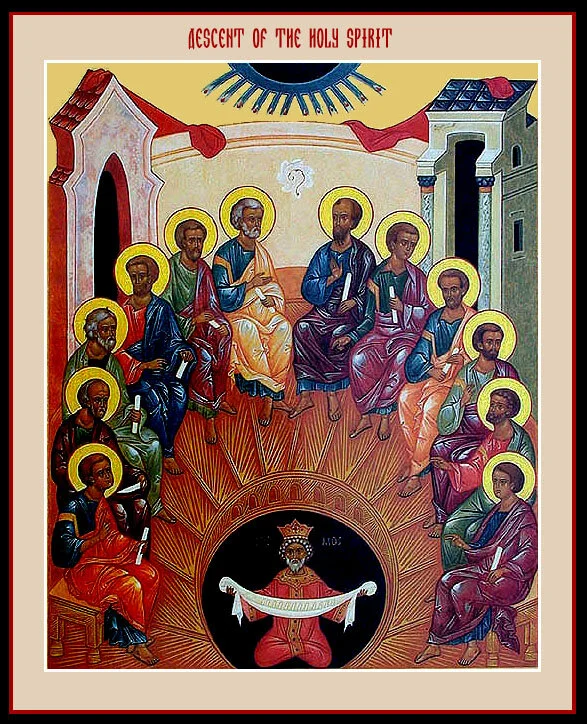
My beloved spiritual children in Our Only True God and Our Only True Savior,
CHRIST IS IN OUR MIDST! HE WAS, IS, AND EVER SHALL BE.
+
APPROACHING THE HOLY AND GLORIOUS SUNDAY OF PENTECOST (June 7th)
+
Apolytikion (Dismissal) Hymn of the Feast of Pentecost Mode pl. 4.
Blessed are You, O Christ our God. You made the fishermen all-wise, by sending down upon them the Holy Spirit, and through them You drew the world into Your net, O Lover of mankind, glory to You.
Pentecost
Before Christ ascended into Heaven He gave a command to His Disciples to return to Jerusalem after His Ascension and remain there until they were invested with power from Heaven. Thus He gave them the promise that they would receive the Holy Spirit, about which He had spoken during His life.
This promise by Christ to the Disciples was realized 50 days after Pascha and ten days after His Ascension to heaven. Thus in the Church we observe the feast of Pentecost, in which we honor the Holy Trinity, and on the following day we celebrated and glorify the Holy Spirit. So the feast of Pentecost is a feast of the Holy Trinity.
The feast of Pentecost is also included in what the Church calls the "Twelve Feasts", because it is the last feast of the Divine Economy. The Incarnation of Christ was aimed at victory over death and the coming of the Holy Spirit into the hearts of men. Moreover, it is well known that the purpose of the ecclesiastical and spiritual life is that we should become members of the Body of Christ and receive the Holy Spirit. These two are inseparably linked together.
The holy hymnographer calls Pentecost the last feast concerning man's reformation and renewal: "Let us believers joyfully celebrate a last fast: it is Pentecost, fulfillment and deadline of a promise". Thus, if the Annunciation to the Theotokos is the beginning of the Incarnation of the Logos/Word and the Divine Economy, Pentecost is the end, since it is then that man, through the Holy Spirit, becomes a member of the risen body of Christ.
We can also place Pentecost, as well as what relates to the Holy Spirit and Christ, in this framework because Christology cannot be understood apart from Pneumatology, nor Pneumatology apart from Christology.
The descent of the Holy Spirit took place on Sunday. And here we see the value of Sunday (Lord's Day), for the Great Feasts of the Lord took place on it. According to Saint Nikodemos the Hagiorite, the creation of the world began on the first day, that is to say' on Sunday, for it was then that light was created; the renewal of creation began on Sunday with the Resurrection of Christ; the completion of creation took place on Sunday with the descent of the Holy Spirit. The making of creation was done by the Father with the cooperation of the Son and the Holy Spirit, the renewal was done by the Son with the good will of the Father and the cooperation of the Holy Spirit, and the completion of creation was done by the Holy Spirit, which proceeds from the Father and is sent by the Son.
Of course, in saying these things, we are giving importance to the Persons that played the leading part in the creation, renewal and completion of creation. But finally, as we have been taught and we believe, and one Person can never be separated and isolated from the others in the Holy Trinity.
The Christian Pentecost in which we celebrate the descent of the Holy Spirit coincides with the Jewish Pentecost. It was on the day when the Jews were celebrating Pentecost that the Holy Spirit descended upon the holy Apostles and made them members of the Risen Body of Christ.
The feast of Pentecost is a feast the Holy Spirit, because we learn from the Descent of the Holy Spirit that God is threefold. Previously too, both obscurely in the Old Testament and in Christ's teaching, people were learning the trinitarian character of God, but at Pentecost they acquire practical experience of His threefold hypostasis. Thus Pentecost is a feast of orthodox theology.
Many names have been given to the Holy Spirit. One of them, which also shows the work which He does in the Church as well as in the lives of people is the name "Comforter". Christ Himself used this word for the Holy Spirit when He said to His Disciples shortly before His Passion: "I will ask the Father, and He will give you another Comforter to be with you forever -the Spirit of Truth" (John 14:16-17). And a little further on, the Holy Spirit is characterized by Christ as the 'Paraclete', the Holy Spirit, Whom the Father will send in My name, will teach you all things and will remind you of everything I have said to you" (John 14:25). Having the assurance that the Holy Spirit is the Comforter, we pray to Him: "Heavenly King, Comforter, the Spirit of Truth".
God the Holy Spirit comforts the person who is struggling against sin, trying to keep Christ's commandments in his life. This struggle is hard, because the fight is against the evil spirits. Therefore the Holy Spirit is a comforter, or one who consoles man, as Saint John Chrysostom says. It is a mark of God that He consoles men, so God is characterized by the same term as the Holy Spirit...
"...The phrase "other Paraclete" means that Christ and the Holy Spirit are different hypostases, but they have a common nature, essence and energy. Saint Gregory the Theologian, interpreting the phrase "other Paraclete", says that this constitutes and characterizes the 'co-lordship' and consubstantiality of the two hypostases (persons). The fact that Christ says the He will send 'another Comforter' means that He too is a comforter. "For it is one and I am the other". In this way we can see the equality in honor of Christ and the Holy Spirit.
The Holy Spirit is consubstantial with the Son and the Father, because all Three Persons of the Holy Trinity have a common essence or nature, and a common energy or intention glory. This is why wherever Christ is, there is the Holy Spirit, and wherever the Holy Spirit is, there is Christ...
"...The Church was founded on the day of Pentecost, in that the holy Apostles became members of the Body of Christ. Thus, while they previously had a communion with Christ, now by the power and energy of the Holy Spirit they became members of the Body of Christ. The Church changed from spirit to flesh. The Saints, the deified, had a relationship and communion not only with the Unincarnate Logos/Word, but with the Logos/Word become flesh, Christ the Godman. The theology that the Church is the Body of Christ is explained by the holy Apostle Paul (1 Corinthians 12:1-31). He says that the Church is not a religious organization, but the Body of Christ. Moreover he says that the distribution of the gifts of grace takes place by the energy of the Holy Spirit. To conclude, the holy Apostle Paul says: "Now you are the body of Christ, and each one of you is a part of it" (1 Corinthians 12:27). (Source: The Feasts of the Lord. An Introduction to the Twelve Feasts and Orthodox Christology by Metropolitan of Nafpaktos HIEROTHEOS)
(To be continued)
_____________________
"Glory Be To GOD For All Things!" -- Saint John Chrysostomos
+++
With sincere agape in His Holy Diakonia (Ministry),
The sinner and unworthy servant of God
+Father George
The Holy Bible: God's Revelation to Man
For the Christian of true worship, the Holy Bible is the greatest source of Truth, virtue, and moral ethics. It is invaluable as a source of teaching doctrine and holiness. We call it the "Book of Life," for in its pages we find the closest expression we have of the Inexpressible. From generation to generation, the books that make up the Canon of Scripture have communicated to us the lessons God has taught and still is teaching His people. It is open to all and should be read by all; men and women, clergy and laity, children and adults, believers and unbelievers.

My beloved spiritual children in Christ Our Only True God and Our Only True Savior,
CHRIST IS IN OUR MIDST! HE WAS, IS, AND EVER SHALL BE.
+
THE HOLY BIBLE: GOD'S REVELATION TO MAN
By The Right Reverend JOSEPH, Bishop of Los Angeles and the West
For the Christian of true worship, the Holy Bible is the greatest source of Truth, virtue, and moral ethics. It is invaluable as a source of teaching doctrine and holiness. We call it the "Book of Life," for in its pages we find the closest expression we have of the Inexpressible. From generation to generation, the books that make up the Canon of Scripture have communicated to us the lessons God has taught and still is teaching His people. It is open to all and should be read by all; men and women, clergy and laity, children and adults, believers and unbelievers.
The Bible Reveals God
From the beginning, God has revealed Himself to mankind. He never ceases to reach out to His creation with abundant blessings, desiring all to freely partake of the personal communion He offers. The Bible also establishes that it was humanity who rejected Him, following after the selfish desire to be as God. Certainly, humanity has afflicted itself with this delusion. Even so, the human race, even in its fallen state, is unable to deter God's unceasing ministry to His people. The Scripture record this ongoing spiritual struggle between the loving Truth of God and man's deluded expression of pride.
Once the Truth of God is accepted, and a person surrenders his pride and his denial of reality, his eyes become open to Christ our God, whose Divine Light invisibly enters in. This is what we call holiness, and therefore only in genuine holiness can we begin to understand the Bible and experience God revealed in it. The Scripture and the histories of the martyrs bear witness to the glory of God as it enters us. They also witness to us the terrible price that people pay when they refuse to acknowledge the presence of the Lord.
The Bible Reveals Our Need
The Old Testament establishes the way of thinking of the one who has "seen" God. He now sees the misery of fallen humanity. He discerns how, in our wretched state, we bring ruin upon ourselves with the lies our pride fabricates for us. In the pages of the Bible, we see how even good men can fail. And we see and hear the warning for us that, just as surely as sunset brings night, the disobedience of mankind brings death and destruction.
The Bible is not a document for the individual seeking to feel self-justified and full of wisdom. Rather, it is a mirror in which each person can see his own weakness without God and his need for Him. One who reads the Scripture and does not fall down praying for God's mercy has not really read them. He may have read the words on the pages, but he is still a man of the world, a prisoner of his blinded intellect and fleshly desires. Perhaps such a person would do better with a technical manual or a history book. The Bible is neither of these. It is a spiritual tool, the greatest of all, designed to change us. It overcomes all boundaries of human time and transcends all cultures.
The Bible Reveals Salvation
The one who reads the Bible and repents of his own sinfulness, recognizing no good in his life without God, opens the door to a new life. He is transformed by encountering the Person of our Lord Jesus Christ, the Son and Logos/Word of God. He is the One Whom the Prophets proclaim would save us from sin and the sting of death which we brought upon ourselves. When we read with a repentant heart, the words of the Bible are not lifeless rules and interesting stories, but insights into a world beyond expression. These words are doors through which to walk, so we may come to know God. The Bible challenges us to emerge from our own personal self-centered and illusory world, and to enter rather into the Kingdom of God. Then every word of the Bible is a window to heaven, to Paradise, and to Perfection.
Just as someone cannot "birth" himself, neither is a man "reborn" by himself. His personal faith in our Lord Jesus Christ will not be fulfilled outside of the Church. For it is there that we enter into a Tradition, a dynamic history of men and women--saints--who honored what they received from God and passed it on intact to the next generation. This embodiment of Faith is founded in the Incarnate Logos/Word of God, Jesus Christ, the Head of the Body which is His Holy Orthodox Church. Within the Church, the repented man, woman or child is born anew through the life-giving waters of Holy Baptism. Here, the passion of the individual begin to die and transformation is initiated.
Truly the fullness of the Scripture cannot be obtained outside the mind of the Church. Heretics and unbelieving intellectuals may read the words of Scripture, but they cannot understand it as does a spiritual man or woman within the Holy Community of the Church. Without the gift of the Holy Spirit to reveal within us the truth of God, the Bible is but raw data. Certainly, the Holy Spirit has whispered Truth into the ears of people not in the Church, but the place where He speaks the fullness of the Faith is within the Church where he dwells.
Only with the teachings of His Church--the Church that proclaims the Truth found in the Bible--can we begin our true work of breaking out of the self-imposed imprisonment of self-idolatry. When we submit our lives to Christ in repentance and lift us up. Therefore, it becomes our joyful duty to ceaselessly knock on the door of the Scripture, asking God to reveal the Truth to us through His Logos/Word, that we might walk through the gates and grow into an ever greater appreciation and experience of Him and His Heavenly Kingdom.
Simply put, the Holy Bible must be read with serious and humble prayer, a genuine desire for God's mercy, along with sound instruction from the Church and the very presence of the Holy Spirit within us. Our Lord Jesus Christ left Himself within this Holy Book, that He might be found by those who genuinely see Him. May you find Him today! (Source: The Orthodox Study Bible)
_______________________
"Glory Be To GOD For All Things!" -- Saint John Chrysostom
+++
With sincere agape in His Holy Diakonia (Ministry),
The sinner and unworthy servant of God
+Father George