
Salvation in Christ According to Orthodox Theology
What follows will be a brief description of the new life and power which the Incarnate Son of God, crucified, resurrected, and exalted, gives us, through the Holy Spirit, as the content of "salvation" according to the Orthodox understanding of that word.

My beloved spiritual children in Christ Our Only True God and Our Only True Savior,
CHRIST IS IN OUR MIDST! HE WAS, IS, AND EVER SHALL BE.
+
SALVATION ACCORDING TO ORTHODOX CHRISTIANITY
By Father Dumitru Staniloae (Romanian theologian)
What follows will be a brief description of the new life and power which the Incarnate Son of God, crucified, resurrected, and exalted, gives us, through the Holy Spirit, as the content of "salvation" according to the Orthodox understanding of that word. The Son of God communicates this life and power in their eschatological fullness to the humanity which He assumed, but He communicates them to us by degrees through His own humanity, and we receive them as a principle of growth, as a gift and a promise implying eschatological development and therefore hope. For as long as Jesus Christ is "full of grace and truth" and as long as He is the "perfect man", then we have only the first fruits of His fullness (2 Corinthians 1:22; Ephesians 1:14), and we must grow in Him into the perfect man according to the measure of the stature of the fullness of Christ (Ephesians 4:13). The life and power communicated by Christ to His humanity are manifested In three directions: towards God, towards human nature as such, and towards His fellow human beings. This new life and power which the Son of God, through the humanity He assumed, communicates to those who believe in Him, are also manifested in the same three directions. And just as the Son of God communicated them to His assumed humanity through His Incarnation, Crucifixion, Resurrection, and Ascension, He communicates them in the same way to those who believe in Him, that is, through the acts which He accomplished and the states, which He reached as man...
"...We shall now consider the new life and power which Christ has brought us, and the ways in which it is manifested through His Incarnation, Crucifixion, Resurrection, and Ascension.
Even through His Incarnation the Son of God brings man a new life and power in his dealings with God, with himself and with his neighbor, Christ unites humanity with God through the incarnation in a manner which is most intimate and at the same time indissoluble, inseparable, and definitive. The Son of God made man becomes, even in His quality as man, the Son of God. His eternal and perfect filial love for the Father fills His humanity also, and therefore as Saint John Damascene says, "the incarnation is a modality of the second personal subsistence (τρόπος δευτέρας υπάρξεως) accommodated solely to the Only Begotten Son in such a manner that its personal individual attribute might remain unchanged..."
But of the three ways in which the new life and power of Christ are manifested it is much more by His death on the Cross that Christ has effected the restoration of the human nature. The Cross of Christ represents a new step in the work of our salvation. Without the Cross of Christ salvation would not have been achieved. In His death, Christ gives Himself to the Father not merely by an exemplary life but also by the very renunciation of life itself. As man He gives the Father everything and holds nothing back for Himself. In His death, the loving kenosis reaches its climax...
"...In this sense we too die in baptism in the likeness of the death of Christ, or better, we are rooted in the likeness of His death, and have been buried into His death (Romans 6:3-5). Thus we become righteous in Christ before the Father. This is not a righteousness of vainglory but of our surrender to God...
Since death entered into the world through sin and Christ committed no sin, it was on account of our sins that He suffered death. And through His death sin and selfishness are destroyed in their very roots together with the fruit which they produce, death. All men can escape these if they in turn are rooted in the death and sacrifice of Christ...If Saint Cyril of Alexandria emphasizes the God-ward direction of Christ's Sacrifice and death--Saint Athanasius, Saint Maximus the Confessor and other Holy Fathers emphasize its man-ward direction, its power to heal and strengthen human nature, to overcome death and sin...Christ accepts death in order to destroy it in the resurrection, but this happens only because He is the Logos/Word of God. The Holy Fathers do not make the death of Christ into a saving event independent of the resurrection and incarnation...Christ does not become incarnate and die simply for the sake of an external reconciliation with us and in order to make us righteous before Him. The purpose of the incarnation was for our deliverance from eternal death, our complete and eternal union with Him in that condition of peace which is constituted precisely by the most complete loving union with Himself and us, a condition in which we live His entire righteousness and holiness in union with Him...
"...In His Resurrection, Christ raises up his entire humanity -- soul and body -- to a state of righteousness, of union with God, of perfect and eternal holiness. This is the state of complete surrender to the Father. In the Ascension the Righteousness of God, the very glory of the Father, is communicated to man. This glory is revealed perfectly through the incarnate Christ in the very moment when, as man, He offers perfect praise to the Father.
All who believe in Him will have a part in this peace, righteousness, holiness, and glory, and through the Spirit of Christ, they participate in the firstfruits of these gifts even in the course of this earthly life...
"...On the Cross, Christ has taken us all into His embrace, for His love has gone out to us all, drawing us all into His condition of self-surrender to God and to man, the condition in which He empties himself (kenosis) for the sake of both God and man. And in His love He gives us too the power to overcome ourselves with all our selfish impulses. (Source: Theology and the Church)
__________________
"Glory Be To GOD For All Things!"-Saint John Chrysostom
+++
With sincere agape in His Holy Diakonia (Ministry)
The sinner and unworthy servant of God
+Father George
How Does One Become a Fool-For-Christ?
"Let no one deceive himself. If anyone among you seems to be wise in this age, let him become a fool that he may become wise. For the wisdom of this world is foolishness with God. For it is written, 'He catches the wise in thief in their craftiness", and again, "The Lord knows the thoughts of the wise, that they are futile.'" (1 Corinthians 3:18-20).

Venerable Maximus of Moscow the Fool-for-Chrsit
My beloved spiritual children in Christ Our Only True God and Our Only True Savior
CHRIST IS IN OUR MIDST! HE WAS, IS, AND EVER SHALL BE.
+
HOW DOES ONE BECOME A FOOL-FOR CHRIST?
"Let no one deceive himself. If anyone among you seems to be wise in this age, let him become a fool that he may become wise. For the wisdom of this world is foolishness with God. For it is written, 'He catches the wise in their craftiness", and again, "The Lord knows the thoughts of the wise, that they are futile.'" (1 Corinthians 3:18-20).
"A Saint who has the title 'Fool-for-Christ is one who is known for his apparent, yet holy, insanity."
Let no man deceive himself. If any man among you seemeth to be wise in this world, let him become a fool, that he may be wise. For the wisdom of this world is foolishness with God. For it is written, He taketh the wise in their own craftiness (I Corinthians 3:18-19).
One form of the ascetic Christian life is called foolishness for the sake of Christ. The fool-for-Christ set for himself the task of battling within himself the root of all sin, pride. In order to accomplish this, he took on an unusual style of life, appearing as someone bereft of his mental faculties, thus bringing upon himself the ridicule of others. In addition, he exposed the evil in the world through metaphorical and symbolic words and actions. He took this ascetic endeavor upon himself in order to humble himself and to also more effectively influence others since most people respond to the usual ordinary sermon with indifference. The spiritual feat of foolishness for Christ was especially widespread in Russia. (Excerpted from The Law of God, Holy Trinity Monastery, Jordanville, N.Y. 1993).
A fool-for Christ is one who truly tries to live their life according to the Holy Gospel teachings, one who loves Jesus Christ above all else and who sincerely strives to live His Divine Teachings:
one who lives a life of sacrificial agape, love towards everyone, including our enemies, and those who seem so different from us;
one who lives in humble self-knowledge, knowing that all good comes only from God and we are but instruments, imperfect in God's hands;
one who lives in unceasing repentance, daily and continuously turning back towards God and away from our sinful passions.
A fool-for-Christ understands that life is not about being comfortable, nor about becoming wealthy and well-known or living a life of luxury. A fool-for-Christ surrenders himself to the will of God and says, "Here I am Lord. Do with me whatever you will. Make me a tool in Your Divine hands. Permit me to exalt Your Holy name in whatever means You approve. I am yours first and foremost, above all else!
Over the many centuries, our Lord Jesus Christ raised up many unusual holy men and women in order to shock us out of our lethargy and complacency, in order to bring us to the realization that there is far more to becoming a participant of the Divine nature. What does it mean to partake of the Divine nature, and how do we experience this? To give an answer, let us first address what deification (theosis) is not, and, then describe what it is.
"What deification (theosis) is not: When the Church calls us to pursue godliness, to be more like God, this does not mean that human beings become divine. We do not become like God in His nature. That would not only be heresy, it would be impossible. For we are human, always have been human, and always will be human. We cannot take on the nature of God.
Saint John of Damascus makes a remarkable observation. The word "God" in the Holy Scripture refers not to the Divine nature or essence, for hat is unknowable. "God" refers rather to the Divine energies--the power and grace of God that we can perceive in this world. The Greek word for God, Theos, comes from a verb meaning "run," "see," or "burn." These are energy words, so to speak, not essence words...
"...What deification (theosis) is: deification (theosis) means we are to become more like God through His grace according to human nature. In other words, humanity by nature is an icon or image of deity: The Divine image is in all humanity. Through sin, however, this image and likeness of God was marred, and we fell.
When the Son of God assumed our humanity in the womb of the Blessed Virgin Mary, the process of our being renewed in God's image and likeness was begun. Thus, those who are joined in Christ, through faith, in Holy Baptism begin a process of re-creation, being renewed in God's image and likeness. We become, as Saint Peter writes, "partakers of the Divine Nature (1:4).
Because of the Incarnation of the Son of God, because the fullness of God has inhabited human flesh, being joined to Christ means that it is again possible to experience theosis (deification), the fulfillment of our human nature destiny. That is, through union with Christ, we become by grace what God is by nature--we "become children of God" (John 1:12). His deity interpenetrates our humanity." (Orthodox Study Bible, p.1692).
There must be something of the holy fool in us all if our eyes are to be opened to a truth that the world does not yet see. So let us not be afraid to live according and to be out of step with the conventional wisdom, for that is how we will follow our Lord Jesus Christ through the folly of the Cross to the Glory of the empty tomb. For Christ foolishness is wiser than the wisdom of the world, and He is our salvation.
For two thousand years, the Church has preserved the memory of the Theotokos as the prototype of all Christians-- the model (paradigm) of who we are to become in Christ. The Mother of God is also our model in that she was the first person to receive Jesus Christ. As the Ever-Virgin Mary bore Christ in her womb physically, all Christians now have the privilege of bearing God within them spiritually. By God's grace and mercy, we are purified and empowered to become like Him. (Source: Greek Orthodox Metropolis of Boston)
______________________
"Glory Be To GOD For All Things!"--Saint John Chrysostom
+++
With sincere agape in His Holy Diakonia (Ministry)
The sinner and unworthy servant of God
+Father George
The Image Not-Made-By-Hands, the Holy Mandylion of Our Lord Jesus Christ
When our Lord and Great God and Savior Jesus Christ was found upon earth, He wrought many mighty works. Myriads of sick people, even from countries remote from the land of Judaea, who was afflicted with infirmities and diseases of every kind, were coming to Him in the hope of being healed. At that time, the toparch of Edessa was king Abgar (Avgaros). He gained renown among the nations east of the Euphrates for his valor. Now his body had been wasting away with a grievous disease, such as there is no cure for among men. And when he heard and was informed of the name of Jesus, and about the mighty works which He did--for everyone alike bore witness concerning Jesus to come and heal him of his disease.

My beloved spiritual children in Christ Our Only True God and Our Only True Savior,
CHRIST IS IN OUR MIDST! HE WAS, IS, AND EVER SHALL BE.
+
ON THE 16TH OF AUGUST, THE HOLY ORTHODOX CHURCH COMMEMORATES THE IMAGE NOT-MADE-BY-HANDS, WHICH IS ALSO CALLED THE MANDYLION, OF OUR LORD AND GOD AND SAVIOR JESUS CHRIST THAT WAS TRANSLATED FROM EDESSA TO CONSTANTINOPLE.
When our Lord and Great God and Savior Jesus Christ was found upon earth, He wrought many mighty works. Myriads of sick people, even from countries remote from the land of Judaea, who was afflicted with infirmities and diseases of every kind, were coming to Him in the hope of being healed. At that time, the toparch of Edessa was king Abgar (Avgaros). He gained renown among the nations east of the Euphrates for his valor. Now his body had been wasting away with a grievous disease, such as there is no cure for among men. And when he heard and was informed of the name of Jesus, and about the mighty works which He did--for everyone alike bore witness concerning Jesus to come and heal him of his disease.
Abgar would have gone himself to Jerusalem that he might see the Lord with his own eyes, but the advanced state of his leprosy and arthritis prevented him from making such a journey and public appearance. Furthermore, his entry into Roman lands was not only difficult but bound to be misunderstood. His independent city-state of Edessa, totally outside of the Roman Empire and with allegiance to the kingdom of Parthia, had its capital at Ctesiphon on the Tigris River, far to the east.
The bitter pangs of these two diseases kept him from exiting his palace. He did not even wish to be seen by his subjects. Thus, in such dire straits, he was emboldened to send an epistle to Jesus the Christ. But our Savior, at the time, on the one hand, did not comply with the king's request, but also, on the other hand, did not disdain the man's evident faith. Jesus deigned to furnish Abgar a letter in reply: for He promised Abgar that He would send one of His disciples, and heal his sicknesses, and give salvation to him and to all who were connected with him. Nor did our Savior delay to fulfill His promise to Abgar. But after Jesus was risen from the place of the dead, and was received into the heavens, Thomas the Apostle, one of the Twelve, as by an impulse from God, sent Thaddaeus, who was himself also numbered among the Seventy Disciples of Christ, to Edessa. Thaddaeus would preach and proclaim the teaching of Christ.
Mar Jacob, Bishop of Nisibis (Mesopotamia, 350 A.D.) writes: "Edessa sent to Christ by an epistle (letter) to come to her and enlighten her. On behalf of all the people did she make intercession to Him that He would leave Sion, which hated Him, and come to the peoples, who loved Him."
Ananias went to deliver the letter, with further instructions to bring back a description of Jesus. Ananias arrived safely in Jerusalem. Now he was among those listening to a sermon on the Mount of Olives. After our Lord preached, Ananias went to one of the Holy Apostles. He asked for an audience with Jesus. Ananias presented the letter of his ailing master, King Abgar, to Jesus. The artist gazed at the Holy face, studying the features with great care. But on account of the press of the multitude, he was unable to stay very long before Him. Ananias then drew back a little, perching himself upon a higher ground that he might better see Jesus over the throngs milling about Him. Ananias attempted to draw the likeness of our Lord. He had a slate and chalk to make the required sketch. But he did not succeed, though he was an artist of some repute. The Savior's grace-filled countenance could not be captured exactly by him. The artist observed that Jesus' face appeared to change as he viewed Him. The Lord, the Knower of hearts and secret intentions, knew the desire of Ananias. Jesus then asked for some water that He might wash. Jesus washed His face and sponged it dry with a piece of linen that was folded in four. After He pressed the towel to His face--behold the wonder!--the imprint of His theandric countenance was transferred to the linen towel. With that ready impression of His Divine features, Not-Made-By-Hands (Acheiropoietos), the Lord said to Ananias, "Remember this to the one who sent thee." The Lord Jesus then answered the epistle (letter) to the king, supplying the following response.
"Blessed is he that has believed in Me, not having seen Me." For it is written concerning Me, that those who see Me will not believe Me, and that those will believe who have not seen Me, and will be saved. But touching that which thou has written to Me, that I should come to thee--it is meet that I should finish here all that for the sake of which I have been sent into the world and after I have finished it, then I shall be taken up into the heavens to Him that sent Me; and, when I have been taken up, I will send to one of My disciples. His name is Thaddaeus, and He will heal thy disease. He will also bring salvation to thee and to those who are with thee. Moreover, to Thy city of Edessa, there shall be rendered sufficient help lest she should be conquered by her enemy.
The epistle (letter) above received seven seals that were imprinted with Hebrew letters. The translation of those Hebrew words into four Greek words beginning with the letter Theta, read: Θεού θέα θείον θαύμα, that is, "Vision of God, Divine Wonder." King Abgar received the Holy Napkin and the letter. We chant today that "when he saw Thy face upon the Napkin, he cried out: 'My Lord and my God art Thou!' With much faith and longing, he made obeisance before the Sacred and Immaculate Image (icon) of Christ. Instantly, he was healed of his diseases. Only on his forehead there remained a small patch of his leprous condition. Then, after the Saving Passion, Resurrection, and Ascension of the Lord into the heavens, the holy Apostle Thaddaeus went to Edessa.
Now a considerable amount of time had passed. Many years later no one remembered that a Sacred Icon had been hidden away over the gateway. The existence of the Mandylion or Holy Napkin is first mentioned in a 6th-century account.
The Holy Napkin is Transferred to Tenth-Century Constantinople
The Mandylion was removed to Constantinople that same year. With solemn ceremony, the holy relic had been liberated from the power of the Hagarene infidel by the grace of God and the strength of Byzantine arms and diplomacy. It was received in the capital that August of 944 when Saint Theophylact was Patriarch of Constantinople (933-956 A.D.). The Holy Napkin was escorted with honor and triumph. This holy victory, more than all of Lourkouas' hard-won battle, made him the hero the moment and at the center of attention for many--along with the Mandylion. It would not be an exaggeration to say that his popularity alarmed the government...Moreover, as the image passed through the streets, a possessed man cried out suddenly, 'Constantinople, take the glory and the blessing, and thou, O Constantine, thy throne.' After the image had been escorted to the middle of the city, it was then put on display on the throne of mercy in the inner sanctuary of Hagia Sophia. It was finally enshrined in the Theotokos Pharos (Lighthouse) Chapel of the Great Palace. This is the translation that is celebrated today, the 6th of August.
The recovery of the Mandylion was the last triumph of the Emperor Romanos I. The Mandylion, on the 15th of August, was brought to the Theotokos Church of Vlachernai. It was placed on the throne of the worldly ruler in the Vlachernai Palace and crowned. The imperial family venerated the Sacred Image with extreme reverence and joy. They were followed by the nobility and the laypeople. The following day, which was the 16th of August, the Holy Icon was placed upon the shoulders of Patriarch Theophylactos. Then, in the company of all the priests and ecclesiastical orders, the Holy Icon was borne aloft to the Golden Gate. The Sacred Image was accompanied by both psalms and hymns, surrounded by tens of thousands of lamps. The procession wended its way toward the Church of the Holy Wisdom (Hagia Sophia) of God.
__________________
"Glory Be To GOD For All Things!" -- Saint John Chrysostomos
+++
With sincere agape in His Holy Diakonia (Ministry)
The sinner and unworthy servant of God
+Father George
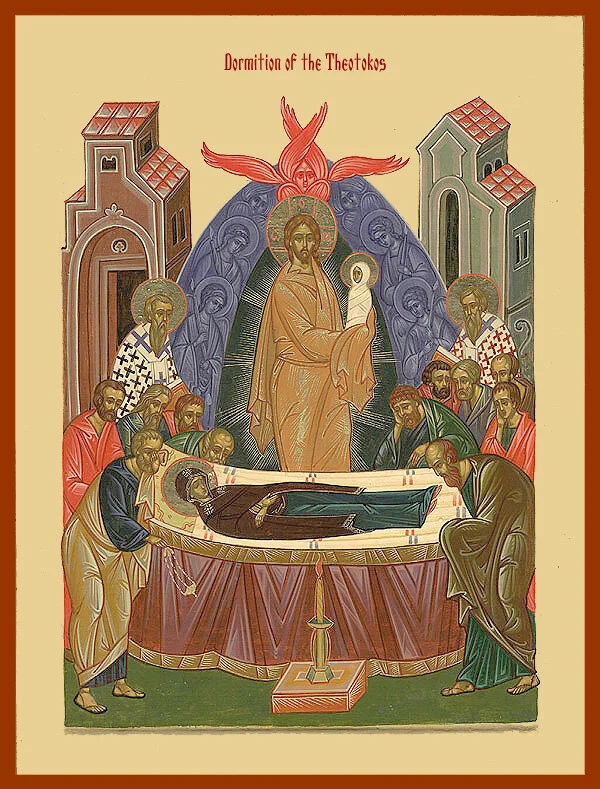
The Dormition of the Most Holy Theotokos
My beloved spiritual children in Christ Our Only True God and Our Only True Savior,
CHRIST IS IN OUR MIDST! HE WAS, IS, AND EVER SHALL BE.
+
THE DORMITION OF THE MOST HOLY THEOTOKOS
St. Tihkon's Seminary
Liturgically, the most important feast of the Theotokos is that of her Dormition or Falling-Asleep. Prior to this feast, there is a strict two-week fast, beginning on August 1st, which is broken only by the feast of the Transfiguration on August 6th. This Feast possesses two distinct aspects inseparably linked in the mind of the believer. On the one hand, there is death and burial and, on the other, resurrection and assumption of the Mother of God. As part of the Inner Tradition of the Church, this event was a mystery that was not designed for the ears of the outside world, but which was revealed to the faithful within the Church.
True believers know that insofar as the Son of God assumed human nature in the womb of the Virgin, she who was the means of His Incarnation was resurrected and taken up into Heaven in the Divine Glory of her Son. "Arise, O Lord, and go to Thy resting place, Thou and the ark of Thy might" (Psalm 132:8). The Son transported His Mother to the eternity of the life to come, "for being the mother of Life she was translated to life by the One Who dwelt in her virginal womb" (from the Kontakion hymn of the Feast). Thus, if every year we commemorate the anniversaries of the deaths of the Saints--the Martyrs, Apostles, Sainted Hierarchs, Venerable Fathers and Mothers, etc--so much the more we do commemorate the death of the Most Holy Theotokos who did not see the corruption of the grave common to all humanity. And not only did her soul ascend to heaven but her body also. As she was the perfect example of obedience which all Christians are called upon to exercise, and as she alone was the Mother of God, her body did not see the natural corruption which follows death, but was raised from the dead and carried to the glory of the King of All in the heavenly mansions.
According to the inner tradition of the Church, the Dormition of the Most-Holy Theotokos took place in the following manner: Having reached an advanced age, the Most-Pure One wished to leave the body and go to God as soon as possible, since the one increasing desire of her soul had always been to see the sweet face of her Son sitting at the right hand of the Father in Heaven. Many tears she shed as she prayed to the Lord to take her from this present vale of sorrows.
The All-Chaste One lived in the house of Saint John Divine on Zion and often she went to the Mount of Olives, which was nearby, offering there, in solitude, for fervent prayers to her Son. Once, as she was praying alone on the Mount, the Archangel Gabriel appeared to her and announced that soon (after three days) she would depart and be with Christ. The Archangel told her that she should not be troubled, but should receive his words with joy as she was being called to immortal life and to the eternal King of Glory.
As a sign of the triumph of the Mother of God over death--that bodily death would not have power over her, just as spiritual death had not had dominion over her, and that she would merely fall asleep for a short time and then, as if waking from sleep, she would rise and shake off death like sleep from the eyes and would see in the Light of the Lord's face the immortal life and glory to which she would go with shouts of joy and spiritual happiness--the Archangel handed the Most-Holy Virgin a branch from Paradise. The Most-Blessed Mother of God was filled with unspeakable joy and, falling down on her knees, she fervently thanked her Creator.
Before her departure from this life, the Most-Pure Lady wanted to see the Holy Apostles who were already scattered all over the world for the preaching of the Gospel. On her knees she prayed that this might be possible and that at the hour of her death she might not see the Prince of Darkness and his terrible servants, but that her Son and God Himself would fulfill His promise and come and receive her soul into His Holy hands. As she knelt, the olive trees growing on the mountain bent, as if they were animate, and when the Pure-Theotokos rose they straighten themselves out again, honoring her as the Mother of God.
Returning home, the Most-Blessed Lady showed the branch from Paradise to Saint John and fold him to carry it before her bed. Then she began to make preparations for her burial. Saint John sent word to Saint James (Iakovos), first Bishop of Jerusalem and the brother of the Lord, and also to all other relatives and neighbors, informing all the Christians living in Jerusalem and surrounding towns. With weeping they came to the home of the Pure Virgin to await her death.
As the multitude gathered at the home of the Theotokos, suddenly there was heard a loud sound, like thunder, and a cloud encircled the house of Saint John the Theologian. At the command of God Angels seized the Apostles that were scattered to the ends of the earth and, bringing them on the clouds to Jerusalem, placed them on Zion before the door of the house. Saint John greeted them and told them of the speedy departure of the Most-Holy Mother of God. Later the Apostle Paul, accompanied by his close disciples, Dionysius the Areopagite, Hierotheos and Timothy, as well as the Seventy Apostles arrived at the home.
On the fifteenth day of the month of August, as all were awaiting the final hour there suddenly shone in the room an ineffable Light of Divine Glory which dimmed the lamps that had been lit in the house. The inhabitants saw the roof of the house opened and the Glory of the Lord descending from Heaven--Christ the King of Glory Himself with the hosts of Angels and Archangels, with all Heavenly Powers, with the Holy Fathers and Prophets who of old prophesied about the Holy Virgin and all the righteous souls, approached His Immaculate Mother.
After her Son, the Virgin surrendered her pure soul into His hands. She felt no pain whatever, for the end was as if the she had fallen into a sweet sleep. At once there began Angelic singing and with triumphant songs the heavenly Hosts accompanied the soul of the Mother of God as she went in the arms of the Lord to the dwelling on High.
After her death, the Apostles bore the Most-Pure body of the Mother of God to the Garden of Gethsemane, where she was placed in a tomb. The Holy Apostles stayed at the tomb of the Most-Pure One without leaving the Garden for three full days, singing psalms day and night. In addition, for all this time there was heard in the air the wonderful singing of the heavenly Hosts praising God and blessing His Immaculate Mother.
By God's arrangement, one of the Apostles, Saint Thomas, was not present at the glorious burial of the body of the Immaculate Mother of God and he only arrived at Gethsemane on the third day. Grieving that he had not been granted the last greeting and blessing of the Most-Pure One, Thomas wept bitterly. Taking pity on him, the Holy Apostles decided to open the tomb so that he might at least see the sacred body of the Blessed Mother. But when the tomb was opened, the body of the Mother of God was not there, but only the burial clothes, giving off a wonderful fragrance.
With weeping and reverence the Holy Apostles kissed the burial clothes, praying that the Lord would reveal to them where the body of the All-Pure One had disappeared to. Later after having eaten a meal in the Garden, the Holy Apostles suddenly heard Angelic singing. Looking up, they saw standing in the air the Immaculate Mother of God surrounded by a multitude of Angels. She was enveloped in an ineffable Light and she said to them, "Rejoice, for I am with you always!" Filled with joy, instead of the usual. Lord Jesus Christ help us!" the Holy Apostles cried "Most Holy Mother of God, help us!" From that time they taught the Holy Church to believe that the Immaculate Mother of God on the third day after her burial was raised by her Son and taken with her body to Heaven.
Thus, the Lord by His special Providence, delayed the arriveal of Saint Thomas until the third day of the Falling-asleep of the Mother of God so that the tomb might be opened for him, so that the Church, in this way, might believe in the resurrection of the Mother of God just as previously through the same Holy Apostle's unbelief the Church had come to believe in the Resurrection of Christ. Thus were accomplished the Fall-asleep of our Most-Blessed Lady the Mother of God, the burial of her undefiled body, her glorious resurrection and the triumphant assurance regarding her ascension to heaven in the flesh.
(Source: Dormition Orthodox Monastery)
___________________
DIVINE SERVICES AT THE HOLY DORMITION CHAPEL:
32365 Chicago Trail, New Carlisle, IN
Friday Evening, August 14th: Great Vespers and the Epitaphios Threnos of the Theotokos at 7:00 p.m.
Saturday, August 15th: Orthros at 9:00 a.m. and Divine Liturgy at 10:00 a.m.
___________________
"Glory Be To GOD For All Things!" --Saint John Chrysostom
+++
With sincere agape in His Holy Diakonia (Ministry)
The sinner and unworthy servant of God
+Father George

Revelation 1:20-2:2 - The Lampstands and the Seven Stars
Accordingly here in the book of Revelation (Apocalypse) He says the seven stars are the bishops of the seven churches (the word Angel in this context is the bishop.) and the seven lampstands are the seven churches in Asia Minor. After explaining these two points, He does not explain the rest of the book of Revelation. He does not explain it, but he gives the key to Saint John to enable him to interpret the visions. Saint John then passes this same key to every reader in the Church throughout the centuries. So, my friends, the Lord gives the key to Saint John, and through him, to all of us. However, even if we happen to hold the key of interpretation, (and you can see how emphatic I am on this matter) we have an entire book before us with a plethora of images. How will explain all these even if we are holding the key of interpretation? It is not enough if the reader, the interpreter, does not have the spirit of God. Nor only the book of Revelation, but every word of the Lord remains sealed the seven seals in the absence of the Holy Spirit.
My beloved spiritual children in Christ Our Only True God and Our Only True Savior,
CHRIST IS IN OUR MIDST! HE WAS, IS, AND EVER SHALL BE.
+
REVELATION 1:20-2:2 - THE LAMPSTANDS AND THE SEVEN STARS
By Archimandrite Athanasios Mitilinaios
Accordingly here in the book of Revelation (Apocalypse) He says the seven stars are the bishops of the seven churches (the word Angel in this context is the bishop.) and the seven lampstands are the seven churches in Asia Minor. After explaining these two points, He does not explain the rest of the book of Revelation. He does not explain it, but he gives the key to Saint John to enable him to interpret the visions. Saint John then passes this same key to every reader in the Church throughout the centuries. So, my friends, the Lord gives the key to Saint John, and through him, to all of us. However, even if we happen to hold the key of interpretation, (and you can see how emphatic I am on this matter) we have an entire book before us with a plethora of images. How will explain all these even if we are holding the key of interpretation? It is not enough if the reader, the interpreter, does not have the spirit of God. Nor only the book of Revelation, but every word of the Lord remains sealed the seven seals in the absence of the Holy Spirit.
So, the Seven Lampstands according to the Lord's interpretation are the seven churches of Asia Minor. They are gold like the seven-light lampstand of the Old Testament. In the Old Testament, this signifies the chosen people; and in the New Testament, it signifies the new Israel of grace, the Christians. The seven stars are the seven angels, and the seven angels are the seven bishops of the seven corresponding churches of reference. These seven bishops are the representatives of the one Church. In the book of the Revelation, one of the definitive characteristics of the Lord and His relationship to the bishops and churches is that we see Him walking among the lampstands, among His churches. This shows maneuverability and power; it also shows that He exercises direct supervision over His churches.
The Lord governs His Churches regardless of the savage attacks of the powers of darkness in history, such as heresies -- and to use a contemporary term, all Zionist masterminds who have never stopped undermining the Church, day in and day out, in its two thousand year history. From the moment of the Lord's death the Jews of the dispersion or of the diaspora, those who believed in Christ comprised the people of grace. They became the new Israel along with the gentiles. They formed the Church. Those that did not believe, however, always turned against the Church...
"...Another definitive characteristic of the Lord's relationship to the bishops and the churches is that the Lord holds seven stars in His hand. He holds the seven stars in His right hand, which means that He holds the seven bishops in His right hand. Consequently, the bishops do not govern the Church as representatives of Christ, but Christ governs the Church and the bishops govern in the presence of Christ. The Greek word for spokesperson is ekprosopos, while the word for representative is antiprosopos. We need to make this distinction and to plainly see the spirit of Orthodoxy and compare it to the spirit of the West or the church of Rome. According to Roman papist thought, Christ governs in heaven and the pope governs on earth. He is in heaven and the pope of Rome serves as his representative here on earth. But, does this not contradict everything that we study in the book of Revelation? Christ holds the seven stars in His right hand and walks among the lampstands, the churches. That He holds the stars in his right hand is a clear indication that the bishops do not govern the church. Christ governs it.
The spirit of Orthodoxy is this: the bishop, the priest, etc. is not the representative, antiprosopos, of Christ but the spokesperson, ekprosopos. He serves in the Person of Christ or from the Person of Christ. The Greek prefix ek or ex- can be translated as from. Therefore, the spirit of Orthodoxy is that the bishops and the priest serve in the Person of Christ and in the presence of Christ. Christ is present. Christ is present when for example a priest celebrates the Divine Liturgy. He gives his hand to Christ. He offers his hand to be used by Christ. In one of the prayers, the priest says to inscriptional outline -- verses four and six of the first chapters, and from the introductory lines of the vision -- verses eight through twenty. For example, "These things says the true witness, the first-born from the dead, the ruler of the kings of the earth. All these things says He who is the alpha and the omega," the beginning and the end and so on. (Source: Homilies on the Book of The Revelation, Vol. pp. 114-118)
__________________________
"Glory Be To GOD For All Things!" - Saint John Chrysostom
+++
With sincere agape in His Holy Diakonia (Ministry)
The sinner and unworthy servant of God
+Father George