
December 6 - Saint Nicholas the Wonderworker, Archbishop of Myra in Lycia (Part I)
Nikolaos (Nicholas), the namesake of victory (The name Nikolaos comes from nike, meaning "victory", and "laos", which means "people'. The etymology of the name may be interpreted as "victorious people" or "victorious with the people." Thus, the Saint's name signifies either victory over a people, that is, either victory over vices, or a victory in the full sense; because by his way of life and doctrine, he taught the peoples to conquer sins and vice.)

ON DECEMBER 6th OUR HOLY ORTHODOX CHRISTIAN CHURCH COMMEMORATES OUR HOLY FATHER AMONG THE SAINTS, THE WONDER-WORKER, NIKOLAOS (NICHOLAS), ARCHBISHOP OF MYRA IN LYCIA.
[The Life of Saint Nikolaos was recorded in Greek by Saint Symeon the Metaphrastes]
Nikolaos (Nicholas), the namesake of victory (The name Nikolaos comes from nike, meaning "victory", and "laos", which means "people'. The etymology of the name may be interpreted as "victorious people" or "victorious with the people." Thus, the Saint's name signifies either victory over a people, that is, either victory over vices, or a victory in the full sense; because by his way of life and doctrine, he taught the peoples to conquer sins and vice.)
+
Our Wonder-Working (Miracle-Working) Father among the Saints, was born in Patara, a city of Lycia (located in the rugged Southwestern region of Asia Minor). The exact date of his birth is unknown. He flourished during the 300s, the epoch of the impious autocrats pagan Diocletian (284-305 A.D.) and Maximian (286-305 A.D.). Maximian was adopted by Diocletian as his colleague in 286 A.D. Both abdicated power in 305 A.D., in favor, respectively, of the augusti Galerius (305-311 A.D.) of the East and Constantius I (305-306 A.D.) of the West, but Maximian again assumed imperial power in 306 A.D. Saint Nicholas was Archbishop of Myra at that time and continued his episcopacy through the reign of Emperor Constantine I the Great (306-337 A.D.)
Emperor Constantine, upon issuing the Edict of Milan (313 A.D.), ensured full religious freedom for Christians, thus allowing the Church to emerge from the catacombs. Saint Nicholas participated in the First Ecumenical Synod at Nicaea, which convened in 325 A.D.
After giving this brief background of Saint Nicholas, we ask you to give great attention to his life's account, which was compiled by Saint Symeon the Metaphrastes. The reader shall receive joy, gladness, and sweet delight.
...All the narratives and accounts concerning the Saints of God are able to attract the listener to virtue and the practice of doing good. The life of our holy Father Nicholas and his accomplishments are also able to inspire one to implementation of such deeds as his.
In the East, in the region of Lycia, there was a city known as Patara which, as was earlier mentioned, was the birthplace of our great Father Nikolaos the Wonder-worker. He was the scion of Christian parents, Theophanes and Nonna. They were neither very poor that they might be despised by others nor very rich that they might become arrogant in their thoughts. They had what was sufficient for their needs; and yet, at the same time, they were able to help the poor with their alms. The virtue of the parents was reflected in their infant son. The Lord says in the Holy Scripture, "the tree is known from the root" (Matthew 12:33). The parents begat no other son, either before or after their Nicholas, thus making it evident another son would not be able to attain the virtue of Nikolaos. Even as an infant, Nicholas displayed what he would later become. Every day, except Wednesday and Friday, he took the breast as other infants. He took nourishment only from his mother's right breast as presaging that he would stand to the Lord's right with the blessed. He partook once daily and only after the setting of the sun. Thus, he abstained and fasted till the ninth hour, before he was eating solid foods. ("Ninth" hour corresponds to about 3:00 o'clock in the afternoon, the drama of our Lord's Sacrifice upon the Cross ended as He gave up His spirit to the Heavenly Father.) Saint Nicholas practiced strict temperance during his entire life, especially on Wednesday and Friday. The infant was sanctified by the prayer and piety of both his parents so that from his youth Nicholas' heart and soul were devoted to God. After the birth of Nicholas, his parents adopted the celibate life. At his Baptism, the infant Nicholas afterward stood up straight in the font for three hours, thus glorifying the Holy Trinity.
This type of behavior was manifest from his youth, which presaged his asceticism and sanctity in adulthood. When he was about five years and came of school age, he received sufficient lessons in letters. He avoided the dissolute pleasures and adventures of his peers. Those children who were disorderly or spoke unbecoming words, he turned his back to and avoided. He loved to regularly attend church and keep company with prudent and elderly men, from whom he might receive beneficial spiritual advice, which was his chief work and pursuit. From his youth, whatever he could understand of the sacred writings and Holy Scripture, he was in the habit of committing them to memory. On account of his quick mind and the grace of the Holy Spirit, he attained wisdom and knowledge. The Bishop of Patara, who was his father's brother, was also named Nicholas. He also took notice of the lad's pursuits and manner of life. He recommended to the parents that they consecrate their son to the service of God. The parents readily heeded the bishop's good recommendation and consecrated to the Lord the child whom they had received from Him as a gift.
When Nicholas grew up, he showed himself to b an honorable man. He shunned vain conversations, avoided familiar speech with women and refrained from gazing upon them, and spent his time in mental prayer and reading spiritual books. At length, he was deemed worthy of the Priesthood and was ordained by Bishop Nicholas. Just as Saint Nicholas was about to be ordained to the Priesthood, Bishop Nicholas was inspired by the Holy Spirit to utter, before the entire congregation, these prophetic words regarding his nephew: "Brethren, I see a new sun rising above the earth. Father Nicholas shall comfort and console many of the afflicted and shall dispatch many souls to the Kingdom of the heavens. Blessed is the flock that shall be vouchsafed such a shepherd; for he will nourish the souls entrusted to him on the pastorage of piety. We shall all find him a ready helper in misfortunes and tribulations." Indeed, all these divine predictions came to be, as the passage of time would clearly evince.
After the Saint was ordained to the Priesthood, one could not recount all his virtues and the good deeds he performed. He engaged in vigils, fasts, continence, and prayers on behalf of the people. Much of this was witnessed by his uncle, Bishop Nicholas, who marveled to find such dedication. The uncle desired to make a pilgrimage to Jerusalem. He decided to entrust his nephew with the care and supervision of the Church at Patara and its monastery. The bishop had built the monastery, naming it New Sion. The holy Priest Nicholas governed the Diocesan house and monastery, even as the bishop himself would have, had he been present. The dignity of this office in fact would follow later for our Father Nicholas.
Father Nicholas lost his parents at an early age. He was left not a little inheritance, which he distributed for the poor's food and shelter. He clothed the naked and cared for the orphan and widow. The inheritance was not spent on desires devoid of reason, costly raiment, and all sorts of entertainment, as those pastimes engaged in by today's young people. Hear the words of the Prophet King David: "If happily wealth flow, cease putting forth your heart upon it" (Psalm 61:10); thus did the Saint put those wise words to practice. He gave no heed to the increased flow of riches and corruptible wealth, but dispersed it as was meet, that he might gain incorruptible and everlasting life. Since he bore profound love for his parents, he asked everyone to pray for them, promising his help in return. Out of all the almsgiving and charitable acts which he performed, listen to one such marvelous and awesome incident. Although his modest fortune was being distributed toward numerous acts of charity, yet Father Nicholas carefully watched for situations where the need was the greatest.
The Three Maidens
At that time, there was a very wealthy man at Patara who had three beautiful daughters. From the enemy's malice, this father had fallen on hard times and into deep poverty. He then conceived the criminal notion of committing his virgin daughters to harlotry, that by means of this profession their family of four might procure life's necessities. Though the wretched father of these three daughters was resolved to put his scheme into effect, yet the All-Good God, knowing the secret things of the heart, desired to deliver the souls of those three girls from perdition and, at the same time, reveal the concealed virtue of the Saint. What did God therefore dispense in His economy? During that same day, when the father revealed his plant to convert his home into a brothel and to sell his daughters into prostitution, Saint Nicholas, by Divine grace, learned of this impending catastrophe and abhorred it. Thereupon, he was determined to do something about it and make haste to save the maidens' souls from this predicament. The Priest Nicholas bound three hundred gold coins in a handkerchief and secretly by night to that formerly wealthy father's house. The Saint observed an open window. It landed with a noise, but the Saint did not tarry to see how or by whom it might be retrieved. He instead quickly took himself away under the cover of night, lest any should recognize him; for he was ever mindful of the Gospel words: "Be taking heed not to do our alms (charity) before men, in order to be seen by them, otherwise ye have no reward with your Father who is in the heavens" (Matthew 6:11). Moreover, Father Nicholas did not wish to embarrass the sensibilities of the former wealthy man who was not in penury. Thus, he was resolved to act secretly, even as the Savior pronounces in the Sacred Gospel: "When thou art doing alms , let not thy left hand know what thy right hand is doing, so that thine alms might be in secret" (Matthew 6:3, 4). The Saint wished to avoid the praise of men that he might receive only praise from God.
The following morning, when the father and three daughters arose, it was the father who found the bound handkerchief inside his house. He picked it up and untied the knot. Imagine his surprise at beholding the coins! He stood there as one beside himself, and then rubbed his eyes, scarcely believing what lay before him, thinking it was an illusion. He found the sum to be exactly three hundred gold coins. Since he could identify no one as his benefactor, he gave thanks to God. Straightway, after using some of the money for the family's immediate needs, he betrothed his eldest daughter to a certain wealthy man of that city. The father of the bride cherished the hope that, as God dispensed to provide for his firstborn daughter with a dowry, He would furnish dowries of his other two daughters. Saint Nicholas with the intention of assisting the second daughter, then prepared another handkerchief with the same amount of coinage. He went quietly and secretly to the house. Under the cover of night, he cast the bound handkerchief through the same open window. When the father and his two remaining daughters arose in the morning, the father quickly looked to see if he had received anything.
Once again, he discovered a tied handkerchief, which unfurled to reveal the sum of three hundred florins. He marveled at this second occurrence and became consumed with curiosity to learn who had the goodness to bestow such generous gifts. He began to implore God with tears and saying, "God and Lord of mercy, Who dispenses in Thine economy the salvation of man and Who wishes not the death of the sinner but that he should return to life and live, Thou art He Who descended from out of the heavens on account of our sins: reveal to me Thy sinful slave (servant) and my benefactor, that I might know who it is that wrought such charity that I might be ransomed from the hands of the devil." The father next betrothed his second daughter.
From that day, the father was ever attending to that open window in the event his benefactor should appear. The father's plan was to run and see who might be this patron. Saint Nicholas once again prepared a handkerchief with another three hundred coins. The Saint approached the open window secretly by night. Below the window, inside the house, the father with his third daughter waited for their secret benefactor. Then suddenly a bound handkerchief flew in through the window and made a sound as it hit the floor. The father quickly took to his heels. He flung open the door to his house and hastened to overtake the fleeing figure whom he detected at a distance. "Stop! Stop!" he cried, "Do not hide thyself from me!" The Priest Nicholas, observing he was seeing pursued, ran to avoid being found out. The father immediately recognized Father Nicholas, because the priest was well-known for both his virtue and noble bearing. The father fell before the Saint's feet and with tears began saying, "I thank thee, O slave (servant) of God, that you didst pity me, the wretched one, and performed these charitable acts on my behalf, the miserable one. If thou hadst not overtaken me in my sin, I should have perished in both soul and body in a vile manner." The father attempted to kiss the Saint's feet, but Father Nicholas drew away. The Saint, seeing that he was discovered, wished to exact a promise from the father and said, "For the sake of the kindness shown thee, do me the favor of saying nothing regarding it for as long as I live; otherwise, I shall hold thee responsible before God." The Saint uttered these words and immediately departed. The following day, the third daughter became engaged to be married. After she was married, the father continued his life in peace, mindful of giving glory to God. (Source: The Great Synaxaristes of the Orthodox Church)
(To be continued)
___________________
"Glory Be To GOD For All Things!" - Saint John Chrysostomos
+++
With sincere agape in His Holy Diakonia (Ministry)
The sinner and unworthy servant of God
+Father George
December 5 - Venerable Sava the Sanctified
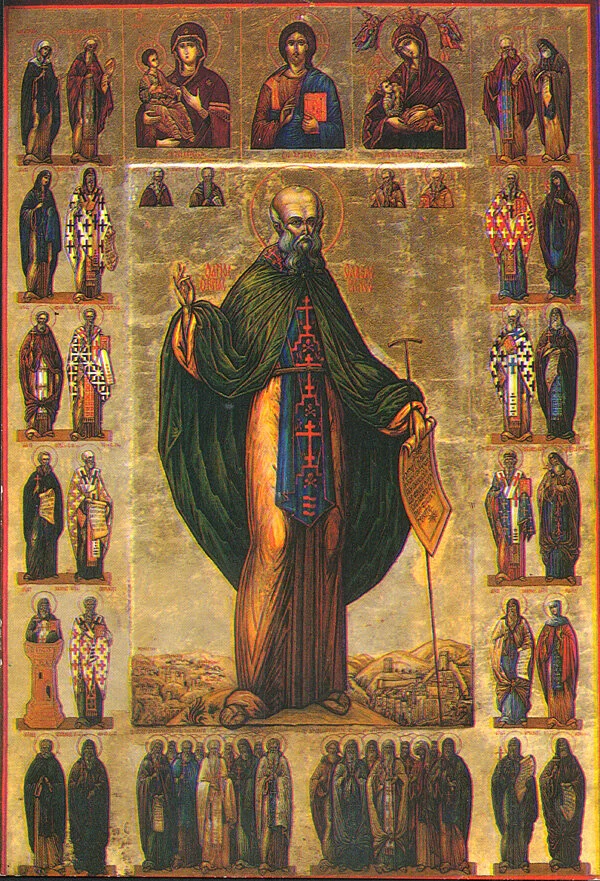
The unknown village of Mutalaska, in the province of Cappadocia, became famous through this great light of the Orthodox Church, for Saint Sava was born there. He left the home of his parents, John and Sophia, at the age of eight and became a monk in a nearby monastery called 'Flavain's'. After ten years, he moved to the monasteries of Palestine, staying longest in the monastery of Saint Efthymius (Eutheymius) the Great (+ January 20th) and Theoctistus.
My beloved spiritual children in Christ Our Only True God and Our Only True Savior,
CHRIST IS IN OUR MIDST! HE WAS, IS, AND EVERS SHALL BE.
+
ON DECEMBER 5th OUR HOLY ORTHODOX CHRISTIAN CHURCH COMMEMORATES THE FEAST OF OUR HOLY FATHER SAVA THE SANCTIFIED
The unknown village of Mutalaska, in the province of Cappadocia, became famous through this great light of the Orthodox Church, for Saint Sava was born there. He left the home of his parents, John and Sophia, at the age of eight and became a monk in a nearby monastery called 'Flavain's'. After ten years, he moved to the monasteries of Palestine, staying longest in the monastery of Saint Efthymius (Eutheymius) the Great (+ January 20th) and Theoctistus. Efthimius, who had the gift of discernment, foretold that he would be a famous monk and leader of monks and that he would found a monastery that would be greater than any other of that day. After Saint Efthimius's death, Sava went into the desert, where he lived for five years as a hermit in a cave that an Angel of God showed him. After that, when he had become a perfected monk, he began by Divine Providence to gather around him many desirous of the spiritual life. They very quickly grew in number, so that Sava had to build both a church and many cells. Some Armenians also came to him, and he set aside a cave for them, and they celebrated the services there in their own language. When his father died, his aged mother Sophia came to him and he made her a nun and gave her a cell away from the monastery, where she lived in asceticism till her death. This Holy Father endured many attacks from those close to him, from heretics and from demons. But he overcame them all in these ways: those close to him he won over by his goodness and forbearance, the heretics by an unshakable confession of the Orthodox faith, and the demons with the sign of the Cross and the invocation of God's aid. He had a particularly severe battle with the demons on the mountain of Castellium, where he founded the second of his seven monasteries. He and his neighbor, Theodosios the Great, are considered to be the greatest lights and pillars of Orthodoxy in the East. Kings and Patriarchs were brought to the right Faith by them, and these holy and wonderful men, strong in the power of God, served each and every man as an example of humility. Saint Sava entered into rest in 532 A.D. at the age of ninety-four, after a life of great labor and great reward.
Among all his other great and good works, let his be remembered above all: that he compiled the first Order of Services for use in monasteries, now known as the Jerusalem Typikon. (Source: The Prologue from Ochrid)
________________________
DIVINE SERVICE ON SATURDAY, DECEMBER 5:
Divine Liturgy at 10:00 a.m.
Officiating Priest: Father Alexios Torrence
__________________________
"Glory Be To GOD For All Things!" - Saint John Chrysostomos
+++
With sincere agape in His Holy Diakonia (Ministry)
The sinner and unworthy servant of God
+Father George
December 4 - Holy Great-Martyr Barbara (Part III)
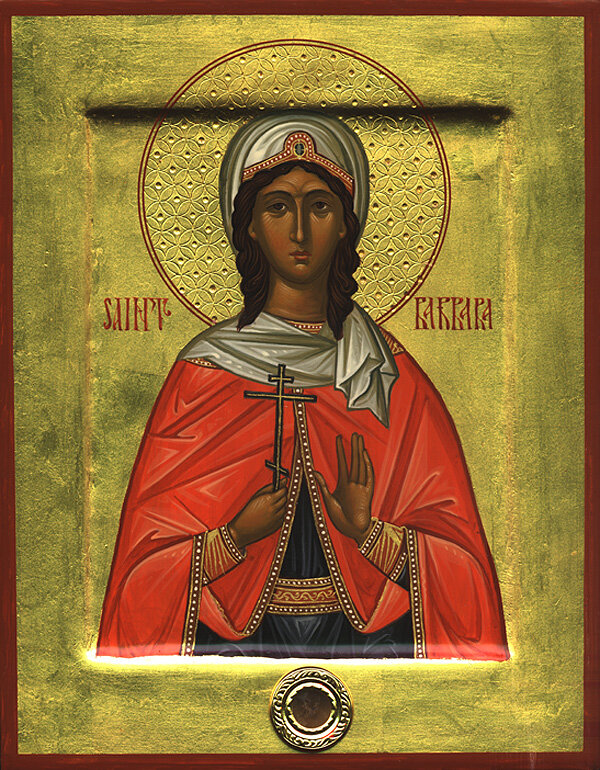
There lived nearby a Christian woman named Juliana who feared God and had seen the torturers lay hold of Saint Barbara. She watched from afar as Barbara was tortured, and after the Saint was taken to the prison, looked in at her through the dungeon window. When she saw that the Lord had healed Saint Barbara's wounds, she was herself filled with longing to suffer for Him. She began to prepare herself for the struggle, praying to Christ Jesus, the Judge of the contest, to grant her the strength to endure torture.
CHRIST IS IN OUR MIDST! HE WAS, IS, AND SHALL ALWAYS BE.
+
THE MARTYRDOM OF THE HOLY GREAT-MARTYR BARBARA AND JULIANA (Part III)
There lived nearby a Christian woman named Juliana who feared God and had seen the torturers lay hold of Saint Barbara. She watched from afar as Barbara was tortured, and after the Saint was taken to the prison, looked in at her through the dungeon window. When she saw that the Lord had healed Saint Barbara's wounds, she was herself filled with longing to suffer for Him. She began to prepare herself for the struggle, praying to Christ Jesus, the Judge of the contest, to grant her the strength to endure torture.
At daybreak, Barbara was brought out of the prison to suffer fresh tortures. Julian followed her at a distance. Barbara was led before the Governor, and he and the others present saw that the maiden had been healed. Her face was bright, and she was even more beautiful than before. Seeing that she bore no trace of her wounds, everyone was astonished, and the Governor exulted, "You see, maiden, how our gods care for you? Give thanks to the gods for their kindness they have shown you, and offer them sacrifice and worship!"
"Why do you say, O Governor, that your gods healed me?" asked the Saint. It was Jesus Christ, my Lord, and God, Who heals every infirmity and quickens the dead, that made me whole. It is Him that I thank and worship, and to Him, I offer myself as an oblation. But you are unworthy to behold Him, for your eyes are blind and your mind diseased with impiety."
The holy martyr's words moved the Governor to anger, and he commanded that she be suspended from a tree and her flesh raked with iron claws. Then he had her sides burned with candles. All these things Saint Barbara endure courageously. After this her head was beaten with a hammer, a torment scarcely to be endured even by the strongest men; nevertheless, the power of God preserved Christ's lamb as she suffered.
Among the people watching the Saint's passion stood Juliana, who could not restrain herself from weeping when she saw Barbara bravely endure torture. Filled with zeal, Juliana cried out amidst the crowd and began to revile the pagan gods and accuse the merciless Governor of inhuman cruelty. She was at once seized and asked what faith she professed. Since she confessed herself to be a Christian, the Governor commanded that she be put in torture with Barbara. Juliana was suspended alongside Barbara and scraped with iron hooks. Meanwhile, the Holy Great-Martyr Barbara lifted her eyes and prayed to the Almighty God: "Forsake me not, O Lord, but mercifully look down upon me and my fellow-sufferer Juliana. Strengthen us both and enable us to complete the present contest well, for "the spirit is willing, but the flesh is weak" (Matthew, Chapter 26).
As the Saint prayed, invisible succor descended from heaven upon the two martyrs, enabling them to endure their torture courageously. Then the persecutor ordered that their breasts be cut off, leaving them in the utmost pain. Again Barbara turned to her Physician and Healer, lifting her eyes and crying, "Cast us not away from Thy face, O Christ, and take not Thy Holy Spirit from us." Grant us, O Lord, the joy of salvation, and by Thy governing Spirit confirm us in Thy love!"
Dioscrorus, Saint Barbara's hardhearted father, not only felt no sorrow at the sight of his daughter's sufferings but gladly volunteered to be her executioner. Seizing Barbara with one hand and holding his bared sword with the other, he led her to the place of execution, a mountain outside the city. Behind them, a soldier led Saint Juliana. As they walked, Saint Barbara prayed to God, saying, "O Eternal God, Who has stretched out the heavens like a curtain and established the earth upon the waters, Whose sun shineth upon the good and evil alike, Who sendest down rain upon the just and the unjust, do Thou now hearken unto me Thy servant, who prayeth unto Thee! Hear me, O King, and bestow Thy grace upon all who remember me and my sufferings. Do not permit illness to befall them unexpectedly, and let not death overtake them unawares; for Thou knowest, O Lord, that we are but flesh and blood, the work of Thy Most pure hand."
As soon as the Saint had completed her prayer, a voice was heard from heaven summoning the martyrs and promising to fulfill Barbara's request. Saint Barbara and Saint Juliana hastened to their death with great joy, wishing to depart from the body quickly and go to their Lord. When they reached the appointed place, Christ's lamb Barbara bent her neck beneath the sword and was beheaded by her merciless father. The soldier beheaded Juliana there also, and the martyrs completed their contest together.
Divine punishment, however, quickly overtook Dioscorus and Governor Martianus. Thunder began to roar, and lightning struck Dioscorus while he was descending the mountain and Martianus as he was sitting at home. Their bodies were entirely consumed, leaving behind not even a trace of ash.
There lived in Heliopolis a pious man named Valentian who removed the precious bodies of the holy martyrs and returned them to the city. He buried them with fitting honor and built a church over them. Through the grace of the Father, Son, and Holy Spirit, and the prayers of the Saints, numerous healings were worked through the holy their holy relics. Unto the God Who is one in Trinity be glory forever. (Source: The Great Collection of the Lives of the Saints)
________________________
"Glory Be To GOD For All Things!" - Saint John Chrysostom
+++
With sincere agape in His Holy Diakonia (Ministry
The sinner and unworthy servant of God
+Father George
December 4 - Holy Great-Martyr Barbara (Part II)
A priest from Heliopolis from Alexandria, disguised as a merchant. Learning of this, Barbara sent for him. He secretly instructed her in the knowledge of the One Almighty God, the Creator of All Things, and in the faith of our Lord Jesus Christ. Thus Barbara attained what her heart had ardently desired for so long. After teaching her the mysteries of the holy faith, the priest baptized her in the Name of the Father, Son, and Holy Spirit, then departed for his own country. Saint Barbara's heart burned even hotter with love for God after she was enlightened by Baptism. She exercised herself continually in prayer, and fasting, laboring for her Lord, to Whom she betrothed herself, vowing to preserve her virginity undefiled.

My beloved spiritual children in Christ Our Only True God and Our Only True Savior,
CHRIST IS IN OUR MIDST! HE WAS, IS, AND EVER SHALL BE.
+
THE HOLY LIFE OF THE GREAT-MARTYR BARBARA (Part II)
A priest from Heliopolis from Alexandria, disguised as a merchant. Learning of this, Barbara sent for him. He secretly instructed her in the knowledge of the One Almighty God, the Creator of All Things, and in the faith of our Lord Jesus Christ. Thus Barbara attained what her heart had ardently desired for so long. After teaching her the mysteries of the holy faith, the priest baptized her in the Name of the Father, Son, and Holy Spirit, then departed for his own country. Saint Barbara's heart burned even hotter with love for God after she was enlightened by Baptism. She exercised herself continually in prayer, and fasting, laboring for her Lord, to Whom she betrothed herself, vowing to preserve her virginity undefiled.
By that time construction had begun on the bathhouse. One day the holy virgin came down from the tower to examine it. Seeing that the structure had only two windows, she said to the builders, "Why have you installed just two windows? Would the building not be more beautiful and better lit with three?"
"Your father ordered us to install two windows, on the south side," answered the laborers.
But Barbara insisted that a third window be added, to represent the Holy Trinity. When the builders objected, fearing difficulties with her father, she insisted, "I shall answer for you to my father. Only do as I say." So a third window was added to the bathhouse in accordance with her instructions.
Now the bath was built, as was said, beside a pool, which was surrounded by a wall of marble. One memorable day, Saint Barbara traced the Holy Cross upon the east side of the wall, and her finger left a mark in the stone as if the marble had been engraved with a chisel. Her virginal footprints remained imprinted in the stone floor of the bath; from them water began to flow, which later became a source of healing for the faithful.
The bathhouse, the marble wall on which the cross was traced, the pool, and the footsteps of the Saint all survived intact until the time of the blessed Symeon Metaphrastes, who revised the account of the passion of Saint Barbara written by Saint John of Damascus. He writes the following: "The pool exists today and heals every disease for those who love Christ. If someone were to compare it with the streams of Jordan or the Pool of Siloam or the Sheep's Pool, he would not sin against truth, for numerous miracles are wrought at Saint Barbara's pool by the power of Christ."
Returning to her tower, Saint Barbara, continued with her usual prayers and fasts, immersing her mind completely in meditation on the Divinity. Presently Dioscorus returned from his journey. After inspecting everything in his house, he went to the newly completed bath. He became angry with the builders and servants, demanding to know why they had disobeyed his orders and installed a third window. They protested, "It was not our notion, but your daughter's. She forced us to disobey you!"
Dioscorus called for Barbara at once and asked her why she had a third window installed in the bathhouse. The Saint replied, "Three windows are better than two. I believe, father, that you wanted the bath lit by two windows to symbolize the sun and the moon, which lighten the heavens. But I prefer three because the unapproachable, ineffable, unwaning Light that illumines every man that comes into the world (John, Chapter 1) shines forever from a triple source."
Barbara's father was amazed by her strange, novel words, which he failed to comprehend. Then father and daughter moved closer to the pool, near the place in the wall where the Saint had inscribed the cross with her finger. Dioscorus asked. "How can the light of three windows illumine every man, as you said?"
"Hear me, father," said the Saint, "and try to understand my words. The Father, Son, and Holy Spirit are the three hypostases of the God Who is one in trinity. They abide in unapproachable Light and illumine and give life to all creation. I had the workers install the three windows in the bathhouse so that one might represent the Father, another the Son, and the third the Holy Spirit. Now even the walls on our bath glorify the Name of the Most Holy Trinity." Then she pointed to the cross inscribed in the marble, and said, "I have traced here the emblem of the Son of God, Who by the gracious will of the Father and the operation of the Holy Spirit became incarnate of the pure Virgin for our salvation. He voluntarily suffered upon a Cross such as the one you see. By depicting the Cross here I have driven away all the power of the demons."
...Burning with rage, Dioscorus forgot the love for his child implanted in his heart by nature, and drew his sword, intending to run it through her. Barbara took flight, and he pursued her with a weapon in hand. The wolf had almost caught up to Christ's spotless lamb when suddenly Barbara found her way blocked by a cliff, as though by a wall. Not knowing how else to escape her father, or rather her persecutor, she turned to her only refuge, God, lifting up the eyes of her soul and body and begging His help. The Lord did not tarry in sending His handmaiden assistance: He commanded the cliff to part, as once the mountain had done for the Protomartyr Thecla when she was fleeing the shameless youths. The face of the cliff opened, and the holy virgin Barbara entered the cleft, after which the rock closed behind her, permitting her to ascend unharmed to the top of the mountain. There the Saint found a cave, in which she hid.
...Dioscorus soon found the cave where his daughter had taken refuge. He seized her and threw her to the ground, then beat and kicked her mercilessly. Taking hold of her hair, he dragged her home along a stony trail. Barbara was locked in a very small, dark hut. Seals were placed upon the windows and doors, and a watch was set. The guards were ordered to afflict the Saint with hunger and thirst. Thereupon Dioscorus went to the Governor, Martianus, and told him that his daughter had rejected the gods and now believed in the Crucified One. He requested the Governor to threaten Barbara with tortures so that she would return to her ancestral faith. Martianus agreed, and Dioscorus handed her over to him.
...The Governor marveled at the maiden's loveliness and was amazed by her noble bearing...He entreated her not to disgrace her family or to ruin the blossom of her youth and ended with this warning: "Have pity on yourself, fair maiden, and be quick to offer sacrifice with us to the gods...but if you do not obey me, I shall be compelled to put you to torture."
The Governor became enraged with her defiance and her disrespect to the pagan gods. He commanded that Barbara be stripped naked. Then the persecutor ordered that she be stretched out upon the ground and lashed with leather straps until the earth was dyed red with her blood. After the flogging, the Saint's wounds were rubbed with sackcloth and scraped with shards to increase her pain. The Governor then had the Saint confined in a dungeon until he could devise some crueler torture. Barbara called out in her prison cell to her beloved Bridegroom, Christ the Lord, beseeching Him not to abandon her. Then suddenly the King of Glory, Barbara's incorruptible Bridegroom, appeared in unspeakable Majesty. Oh, how the Saint rejoiced in spirit when she beheld Him! The sweet Lord said, "Take courage, My bride, and fear not, for I am with you. I stand watch over you, looking down on your contest, and will ease your pain. I have prepared an everlasting reward for you in the bridal chamber of heaven. Endure till the end, that you may enjoy the Eternal Blessings of My Kingdom.!"
...Jesus healed her wounds, permitting no trace of them to remain on her body. Then He disappeared, leaving her filled with a sense of ineffable spiritual gladness. (Source: The Great Collection of the Lives of the Saints)
(To be continued)
_____________________
DIVINE SERVICE FOR THE FEAST OF SAINT BARBARA ON FRIDAY, DECEMBER 4:
Divine Liturgy at 10:00 a.m.
_________________________
"Glory Be To GOD For All Things!" - Saint John Chrysostomos
+++
With sincere agape in His Holy Diakonia (Ministry)
The sinner and unworthy servant of God
+Father George
December 4 - Holy Great-Martyr Barbara (Part I)
During the reign of the impious pagan Roman emperor Maximian, there lived in the East, near Heliopolis, a wealthy, renowned nobleman named Dioscoros, by ancestry and faith a Hellene (Greek). He had a daughter named Barbara, his only child, over whom he kept watch as the apple of his eye. The maiden was exceedingly beautiful, and no girl or woman in the country could compare with her.

My beloved spiritual children in Christ Our Only True God and Our Only True Savior,
CHRIST IS IN OUR MIDST! HE WAS, IS, AND EVER SHALL BE.
+
ON NOVEMBER 4th OUR HOLY ORTHODOX CHRISTIAN CHURCH COMMEMORATES THE HOLY GREAT-MARTYR BARBARA
During the reign of the impious pagan Roman emperor Maximian, there lived in the East, near Heliopolis, a wealthy, renowned nobleman named Dioscoros, by ancestry and faith a Hellene (Greek). He had a daughter named Barbara, his only child, over whom he kept watch as the apple of his eye. The maiden was exceedingly beautiful, and no girl or woman in the country could compare with her. Thinking baseborn, common folk unworthy to behold his daughter's fair countenance, Dioscoros built a lofty tower in which were lovely rooms. There Barbara remained, with well-bred governess and maidservants. By that time her mother was already dead. While living in the tower, the maiden found consolation in looking out over the hills and valleys created by God, at the splendor of the heavens, and the majesty of the earth. One day, while gazing into the sky, she began to reflect on the brilliance of the sun, the moon in its course, and the luster of the stars. Suddenly she asked the governesses and servants living with her, "Who made these things?" Then, regarding the beauty of the earth, its green fields, gardens, and vineyards, the hills and streams, she asked again, "Whose hand created all this?"
"All things were made by the gods," the women replied.
"Which gods?" asked the maiden.
The servants answered, "The gold, silver, and wooden gods that your father keeps in his palace and worships. These are the gods that made everything you see."
Doubting the truth of this, Barbara said to herself, "The gods my father reveres were made by the hands of men: those of gold and silver by smiths, those of stone by sculptors, and the ones of wood by carvers. How can gods which have themselves been fashioned, that can neither walk nor move their hands, have created the luminous expanse of the sky and this beautiful earth?"
As she pondered on this, she gazed up into the sky by day and night, hoping to come to know the Creator through His creation. Then one night, after staring into the heavens for a long time, her soul filled with longing to know who created its wondrous beauty, expanse, and splendor, the Divine Light of grace suddenly shone within her, opening the eyes of her mind to know the one invisible, unfathomable God, Who made heaven and earth in His wisdom. She said to herself, "He alone is God Who was not formed by the hands of man, but is self-existent, and made all things by His hand. He alone is God Who stretched out the expanse of the heavens and sends down from on high the rays of the sun, the light of the moon, and the glow of the stars to illumine the whole world; while below He adorns the earth with various trees and flowers, and waters it with streams and springs. He alone is God Who upholds orders, and gives life to all things, caring for everything that exists!"
In this way Barbara came to know the Creator by His creation, and in the words of Prophet and king David were fulfilled: "I meditated on all Thy works, I pondered on the creations of Thy hands" (Psalm 142). Such meditations kindled the fire of divine love in her heart, and the flame of desire for God burned fiercely in her soul by day and night. Her one thought, her one desire was to come to know as fully as possible the Creator of all things. She had no human teacher to reveal to her the mysteries of the holy faith and guide her to the path of salvation, for her father Dioscoros kept close watch to ensure that only the servants had access to her; but she had as a wise teacher and guide the Holy Spirit Himself, Who invisibly instructed her by the secret inspiration of His grace, communicating to her mind the knowledge of the Truth. Like a sparrow sitting alone upon a house-top, (Psalm 10), the maiden remained in her tower, her thoughts ever turned toward heaven. Her heart was attached to nothing earthly; neither gold, nor costly pearls or jewels, nor fine apparel, nor any other sort of feminine adornment. She never considered marriage, since her mind was fixed upon the one God and she was held fast by love for Him...
...Dioscoros, her father, however, continued to press her, in spite of the many reasons she gave for her refusal to marry, and finally she was forced to declare, "Father, if you compel me to marry or even speak of this matter again, I shall kill myself, and you will lose your only child."
Horrified, Dioscoros desisted for the while, hoping that time would bring her to reconsider and that he would not need to compel her to obey him. Then the notion came to him of taking a long journey to attend to some business. He believed that Barbara would miss him and that when he returned it would be easier to persuade her to do as he wished. Before going away, Dioscorus gave orders for a splendid bathhouse to be built by the pool in his garden. Two windows were to be set in the south wall of the building. Dioscorus also left instructions with his daughter's attendants to permit her to come down from the tower and go wherever she wished, for he imagined that if Barbara began to converse with many people and see that other maidens willingly agreed to marriage, she would herself desire to be joined to a husband.
Free to come and go, and speak with whomever she wished, Barbara made the acquaintance of several Christian maidens. From them she first heard of Jesus Christ. The name of Christ caused her to rejoice in spirit and she asked them to tell her more concerning the Savior. They told her all they could of the Lord's ineffable Divinity, His Incarnation from the Most Pure Virgin Mary, His voluntary Passion and Resurrection, the Judgment to come, Eternal torments prepared for idolaters, and the endless joy that awaits faithful Christians in the heavenly Kingdom. Barbara's heart was filled with delight as they spoke, and afire with love for Christ, she longed to be baptized. (Source: The Great Collection of the Lives of the Saints)
(To be continued)
_____________________
"Glory Be To GOD For All Things!" - Saint John Chrysostomos
+++
With sincere agape in His Holy Diakonia (Ministry)
The sinner and unworthy servant of God
+Father George
Metropolitan Nathanael of Chicago's Advent Message and The Forerunner - December 6

St. Nicholas the Wonderworker, Archbishop of Myra
Please click on icon to view bulletin