
The Nativity of Our Lord Jesus Christ (Part II)
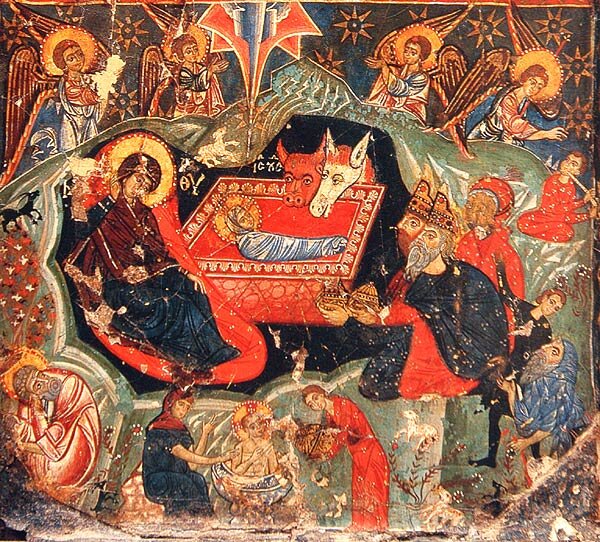
We chant: "He Who is equal in Honor with the Father and Spirit, out of compassion, has clothed Himself in our substance...and He Who before the morning star was begotten without mother of the Father, is today without father made flesh upon earth of thee" (Vespers Sticheron of Forefeast, Mode Four). Saint Paul confirms His manhood, saying, "But when the fullness of the time came, God sent forth His Son, born of a woman, born under the law, in order that might redeem those under the law, that we might receive what is our due, the adoption as sons" (Galatians 4:4).
My beloved spiritual children in Christ Our Only True God and Our Only True Savior,
CHRIST IS IN OUR MIDST! HE WAS, IS, AND EVER SHALL BE.
+
God Made Man
We chant: "He Who is equal in Honor with the Father and Spirit, out of compassion, has clothed Himself in our substance...and He Who before the morning star was begotten without mother of the Father, is today without father made flesh upon earth of thee" (Vespers Sticheron of Forefeast, Mode Four). Saint Paul confirms His manhood, saying, "But when the fullness of the time came, God sent forth His Son, born of a woman, born under the law, in order that might redeem those under the law, that we might receive what is our due, the adoption as sons" (Galatians 4:4).
Saint Athanasius comments, "Therefore what came forth from Mary, according to the divine Scripture, was human, and the Lord's body was real; real, I say, since it was the same as ours. For Mary is our sister, in that we are all sprung from Adam" (Saint Athanasius). The two natures would be united without confusion or loss of identity as God or man. The humanity of Jesus was the same as sour own; and, according to His divinity, He was of one essence with the Father and the Holy Spirit.
Saint Kyril of Alexandria writes that "an ordinary man was not born of the Holy Virgin and then the Logos/Word descended into Him. United with flesh in her womb, the Logos/Word is said to have endured birth according to the flesh, so as to claim, as His own, the birth of His own flesh...For our sake and for our salvation, He united a human nature to Himself by hypostatically and was born from a woman; in this manner, He is said to have born according to the flesh...We do not hesitate to call the Holy Virgin the Mother of God. The holy Fathers do not say that the nature of the Logos/Word or His Divinity took the beginning of being from the Holy Virgin, but that His Holy Body, animated by a rational soul, was born of her...Thus, the Logos' being made flesh is nothing else than that He partook of flesh and blood in like manner with us, and made our body His Own, and was born Man from a woman, without having cast away His Divinity...This is what the expression of the exact Faith everywhere preaches; this is the mind we shall find in the Holy Fathers."
Saint Kyril goes on to say that "neither was the flesh turned into the nature of Divinity, nor, indeed, was the ineffable nature of the Logos/Word of God altered into the nature of the flesh; for He is immutable and absolutely unchangeable, always the same, according to the Holy Scripture. But when He was visible, and still remained an Infant in swaddling clothes, and in the bosom of the Virgin who bore Him, He filled the whole of creation as god and was Co-Ruler with the One Who begot Him. For the Divine is both without quantity and without magnitude, and does not admit of limitation." And in the same letter, he points out that Christ "was born in order that He might bless the very beginning of our existence, and in order that the curse against the whole race might be stopped. This curse was sending our bodies from the earth to death; and by abolishing it, He abolished the saying, "in pain thou shalt bring forth children" (Genesis 3:17).
Patriarch Germanos of Constantinople chants: "No more shall women bear children in sorrow: for joy has put forth its flower, and the Life of men has come to dwell in the world." Saint Joseph the Hymnographer writes: "Eve hath been delivered from pain, O All-Immaculate One; for thou gavest birth without pain unto Christ Our God Who hath manifestly healed the sufferings and pain of all." Before the coming of Christ, women would bear children in sorrow with the knowledge that their offspring would be subject to sin, death, and Hades. Although the physical discomfort of pregnancy and labor still exists to the present day, yet the hymnographers speak of deliverance from the grief of death and sin to the offspring of those mothers who would be regenerated in Christ through Baptism.
Saint Ephraim then speaks of what Mary gained by carrying in her womb the Christ Child, "The Son of the Most High came and dwelt in me, and I became His Mother, and as by a second birth I brought Him forth, so did He bring me forth by the second birth, because He put His Mother's garments on, she clothed her body with His glory."
In the classic passage of Saint John of Damascus, he writes: "Hence it is with justice and truth that we call the Holy Mary the Theotokos, God's birth giver. For this name embraces the whole mystery of the dispensation...moreover, we proclaim the Holy Virgin to be in strict truth the Theotokos. For inasmuch as He Who was born of her was True God, she who bore the True God Incarnate is the True Mother of God." Saint Kyril of Jerusalem also comments that "He did not pass through the Virgin as through a channel but was truly made flesh from her, and truly was nourished with her milk."
In his sermon on the Feast of the Nativity, Saint Leo the Great (+ 461 A.D.) writes: "The bodily nativity therefore of the Son of God took nothing from and added nothing to His Majesty because His unchangeable substance could be neither diminished nor increased. For that "the Logos/Word became flesh does not signify that the nature of God was changed into flesh, but that the Logos/Word took flesh into the unity of His Person (hypostasis): and therein undoubtedly the whole man was received with which within the Virgin's womb was made fruitful by the Holy Spirit; her virginity was foreordained never to be lost. Thus, the Son of God...Who was born without time of the Father's essence was Himself in time born of the Virgin's womb. We could not otherwise be released from the chains of everlasting death but by Him becoming humble in our nature. Thus, Our Lord Jesus Christ, being at birth True Man, though He never ceased to be True God, made in Himself the beginning of a new creation, and in the 'form' of His birth started the spiritual life of mankind afresh. (Source: The Great Synaxaristes of the Orthodox Church)
(To be continued)
______________________
"Glory Be To GOD For All Things!" - Saint John Chrysostomos
+++
With sincere agape in His Holy Diakonia (Ministry)
The sinner and unworthy servant of God
+Father George
The Nativity of Our Lord Jesus Christ
"O Creator, Thou makest new those born on earth by Thyself becoming clay. A manger and swaddling clothes and a cave are the mark of Thy lowliness. The betrothed of Thy Mother, Joseph, is thought by men to be Thy father according to the flesh" (Canon of Forefeast of Nativity, Ode Five. Mode Plagal Two).

My beloved spiritual children in Christ Our Only True God and Our Only True Savior,
CHRIST IS IN OUR MIDST! HE WAS, IS, AND EVER SHALL BE.
+
THE NATIVITY OF OUR LORD JESUS CHRIST
The Manger a Throne
"O Creator, Thou makest new those born on earth by Thyself becoming clay. A manger and swaddling clothes and a cave are the mark of Thy lowliness. The betrothed of Thy Mother, Joseph, is thought by men to be Thy father according to the flesh" (Canon of Forefeast of Nativity, Ode Five. Mode Plagal Two).
Saint Gregory of Nyssa writes that "the Child is wrapped in swaddling clothes and laid in a manger; and the Mother is an incorrupt Virgin after childbirth, and embraces her Son" (Saint Gregory of Nyssa). The Saint then accentuates the note of joy in his writing about the Theotokos. As Eve introduces death through sin and gave birth in sorrow and pain. "It was fitting that the Mother of Life (New Eve) should begin her pregnancy with joy and complete her giving birth in joy" (Saint Gregory of Nyssa).
The New Eve
In this festival of re-creation, Mary is the renewal of all born o the earth. She is the New Eve. As the first Eve became the mother of all living people, so the New Eve became the Mother of all renewed mankind, divinized through the Incarnation of the Son of God. The Virgin Mary, the glory of our race, is the highest thanksgiving to God, which man, from among all created beings, brings to the Creator. (Quspensky and Lossky, The Meaning of Icons, p. 159).
Saint Andrew of Crete, in the Praises of the Feast, chants: "O virgin Theotokos who hast born overthrown the ancient curse of Eve" (Lauds of Nativity, Mode Four). Saint Ephraim the Syrian also speaks of the mystery concerning the two virgins, Eve and Mary. "Today Adam has been recalled from error and from the dark deceiving of the adversary (Satan), for Christ is made flesh as man from the Virgin; and renewing Adam, He has removed the curse that came from the virgin Eve" (Lauds of Forefeast). And, "Let women praise her, the pure Mary: that as Eve their mother, great was their reproach; lo! In Mary their sister, greatly magnified was their honor. Blessed is He Who sprang from women!" (Saint Epraim, "Hymn XV," On the Nativity).
Saint Hesychios of Jerusalem succinctly states that "the Only-begotten Son of God, Creator of the world, was born by her as an infant, He Who refashioned Adam, sanctified Eve, destroyed the Serpent, and opened paradise keeping firm the virginal seal."
Saint Gregory Palamas writes that "after dwelling in the Theotokos in an inexpressible manner, He proceeded from her bearing flesh. Then appearing on earth and living among men, He divinized our nature and granted us thing which Angels desire to look into" (1 Peter 1:12).
Righteous Joseph's Trial
We see in holy icons that Righteous Joseph is not depicted in the immediate group of the Christ Child and His Mother. He is not the father and therefore he is emphatically separated from them. At times he is depicted as though pondering the wonder (miracle) of the Event, which is beyond the natural order of things. In many holy icons, the devil, in the guise of an old and bent shepherd, is seen standing before Joseph trying to tempt him. This scene bespeaks Joseph's doubts and troubled state of soul, which are expressed by his dejected attitude. The devil is telling him that a virgin birth is not possible; that it is opposed to the laws of nature and beyond words or reason.
However, in a hymn from the Third Hour on the Eve of the Feast of the Nativity, let us hear how Joseph answered these thoughts: "Tell us, Joseph, how is it that thou bringest to Bethlehem, great with child, the Maiden whom thou hast received from the sanctuary? 'I have searched the Prophets," said he, "and have been warned by an Angel. And I am persuaded that Mary shall give birth to God, in way surpassing all interpretation. And Magi from the east shall come to worship Him with precious gifts."
By a Strange Self-emptying He Passed Through Thy Womb, Vaster than the Heavens
"What shall we offer Thee, O Christ, Who for our sakes hast appeared on earth as Man? Every creature made by Thee offers Thee thanks. The Angels offer Thee a hymn; the heavens, a Star; the Magi, gifts; the shepherds, their wonder; the earth, its cave; the wilderness, the manger; and we offer Thee a virgin Mother, O Pre-eternal God, have mercy upon us!"
On this occasion of the Divine Birth-giving, Saint John Kronstadt comments upon the unsurpassing affection of the Mother for her Son. "The Theotokos is one flesh and blood, and one spirit with the Savior, as His Mother. So infinitely great was her virtue by the grace of God that she became the Mother of God. She gave Him her most pure and most sacred flesh, nourishing Him with her milk, carrying Him in her arms, clothing Him, caring in every way for Him in His infancy, kissing Him over and over again and caressing Him. O Lord, who can describe the presence of the God-bearing Virgin?...She is one with God..." (Saint John Kronstadt, My Life in Christ, p.255) [Source: The Great Synaxaristes of the Orthodox Church)
(To be continued)
___________________
"Glory Be To GOD For All Things!"- Saint John Chrysostomos
+++
With sincere agape in His Holy Diakonia (Ministry)
The sinner and unworthy servant of God
+Father George
On the Mysterion (Sacrament) of the Priesthood (Part II)
Again, if a king confers on one of his subjects the right to imprison and release again at will, that man is the envy and admiration of all. But although the priest has received from God an authority as much greater than that, as heaven is more precious than earth and souls than bodies, some people think he has received so slight an honor that they can imagine someone entrusted with it actually despising the gift. God save us from such madness!

My beloved spiritual children in Christ Our Only True God and Our Only True Savior,
CHRIST IS IN OUR MIDST! HE WAS, IS, AND EVER SHALL BE.
+
ON THE MYSTERION (SACRAMENT) OF PRIESTHOOD (Part II)
By Saint John Chrysostomos
Again, if a king confers on one of his subjects the right to imprison and release again at will, that man is the envy and admiration of all. But although the priest has received from God an authority as much greater than that, as heaven is more precious than earth and souls than bodies, some people think he has received so slight an honor that they can imagine someone entrusted with it actually despising the gift. God save us from such madness! For it is patently mad to despise this Great Office without which we cannot attain to salvation or God's good promises.
For if a man "cannot enter into the Kingdom of Heaven except he be born again of water and the spirit," (John 3-5) and if he that eateth not the Lord's Flesh and drinketh not His Blood is cast out of everlasting life (cf. John 6:53), and all these things can happen through no other agency except their sacred hands (the priests', I mean), how can anyone, without their help, escape the fire of Gehenna or win his appointed crown? They are the ones--they and no others--who are in charge of spiritual travail and responsible for the birth that comes through baptism. Through them, we put on Christ and are united with the Son of God and become limbs obedient to that blessed Head. So they should properly be not only more feared than rulers and kings, but more honored even than the fathers. For our fathers begot us "of blood and the will of the flesh"; but they (the priests) are responsible for our birth from God, that blessed second birth, our true emancipation, the adoption according to grace.
The priests of the Jews had the authority to cure the leprosy of the body, or rather, not to cure it, but only to certify the cure. And you know what rivalry there used to e for the priesthood then. But our priests have received authority not over leprosy of the body but over uncleanness of the soul, and not just to certify its cure, but actually to cure it. So people who look down on them are far more execrable than Dathan and his company and deserve more punishment. For although they claimed an office which did not belong to them, at least they had a marvelous opinion of it, as they showed by wanting it so much. But the people we are considering have done just the opposite at a time when the priesthood has been so embellished and enhanced. Their presumption, therefore, is far greater. In the assessment of contempt, there is no comparison between coveting an honor that does not belong to you and making light of it. Between one and the other, there is all the difference between admiration and disdain.
But, to return to the topic from which I digressed, God has given greater power to priests than to natural parents, not only for punishment, but also for help. The differences between the two are as great as between the parents and the future life. Parents bring us into this life; priests into the life to come. Parents cannot avert bodily death nor drive away the onset of disease: priests have often saved the soul that is sick and at the point of death, by making the punishment milder for some, and preventing others from ever incurring it, not only through instruction and warning, but also through helping them by prayer. They have authority to remit sins, not only when they make us regenerate, but afterwards too, "is any among you sick? Let him call for the presbyters (elders) of the church, and let them pray over him, anointing him with oil in the name of the Lord. And the prayer of faith shall save him that is sick, and the Lord shall raise him up, and if he have committed sins, they shall be forgiven him" (John 5:14-15). Again natural parents cannot help their sons if they fall foul of the prominent and powerful, but priests have often appeased the anger of God himself, to say nothing of rulers and kings.
Will anyone still dare to accuse me of arrogance after this? I think that after what I have said, such reverence must fill the minds of my hearers that they can no longer accuse of conceit and presumption those who avoid this honor, but only those who seek it of their own accord and are determined to get it for themselves. (Source: Saint John Chrysostom On the Priesthood)
________________________
"Glory Be To GOD For All Things! - Saint John Chrysostomos
+++
With sincere agape in His Holy Diakonia (Ministry)
The sinner and unworthy servant of God
+Father George
December 9 - The Conception by the Righteous Anna of the Virgin Mary
Our Lord and God, wishing to prepare a Living Temple and Sacred Abode for Himself, sent an Angel to the righteous Joachim and Anna with word that the barren and childless Anna would conceive the Maiden. He had fore-chosen to be His Mother according to the flesh. Soon after marital union Anna indeed found herself to be with child, and in time bore the Holy Virgin Mary, according to the Divine promise. Only Our Lord and God Jesus Christ was conceived ineffably and without seed, by the Theotokos and through the operation of the Holy Spirit. At His Incarnation, the Lord received the fullness of His human nature (that same nature which He Himself created in the beginning) from the Maiden who knew not wedlock. Saint Anna became pregnant after she and her husband came together, and she carried the Queen of Heaven within for a full nine months.
My beloved spiritual children in Christ Our Only True God and Our Only True Savior,
CHRIST IS IN OUR MIDST! HE WAS, IS, AND EVERS SHALL BE.
+
ON DECEMBER 9th OUR HOLY ORTHODOX CHRISTIAN CHURCH COMMEMORATES THE CONCEPTION BY RIGHTEOUS ANNA OF THE VIRGIN MARY
Our Lord and God, wishing to prepare a Living Temple and Sacred Abode for Himself, sent an Angel to the righteous Joachim and Anna with word that the barren and childless Anna would conceive the Maiden. He had fore-chosen to be His Mother according to the flesh. Soon after marital union Anna indeed found herself to be with child, and in time bore the Holy Virgin Mary, according to the Divine promise. Only Our Lord and God Jesus Christ was conceived ineffably and without seed, by the Theotokos and through the operation of the Holy Spirit. At His Incarnation, the Lord received the fullness of His human nature (that same nature which He Himself created in the beginning) from the Maiden who knew not wedlock. Saint Anna became pregnant after she and her husband came together, and she carried the Queen of Heaven within for a full nine months.
The present feast was celebrated with a special splendor at the Most Honorable Temple of Our Lady the Theotokos at Evorania, near the Great Church of Holy Wisdom (Agia Sophia) in Constantinople.
In the Orthodox Church, the place of Our All-Holy Lady, the Theotokos, and Ever-Virgin Mary, is especially sublime. According to Saint John of Damaskos, she holds second place after the Holy Trinity...The person of the Theotokos is presented in the Gospels as the Model and example of a faithful woman, called to salvation in the faith and grace of God. She holds an exceptional position within the Church. She is the beautiful, modest, humble Maiden who totally accepted the Divine Logos/Word with complete faith. In contrast to the first Eve, Mary is obedient to the divine will--to the divine calling in its most perfect form" (+Elder Moses of Mt. Athos).
On December 9th we celebrate not only the gladsome tidings of the conception of the Most Holy Theotokos, which carried by the Angel of the righteous progenitors of the Pure Mother of God but also the memory of the sacred parents. By the messages of the Angel, God, Who has created everything from nothing, stirred the womb of the elderly Anna to bear fruit. The one who spent the whole of her child-bearing years in childlessness has the Lord God, on this day, turned into a child-bearing mother. He granted to the righteous people the fruit of their prayer because it pleased Him to bestow on the prudent parents, a daughter who was foreordained before all ages and chosen from all generations as the one from whom He wished to become Incarnate.
The Orthodox Church accepts the validity of the information supplied in the first five chapters of the Protoevangelium of James, concerning the conception by the righteous foremother of Christ, Anna. Many Holy Fathers quote the Protoevangelion regarding this event; included in this list is Saint John of Damascus, Saint Germanos, Saint Leo the Wise, and Saint Gregory Palamas, to mention a few.
The Blessed and Ever-glorious Virgin Mary sprang from the royal stock and family of David. Her father's name was Joachim, and her mother's name was Anna. Her father's family, of the Tribe of Judah, was from Nazareth of Galilee, but her mother's family was from Bethlehem of Judea. Her mother, Anna, was the daughter of Matthan the priest, of the Tribe of Levi.
Their lives were simple and righteous before the Lord, and irreproachable and pious before men. Joachim was the shepherd of his own sheep He feared the Lord in integrity and singleness of heart. Apart from his herds, he had no other occupation. Joachim was an exceedingly rich man and was wont to bring double offerings of what the law required, saying, "The superabundance of my substance shall be for the benefit of all the people, but the offering I make for myself is so that I might find mercy and forgiveness from the Lord for my sins."
At the age of twenty, Joachim took to wife Anna. They lived many years together, some say fifty, but had neither a son nor a daughter. This fact saddened the righteous ones because they could not hope that nay progeny of theirs might live to see the Messiah. Nevertheless, they vowed that, should the Lord grant them offspring, they would dedicate their child to the service of Lord God. On account of this, this pious husband and wife were wont to go up to Jerusalem, to the temple of the Lord, at each of the yearly festivals.
While Joachim tarried in the mountains, on a certain day, when he was alone, the Archangel Gabriel stood by him. Joachim was frightened at his appearance, but the Angel endeavored to restrain his fear, saying, "Fear not, Joachim, nor be disturbed by my appearance. I am the Angel of the Lord and have been sent by Him to tell thee that thy prayers have been heard and that thy charitable deeds have gone up into His Presence. God has seen thy shame and has heard the reproach of the unfruitfulness which has been unjustly brought against thee; for God is the avenger of sin, not of nature...
"...Anna, thy wife, will bring forth a daughter to thee, and thou shalt call her Mary. According to they vow, she shall be devoted to the Lord from her infancy, and she shall be filled with the Holy Spirit, even from her mother's womb. Mary shall not eat or drink anything unclean, nor shall her conversation of life be among the crowds of the people, but in the Temple of the Lord, that it may not be possible to say, or so much as to suspect, any evil concerning her."
The account of the Nativity of Mary portrays the Archangel Gabriel as knowledgeable of the Great Destiny of Mary when he utters the following sentence: "So in the process of her years, as she shall be in a miraculous manner born of one that was barren, so she shall, while yet a virgin, in an incomparable manner, bring forth the Son of the Most High, the Savior of all nations."
"And this shall be a sign to thee of the things which I announce; When thou shalt come to the Golden Gate in Jerusalem, thou shalt meet there thy wife Anna who, lately, has been anxious from the delay of thy return, and will rejoice to see thee." Having thus spoken, the Angel departed from Joachim.
The Angel Appears to Anna
While the holy Anna was in the garden, behold, the same Angel of the Lord then appeared to her, saying, "Anna, Anna, the Lord has heard thy prayer, and thou shalt conceive and bring forth; and thy seed shall be spoken of in all the world." And Anna said, "As the Lord my God liveth, if I beget either male or female, I will bring it as a gift to the Lord my God; and I shall minister unto Him all the days of its life" (1 Samuel 1:11).
At Vespers (Esperinos) of this feast, we chant: "Wise Anna prayed faithfully, and God hearkened. And she heard the Angel's confirmation of her many entreaties."
The Angel said, "I am the Angel who has presented thy prayers and alms before God; and now I have been sent to thee to announce to thee that thou shalt bring forth a daughter, who shall be called Mary, and who shall be blessed above all women. She shall be full of the favor of the Lord, even from her birth. She shall remain in her father's house until she is weaned, and thereafter she shall be delivered to the service of the Lord. She shall serve God, day and night, in fasting and prayers. She shall abstain from every unclean thing and shall not depart from the temple until she shall reach the years of discretion."
Gabriel then said, "Arise, therefore, and go up to Jerusalem, and when thou shalt come to the gate which, because it is plated with gold, is called 'Golden,' there, for a sign, thou shalt meet thy husband, for whose safety thou hast been anxious. When, therefore, thou shalt find these things accomplished, believe that all the rest which I have told thee shall also undoubtedly be accomplished."
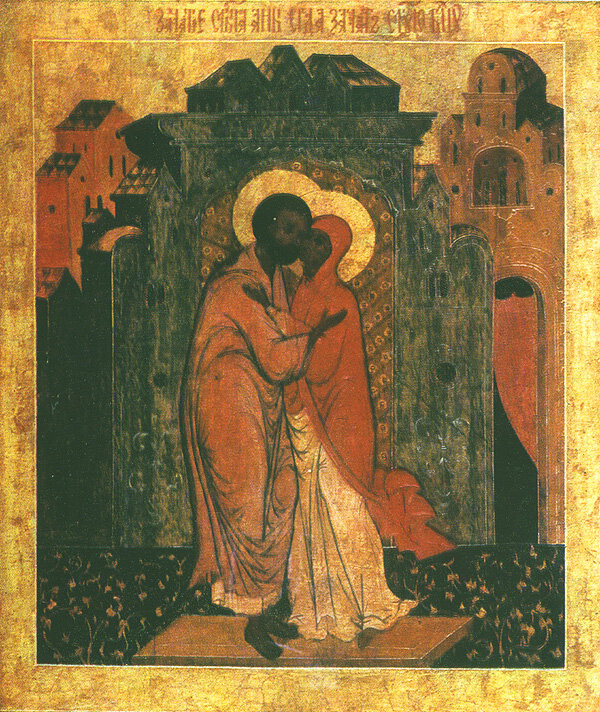
Therefore, as the Angel had commanded, both Joachim and Anna had set out from their respective places and went up to the Beautiful Gate of the Temple. Anna hastened with her maidens and, praying to the Lord, stood a long time in the gate waiting for Joachim. When she was wearied with long waiting, she lifted up her eyes and saw Joachim afar off, coming with his flocks. She ran to him and hung on his neck, giving thanks to God, saying, "Now I know that the Lord has blessed me exceedingly; for behold, I was a widow, and now I am not so; I, the childless one, shall conceive." Then, rejoicing at seeing each other, and secure in the certainty of the promised offspring, they gave thanks due to the Lord Who exalts the humble. And Joachim rested that day.
On the following day, Joachim brought his offerings into the Temple. After they had worshipped the Lord, they returned home, and Anna conceived by Joachim's seed, and they awaited the Divine promise in certainty and in gladness. When it was heard that Anna had conceived, there was great joy among all their neighbors and acquaintances, so that the whole land of Israel congratulated them.
The Heterodox Misconception of "Immaculate Conception" and "Original Sin"
Saint Ambrose (339-397 A.D.), bishop of Milan, comments that "of all those born of women, there is not a single one who is perfectly holy, apart from the Lord Jesus Christ..." The Orthodox Church teaches that the Virgin Mary was conceived by Joachim's seed and the period of gestation was nine months. None of the ancient Holy Fathers say that God in miraculous fashion purified the Virgin Mary while yet in Anna's womb. Only Jesus Christ is completely pure of every sin, while all men, being born of Adam, have borne a flesh subject to the law of sin. Many have correctly indicated that the Virgin Mary, just as all men, endured a battle with sinfulness, but was victorious over temptations and was saved by her Divine Son. (Source: The Great Synaxaristes of the Orthodox Church)
__________________________
DIVINE SERVICE ON WEDNESDAY:
Divine Liturgy at 10:00 a.m.
Officiating Priest: Father Alexios Torrence
_______________________
"Glory Be To GOD For All Things!" - Saint John Chrysostomos
+++
With sincere agape in His Holy Diakonia (Ministry)
The sinner and unworthy servant of God
+Father George
On the Mysterion (Sacrament) of the Priesthood (Part I)
Saint Gregory Nazianzen illustrates the difficulty of a priest's work by comparing it with that of a doctor. The priest's is the harder task because he deals with souls that resist their own healing instead of bodies that co-operate; because spiritual disease is hidden, whereas physical ailments are apparent; and because he aims, not simply to preserve or restore health, but to "deify those who belong to the heavenly host". Nothing less than this was the purpose of the Incarnation. Where doctors work merely to extend a possibly sinful life, we (says St. Gregory) work for the salvation of the soul.

My beloved spiritual children in Christ Our Only True God and Our Only True Savior,
CHRIST IS IN OUR MIDST! HE WAS, IS, AND EVER SHALL BE.
+
ON THE MYSTERION (SACRAMENT) OF PRIESTHOOD
By Saint John Chrysostomos
Saint Gregory Nazianzen illustrates the difficulty of a priest's work by comparing it with that of a doctor. The priest's is the harder task because he deals with souls that resist their own healing instead of bodies that co-operate; because spiritual disease is hidden, whereas physical ailments are apparent; and because he aims, not simply to preserve or restore health, but to "deify those who belong to the heavenly host". Nothing less than this was the purpose of the Incarnation. Where doctors work merely to extend a possibly sinful life, we (says St. Gregory) work for the salvation of the soul. And because we deal with many different types of men, we must continually vary our methods, not only according to their differences but also as times and circumstances change. It is as tricky a job as tight-rope walking!
Then there is the ministry (diakonia) of the Logos/Word. With the comprehension of a subtle theologian, Saint Gregory dilates upon the problem (all too real in his days) of communicating orthodox Trinitarian doctrine to a mixed and largely uneducated congregation, their minds full of preconceived ideas, or self-conceit, or plain ignorance...The problem is not simply to teach them the Truth, but to disabuse their minds of false doctrines.
...A priest is not made in a day. "Who can mold, as clay-figures are modeled in a single day, the defender of the truth, who is to take his stand with Angels, and give glory with Archangels, and cause the sacrifice to ascend to the altar on high, and share the Priesthood of Christ, and renew the creature, and set forth the image, and create inhabitants for the world above, aye, and, greatest of all, be God and make others God?"
Deeply moved by the sacred duties of the Priesthood, conscious that it has been given to him to understand something of the mystery and Majesty of God, and responsive to the vocation which his very home and upbringing seem to urge upon him, Saint Gregory is half won to the acceptance of his unsought ministry. But his attention turns from the ideal of the Priesthood to the harsh realities, not of the world but of the Church. How can he take on himself the guidance of others in such troubled times--the Church profaned, invective prized, personal rivalries flourishing, all in chaos in the strife. Pagans hate us for our dissensions. Our own best people are scandalized. The Christian is even lampooned on the stage. His own disciples make Christ's name to be blasphemed...
"...How could I dare", he asks, "to offer to God the external sacrifice, the antitype of the great mysteries, or clothe myself with the garb and name of priest, before my hands had been consecrated by holy works; before my eyes had been accustomed to gaze safely on created things, with wonder only for the Creator, and without injury to the creature; before my ear had been sufficiently opened to the instruction of the Lord, and he had opened my ear to hear without heaviness and had set a golden ear-ring with precious sardius, that is, a wise man's word in an obedient ear, and opened wide to be filled with the spirit of speaking mysteries and doctrines...before all my members had become instruments of righteousness, and all mortality had been put off, and swallowed up of life, and had yielded to the Spirit?"
The priest is a shepherd. "The shepherd needs great wisdom, according to Saint John Chrysostom, and a thousand eyes, to examine the soul's condition from every angle. As there are plenty of people who are puffed up into arrogance and then fall into heedlessness of their own salvation because they cannot stand bitter medicines; so there are others who, because they do not pay a proportionate penalty for their sins, are misled into negligence and become far worse, and are led on to commit greater sins. The priest, therefore, must not overlook any of these considerations, but examine them all with care and apply all his remedies appropriately, for fear his care should be in vain.
The shepherd of sheep has the flock following him wherever he leads; or if some turn aside from the direct path and leave the good pasture to graze in barren and precipitous places, it is enough for him to call more loudly, drive them back again, and restore to the flock those which were separated. But if a man wanders away from the right faith, the shepherd needs a lot of concentration, perseverance, and patience. He cannot drag by force or constrain by fear, but must by persuasion lead him back to the true beginning from which he has fallen away. He needs, therefore, a heroic spirit, not to grow despondent or neglect the salvation of the wanderers, but to keep on thinking and saying: "Peradventure God may give them the knowledge of the truth and they may freed from the snare of the devil."
"That is why the Lord, speaking to the disciples, said: "Who, then, is the faithful and wise servant?" The man who practices asceticism helps no one but himself. But the advantage of a shepherd's skill extends to the whole people. The man who distributes alms to the needy or in other ways defends the wronged, has done some good to his neighbors; but less than the priest, as the body is less than the soul. It is not surprising, then, that the Lord said concern for his sheep was a sign of love for himself."
The Glory of the Priesthood
The work of the Priesthood is done on earth, but it is ranked among heavenly ordinances. And this is only right, for no man, no Angel, no Archangel, no other created power, but the Paraclete (Holy Spirit) Himself ordained this succession, and persuaded men, while still remaining in the flesh to represent the ministry (diakonia) of Angels. The priest, therefore, must be pure as if he were standing in heaven itself, in the midst of those powers.
The symbols which existed before the ministry (diakonia) of grace were fearful and awe-inspiring: for example, the bells, the pomegranates, the stones on the breastplate, the stones on the ephod, the miter, the diadem, the long robe, the golden crown, the Holy of Holies, the deep silence within. But if you consider the ministry (diakonia) of grace, you will find that those fearful and awe-inspiring symbols are only trivial...When you see the Lord sacrificed and lying before you, and the High Priest standing over the sacrifice and praying, and all who partake being tinctured with that Precious Blood, can you think that you are still among men and still standing on earth? Are you not at once transported to heaven, and, having driven out of your soul every carnal thought, do you not with soul naked and mind pure look upon heavenly things? Oh, the wonder of it! Oh, the loving-kindness of God to men! He who sits above with the Father is at that moment held in our hands and gives himself to those who wish to clasp and embrace him--which they do, all of them, with their eyes. Do you think this could be despised? Or that it is the kind of thing anyone can be superior about?
...Anyone who considers how much it means to be able, in his humanity, still entangled in flesh and blood, to approach that blessed and immaculate Being, will see clearly how great is the honor which the grace of the Spirit has bestowed on priests. It is through them that this work is performed and other work no less than this in its bearing upon our dignity and our salvation.
For earth's inhabitants, having their life in this world, have been entrusted with the stewardship of heavenly things, and have received an authority which God has not given to Angels or Archangels. Not to them was it said, "What things soever ye shall bind on earth shall be bound also in heaven; and what things soever ye shall loose, shall be loosed" (cf. Matthew 18:18). Those who are lords on earth have indeed the power to bind, but only men's bodies. But this binding touches the very soul and reaches through heaven. What priests do on earth, God ratifies above. The Master confirms the decisions of His slaves. Indeed he has given them nothing less than the whole authority of heaven. For He says, "Whose soever sin ye forgive, they are forgiven, and whose soever sins ye retain, they are retained" (John 20:23). What authority could be greater than that? "The Father hath given all judgment unto the Son." But I see that the Son has placed it all in their hands. For they have been raised to this prerogative, as though they were already translated to heaven and had transcended human nature and were freed from our passions. (Source: Saint John Chrysostom. Six Books on the Priesthood)
(To be continued)
Please note: It is most important that the Priesthood is held always in high esteem and respect by all. Saint John Chrysostom makes it very clear and direct what it means and how it should be perceived by the priest as well as the people within the Church.
As a priest of 51 years in the service of Our Lord, I have to know of my unworthiness and deficiencies. No one, but no one, is worthy of this most sacred office. As a priest, I have faced many challenges, difficulties, problems, confrontations, temptations, attacks by humans as well as our common enemy, the devil. I have, however, experienced the grace of God, His love, His guidance, His support, His protection, His enlightenment, His forgiveness, His presence, His kindness, His compassion, His mercy, His abundant miracles. If I am living today it is only because of Him.
No one should ever disrespect the divine Priesthood that Our Lord founded and established. He is after all the High Priest of our Church. The priest is far from being a perfect human being and his responsibility to the Almighty God is enormous. He is responsible not only for his own sins and transgressions but he is responsible for the salvation of all the souls which God has entrusted to him.
The priest is the shepherd of the flock. His not only one entrusted to guide his spiritual flock but to lead them to green pastures, to protect them from the wild beasts, to nourish them, to lead them to the Living Water, Christ God. He is the servant of servants who makes every effort to fulfill all the needs of his people.
Somehow though, I have witnessed unfortunately the distortion of who the priest is in our parishes. For years the contemporary Greek Orthodox priest has been treated as a hired employee of the local community. As someone who is hired and fired at will. His Priesthood and ministry have been misunderstood. At times the priest is seen as a rival, as an intruder, as a suspect, and as someone who should not be trusted, someone who could be threatened and easily be replaced or removed.
Some years ago in one of the parishes which I was serving at the time, older members of the parish council were advising the young men who were to be elected to serve on the board, "not to listen to anything that the priest said or advised." The Christian parish was to be treated as a business or something like a MacDonald's franchise. Everything was about money and fun.
The Priesthood, the Epourgema (Ministry), must be protected and defended by all. Without the priest, the Church cannot function and so the local parish. What good is it to have a ten million dollar facility and not have a priest to serve the people? It becomes a museum or a lifeless complex of buildings. The priest is indeed most essential!
__________________
"Glory Be To GOD For All Things!" - Saint John Chrysostomos
+++
With sincere agape in His Holy Diakonia (Ministry)
The sinner and unworthy servant of God
+Father George
December 6 - Saint Nicholas the Wonderworker, Archbishop of Myra in Lycia (Part II)
The Saint was desirous to visit the all-holy Sepulchre of the Lord. He was filled with longing to see and venerate those holy sites, where the feet of our Lord Jesus Christ trod. It was also his keen hope to find a place of solitude and quiet, where he might abide alone. On a clear day, Father Nicholas boarded an Egyptian vessel with fellow Christians.

My beloved spiritual children in Christ Our Only True God and Our Only True Savior,
CHRIST IS IN OUR MIDST! HE WAS, IS, AND EVER SHALL BE.
+
ON DECEMBER 6th OUR HOLY ORTHODOX CHRISTIAN CHURCH COMMEMORATES OUR HOLY FATHER AMONG THE SAINTS, NIKOLAOS (NICHOLAS) ARCHBISHOP OF MYRA IN LYCIA THE MIRACLE-WORKER (Part II)
The Saint was desirous to visit the all-holy Sepulchre of the Lord. He was filled with longing to see and venerate those holy sites, where the feet of our Lord Jesus Christ trod. It was also his keen hope to find a place of solitude and quiet, where he might abide alone. On a clear day, Father Nicholas boarded an Egyptian vessel with fellow Christians. After putting out to sea, the Saint fell asleep. In his sleep, by Divine revelation, he beheld the enemy of truth, the devil, sever the ropes of the mast. When the Saint rose in the morning, he foresaw imminent peril close at hand. The devil wished to drown all on board. Father Nicholas notified the seamen and said, "Today, a fierce storm shall strike us, because I beheld in my dream that we shall endure much. Nevertheless, do not fear; have faith in God, and He shall deliver us from death." While the Saint was speaking these words, there immediately appeared a great and dark cloud. The wind rose up and the sea became agitated. All of the crew and passengers became disheartened and awaited death as they beheld the turbulent waves. Having found themselves in such desperate straits, they besought the holy Priest Nicholas with tear-filled eyes to entreat God Almighty on their behalf to stay the powerful wind. The Saint stood in their midst and offered up fervent supplication. Straightway, the might wind died, and the raging seas grew calm. Those on board rejoiced upon receiving so speedy a response to the holy Priest's petitions.
The Saint continued his pilgrimage to the Holy Land. He arrived in Jerusalem and made obeisance at the Holy Sepulchre (Church of the Resurrection) of the Lord and at Golgotha. He also venerated the Honorable and Holy Cross and all the august and revered places, especially at Gethsemane.
After the Saint returned to his homeland his countrymen received him with great joy beholding their holy Priest. All came to greet him and offer him hospitality, so that he might impart the word of God to those desiring the salvation of their souls. The Saint did not wish to tarry in Patara, where he was well known and was likely to receive their praise. Therefore, the Saint repaired to the capital of the province, populous Myra, where he was unknown.
...The faithful inhabitants were searching for a hierarch worthy of the episcopal throne. Thereupon, the bishops and other clergy of the eparchy of Myra came together to select their new archbishop...The bishops fasted and prayed for God that God will reveal who was worthy of the dignity. Suddenly, an Angel of the Lord appeared to a certain elderly bishop, saying, "O bishop, why dost thou toil? The worthy Archbishop is near at hand. Thou shall behold a certain Priest, full of understanding and prudence, enter the doors of the church. His name is Nicholas, and he is filled with the Spirit. He is whom you should consecrate Metropolitan, for he is worthy to shepherd the people; this is what God wills."
After the bishop beheld such a vision, he informed the other hierarchs. Upon hearing his disclosure, they gave glory to God for His revelation. The bishop who was vouchsafed the vision obeyed the words he heard in the vision. He entered the church, stood by the doorway, and awaited the coming of the Priest prophesied by the Angel...Father Nicholas, as usual, arrived before the other worshippers. He approached Father Nicholas and said, "My child, how art thou called?" The Saint meekly answered, "Nicholas". The bishop then took Father Nicholas by the hand and brought him among the other bishops and clergy. As soon as they caught sight of Father Nicholas, they were well pleased and gave thanks to God Who granted them such a chief shepherd. Word traveled throughout the city quickly, so that a multitude of faithful came to the church. Thereupon, Father Nicholas was consecrated to the episcopacy.
Initially, the Saint refused the dignity of such a high office, dreading the praise of men. However, before the repose of Archbishop John of Myra, the Saint had received a vision wherein he was commanded to accept consecration to the hierarchical rank.
He was true to the description given by Saint Paul of the attributes of a bishop: "The bishop is to be blameless, sober, of sound mind, of good behavior, hospitable, apt at teaching, not given to behave ill at wine, not a striker, not sordidly greedy of gain, but gentle, not contentious, nor a lover of money" (1 Timothy 3:2, 3). Over the years, the Saint led a private life and secretly served God in asceticism and charitable endeavors.
...The Saint was an affable and prudent benefactor. He mixed ascetic and civic virtue. He rendered assistance to orphans, widows, poor folk, mourners, and those who were wronged.
The devil, envious of what is good: what did he contrive? When that vile creature beheld flourishing and the Christians increasing in number, he could not endure to have his power diminished. He incited the joint pagan emperors, Diocletian and Maximian, to war against the Christians. This pair of the devil, these wild beasts, these persecutors of true piety, unleashed terrible chastisements and torments against the Christians. It was everywhere declared that whosoever was a Christian if such a one refused to renounce the Christ, would be deemed a criminal and liable to severe modes of punishment from the state. Christian gatherings were forbidden, churches were destroyed, sacred books were committed to the flames. Among the Christians, many boldly confessed the Christ as True God. These Martyrs consequently died under diverse tortures.
...Some of the imperial officers arrived in Myra, the diocese of Saint Nicholas who, in the performance of his duties, was undaunted by the cruel and barbaric persecution. Since he was the Chief Priest of the Christians of that city and with great liberty ceased not preaching the Truths of the Faith, the imperial deputies and governors arrested him. He was chained and cast into prison with many other Christians. The Saint was detained in prison for a considerable time but remained firm in the face of tribulation...He encouraged his fellow inmates to abide steadfast in their afflictions for the Faith. Though the enemy (devil) of the truth wrought incalculable sufferings and misery upon the faithful, yet God dispensed otherwise and for the benefit of man. Upon the death of the two profane emperors, who went straight to the Gehenna of the fire, Constantine the Great, the son of Helen and Constantine Chlorus, came to power. Constantine the Great emptied the prisons of the Christians. After their release, churches were rebuilt and the idol temples were leveled. Among those delivered from imprisonment was the beloved living martyr and confessor Hierarch Nicholas. He resumed his duties and administration as chief Priest and shepherd of Myra.
The First Ecumenical Synod
During Emperor Constantine's reign, Arius emerged from Alexandria and spread his vile heresies. Arius began to publicly speak blasphemies against God, saying that Christ, the Logos/Word of God, was not true God. He continued to proclaim his rotten dogma.
Emperor Constantine the Great, seeing the confusion created in the Church, dispatched orders to every corner of the empire. He summoned all the hierarchs and chief monastics, that they should meet in the city of Nicaea and discuss Arius, who was shown to be at fault and a blasphemer. Thus, the First Ecumenical Synod was held in Nicaea in Bithynia during the reign of Constantine the Great, in 325 A.D.
...This Ecumenical Synod produced the divine Symbol of the Faith (The Nicene Creed of 325 A.D.), proclaiming the Son of God and Logos/Word of God to be true God coessential with the Father, saying: "I believe in one God: the Father, Almighty, Maker of all things visible and invisible; and in one Lord Jesus Christ, the Son of God, the Only-begotten, the One having been begotten of the Father before all ages--Light of Light, True God of True God; having been begotten, not having been made; co-essential with the Father; by Whom all things were made, including all things in the heaven and all things on the earth; Who for us men and for our salvation came down from the heavens, and became incarnate of the Holy Spirit and the Virgin Mary, and was made man; and crucified for us under Pontius Pilate, and suffered, and was buried; and rose up the third day according to the Scriptures; and ascended into the heavens, and sitteth at the right of the Father; and shall come again, with glory, to judge the living and the dead; the Kingdom of Whose there shall be no end; and in the Spirit, the Holy One.
This original Nicene Creed was later enlarged in 381 A.D. at the Second Ecumenical Synod held in Constantinople, convened by and during the reign of Theodosios. At that time, besides some minor changes in the first two articles, there were added all the clauses after the "Holy Spirit"; the anathema was omitted.
The Repose of Saint Nicholas
Since, however, Saint Nicholas was a mortal, the time approached for his repose. Prior to his falling asleep in the Lord, he became slightly ill. He reposed in peace and left his honorable holy relics upon the earth as a benefit to mankind, while his blessed soul joyfully ascended into the heavens, accompanied by the hymns of Angels. (Source: The Great Synaxaristes of the Orthodox Church)
________________________
"Glory Be To GOD For All Things!" -Saint John Chrysostomos
+++
With sincere agape in His Holy Diakonia (Ministry)
The sinner and unworthy servant of God
+Father George